
Manual Vegetable Chopper Mechanism Explained

Quick Answer
A manual vegetable chopper works by converting hand movement into cutting force. Pull-cord, pump, and crank models rotate sharp blades inside a container, while push-down grid choppers force vegetables through stationary blades. The mechanism determines how the food is cut, how much effort is needed, and whether the result is a rough chop or consistently shaped pieces. No electricity is required.
Most manual vegetable choppers look simple from the outside. However, the movement inside the lid or cutting assembly explains why two choppers can produce very different results from the same onion.
Understanding the mechanism helps you operate the tool correctly, recognize common problems, and choose the right chopping action for different ingredients.
How Does a Manual Vegetable Chopper Work?

A manual vegetable chopper uses mechanical energy supplied by your hand. Pulling a cord, pressing a handle, or turning a crank transfers force through a mechanical connection to the cutting blades.
For rotating-blade models, the operating sequence is straightforward:
- Input: Your hand moves a cord, handle, or crank.
- Transmission: An internal mechanism transfers that motion to a drive shaft.
- Blade movement: The drive shaft turns one or more cutting blades.
- Cutting: Moving blades pass through the vegetables and divide them into smaller pieces.
- Repeat: Additional movements expose ingredients to further cuts.
Grid-style choppers work differently. Instead of spinning blades, they use pressure to push vegetables through a fixed cutting grid. This produces pieces with dimensions largely determined by the grid openings.
The distinction matters: rotating blades repeatedly chop the food, whereas grid blades divide it into more regularly shaped pieces during a pressing action.
The Main Parts Inside a Manual Chopper
The components vary by design, but several parts perform similar functions across manual choppers.
Cutting blades
Rotating choppers commonly use curved metal blades arranged around a central shaft. The blades sweep through ingredients as the shaft rotates.
Some designs position blades at different heights to reach food in multiple areas of the container. However, blade number alone does not guarantee an even chop.
Drive shaft and coupling
The drive shaft connects the operating mechanism to the blades. A coupling transfers motion from the lid or handle into the blade assembly.
If the coupling is misaligned, worn, or damaged, the handle may move without properly rotating the blades.
Mechanical transmission
Depending on the design, the transmission may contain gears, a ratchet, a threaded spindle, or another motion-converting component.
Its purpose is to produce useful blade movement from the particular motion supplied by the user.
Container, lid, and support
The bowl holds the ingredients while the lid supports the operating assembly. A central support may keep the blades properly positioned.
Stable alignment reduces unwanted movement, while a secure lid helps keep the rotating mechanism enclosed during operation.
How the Pull-Cord Chopper Mechanism Works
A pull-cord chopper converts a straight pulling motion into blade rotation. The cord is attached to a reel inside the lid, and pulling the handle causes the reel to turn.
One documented design uses a cord reel, torsion spring, pawls, and ratchet wheel. The ratchet transfers rotation during the pulling stroke while allowing the cord to rewind without driving the blades backward.
This arrangement is described in the hand-pulled vegetable cutter patent. It illustrates a real mechanical configuration, although individual commercial models may use different internal components.
What happens during a pull?
- You pull the handle outward, unwinding the cord.
- The cord rotates its internal reel.
- The engaged drive mechanism transfers motion to the blade shaft.
- The blades sweep through the vegetables.
- When the cord is released, the return spring rewinds it.
- The mechanism resets for another pull.
Each additional pull provides another cutting opportunity. The resulting texture depends on blade design, ingredient properties, fill level, and how the food moves within the bowl.
Key Insight
The return spring primarily rewinds the pull cord. In a ratchet-based design, the cutting stroke and the rewind stroke perform different jobs. This is why a cord can retract without reversing the blade assembly.
How Push-Down and Pump Choppers Work
Push-operated choppers use downward hand pressure, but not every push mechanism works the same way.
In a rotating pump chopper, pressing the plunger moves an internal transmission that turns the blades. A spring then returns the plunger to its starting position.
Some designs convert the plunger’s vertical movement into shaft rotation through a helical or related mechanical arrangement.
Repeated presses produce additional blade movement, gradually reducing the size of the food.
A push-down grid chopper has a different operating principle. The user closes a hinged lid or presses a food holder, forcing vegetables through fixed intersecting blades.
The grid determines the approximate width of the resulting pieces. It does not repeatedly mince the ingredients with rotating blades.
For example, a rotating pump chopper can progressively mince onion, while a grid chopper is better suited to producing regularly shaped diced onion pieces.
How Hand-Crank Choppers Transfer Motion
A hand-crank chopper uses continuous circular movement instead of pulling or pushing.
Turning the crank rotates a shaft directly or through a gear arrangement connected to the blade assembly.
The operator can maintain movement for as long as needed, subject to the load and the manufacturer’s instructions.
Crank designs may feel smoother because they do not require repeated cord extension or plunger strokes. However, their performance still depends on blade sharpness, internal gearing, and the resistance of the ingredients.
Not every crank-operated food processor is intended for chopping. Some are configured for mixing, whipping, or spinning, so the attachment and actual blade movement matter more than the handle style alone.
Comparing the Four Main Chopping Mechanisms
The easiest way to understand the differences is to compare how each mechanism creates its cut.
| Mechanism | Hand movement | Cutting action | Typical result |
|---|---|---|---|
| Pull-cord | Repeated pulling | Blade rotation | Coarse to fine chop |
| Pump/plunger | Repeated pressing | Blade rotation or chopping strokes | Progressively chopped pieces |
| Hand-crank | Circular turning | Continuous blade rotation | Controlled repeated chopping |
| Push-down grid | Downward pressure | Food passes through fixed blades | More regularly sized dice |
If the goal is finely chopped garlic or herbs, repeated rotating-blade cuts may be useful. For vegetables that need uniform pieces for presentation or even cooking, a suitable cutting grid can provide better control over piece dimensions.
Why Some Choppers Cut Better Than Others
A manual chopper’s effectiveness is not determined by the mechanism alone. Cutting performance also depends on how well the ingredients encounter the blade edges.
Blade sharpness and geometry
Sharp edges cut food more cleanly, while dull or damaged blades tend to crush, tear, or require greater force. Curvature and blade position influence how ingredients enter the cutting path.
Ingredient hardness
Soft tomatoes, onions, herbs, and firm carrots behave differently under the same blade movement.
Hard, dense ingredients create more resistance. Large pieces may also prevent the blade from moving freely, especially in small pull-cord models.
Container fill level
When the container is excessively full, ingredients have less room to circulate through rotating blades. Some pieces may remain large while others receive repeated cuts.
Smaller batches can improve ingredient movement and reduce resistance. The appropriate fill level depends on the model.
Number of cutting movements
More blade movements generally create more opportunities for cutting, but this does not guarantee uniform results.
Watery vegetables may become increasingly pulpy, while irregularly positioned pieces may escape contact with the blade for several strokes.
For better preparation habits beyond chopping, see our guide to essential cooking skills.
How to Use the Mechanism Without Overloading It
Correct loading and operation help the blades move as intended.
- Prepare the ingredients. Wash produce and cut oversized vegetables into pieces that fit comfortably inside the container.
- Inspect the mechanism. Check that the blades, lid, coupling, and operating handle are intact.
- Fit the components. Install removable blades using their designated grip or holder, following the product instructions.
- Load a manageable amount. Leave enough room for rotating-blade models to move ingredients.
- Secure the lid. Position the bowl on a stable counter and confirm that the operating assembly is correctly seated.
- Operate in controlled movements. Pull, press, or turn without forcing a stalled mechanism.
- Check the texture. Stop the blades completely before opening the container or repositioning ingredients.
Keeping ingredients ready before cooking also improves workflow. Our article on saving preparation time explains how organized kitchen routines help reduce interruptions.
Warning
Never insert fingers or utensils into an assembled chopper to free stuck food. Stop operation, open it safely, and remove obstructions only after blade movement has completely stopped. Handle removable blades by their designated supports.
Common Mechanical Problems and What They Mean
A problem with chopping does not always mean the blades are dull. The symptoms often point to different parts of the mechanism.
The pull cord moves, but the blades do not turn
Possible causes include an improperly fitted blade shaft, a worn drive coupling, or a damaged transmission component.
Remove the ingredients and inspect accessible parts according to the manufacturer instructions. Do not force the handle or open a sealed spring housing.
The cord does not retract
A jammed reel, tangled cord, or faulty return mechanism may prevent rewinding.
Stop using the chopper if the cord remains extended. Spring-loaded assemblies can contain stored mechanical energy and should not be dismantled casually.
The blades rotate but chopping is uneven
The bowl may be overloaded, the ingredients may be too large, or some pieces may not be moving into the cutting path.
Try a smaller batch and prepare more evenly sized starting pieces. Check that the blade assembly is seated correctly.
The handle becomes unusually difficult to operate
Excessively hard ingredients, an obstruction, or a damaged mechanical component may be increasing resistance.
Do not apply additional force until the cause has been identified. Continued operation can damage the drive mechanism.
Cleaning and Maintaining the Mechanism
Regular cleaning prevents food residue from accumulating around blade supports, shafts, and other accessible food-contact components.
Separate removable parts according to the manufacturer’s instructions. Wash the appropriate food-contact components with warm, soapy water, rinse thoroughly, and allow them to dry before reassembly.
The FDA’s safe food handling guidance recommends cleaning utensils and food-contact surfaces after preparing each food item.
Do not immerse a sealed pull-cord lid unless the manufacturer specifically confirms it is washable that way. Water entering the reel or spring compartment may be difficult to remove.
Inspect blade edges, couplings, and plastic supports for damage before reuse. Keep disassembled sharp blades away from children and avoid storing them loose among other utensils.
For additional kitchen precautions, refer to these kitchen safety tips.
Which Mechanism Makes Sense for Different Tasks?
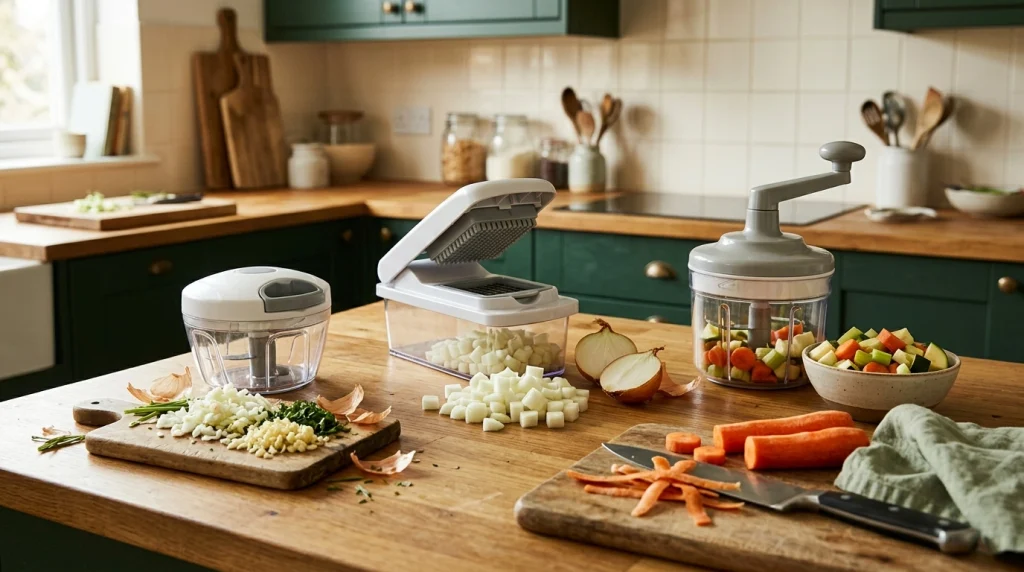
Match the mechanism to the cutting result, not simply the vegetable name.
- For finely chopped aromatics: A pull-cord or rotating pump chopper allows repeated cutting until the desired texture is reached.
- For consistently sized cubes: A push-down grid with appropriately sized openings is generally the more suitable design.
- For continuous hand-operated chopping: A crank mechanism may suit users who prefer rotational movement over repeated pulling.
- For very firm vegetables: A suitable grid chopper or knife may be more appropriate than a small rotating-blade bowl, depending on the model’s limits.
The practical lesson is that identical ingredients can require different tools when the intended finished shape changes.
Related Product
Manual Pull-Cord Vegetable Chopper
A compact rotating-blade chopper is a practical example of the cord, reel, and blade mechanism explained above.
As an Amazon Associate, we earn from qualifying purchases.
Frequently Asked Questions
Does every manual vegetable chopper contain gears?
No. Some models use gears or ratchets, while others rely on direct-drive connections, threaded mechanisms, or fixed blade grids. The transmission depends on the chopping design.
Why do pull-cord choppers have a spring?
The spring commonly helps rewind the cord after a pull. In certain ratchet designs, this reset happens without reversing the cutting blades.
Can a manual vegetable chopper produce completely uniform pieces?
Rotating-blade models generally produce varying piece sizes because food encounters the blades repeatedly. Fixed cutting grids can create more consistent dimensions, although results still depend on ingredient positioning and preparation.
Why does my chopper turn vegetables into mush?
Repeated cutting can break soft, moisture-rich ingredients into very small fragments and release liquid. Reducing the number of cutting strokes and working in smaller batches may help preserve a coarser texture.
Can I use a manual chopper for raw carrots?
Some models can handle carrots when they are cut into manageable pieces. However, hard vegetables create substantial resistance, so follow the manufacturer’s ingredient and loading guidance rather than forcing the mechanism.
Can a broken pull-cord mechanism be repaired?
Repairability depends on the model, available replacement parts, and how the mechanism is assembled. A damaged sealed spring or drive assembly should not be opened without manufacturer-approved instructions. Replacement is often the safer choice when suitable parts are unavailable.
Conclusion
The manual vegetable chopper mechanism determines how hand movement becomes cutting action. Pull-cord, pump, and crank systems generally rotate blades, while grid choppers cut through direct pressure. Understanding the difference makes it easier to control texture, avoid overloading the mechanism, and recognize maintenance problems before they cause further damage.