Rice cookers excel at perfectly cooked grains with hands-off convenience, while slow cookers transform tough cuts of meat into tender meals through low, slow heat. This comparison guide breaks down the key differences in cooking time, versatility, and energy use to help you choose the right appliance for your kitchen. Whether you’re meal prepping or cooking for a family, we’ll show you which tool fits your lifestyle best.
Contents
- 1 Key Takeaways
- 2 Introduction: Making the Right Choice for Your Kitchen
- 3 What Is a Rice Cooker?
- 4 What Is a Slow Cooker?
- 5 Key Differences: Rice Cooker vs Slow Cooker Comparison
- 6 Detailed Feature Breakdown
- 7 Best Uses for Each Appliance
- 8 Recipe Examples to Try
- 9 How to Choose the Right One for Your Kitchen
- 10 Troubleshooting Common Issues
- 11 Can You Use Them Interchangeably?
- 12 Conclusion: Which One Is Right for You?
Key Takeaways
- Cooking Time: Rice cookers complete meals in 15-45 minutes; slow cookers require 4-10 hours for tender results.
- Primary Function: Rice cookers specialize in grains and one-pot dishes; slow cookers excel at tenderizing meats and developing deep flavors.
- Temperature Control: Rice cookers use automatic shut-off; slow cookers offer low, high, and warm settings for flexible timing.
- Versatility: Both appliances offer surprising multi-use capabilities beyond their main purpose.
- Energy Efficiency: Rice cookers use less power per cooking session; slow cookers use low wattage over extended periods.
- Best For: Choose rice cookers for quick weeknight meals; pick slow cookers for hands-off batch cooking and meal prep.
Introduction: Making the Right Choice for Your Kitchen
Choosing between a rice cooker and a slow cooker can feel overwhelming. Both appliances promise convenience. Both save time. Both deliver delicious meals with minimal effort. But they work in completely different ways.
This guide will help you understand exactly how these kitchen workhorses differ. You’ll learn when to reach for each appliance. You’ll discover surprising ways to use both tools. By the end, you’ll know which one deserves prime counter space in your kitchen. Or whether you need both.
We’ll compare cooking times, temperature controls, versatility, and energy use. We’ll show you real recipe examples. We’ll even troubleshoot common problems. Let’s dive into this rice cooker vs slow cooker comparison.
What Is a Rice Cooker?
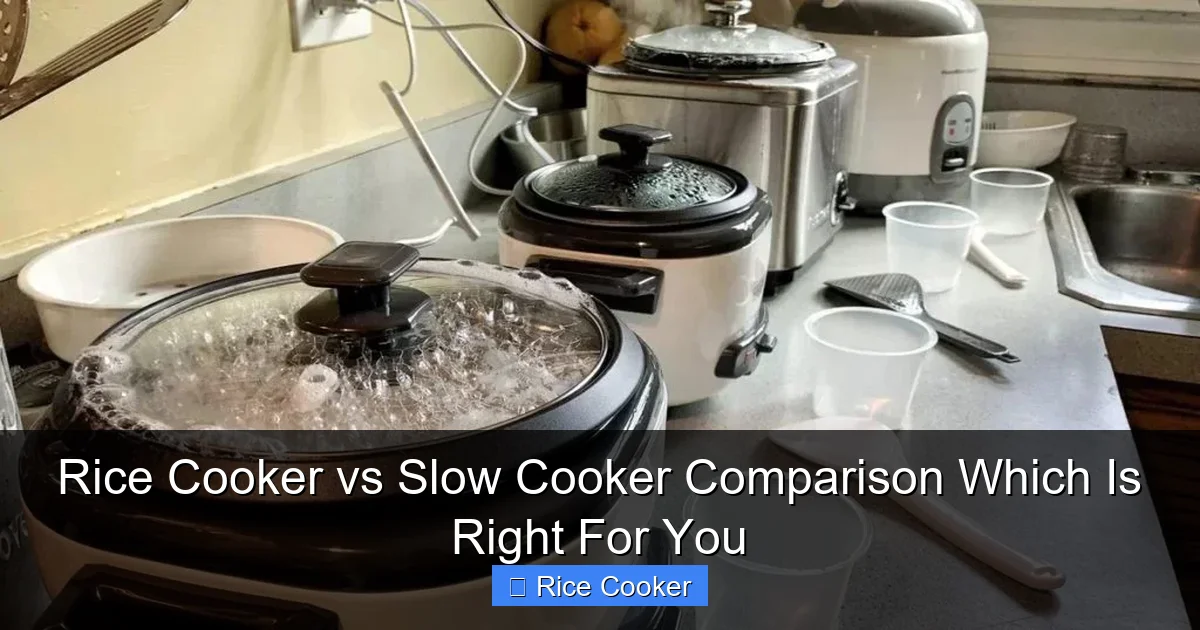
A rice cooker is a countertop appliance designed specifically for cooking grains. It uses electricity to heat a metal bowl from below. The bowl contains the rice and water. As the water heats, it absorbs into the rice grains. Once the water is gone, the temperature rises above boiling point.
Visual guide about Rice Cooker vs Slow Cooker Comparison Which Is Right For You
Image source: ricecookerjunkie.com
Most rice cookers have a simple mechanical switch. It drops down when you press the start button. When the rice is done, the switch pops up automatically. This prevents overcooking and burning. Modern rice cookers come with fuzzy logic technology. They adjust cooking time based on the type and quantity of rice.
But rice cookers do much more than rice. You can steam vegetables. You can cook oatmeal. You can even bake cakes. The key is the rapid, controlled heating cycle. A typical cooking session takes between 15 and 45 minutes.
If you’re new to rice cookers, you might wonder about different rice varieties. Check out our guide on types of rice and best uses to understand which grains work best in your appliance.
Learning to use a rice cooker is simple. The basic ratio is one part rice to two parts water. Add your ingredients, close the lid, and press start. The machine does the rest. For perfect results every time, read our guide on how to cook rice perfectly every time.
What Is a Slow Cooker?
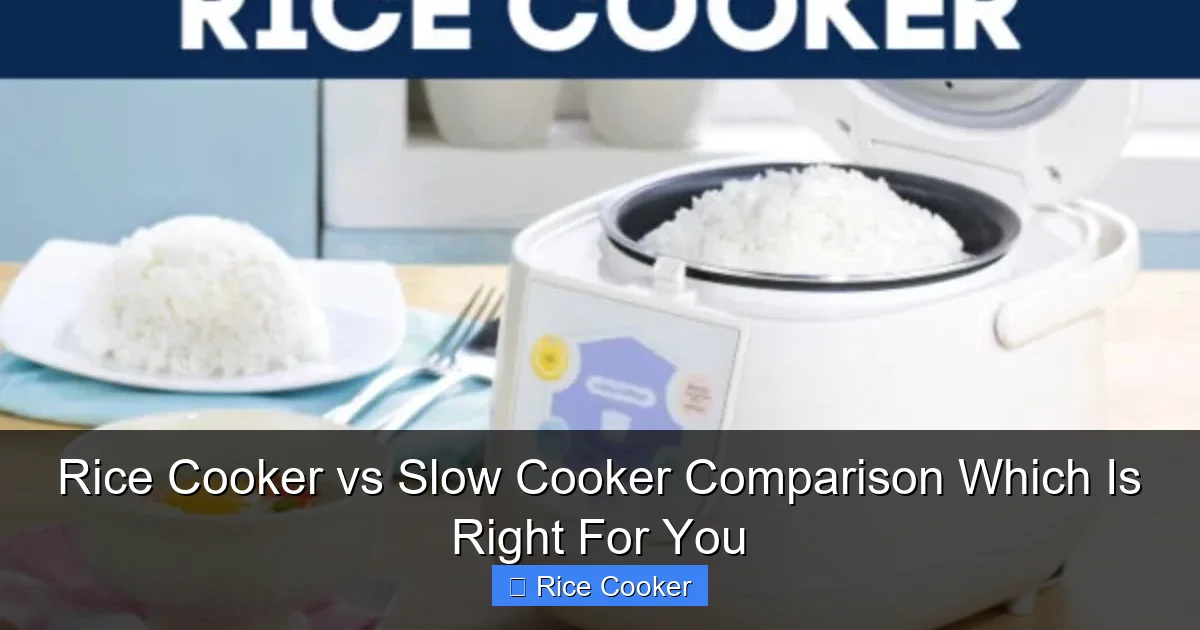
A slow cooker, also called a crock-pot, cooks food at low temperatures over many hours. It has a ceramic or porcelain pot surrounded by heating elements. The lid traps moisture, creating a steamy environment that tenderizes food slowly.
Visual guide about Rice Cooker vs Slow Cooker Comparison Which Is Right For You
Image source: tastylicious.com
Most slow cookers have two or three heat settings. Low typically runs at 170-200°F. High runs at 250-300°F. Some models include a warm setting that keeps food safe after cooking. You can set it and forget it for the day.
The magic happens through slow, moist heat. Tough connective tissues in meat break down into gelatin. This makes inexpensive cuts like chuck roast or pork shoulder incredibly tender. Flavors meld together as herbs and spices infuse throughout the cooking liquid.
A typical slow cooker meal takes 6-10 hours on low or 3-5 hours on high. You can brown meat first for extra flavor, but it’s not required. Just add ingredients in the morning and dinner is ready when you get home.
Key Differences: Rice Cooker vs Slow Cooker Comparison
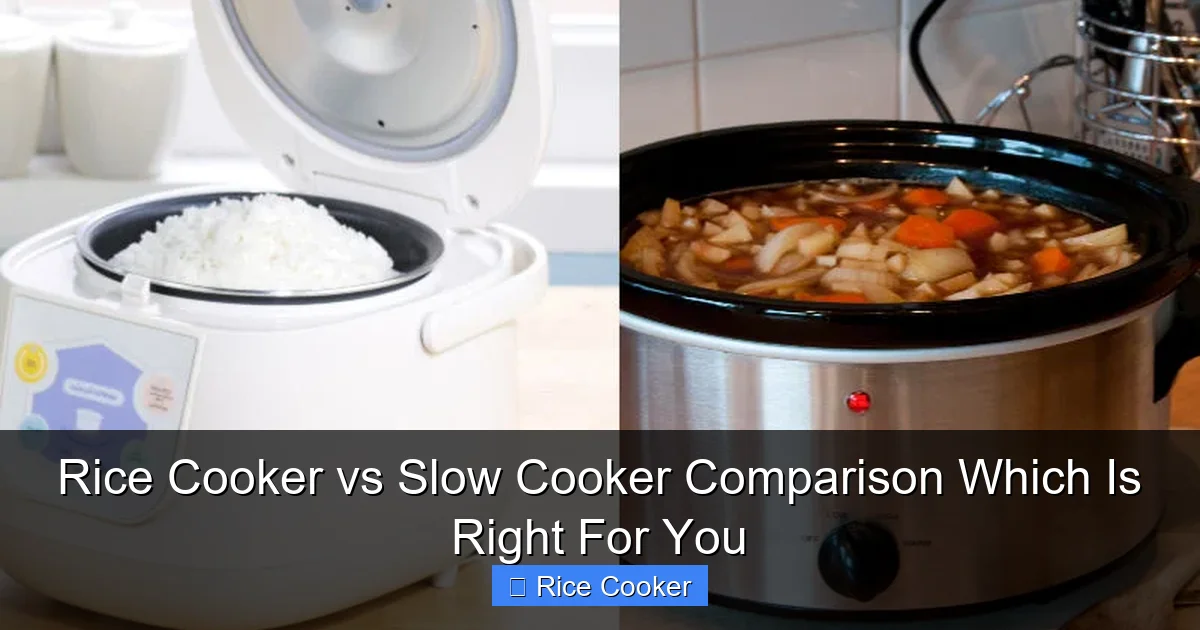
Let’s break down the major differences between these two appliances. This will help you see which one fits your cooking style.
Visual guide about Rice Cooker vs Slow Cooker Comparison Which Is Right For You
Image source: tastylicious.com
Cooking Time and Speed
This is the biggest difference. Rice cookers are fast. They work in minutes, not hours. A batch of white rice takes about 20 minutes. Brown rice needs 35-45 minutes. The appliance automatically switches to warm when done.
Slow cookers are the opposite. They need time to work their magic. A pot roast takes 8 hours on low. A chicken stew needs 6-7 hours. The low-and-slow approach develops flavors and textures you can’t get any other way.
Your lifestyle matters here. If you need dinner on the table quickly, a rice cooker wins. If you want to prep in the morning and forget until evening, choose a slow cooker.
Temperature Control and Settings
Rice cookers are simple. They have a single switch. It’s either cooking or warming. You add the right amount of liquid, and the machine knows when to stop. Some advanced models have settings for different rice types: white, brown, jasmine, basmati, sushi rice.
Slow cookers offer more temperature control. You choose between low and high heat. Some models have digital timers and programmable settings. You can delay the start time. You can set it to cook for a specific number of hours, then automatically switch to warm.
The temperature difference affects what you can cook. Rice cookers reach boiling point quickly. This is perfect for grains that need precise water absorption. Slow cookers never reach boiling. They simmer gently, which prevents food from drying out or overcooking.
Versatility and Recipe Options
Both appliances surprise people with their versatility. But they excel in different areas.
Rice cookers handle:
- All types of rice (white, brown, wild, jasmine, basmati)
- Steamed vegetables and dumplings
- Oatmeal and other hot cereals
- Simple soups and broths
- Eggs (hard-boiled or scrambled)
- Cakes and breads
- One-pot pasta dishes
Slow cookers handle:
- Tough cuts of meat (beef chuck, pork shoulder, lamb shanks)
- Hearty stews and chili
- Pulled pork and barbecue meats
- Beans and legumes (without pre-soaking)
- Casseroles and grain dishes
- Desserts like bread pudding
- Yogurt making (on some models)
The rice cooker’s strength is speed and precision. The slow cooker’s strength is hands-off time and flavor development.
Energy Efficiency and Running Costs
Rice cookers use more power per minute but cook quickly. A typical rice cooker uses 300-700 watts. Cooking for 30 minutes uses about 0.3 kWh of electricity.
Slow cookers use less power but run for hours. A standard slow cooker uses 75-250 watts. Cooking for 8 hours on low uses about 0.6-1.0 kWh.
Your actual cost depends on local electricity rates. But rice cookers are generally cheaper for quick meals. Slow cookers cost more per use but can replace oven cooking, which saves energy overall.
For a broader understanding of kitchen energy use, read our gas vs electric cooking comparison guide.
Price and Value Comparison
Basic rice cookers start around $25-30. You get simple on/off functionality. Mid-range models with fuzzy logic cost $50-80. High-end rice cookers with advanced settings can cost $150-300.
Simple slow cookers start at $20-25. They have manual low/high switches. Digital models with timers cost $40-60. Multi-cookers that combine slow cooking with pressure cooking can cost $100-200.
Both appliances offer excellent value. They replace several other tools. A rice cooker replaces your pot for rice, your steamer, and your oatmeal pot. A slow cooker replaces your Dutch oven, stew pot, and braising pan.
Storage and Counter Space
Rice cookers tend to be more compact. The bowl sits inside a heating base. The lid rests on top. Most models are cylindrical and fit easily in cabinets. Cord storage is common.
Slow cookers are bulkier. The ceramic insert adds weight and size. The lid is separate and fragile. You need space for both pieces. Oval slow cookers take up more counter space than round ones.
If kitchen space is limited, consider a multi-cooker. Some appliances combine rice cooking and slow cooking functions. But dedicated machines usually perform better at their specialty.
Detailed Feature Breakdown
Let’s look closer at what each appliance offers.
Rice Cooker Features to Consider
Capacity: Most rice cookers hold 3-10 cups of uncooked rice. A 3-cup model serves 2-4 people. A 5-cup model serves 4-6. Choose based on your family size.
Inner Pot: Non-stick coating makes cleanup easy. Some pots have ceramic coatings that are more durable. Look for thick, heavy pots that distribute heat evenly.
Keep-Warm Function: All rice cookers have this. It keeps rice at serving temperature for hours. Some models have separate steam trays for vegetables.
Advanced Settings: Fuzzy logic adjusts cooking time automatically. GABA rice settings add extra soaking time for sprouted rice. Quick cook modes reduce time by 25%.
Slow Cooker Features to Consider
Capacity: Slow cookers range from 1.5 to 8 quarts. A 3.5-quart model serves 2-3 people. A 6-quart model serves 4-6. Larger models handle whole chickens or large roasts.
Removable Insert: All modern slow cookers have this. You can brown meat directly in the insert on the stovetop. Then return it to the base for slow cooking. This saves dishes and improves flavor.
Lid Design: A tight-fitting glass lid lets you watch food without losing heat. Some lids have clips to seal during transport. Look for dishwasher-safe lids.
Programmable Timer: This feature lets you set cooking time and forget it. The slow cooker automatically switches to warm when done. Delay timers let you add ingredients later.
Best Uses for Each Appliance
Understanding when to use each tool will transform your cooking.
When to Use a Rice Cooker
Use your rice cooker when you need:
- Perfect rice every time: No more mushy or undercooked grains. The automatic shut-off prevents disasters.
- Quick weeknight meals: You can have rice ready in 20 minutes. Steam vegetables above while rice cooks below.
- Meal prep: Cook a large batch of rice on Sunday. Use it all week in salads, bowls, and side dishes.
- Morning oatmeal: Wake up to hot, creamy oatmeal without standing over the stove.
- One-pot convenience: Make rice and beans, rice pudding, or a simple soup in one appliance.
Rice cookers are ideal for busy families, college students, and anyone who struggles with cooking rice on the stovetop.
When to Use a Slow Cooker
Use your slow cooker when you want:
- Hands-off cooking: Brown meat in the morning, add vegetables, and come home to a finished meal.
- Tender meat from cheap cuts: Transform $2-per-pound chuck roast into restaurant-quality pot roast.
- Flavor development: Slow cooking melds spices and herbs into rich, complex flavors.
- Entertaining with ease: Prepare a large meal without watching the stove. Guests serve themselves.
- Batch cooking: Make a huge pot of chili or stew. Freeze portions for future meals.
Slow cookers shine for weekend cooking, meal prep for the week, and feeding large groups.
Recipe Examples to Try
Let’s look at specific recipes that highlight each appliance’s strengths.
Delicious Rice Cooker Recipes
Basic White Rice: Add 2 cups rice and 4 cups water. Press start. In 20 minutes, you have fluffy rice for stir-fries or curries.
One-Pot Rice and Beans: Add 1 cup rice, 2 cups vegetable broth, 1 can black beans, 1 cup corn, and taco seasoning. Cook for one cycle. Top with cheese and avocado.
Speaking of rice and beans, try our easy rice and beans recipe for a complete meal that’s ready in under 30 minutes.
Steamed Dumplings: Place frozen dumplings in the steam tray. Set the rice cooker to cook for 15 minutes. You get perfectly steamed snacks without a bamboo steamer.
Rice Pudding: Cook rice normally. Then add 1 cup milk, 1/4 cup sugar, and raisins. Let it cook on warm for 30 minutes, stirring occasionally.
Hearty Slow Cooker Recipes
Classic Pot Roast: Season a 3-pound chuck roast. Place in slow cooker with carrots, potatoes, onions, and beef broth. Cook on low for 8 hours. The meat falls apart.
Pulled Pork: Rub pork shoulder with barbecue spice. Cook on low for 10 hours. Shred with forks and mix with sauce. Serve on buns.
Vegetarian Chili: Add kidney beans, black beans, corn, tomatoes, and chili powder. Cook on low for 6 hours. Flavors deepen and improve overnight.
Creamy Chicken and Rice: Add chicken breasts, cream of mushroom soup, and rice. Cook on low for 4 hours. Shred chicken and stir. Serve over extra rice.
Apple Cider: Simmer apples, cinnamon sticks, and orange peel on low for 6 hours. Strain and serve warm.
How to Choose the Right One for Your Kitchen
Making the final decision requires thinking about your specific needs.
Assess Your Cooking Style
Ask yourself these questions:
- Do you cook rice more than twice a week?
- Do you work outside the home for 8+ hours?
- Do you enjoy meal prepping on weekends?
- Are you feeding a large family or just yourself?
- Do you have limited stove space?
If you answered yes to the first question, get a rice cooker. If you answered yes to the second or third, get a slow cooker. If you answered yes to multiple questions, you might need both.
Consider Your Family Size
For 1-2 people, a 3-cup rice cooker or 3.5-quart slow cooker works well. For 3-5 people, choose a 5-cup rice cooker or 5-6 quart slow cooker. For 6+ people, go for an 8-cup rice cooker or 7-8 quart slow cooker.
Think about leftovers too. If you love rice for lunch the next day, get a larger rice cooker. If you freeze portions of stew, choose a larger slow cooker.
Evaluate Your Kitchen Space
Measure your counter space and cabinets. Rice cookers store vertically. They fit on narrow shelves. Slow cookers need space for the base, insert, and lid. Consider storing the slow cooker insert in the base to save space.
If space is extremely limited, look at multi-cookers. The Instant Pot combines pressure cooking, slow cooking, and rice cooking. But dedicated appliances usually perform better at their specialty tasks.
Set Your Budget
Start with $30-40 for a basic model of either type. This gets you reliable performance without fancy features. For $60-80, you get programmable settings and better build quality. For $100+, you get advanced features and brand warranties.
Remember that both appliances save money in the long run. Rice cookers help you buy cheaper bulk rice. Slow cookers let you use inexpensive cuts of meat. Both reduce the need for multiple pots and pans.
Troubleshooting Common Issues
Even the best appliances can have problems. Here’s how to fix them.
Rice Cooker Problems and Solutions
Rice is mushy: You probably added too much water. Reduce liquid by 1/4 cup next time. Also check that the inner pot is sitting flat on the heating element.
Rice is undercooked: Add more water. Brown rice and wild rice need extra liquid. Make sure the lid is closing properly and sealing in steam.
Rice sticks to the bottom: The non-stick coating may be wearing off. Gently wash the pot with soft sponges. Avoid metal utensils that scratch the surface.
Steam leaks from the lid: Clean the lid and rubber gasket. Food particles can prevent a tight seal. Check that the lid is positioned correctly.
The cooker won’t turn on: Check that the power cord is plugged in. Make sure the inner pot is sitting properly on the heating element. Some models have a safety switch that prevents operation without the pot.
Slow Cooker Problems and Solutions
Food isn’t tender: The meat may be too lean. Choose cuts with more connective tissue. Make sure you’re cooking long enough. Tough cuts need 8+ hours on low.
Food is overcooked: You may have used the high setting for too long. Switch to low for longer cooking. Also avoid overfilling the slow cooker. Fill to 1/2 to 2/3 full for best results.
Liquid is too thin: Remove the lid during the last hour of cooking to let liquid evaporate. You can also thicken with cornstarch mixed with cold water. Stir it in during the last 30 minutes.
Liquid is too thick: Add more broth or water at the beginning. Check that you’re using the right amount of liquid. Most recipes need 1-2 cups of liquid.
The lid doesn’t fit snugly: Don’t force it. The lid should rest loosely on top. A tight seal can cause pressure to build up. If the lid is warped, replace it.
Can You Use Them Interchangeably?
Sometimes yes, but usually no. Let’s be clear.
You can cook rice in a slow cooker. It takes 1-2 hours on low. But the results are often gummy. The slow cooker doesn’t get hot enough to create the right texture. You also can’t steam vegetables while the rice cooks.
You can make soup in a rice cooker. But it will take multiple cooking cycles. The rice cooker shuts off when the liquid is absorbed. You’d need to restart it several times. This is inefficient and risks overcooking.
You can slow-cook meat in a rice cooker on the warm setting. But warm is only about 140°F. That’s not hot enough to tenderize tough cuts. Food safety is also a concern. Meats need to reach 145°F within 2 hours to be safe.
Stick to each appliance’s strengths. Use rice cookers for rice and quick meals. Use slow cookers for tender meats and all-day stews. Trying to swap them leads to frustration and potentially unsafe food.
Conclusion: Which One Is Right for You?
The rice cooker vs slow cooker comparison comes down to your lifestyle. Both are excellent appliances. Both save time and effort. But they serve different purposes.
Choose a rice cooker if you:
- Need fast, reliable rice and grains
- Cook quick weeknight meals
- Have limited time but want home-cooked food
- Love steamed vegetables and simple one-pot dishes
Choose a slow cooker if you:
- Want hands-off cooking while you’re away
- Enjoy tender meats from inexpensive cuts
- Like to meal prep large batches
- Have time for flavors to develop slowly
The best solution for many families is to own both. They complement each other perfectly. Use the rice cooker for Monday night dinner. Use the slow cooker for Sunday meal prep. Together, they cover almost any cooking situation.
Start with the appliance that matches your most common cooking challenge. Add the other one later as your budget allows. Your future self will thank you for making kitchen life easier and more delicious.
