
Manual Vegetable Chopper Limitations: 10 Drawbacks to Know

Quick Answer
The main manual vegetable chopper limitations are uneven cutting, small capacity, difficulty handling very hard or soft ingredients, repetitive hand effort, and cleaning challenges. These tools work well for quick onion, pepper, herb, and salsa preparation, but they cannot replace a sharp kitchen knife or full-size food processor. Proper cleaning also matters because food can collect around blades and removable parts, making safe food preparation essential.
The Biggest Limitations
- Uneven vegetable pieces: Rotating blades can produce a mixture of large chunks and fine fragments.
- Limited bowl capacity: Small containers require several batches for family-sized meals.
- Ingredient restrictions: Very hard vegetables may jam blades, while ripe tomatoes can become mushy.
- Physical effort: Pull cords, plungers, and pressing mechanisms require repeated hand movements.
- Tricky cleaning: Food particles can become trapped in blade assemblies, corners, and grids.
- Limited cutting styles: Most basic models cannot create precise slices, julienne strips, or uniform knife cuts.
Before You Buy
- Check the mechanism: Pull-cord, push-down, and grid-style choppers have different weaknesses.
- Match your ingredients: Choose a design suited to the vegetables you prepare most often.
- Inspect cleaning instructions: Confirm which components can be removed and washed safely.
Manual choppers promise faster food preparation without electricity, bulky appliances, or complicated controls. Yet their convenience comes with practical trade-offs that are easy to overlook.
I’ll explain where these tools struggle, why those problems occur, and which limitations you can realistically overcome. The goal is to help you decide whether a manual chopper belongs in your kitchen.
What Is a Manual Vegetable Chopper?
A manual vegetable chopper is a hand-powered kitchen tool that cuts produce using blades operated by pressing, pulling, or pushing. Unlike an electric food processor, it relies entirely on human movement.
Three common mechanisms dominate this category:
- Pull-cord choppers: A retractable cord rotates internal blades when pulled.
- Push-down choppers: A plunger drives blades through ingredients or activates a chopping mechanism.
- Grid-style dicers: A hinged lid pushes vegetables through stationary cutting grids.
Each design behaves differently. For example, a grid dicer can create more consistent cubes than a typical rotating-blade chopper, provided ingredients fit and pass through the grid.
As of 2026, all three styles remain useful choices for small kitchen-preparation tasks. However, no single mechanism handles every vegetable texture or cutting requirement equally well.
What Are the Main Manual Vegetable Chopper Limitations?
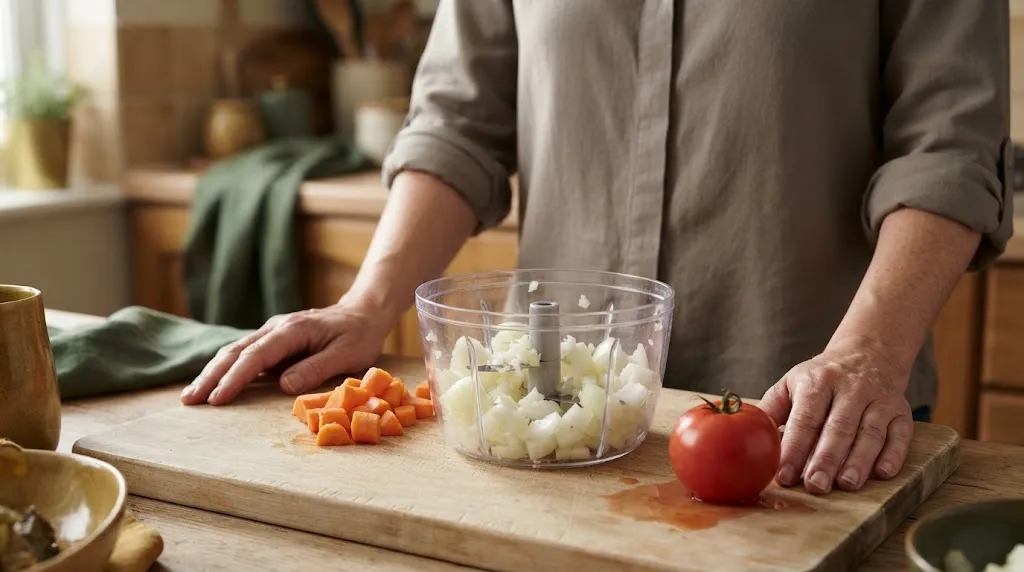
The most important drawbacks concern cutting consistency, capacity, ingredient compatibility, hand effort, and maintenance. Understanding these issues helps prevent disappointing results and unnecessary purchases.
1. Uneven Cutting Results
Many rotating-blade choppers struggle to produce consistently sized pieces. Food near the blades may receive repeated cuts while other pieces remain comparatively large.
This becomes noticeable when preparing vegetables for dishes requiring even cooking.
- Onions may contain both fine fragments and large pieces.
- Carrots may need additional chopping after the first cycle.
- Herbs may stick to the container walls instead of circulating.
- Extra pulls can turn previously chopped vegetables into a paste.
A useful illustration is preparing onions for a stir-fry. A chef’s knife allows deliberate cuts, while a pull-cord model offers less control over the final shape.
How to reduce the problem: Cut ingredients into similar starting pieces and avoid filling the container above its recommended level.
2. Small Capacity and Frequent Batches
Manual choppers commonly use compact bowls, making them convenient for smaller preparations but inconvenient for large quantities. Capacity varies significantly between models.
For example, the Zyliss Easy Pull model E910074 has an 800 ml container, approximately 27 fluid ounces. That capacity is useful for individual ingredients but does not eliminate batch preparation.
Consider chopping several onions, carrots, and peppers for a large soup. You may need to empty and reload the container repeatedly.
- Small batches: Convenient for a garnish, salsa, or one onion.
- Medium batches: May require multiple cycles and container emptying.
- Large batches: Often better suited to a larger food processor or knife.
Practical tip: Treat the stated bowl volume as container size, not a promise that the entire volume can be chopped efficiently at once.
3. Difficulty Cutting Very Hard Vegetables
Dense ingredients require greater force, particularly when they enter a cutting grid or contact a relatively small blade. Performance depends on blade sharpness, mechanism strength, and ingredient size.
Raw sweet potatoes, thick carrots, and dense squash can be challenging for some designs. Forcing an unsuitable ingredient may damage the mechanism or create an injury risk.
Try these safer adjustments:
- Cut large vegetables into manageable pieces first.
- Use only ingredients supported by the manufacturer’s instructions.
- Stop immediately if the mechanism jams or requires excessive force.
- Use a sturdy knife and stable cutting board when the chopper is unsuitable.
A powerful manual chopper may still process firm vegetables successfully. The limitation is that performance cannot be assumed across every model.
4. Soft Vegetables Can Become Mushy
Soft produce creates the opposite problem. Instead of remaining in neat pieces, ripe ingredients may break down after repeated chopping.
This happens because rotating blades repeatedly strike the same food as its structure weakens.
- Ripe tomatoes: May release juice and form a loose mixture.
- Avocados: Can quickly become mashed rather than cubed.
- Soft berries: May collapse and release liquid.
- Delicate herbs: Can bruise or cling to damp container walls.
This is not always undesirable. A slightly crushed texture may work beautifully for salsa, guacamole, or dressings.
For a salad requiring distinct tomato cubes, however, a sharp knife usually offers better control.
5. Repetitive Hand and Wrist Effort
Manual choppers do not require electricity, but that energy must come from the user. Frequent pressing or pulling can become tiring during larger preparation jobs.
The effort is especially relevant for people with limited grip strength, wrist discomfort, or reduced hand mobility.
- Pull-cord models require repeated gripping and pulling.
- Push-down designs involve repetitive downward pressure.
- Grid dicers may demand substantial force with dense produce.
Practical tip: Try the movement before purchasing when possible, and avoid any model that forces your wrist into an uncomfortable position.
A compact electric mini chopper may be more comfortable for some users. However, its buttons, assembly, and cleaning requirements still deserve consideration.
6. Blades and Corners Can Be Difficult to Clean
Cleaning is among the most overlooked manual vegetable chopper limitations. Chopped food can accumulate beneath blades, inside grid openings, and around the container lid.
Garlic, onion, herbs, and starchy vegetables can make the problem particularly noticeable.
For easier maintenance:
- Disassemble only the components intended for removal.
- Rinse accessible food-contact parts promptly after use.
- Wash components according to the manufacturer’s instructions.
- Use the supplied cleaning tool when handling cutting grids.
- Allow components to dry fully before storing.
Never wipe exposed cutting edges with bare fingers. Use a suitable brush and handle detachable blades carefully.
The USDA’s kitchen cleaning guidance explains why utensils and food-contact surfaces must be cleaned thoroughly.
7. Sharp Blades Create Handling Risks
A manual chopper is not automatically safer than a kitchen knife. Its cutting edges can cause injuries during assembly, cleaning, and food removal.
Some grid-style tools include exposed blade inserts, while rotating designs feature sharp removable assemblies.
- Keep fingers away from the cutting path.
- Use supplied pushers or food holders correctly.
- Never clear a blockage while a blade mechanism is engaged.
- Keep loose blades away from children.
- Replace damaged or cracked components rather than forcing continued use.
Safety reminder: A stable nonslip base helps keep a tool positioned correctly, but it does not eliminate blade hazards.
8. Limited Cutting Shapes and Precision
A basic chopper primarily reduces food into smaller pieces. It does not necessarily produce controlled slices, matchsticks, wedges, or decorative cuts.
This matters when appearance and cooking consistency are important.
- Stir-fry strips: Better prepared using controlled knife cuts or a suitable slicer.
- Uniform potato cubes: Require an appropriate dicing grid or careful knife work.
- Thin cucumber slices: Need a slicer, mandoline, or knife.
- Fine herb ribbons: Usually require a sharp knife.
Interchangeable attachments can broaden a chopper’s capabilities. However, additional accessories introduce more pieces to assemble, clean, and store.
9. Mechanical Parts Can Wear Out
Manual choppers depend on moving components, including cords, springs, gears, hinges, or plungers. These parts may eventually wear, especially with frequent use or excessive force.
Wear can appear as a sticking mechanism, unreliable lid closure, damaged cutting inserts, or reduced blade performance.
Before purchasing, check:
- Whether the brand offers replacement blades or other parts.
- Whether the warranty covers mechanical failures.
- Whether the lid and bowl lock securely.
- Whether the mechanism moves smoothly without excessive force.
Not every model experiences these problems. Build quality and correct usage strongly influence durability.
10. Food Can Stick or Collect Around the Blades
Some ingredients cling to the walls, blade shaft, or underside of the lid. This interrupts circulation and can produce inconsistent results.
Garlic and fresh herbs are common examples because their texture and moisture encourage sticking.
To improve results, use smaller loads and follow the manufacturer’s recommended operating technique. Stop and open the tool safely if ingredients need repositioning.
Never reach inside an assembled chopper while its cutting mechanism could move.
Manual Vegetable Chopper vs Knife vs Electric Food Processor
The best tool depends on batch size, desired texture, physical effort, and cleanup. No option wins every category.
| Feature | Manual Chopper | Chef’s Knife | Electric Processor |
|---|---|---|---|
| Power source | Hand-powered | Hand-powered | Electric motor |
| Best batch size | Small | Small to large | Varies by bowl size |
| Precision | Moderate; design-dependent | High with skill | Variable |
| Cutting styles | Usually limited | Highly versatile | Attachment-dependent |
| Physical effort | Repeated operation | Manual cutting | Low during processing |
| Cleanup | Multiple small parts | Knife and board | Bowl, lid, and blades |
| Storage | Usually compact | Minimal | Often larger |
Comparison reflects typical tool designs, not controlled testing of specific models.
For one onion or a handful of herbs, a compact chopper can be convenient. When preparing a large pot of vegetables, a suitable electric processor may reduce repetitive effort.
For exact slicing and carefully shaped ingredients, the knife remains the most flexible option.
How Can You Reduce Manual Vegetable Chopper Problems?
You can improve results by matching the tool to the ingredient, preparing food correctly, and avoiding excessive loads. Good technique helps, although it cannot overcome every design limitation.
Use a Simple Five-Step Method
- Prepare the produce: Wash vegetables and remove unsuitable stems, pits, or other hard parts.
- Cut oversized pieces: Reduce ingredients to sizes recommended by the manufacturer.
- Load carefully: Leave enough room for rotating blades or the lid to operate properly.
- Operate gradually: Check the texture between chopping cycles instead of overprocessing.
- Clean promptly: Disassemble and wash approved components before residue dries.
The most useful principle is to stop chopping once the ingredients reach the desired texture. More pulls or presses do not always mean better results.
Match the Chopper to the Recipe
Consider two contrasting recipes: chunky fresh salsa and carefully arranged vegetable salad. The salsa can tolerate mixed textures, while the salad may need deliberate knife cuts.
This difference explains why the same appliance can feel helpful in one recipe and frustrating in another.
Practical decision rule: Use a rotating manual chopper when ingredient size matters more than exact shape. Choose a knife or suitable dicing tool when consistent shape is essential.
Which Vegetables Work Best in Manual Choppers?
Most manual choppers perform best with ingredients that fit their blade design and require moderate cutting force. The exact results vary by mechanism.
- Onions: Good candidates for many rotating-blade and grid models.
- Bell peppers: Generally suitable after removing seeds and preparing manageable pieces.
- Garlic: Useful for mincing, although small pieces can stick.
- Carrots: Suitable for some models when cut smaller; dense pieces can resist cutting.
- Tomatoes: Suitable for chunky sauces, but soft varieties can become watery.
- Fresh herbs: Useful in small quantities, although delicate leaves may bruise or cling.
Ingredient preparation matters as much as the blade itself. Even a capable chopper may struggle when overloaded or given oversized pieces.
Are Manual Vegetable Choppers Safe and Hygienic?
Manual vegetable choppers can be safe for routine kitchen use when assembled, operated, and cleaned correctly. However, enclosed containers should never be mistaken for protection against every cutting hazard.
Clean food-contact components between tasks, especially when switching from raw animal products to ready-to-eat produce. Ideally, dedicate the chopper to vegetables if its design is difficult to clean.
The USDA cutting board recommendations reinforce the importance of separating raw animal foods from fresh produce.
Do not assume every detachable part is dishwasher-safe. For example, Zyliss specifies that the Easy Pull E910074 bowl and blades are dishwasher-safe, while the cord-mechanism lid requires hand cleaning.
When Should You Avoid Using a Manual Vegetable Chopper?
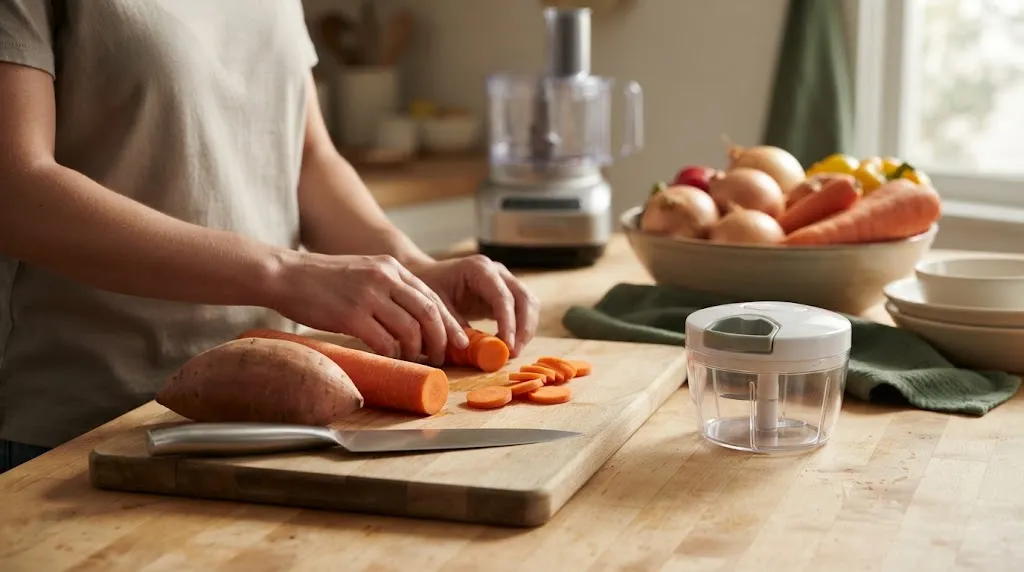
Skip the chopper when the recipe demands precision or the tool requires excessive force. It is also unsuitable whenever its blade mechanism is damaged or cannot be cleaned properly.
Common situations where another tool may be preferable include:
- Preparing exceptionally large quantities of vegetables.
- Creating thin, uniform slices for gratins or salads.
- Cutting ingredients prohibited by the chopper’s instructions.
- Processing hard vegetables that cause the mechanism to jam.
- Working with a worn pull cord, cracked housing, or damaged blade.
- Completing repetitive preparation with limited hand strength.
A chopper should make preparation easier, not introduce unnecessary effort or safety risks.
Which Manual Vegetable Choppers Are Worth Considering?
If you understand the limitations and still prefer a manual tool, prioritize a mechanism that matches your everyday cooking. The following models offer two different approaches rather than identical features.
Product selection is based on manufacturer-published features and intended use, not personal hands-on testing. The scores below are editorial suitability assessments, not customer-review averages.
🏆 Best for Pull-Cord Chopping
Zyliss Easy Pull Food Chopper & Processor (E910074)
★★★★☆ 4/5 editorial fit
This manual processor features an 800 ml bowl and three stainless steel blades. Its pull-cord mechanism handles chopping and blending without electricity.
I would shortlist it for onions, herbs, salsa, and small batches of dips. Remember that the cord-mechanism lid needs careful hand cleaning.
🥗 Best for Quick Press-Down Chopping
OXO Good Grips Vegetable Chopper with Easy-Pour Opening
★★★★☆ 4/5 editorial fit
This model uses a stainless steel cutting pattern and a press-down mechanism. Its easy-pour opening helps transfer chopped ingredients without removing the lid.
I would consider it for everyday onion and pepper preparation. It is less suitable when you need long slices or decorative vegetable cuts.
Frequently Asked Questions
What are the biggest disadvantages of a manual vegetable chopper?
The main disadvantages include uneven chopping, small container capacity, repetitive hand effort, difficult cleaning, and limited cutting options. Some models also struggle with dense vegetables or turn delicate ingredients into mush. These drawbacks become more noticeable when preparing large meals or recipes requiring precise cuts.
Can a manual vegetable chopper cut carrots and potatoes?
Some manual choppers can process carrots and potatoes, but performance depends on their design and the size of the pieces. Dense raw vegetables may require considerable force. Cut ingredients into manageable portions and follow the manufacturer’s recommendations rather than forcing an overloaded mechanism.
Are manual choppers better than electric food processors?
Manual choppers are often more convenient for small portions, compact storage, and kitchens without convenient electrical access. Electric processors are generally better suited to larger or repetitive tasks, depending on their capacity. Neither option consistently provides the same cutting precision as controlled knife work.
Why does my manual vegetable chopper chop unevenly?
Uneven results often come from oversized ingredients, overfilled containers, food sticking near the blades, or uneven contact with the cutting mechanism. Try cutting ingredients into similar starting sizes, processing smaller batches, and checking the texture regularly. Worn or damaged blades may also contribute.
How long do manual vegetable choppers last?
There is no universal lifespan because durability depends on build quality, usage frequency, ingredient hardness, and maintenance. Blades may lose performance, while cords, hinges, and plungers can wear. Inspect components regularly and replace the tool if damaged parts affect operation or safety.
Final Takeaway: Is a Manual Vegetable Chopper Right for You?
Manual vegetable choppers are useful kitchen helpers, but they are not universal replacements for knives or electric processors. Their biggest advantages appear during small, repetitive preparation tasks where perfect cutting precision is unnecessary.
Choose one if you regularly chop onions, peppers, herbs, or salsa ingredients in modest portions. For large batches, dense vegetables, or exact cuts, keep a reliable knife or appropriate processor available.
The best choice is the one that matches your cooking habits, not the one promising to replace every kitchen tool.
