
Pull Cord Chopper for Hard Vegetables: What Works Best?

Quick Answer
A pull cord chopper can handle some hard vegetables, including carrots and potatoes, when the specific model permits them and you cut them into small, manageable pieces first. However, dense raw vegetables such as beetroot and sweet potatoes can strain a small manual chopper. For frequent hard-vegetable preparation, a sturdy knife, suitable push-style dicer, or food processor may be a better choice.
How to Choose and Use One
- Check compatibility: Read the manufacturer’s instructions before putting hard vegetables into the bowl.
- Cut smaller: Divide carrots and potatoes into manageable pieces instead of loading them whole.
- Load lightly: Leave enough room for the ingredients to move around the blades.
- Pull steadily: Use controlled pulls and stop if the cord resists or the blades stop rotating freely.
- Check the texture: Open the chopper only after the blades have stopped, then inspect the pieces before continuing.
- Choose the right tool: Consider a food processor or suitable dicer if you regularly prepare large quantities of hard vegetables.
One Important Safety Tip
- Never force the pull cord, overload the bowl, or push ingredients toward the blades with your fingers.
Hard vegetables can make everyday meal preparation feel like a workout, especially when you need evenly chopped carrots, potatoes, or other root vegetables. A pull cord chopper looks like a convenient shortcut, but its performance depends on the blade design, the size of each piece, and the vegetable’s firmness.
In this guide, I’ll explain what these choppers can reasonably handle, how to prepare tougher ingredients, and when another kitchen tool makes more sense. I’ll also cover the buying features that matter most in 2026, so you can choose equipment that fits your cooking routine without expecting a small manual chopper to do everything.
What Is a Pull Cord Chopper for Hard Vegetables?
A pull cord chopper is a manual food-preparation tool that uses a retractable cord to spin blades inside a covered bowl. Each pull rotates the blade assembly, cutting ingredients into smaller pieces without electricity.
For hard vegetables, the key difference is between a chopper that can process small, firm pieces and one that is designed to handle dense ingredients repeatedly. A product’s blade material alone does not establish its ability to chop every hard vegetable safely.
- Blade assembly: Determines how the blades move through the ingredients and how evenly they distribute cutting action.
- Bowl capacity: Affects how much room the pieces have to move during chopping.
- Pull mechanism: Determines how the cord transfers your effort to the rotating blades.
- Ingredient compatibility: Defines which foods the manufacturer permits you to process.
Some models suit onions, garlic, herbs, and other relatively easy-to-cut ingredients better than dense raw vegetables. I would treat the instruction manual as the deciding factor, not a broad marketing claim that the product chops everything.
Can a Pull Cord Chopper Cut Carrots and Potatoes?
Sometimes, yes. A compatible model may chop carrots and potatoes when you first reduce them to small pieces, avoid overfilling the bowl, and use controlled pulls.
However, carrots and potatoes vary in size, firmness, and preparation needs, so results will not be identical across every chopper. Some manufacturers specifically require smaller chunks, while others restrict their models to smaller or softer foods.
Which hard vegetables are suitable?
| Vegetable | Practical approach | What to watch for |
|---|---|---|
| Carrots | Cut into small chunks if permitted. | Dense pieces may resist the blades. |
| Potatoes | Use small, manageable pieces in a compatible model. | Large chunks can jam the assembly. |
| Beetroot | Check the manual carefully; consider another tool. | Its dense texture can be demanding. |
| Sweet potatoes | Use only if explicitly suitable for the model. | Hard flesh may resist small blades. |
| Radishes | Try small pieces only if the manual allows them. | Round pieces may move unevenly. |
| Butternut squash | Use a suitable knife or approved processor instead. | Dense flesh and tough skin can challenge small choppers. |
This table is a practical starting point, not a universal compatibility chart. A vegetable listed here may still be unsuitable for a particular product, and you should never use a chopper outside its stated limits.
For example, the Salter pull chopper manual describes its model as suitable for small fruits and vegetables and instructs users to cut larger items, including carrots, into small chunks. That guidance illustrates why model-specific instructions matter more than assumptions based on the pull-cord design alone.
How Should You Prepare Hard Vegetables Before Chopping?
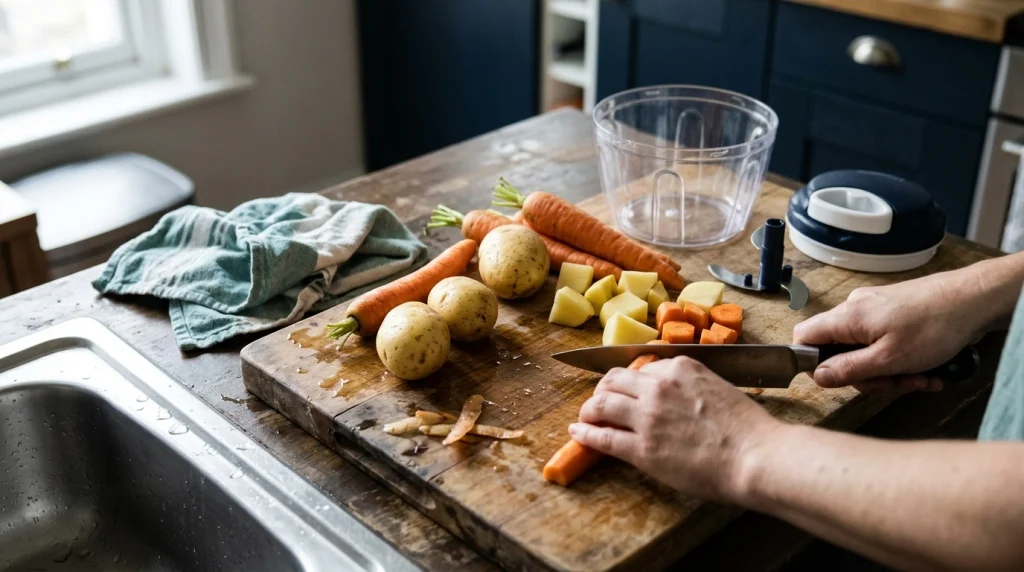
Good preparation reduces the demand on a manual chopper and gives the blades a better chance of cutting the ingredients evenly. It cannot, however, make an incompatible model suitable for hard foods.
- Wash and inspect: Clean the vegetables and remove damaged areas, stems, and other unwanted parts.
- Peel when appropriate: Remove thick or tough skins if the recipe requires it and the manufacturer’s instructions call for it.
- Cut into manageable chunks: Follow the model’s instructions for permitted piece size instead of relying on a universal measurement.
- Remove excess moisture: Drain washed vegetables so water does not collect unnecessarily in the bowl.
- Load below capacity: Leave enough free space for the ingredients to move rather than packing them tightly.
- Secure the lid: Check that the lid and blade assembly fit correctly before operating the cord.
Do not try to compensate for oversized chunks by pulling harder. If the blade struggles, stop and check the ingredient size, loading, assembly, and manual before deciding whether the tool is suitable.
Should you soften hard vegetables first?
Pre-cooking can soften some vegetables, but it changes their texture and may not suit a recipe that calls for raw, evenly chopped pieces. Never assume that microwaving, boiling, or steaming makes every vegetable safe to process in every chopper.
If a manufacturer recommends briefly cooking a particular hard ingredient before processing, follow its specific directions. Otherwise, use a knife or another tool designed for that preparation task.
How Do You Use a Pull Cord Chopper Without Straining It?
The goal is to let the mechanism rotate the blades rather than treating the cord as a lever for forcing stubborn food through them. Smooth operation, modest loads, and regular checks matter more than pulling as hard as possible.
- Place it on a stable surface: Keep the bowl level and secure so it does not slide during use.
- Check the contents: Confirm that the vegetable pieces are small enough and permitted by the manufacturer.
- Close the lid completely: Ensure the lid locks or seats as intended before pulling the cord.
- Pull and release smoothly: Use a controlled motion and allow the cord to retract as designed.
- Inspect the results: Once the blades stop, open the lid and check whether the pieces have reached the desired size.
- Repeat only when appropriate: Continue with gentle pulls if the mechanism moves freely and the manual allows further chopping.
There is no universal number of pulls for carrots or potatoes. Blade design, ingredient size, quantity, and the texture you want all affect the result.
For diced vegetables, stop when the pieces reach a useful size rather than continuing until everything becomes mushy. A pull chopper typically produces chopped pieces, not the precise, uniform cubes that a suitable dicing grid can provide.
Why Does a Pull Cord Chopper Struggle With Hard Vegetables?
A pull cord chopper may struggle because the ingredients resist the blades, the bowl contains too much food, or the mechanism does not suit that particular vegetable. Recognizing the cause helps you avoid damaging the tool or creating an unsafe situation.
Oversized pieces
Large chunks can crowd the bowl and prevent the blades from moving freely. Cut permitted ingredients into smaller pieces before loading them, and do not keep pulling when the assembly appears stuck.
Overfilling the bowl
Too much food can restrict movement and produce uneven results. Many compact choppers work better when you process smaller batches and leave room around the blade assembly.
Dense or tough ingredients
Raw beetroot, sweet potato, and thick pieces of carrot can demand more cutting force than a lightweight chopper can comfortably provide. If the manual excludes these foods, switch to a suitable alternative rather than trying to overcome the restriction.
Dull or damaged blades
Worn, bent, loose, or damaged blades can reduce cutting performance and increase the risk of injury. Stop using the chopper if you notice damage, and replace parts only with compatible components approved for that model.
Incorrect assembly
A lid or blade assembly that does not fit correctly may prevent normal operation. Turn the chopper off by stopping the pulling action, wait for all movement to cease, and check the assembly according to the manual.
Important: Never put your fingers into the bowl to free trapped food while the blade assembly remains installed. Follow the manufacturer’s removal and cleaning instructions, and keep your hands clear of sharp edges.
Pull Cord Chopper vs. Push Chopper vs. Food Processor
Each tool handles vegetable preparation differently. The right choice depends on whether you value compact storage, uniform cuts, larger batches, or the ability to process dense raw vegetables.
| Feature | Pull cord chopper | Push-style dicer | Food processor |
|---|---|---|---|
| Power source | Manual cord | Manual pressure | Usually electric |
| Hard raw vegetables | Model-dependent; pre-cutting may be required | Depends on the grid and food restrictions | Depends on the motor, blade, and instructions |
| Cut consistency | Often irregular chopped pieces | Can produce uniform pieces with a suitable grid | Depends on attachment and processing time |
| Batch size | Usually small | Depends on the cutting chamber | Often better for larger batches |
| Main trade-off | Limited capacity and ingredient compatibility | Can require substantial hand pressure | Requires power, storage, and cleaning |
These are general design differences, not measured performance results for every product. A specific model’s instructions, capacity, and permitted foods should guide your final decision.
If you mostly prepare onions, garlic, and herbs, a pull cord chopper may be a convenient addition to your kitchen. If you routinely dice raw carrots, potatoes, and other dense vegetables for family meals, a suitable food processor or dicer may be more practical.
What Features Matter When Buying a Pull Cord Chopper?
When shopping for a manual chopper, I would prioritize clearly stated ingredient compatibility and dependable construction over a long list of advertised functions. A simple design that suits your routine is more useful than extra features you cannot safely use.
- Clear usage instructions: Look for an explicit list of suitable foods and restrictions on hard ingredients.
- Blade construction: Check the stated material, attachment design, and availability of compatible replacements.
- Useful bowl capacity: Match the bowl size to the amount you typically prepare, while allowing room for movement.
- Secure lid: Choose a design that fits firmly and can be operated according to the manufacturer’s instructions.
- Comfortable cord handle: A handle that is easy to grip can make repeated pulls more manageable.
- Easy cleaning: Check which parts can be washed, whether the lid must stay out of water, and how to remove food safely.
- Replacement-part support: Confirm whether the manufacturer offers replacement blades, bowls, or lids for the model.
Be cautious about vague claims such as “chops every vegetable” or “handles any hard food.” The useful details are the manufacturer’s permitted ingredients, preparation instructions, and any explicit restrictions.
For more general kitchen-preparation ideas, see this guide to practical cooking hacks for easier meal preparation.
How Can You Get More Consistent Chopping Results?
A pull chopper works by repeatedly moving its blades through the food, so the final texture depends on how the pieces move around the bowl. You can improve consistency with a few simple habits without assuming that every ingredient will chop identically.
- Start with similar-sized pieces: Cut the vegetable chunks to roughly comparable dimensions before loading them.
- Work in small batches: Avoid packing the bowl so tightly that pieces cannot circulate.
- Check between rounds: Inspect the texture after each short set of pulls, with the blades completely stopped before opening the lid.
- Separate stubborn pieces: If larger pieces remain, remove the food safely and prepare those pieces separately with a suitable tool.
- Stop at the right texture: More pulls create smaller pieces but may also turn softer ingredients into a paste.
For example, if you need carrots for a chunky vegetable soup, you may prefer larger pieces and a different cutting method. For a finely chopped mixture, a compatible pull chopper may help, but it will not necessarily produce perfectly uniform cubes.
My main practical recommendation is to judge the result by the food’s texture rather than by a fixed pull count. This also helps prevent overprocessing onions, tomatoes, and other ingredients that release moisture as they break down.
How Should You Clean and Maintain a Pull Cord Chopper?
Proper cleaning helps keep the blades usable and prevents food residue from interfering with the mechanism. Always follow the care instructions for your specific model because the bowl, blade assembly, and lid may have different cleaning requirements.
- Finish chopping: Wait until the blades have stopped moving before opening the lid.
- Remove food: Transfer the chopped ingredients with a suitable utensil, keeping fingers away from the blades.
- Disassemble carefully: Remove the blade assembly only as directed by the manufacturer.
- Wash approved parts: Use mild detergent and a suitable brush where the instructions permit it.
- Rinse and dry: Remove residue and dry the components thoroughly before storage.
- Inspect the mechanism: Look for cord damage, loose components, cracks, or blade deterioration before the next use.
Do not submerge a pull-cord lid unless its manufacturer explicitly permits that cleaning method. Water entering the mechanism may damage components, and sharp blades require careful handling even after use.
If the cord frays, fails to retract, or begins to feel unusually stiff, stop using the chopper until you can identify the problem safely. Never open a sealed mechanism or attempt an improvised repair that the manufacturer does not support.
For additional food-handling guidance, consult the U.S. Food and Drug Administration’s food safety resources.
Which Alternative Should You Choose for Frequent Hard-Vegetable Prep?
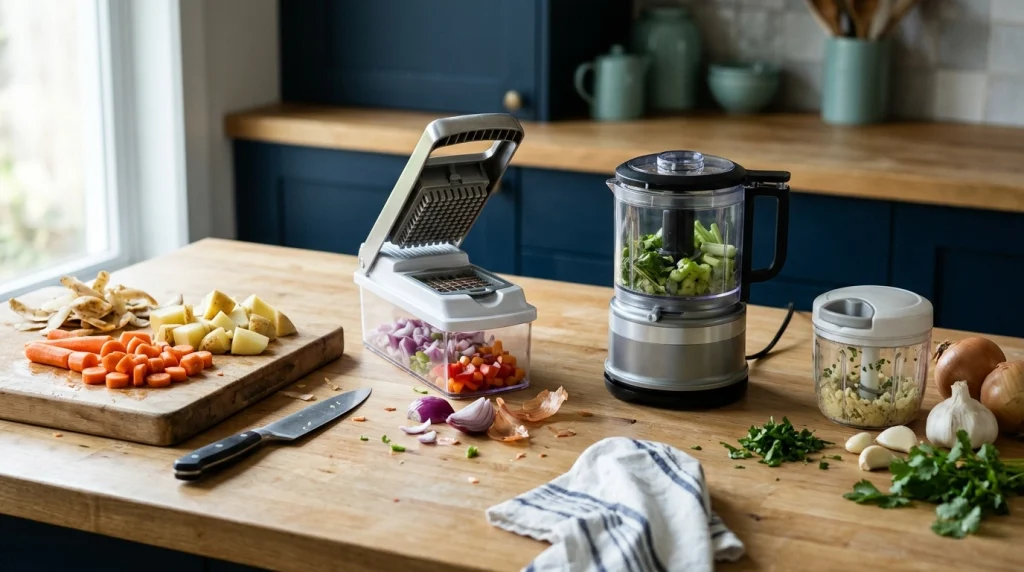
If hard vegetables are a regular part of your cooking, it may be worth choosing a tool designed around that specific task instead of pushing a small pull chopper beyond its limits. Consider the preparation method and the cut you want before buying another gadget.
- For everyday carrot and potato chopping: A sharp chef’s knife and stable cutting board offer flexibility and precise control when used correctly.
- For uniform cubes: Consider a suitable push-style dicer, but verify its restrictions on dense raw vegetables and never force food through its grid.
- For larger batches: A food processor with an appropriate chopping attachment may reduce repetitive manual effort.
- For slices and shreds: A suitable slicer or grater may be better than a chopper that only produces irregular pieces.
- For onions, garlic, and herbs: A pull cord chopper can remain useful for quick, small-batch preparation.
There is no single best tool for every kitchen. The best fit is the one that handles your usual ingredients within its stated limits, produces the texture you need, and is easy to clean and store.
For safe knife handling and general food-preparation practices, the FoodSafety.gov website provides a useful starting point for broader kitchen safety information.
Product Recommendations: Tools to Consider for Hard Vegetables
If you’re ready to choose a tool, I’d start by matching the product to the vegetables you prepare most often. The following options represent different preparation methods; check each product’s current specifications and instructions before purchasing.
🏆 BEST FOR MANUAL PREP
Zyliss Easy Pull Food Processor
★★★★☆
This pull-operated food-preparation tool is worth investigating if you prefer a manual mechanism. Before using it for raw carrots or potatoes, verify the exact model’s ingredient restrictions and recommended preparation sizes; this is a product to evaluate, not a claim of hands-on testing.
🔪 BEST FOR CONTROLLED CUTS
OXO Good Grips Chef’s Knife
★★★★☆
A chef’s knife gives you direct control over the size and shape of carrot, potato, and beetroot pieces. I would consider this approach when exact cuts matter more than one-pull convenience, provided you’re comfortable using a sharp knife and a stable cutting board.
⚙️ BEST FOR LARGER BATCHES
Cuisinart Mini-Prep Food Processor
★★★★☆
An electric mini processor is an alternative for cooks who want powered chopping rather than repeated cord pulls. Check the capacity, chopping instructions, and limitations for hard raw vegetables before selecting a model; smaller processors are not automatically suitable for every dense ingredient.
Selection note: The stars above are indicative editorial fit ratings, not verified customer-review scores or results from comparative hands-on testing. Product availability, model names, features, and compatibility can change, so confirm the listing and manufacturer’s instructions before ordering.
Frequently Asked Questions
Can a pull cord chopper chop raw carrots?
Some pull cord choppers can process raw carrots when the manufacturer permits them and you cut them into appropriately sized chunks. Others are intended mainly for small or softer ingredients. Check the model’s instructions and stop if the cord resists or the blades fail to rotate freely.
Can I put raw potatoes in a pull cord chopper?
Only if the specific chopper is designed for raw potatoes. Cut them into manageable pieces when the instructions allow it, and avoid overloading the bowl. If the mechanism struggles, stop rather than forcing the cord, and use a suitable knife or food processor instead.
How small should I cut vegetables before putting them in a pull chopper?
There is no universal chunk size for every model. Follow the manufacturer’s stated preparation dimensions and capacity limits. When the manual permits hard vegetables but does not specify a precise size, choose manageable pieces that fit comfortably and allow the blades to move freely.
Why does my pull cord chopper stop working with hard vegetables?
Large pieces, an overloaded bowl, unsuitable ingredients, incorrect assembly, or damaged blades can prevent normal operation. Stop pulling, wait until all movement ends, and inspect the chopper according to its manual. Never reach into the bowl to free food while the blades are installed.
Is a pull cord chopper better than a food processor for hard vegetables?
Not necessarily. A pull cord chopper offers manual operation and compact storage, while a compatible food processor may suit larger batches and repeated preparation better. The best option depends on ingredient restrictions, capacity, desired cut, available storage, and how often you prepare dense raw vegetables.
Final Takeaway: Choose the Chopper for the Food You Actually Prepare
A pull cord chopper can be useful for hard vegetables, but only when the model supports those ingredients and you prepare them correctly. Small batches, suitable piece sizes, and controlled pulls can help the mechanism work as intended.
For occasional carrots or potatoes, a compatible manual chopper may be enough. If you regularly prepare dense root vegetables, need uniform cubes, or cook in large batches, a suitable dicer, knife, or food processor may be the more practical investment.
Before buying, read the instructions, verify hard-vegetable compatibility, and check how the product should be cleaned and maintained. A realistic match between the tool and your cooking routine is more valuable than a promise that one gadget can chop everything.
Affiliate disclosure: This article contains affiliate links. If you purchase through these links, RecipesPalette may earn a commission at no additional cost to you.