
History of the Rice Cooker: A Timeline From 1923 to Today

The electric rice cooker began in Japan. Mitsubishi Electric built an early electric cooker, the NJ-N1, in 1923, but it had no automatic shut-off. The real breakthrough came in December 1955, when Toshiba released the ER-4, widely recognized as the first automatic electric rice cooker for home use. Within about five years, roughly half of Japanese households had one. Keep-warm functions arrived in the early 1970s, microcomputer control in 1979, and induction heating (IH) in 1988.
Rice Cooker Timeline at a Glance
| Year | Milestone |
|---|---|
| 1923 | Mitsubishi Electric develops the NJ-N1, an early electric rice cooker without automation |
| 1940s to early 1950s | Mitsubishi, Matsushita (now Panasonic) and the young Sony try manual electric cookers; they sell poorly |
| 1951 | Toshiba begins developing an automatic cooker |
| 1955 | Toshiba launches the ER-4, the first automatic electric rice cooker for homes |
| 1956 | Matsushita releases a cheaper single-pot automatic model |
| Around 1960 | About half of Japanese homes use an automatic rice cooker |
| 1950s to 1970s | Rice cookers spread to the US via Hawaii and California, then across Asia and beyond |
| 1972 | Cookers with a heat-retention (keep-warm) function appear |
| 1979 | Microcomputer-controlled cookers manage soaking and heat levels |
| 1988 | Induction heating (IH) rice cookers are introduced |
| 1990s onward | Fuzzy logic programs, pressure IH models and multi-function settings become common |
| 2010s onward | App and Wi-Fi control appear on some models |
Before Electricity: Rice in a Pot
For centuries, rice in Japan and across Asia was cooked in heavy pots over wood or charcoal fires. In Japan the traditional pot was the kamado-style cauldron, and getting rice right took constant attention to the fire and timing. That labor, usually done early every morning, is what electric cookers set out to remove.
1923 to the Early 1950s: Early Electric Cookers
Mitsubishi Electric’s NJ-N1 of 1923 is often cited as the first electric rice cooker. Like the models that followed in the 1940s and early 1950s from Mitsubishi, Matsushita and even Sony’s predecessor company, it was essentially a pot with a heater. Someone still had to watch it and switch it off, and results were uneven. These cookers did not catch on.
1955: Toshiba’s Automatic Rice Cooker
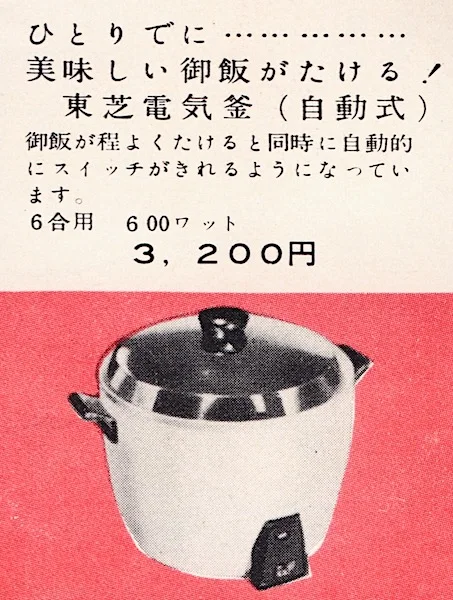
Toshiba engineers began work on an automatic design in 1951, with key development by Yoshitada Minami. The ER-4, released on December 10, 1955 (some sources say 1956), used a double-pot, indirect heating design and a thermostat that switched off the heat automatically once the water was used up and the temperature began to rise above boiling. For the first time, families could add rice and water, press a switch and walk away. It launched at 3,200 yen and became a huge success.
The same basic principle is still used in simple rice cookers today: a spring-loaded thermostat under the pot senses the temperature jump when the water is gone and flips the cooker off or to warm. If yours has stopped doing that, see our guide on a rice cooker not switching to warm.
1956 to 1960s: Rice Cookers Become Standard
Matsushita entered with a cheaper single-pot model in 1956, and competition pushed prices down. By around 1960, about half of Japanese households used an automatic electric rice cooker. Japanese communities and imports carried the appliance to Hawaii and California in the 1950s, and it spread across East and Southeast Asia in the following decades.
1970s: Keeping Rice Warm
Early automatic cookers simply switched off, so rice cooled down. Cookers with a heat-retention function appeared in 1972, keeping cooked rice warm and ready for hours. Keep-warm is now standard on almost every model.
1979 to 1990s: Microcomputers and Fuzzy Logic
In 1979, microcomputer-controlled cookers arrived that could manage soaking time and adjust heat through the cycle instead of using one fixed setting. Over the following years, manufacturers added menus for different rice types, delay timers and “fuzzy logic” programs that adjust cooking based on sensor readings. This is why a modern cooker can handle white rice, brown rice, sushi rice and porridge on different settings.
1988: Induction Heating
Induction heating (IH) cookers, introduced in 1988, use a magnetic field to heat the inner pot itself rather than relying on a single heating plate at the bottom. This heats the pot more evenly and lets the cooker change temperature quickly. Later, many brands combined IH with pressure cooking for softer, stickier rice. If you are weighing up this type, see our guide to induction rice cookers.
Today: Multi-Cookers and Smart Features
Modern rice cookers range from simple one-switch models to high-end IH pressure cookers. Many add steaming, slow cooking or cake settings, and some offer app control. At the same time, electric multi-cookers with rice programs have become popular in many kitchens, especially outside Asia.
What the History Means When You Buy One
- Basic switch-type cookers still use the 1955 thermostat idea. They are cheap, simple and great for white rice.
- Microcomputer or fuzzy logic cookers follow the 1979 approach and handle more rice types and textures.
- IH and pressure IH cookers are the most even and precise, at a higher price.
Not sure if you need one at all? Read whether a rice cooker is worth the money.
Frequently Asked Questions
Who invented the rice cooker?
The first automatic home rice cooker was developed at Toshiba, with Yoshitada Minami credited for the key breakthrough, and released in 1955. Earlier non-automatic electric cookers were made by Mitsubishi Electric from 1923. See our guide on who invented the rice cooker.
When did rice cookers come to the United States?
They reached the US in the 1950s, first through Hawaii and California, and grew more common over the following decades.
When was the keep-warm function added?
Cookers with a heat-retention function were introduced in 1972.
When did induction rice cookers appear?
Induction heating rice cookers were introduced in 1988.
How did the first automatic rice cooker know when to stop?
A thermostat sensed when the water was used up and the temperature rose above boiling, then switched off the heat.
Final Thoughts
The rice cooker went from a manual electric pot in 1923 to a self-switching appliance in 1955, then added keep-warm, microcomputers and induction heating. The core idea, sensing when the water is gone, has barely changed in 70 years, which is why even a basic cooker still makes reliable rice. For better results with any model, see how to cook rice perfectly every time.