Pull Cord Chopper for Carrots: How to Get Even, Consistent Cuts

Quick Answer
A pull cord chopper can chop carrots into small pieces, but preparation matters because raw carrots are firm and dense. Peel and wash the carrots, cut them into small chunks, fill the container below its maximum capacity, and pull the cord in short bursts until the pieces reach your preferred size.
What to look for when chopping carrots
- Smaller pieces: Cut carrots into short chunks before placing them in the bowl.
- Sharp blades: Look for securely fitted stainless-steel blades designed for firm vegetables.
- Controlled pulls: Start with a few pulls, inspect the results, and continue gradually.
- Manageable batches: Leave enough room for the carrot pieces to move around the blades.
- Stable base: Choose a model with a nonslip base or secure lid to reduce movement during use.
- Easy cleaning: Check whether the bowl, lid, and removable blades can be cleaned safely and conveniently.
One important tip
- Never force the cord if the blades jam. Open the chopper according to its instructions and clear the obstruction only when the blades are safely accessible.
Carrots can be awkward to chop by hand when a recipe calls for lots of small, even pieces. A pull cord chopper offers a compact alternative, provided you prepare the carrots correctly and choose a model suited to firm vegetables.
In this guide, I’ll explain how to prepare carrots, control the chopping size, avoid common problems, and decide when a manual chopper makes sense. I’ll also cover the features worth checking before you buy one in 2026.
What Is a Pull Cord Chopper for Carrots?
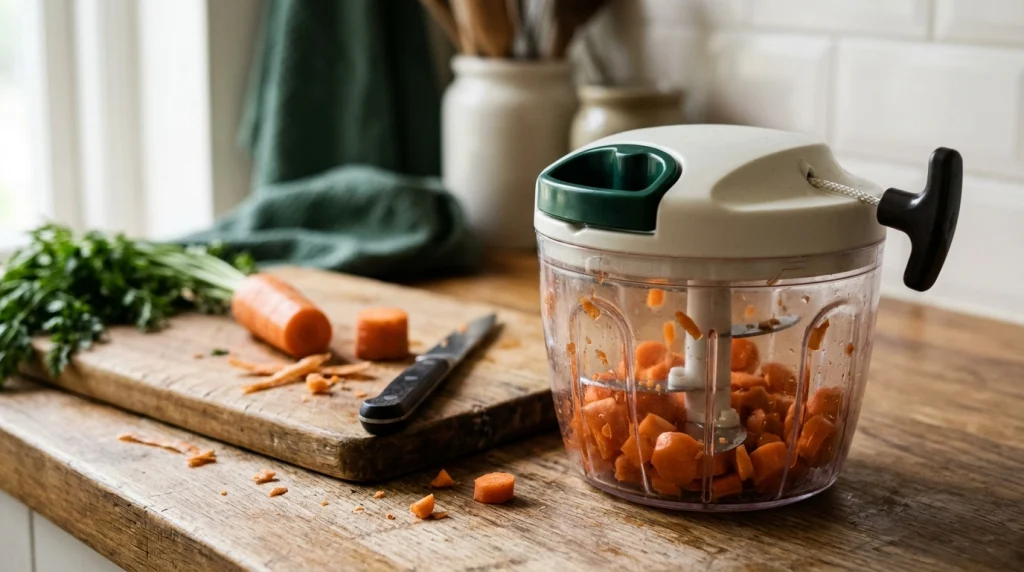
A pull cord chopper is a manual kitchen tool that spins blades when you pull a retractable cord attached to its lid. The rotating blades cut food inside a container without requiring electricity.
For carrots, the main advantage is convenience: you can prepare small pieces for salads, soups, sauces, and cooked dishes without repeatedly using a knife. However, the result depends on carrot size, blade design, container capacity, and how you operate the cord.
- Container: Holds the carrot pieces while they move around the blades.
- Blade assembly: Cuts the carrots as the internal mechanism rotates.
- Pull cord and handle: Transfer your pulling motion into blade rotation.
- Lid and base: Help keep the mechanism assembled and the container stable.
Unlike a box grater, a pull cord chopper usually produces chopped pieces rather than long, thin shreds. If you want grated carrots for carrot cake or coleslaw, a grater or a food processor with a shredding disc is often a better fit.
Can a Pull Cord Chopper Handle Raw Carrots?
Yes, many pull cord choppers can handle raw carrots when you cut them into suitable chunks first. However, not every small manual chopper has the same blade strength, capacity, or mechanism durability.
Raw carrots are firm, so forcing large pieces into a small bowl can make chopping difficult. Check the manufacturer’s instructions for suitable ingredients and preparation sizes before using your chopper.
Why carrot preparation matters
A whole carrot presents a different challenge from a small carrot chunk because the blade must engage a larger, harder piece. Pre-cutting reduces the amount of work each pull needs to accomplish.
- Trim off the ends and remove any damaged areas.
- Cut thick carrots lengthwise when necessary.
- Slice them into short, manageable chunks.
- Avoid adding whole carrots or oversized pieces unless the product instructions explicitly permit them.
Do not assume that more force produces better results. A cord that suddenly becomes difficult to pull may indicate an obstruction or excessive load.
How Do You Chop Carrots in a Pull Cord Chopper?
The best method is to prepare the carrots, load a small batch, and increase the number of pulls gradually. This gives you more control over the final texture and helps prevent unnecessary strain on the mechanism.
- Wash the carrots. Rinse them under running water and scrub firm surfaces with a clean produce brush when needed.
- Peel if desired. Remove the skin if your recipe or preference calls for peeled carrots.
- Cut into chunks. Use a knife and cutting board to make pieces small enough for the chopper’s instructions.
- Load the container. Add a moderate amount, keeping below the fill line if the manufacturer provides one.
- Secure the lid. Confirm that the lid and blade assembly sit correctly before operating the cord.
- Pull gently. Use short, controlled pulls rather than yanking the cord aggressively.
- Inspect the texture. Stop, open the unit as directed, and check whether the carrots need additional chopping.
- Repeat if necessary. Continue in small increments until the pieces suit your recipe.
Always keep your fingers away from the blades, and never reach into the container while the mechanism is assembled for use. Follow the product’s specific instructions for opening, unloading, and cleaning.
How Many Pulls Do Carrots Need?
There is no universal pull count for carrots because chopper designs and carrot sizes vary. The most reliable approach is to use a few pulls, inspect the pieces, and continue until the texture looks right.
The following guide describes a practical starting approach, not a guaranteed result for every model.
| Stage | Starting approach | What to check |
|---|---|---|
| Initial chopping | Try 2–3 controlled pulls. | Have the chunks started breaking apart? |
| Medium pieces | Add a few pulls if needed. | Are most pieces close to your target size? |
| Fine chopping | Continue in short increments. | Are larger pieces still present, or is the mixture becoming too fine? |
| Uneven results | Stop and inspect the contents. | Are pieces trapped, overcrowded, or too large? |
I recommend judging the carrots by appearance rather than relying on a fixed number of pulls. A small batch of thin carrot chunks may chop faster than a crowded container holding thick pieces.
What Chopping Results Can You Expect?
A pull cord chopper usually produces a mixture of small and slightly larger pieces rather than perfectly identical cubes. That is often fine for soups, stir-fries, fillings, and homemade sauces.
For dishes where appearance matters, inspect the carrots after each chopping stage and remove any unusually large pieces for further cutting.
| Desired result | Recommended method | Main limitation |
|---|---|---|
| Coarse chunks | Use fewer pulls and check early. | Piece sizes may vary. |
| Small chopped carrots | Use several short chopping stages. | Some pieces may remain larger. |
| Very fine mince | Chop gradually and inspect frequently. | Carrots can become uneven or mushy if overprocessed. |
| Thin carrot strips | Use a julienne peeler or suitable slicer. | A standard pull cord chopper isn’t designed to make long strips. |
| Fine grated carrots | Use a box grater or shredding disc. | Chopping doesn’t reproduce a grated texture. |
Which Features Matter Most When Buying a Pull Cord Chopper?
The best pull cord chopper for carrots combines a suitable blade assembly, practical bowl capacity, comfortable operation, and straightforward cleaning. A long list of accessories matters less if the basic chopping mechanism struggles with firm vegetables.
1. Blade quality and arrangement
Look for securely mounted stainless-steel blades and a design intended for chopping vegetables. Multiple blade levels may help expose ingredients to cutting edges at different heights, although the actual results depend on the complete design.
Don’t judge blade quality by the number of blades alone. A well-designed assembly that rotates freely can be more useful than a complicated arrangement that traps carrot pieces.
2. Bowl capacity
A larger container can reduce the number of batches needed for meal preparation, but capacity should match the amount you normally cook. Even a large bowl can produce poor results when packed beyond its recommended fill line.
- Small batches: Practical for a quick salad or a single serving.
- Medium batches: Useful for everyday meal preparation.
- Larger batches: More convenient for family meals, provided the mechanism can handle the load.
3. Pull mechanism and handle
The cord should retract smoothly, and the handle should feel comfortable to grip. A mechanism that catches, fails to retract, or requires excessive force can make routine chopping frustrating.
Check the manufacturer’s care instructions, warranty terms, and replacement-part availability where applicable. These details can matter more over time than an extra accessory.
4. Stability and safety
A nonslip base helps keep the bowl steady while you pull the cord. A lid that locks or seats securely also helps keep the assembly together during operation.
Because the blades are sharp, look for a design that allows you to remove the lid and unload the contents without putting your fingers near the cutting edges.
5. Cleaning and storage
Carrot fragments can collect around blade hubs and under the lid. A chopper that comes apart according to clear instructions is easier to clean thoroughly after use.
Before buying, check whether the manufacturer allows the bowl, lid, and blades to go in a dishwasher. Never assume the pull mechanism or lid is dishwasher-safe simply because the container is.
Pull Cord Chopper vs. Food Processor vs. Grater: Which Is Better for Carrots?
The right tool depends on the carrot texture you need, how much food you prepare, and whether you want manual or powered operation. A pull cord chopper is a convenient middle ground for small quantities of chopped carrots.
| Tool | Best use | Advantages | Trade-offs |
|---|---|---|---|
| Pull cord chopper | Small quantities of chopped carrots | Manual, compact, no electrical outlet needed | Requires pre-cutting and repeated pulls |
| Food processor | Larger batches and varied preparation tasks | Powered chopping; some models offer shredding attachments | Requires electricity and more cleanup |
| Box grater | Grated carrots for baking or salads | Direct control over grating texture | Requires manual pressure and careful handling |
| Knife and cutting board | Uniform dice or specific shapes | Precise control with suitable knife skills | Takes practice and repeated cutting |
For a few carrots in a soup or sauce, I’d start with a pull cord chopper if the model is rated for firm vegetables. For grated carrot cake ingredients, choose a grater or a food processor with a proper shredding attachment instead.
Why Does a Pull Cord Chopper Struggle With Carrots?
Most chopping problems come down to oversized pieces, overfilling, dull or damaged blades, or a mechanism that isn’t suited to dense vegetables. Identifying the cause is safer than pulling harder.
Carrots remain in large chunks
If the carrots barely change after several pulls, stop and check their size and placement. Cut oversized pieces smaller, reduce the batch, and make sure the blade assembly sits correctly.
The cord becomes difficult to pull
Resistance can indicate a jam, an overloaded container, or a problem with the mechanism. Stop immediately rather than forcing the cord, and follow the manufacturer’s procedure for clearing an obstruction.
Some pieces are fine while others remain large
Uneven results can occur when carrot chunks vary greatly in size or fail to circulate around the blades. Prepare more uniform chunks, use smaller batches, and inspect the mixture between chopping stages.
The carrots become wet or mushy
Too many pulls can break carrots down beyond the texture you intended. Stop as soon as the pieces reach the desired size, especially when preparing carrots for salads or dishes where distinct pieces matter.
The mechanism stops retracting smoothly
Food residue, a damaged cord, or internal wear may interfere with operation. Don’t disassemble a sealed or spring-loaded mechanism unless the manufacturer provides instructions for doing so.
If the cord frays, the lid cracks, or the blades become loose, discontinue use until the product can be repaired appropriately or replaced.
How Can You Get More Consistent Carrot Pieces?
Consistency comes from controlling the ingredients and checking the results, not from pulling the cord as quickly as possible. A few simple habits make the process more predictable.
- Start with similar-sized chunks: Uniform starting pieces make the chopping process easier to manage.
- Use smaller batches: Leave space for ingredients to circulate rather than compressing them into the bowl.
- Keep the chopper level: Place the container on a stable, dry surface.
- Check between stages: Open the unit only as directed, inspect the texture, and continue if necessary.
- Separate oversized pieces: Remove larger chunks for another short chopping stage rather than repeatedly processing everything.
- Maintain the blades: Clean them properly and replace damaged parts only with compatible components.
For example, when preparing carrots for vegetable soup, a coarse chop may be sufficient because the pieces will soften during cooking. A carrot salad may need finer, more even pieces, making frequent visual checks especially useful.
How Do You Clean a Pull Cord Chopper After Chopping Carrots?
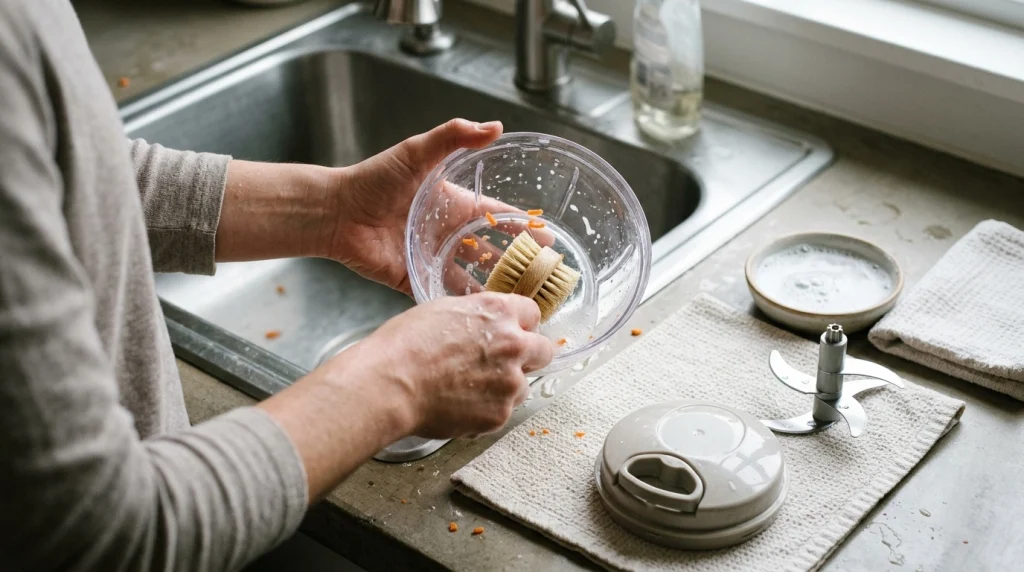
Clean the bowl and removable parts promptly after use so carrot residue doesn’t dry around the blades or lid. Always follow the product’s cleaning instructions, particularly for the pull mechanism.
- Remove the lid and blade assembly using the recommended procedure.
- Transfer the chopped carrots with a suitable utensil, keeping your hands away from the blades.
- Wash the food-contact parts with warm water and dish soap when permitted by the manufacturer.
- Use a suitable cleaning brush to reach residue around blade hubs without touching cutting edges directly.
- Rinse and dry the parts as instructed before storage.
- Keep the cord mechanism away from water unless the manufacturer explicitly allows washing it.
For safe produce preparation, FoodSafety.gov’s food safety guidance recommends rinsing fruits and vegetables under running water and washing food-contact utensils and surfaces appropriately.
Wash carrots before cutting them, and don’t use soap or household cleaning chemicals directly on the produce. The University of Minnesota Extension’s produce-washing advice provides further practical guidance.
Which Pull Cord Chopper Should You Consider for Carrots?
If you’re ready to choose a chopper, focus on whether the model suits raw carrots, how much it holds, and how easily you can clean it. The following are products worth comparing, but confirm each model’s current specifications and suitability for firm vegetables before purchasing.
🏆 BEST FOR MANUAL PREP
Brieftons QuickPull Food Chopper
A manual pull-operated chopper to investigate if you want to prepare vegetables without electricity. Check the specific model’s blade arrangement, bowl capacity, and instructions for chopping raw carrots before buying.
💡 BEST FOR SIMPLE OPERATION
Zyliss Easy Pull Food Chopper
This is another manual chopper to compare for everyday vegetable preparation. Review the current model’s operating instructions and confirm that its recommended ingredients include raw carrots.
🥕 BEST ALTERNATIVE FOR GRATING
OXO Good Grips Box Grater
A box grater is worth considering when you need shredded rather than chopped carrots. Choose a suitable grating surface and work carefully around the sharp edges, especially as the carrot gets smaller.
These are comparison starting points, not independently tested rankings. I haven’t verified current listings, prices, consumer ratings, or performance results for the specific models, so I wouldn’t assign them star scores without supporting evidence.
Frequently Asked Questions
Can you put whole carrots in a pull cord chopper?
It’s best to cut carrots into smaller chunks before loading a pull cord chopper. Whole carrots may not fit safely or allow the blades to rotate freely, and they can put unnecessary strain on the mechanism. Always follow the manufacturer’s preparation and capacity instructions.
Can a pull cord chopper make carrots suitable for carrot cake?
A pull cord chopper can break carrots into small pieces, but it usually won’t produce the fine, consistent shreds that carrot cake recipes call for. Use a box grater or a food processor with a shredding disc when the recipe specifies grated carrots.
Why are my chopped carrots uneven?
Uneven carrot pieces can result from oversized chunks, an overloaded container, or ingredients that don’t circulate evenly around the blades. Prepare similar-sized pieces, reduce the batch, and inspect the texture after a few controlled pulls rather than continuing blindly.
Is a pull cord chopper better than chopping carrots with a knife?
A pull cord chopper can be convenient for preparing small batches with less repetitive knife work. A knife offers more direct control over uniform cubes and specific shapes, while a chopper generally produces less consistent pieces. The better choice depends on your recipe and preferred texture.
How do you stop carrots from jamming a pull cord chopper?
Cut the carrots smaller, avoid exceeding the recommended fill level, and use short, controlled pulls. If the cord becomes unusually difficult to move, stop immediately. Follow the manufacturer’s instructions to open the chopper and safely clear any obstruction before trying again.
Final Takeaway: Choose the Chopper for Your Carrot Preparation Needs
A pull cord chopper can make everyday carrot preparation more convenient when you use the right technique. Small, evenly prepared chunks, manageable batches, and gradual chopping give you better control over the final texture.
Before buying, prioritize a suitable blade assembly, stable container, comfortable pull mechanism, and straightforward cleaning. If you regularly need finely grated carrots or precisely uniform dice, a grater, food processor, or knife may serve you better.
My recommendation is simple: match the tool to the result you want, follow the manufacturer’s instructions, and stop when the carrots reach the right size for your recipe.
Affiliate disclosure: This article contains affiliate links. If you purchase through them, RecipesPalette may earn a commission at no additional cost to you.
“`