
What Are the Standard Dimensions of a Dish Rack?

Quick Answer
There isn’t one mandatory standard size for every dish rack. However, a typical medium countertop rack measures about 16–20 inches wide, 12–16 inches deep, and 5–10 inches high. Compact racks are often closer to 12–16 inches wide, while large-capacity racks can exceed 20 inches. These ranges also line up with general dish rack sizing guidance.
Common Dish Rack Sizes
- Compact: Roughly 12–16 inches wide and 10–12 inches deep.
- Standard: Roughly 16–20 inches wide and 12–16 inches deep.
- Large: Roughly 20–24 inches or more in width.
- Two-tier: Similar counter footprint but commonly 12–18 inches tall.
- Over-sink: Often adjustable to roughly 24–36 inches across.
Before You Buy
- Measure the whole footprint: Include drainboards, utensil cups, cup holders, and the drainage spout.
If you’re asking about standard dish rack dimensions, you’re probably trying to avoid buying something that overwhelms your counter or doesn’t hold enough dishes. Size matters more than it first appears.
I always measure the available space before comparing features. A rack can look compact online while its drainboard or utensil holder adds several inches to the real footprint.
Are There Standard Dimensions for a Dish Rack?
There is no single universal dimension that every dish rack manufacturer follows. Instead, most products fall into a few common size ranges based on capacity and design.
Definition: Dish rack dimensions describe the rack’s external width, depth, and height when it is ready for normal use. The usable drying area may be smaller than those exterior measurements.
As of 2026, a medium single-tier countertop rack is commonly around 16–20 inches wide. Its depth often falls near 12–16 inches.
That range works because it gives dinner plates enough support without occupying the entire counter beside a typical sink.
What Are the Most Common Dish Rack Sizes?
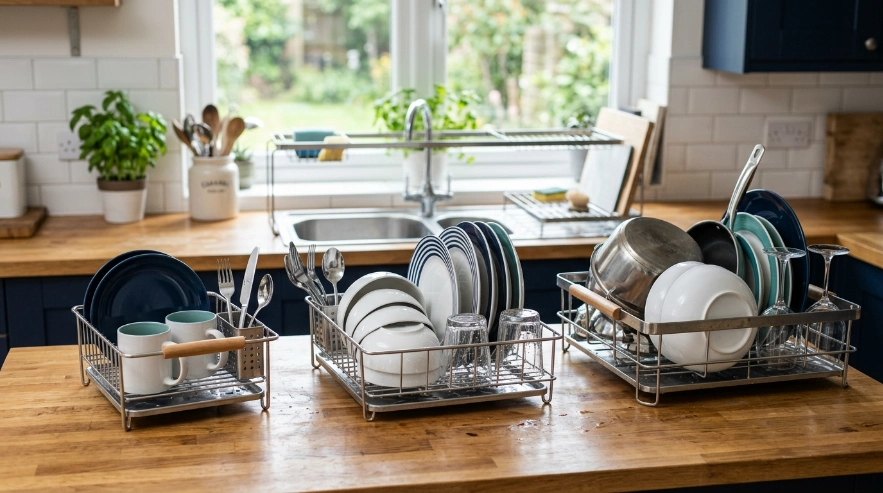
Dish racks can be grouped into compact, standard, and large sizes. Choosing by category is easier than searching for one supposedly universal measurement.
| Rack Size | Typical Width | Typical Depth | Typical Height | Best For |
|---|---|---|---|---|
| Compact | 12–16 in | 10–12 in | 4–7 in | One person, apartments, RVs |
| Standard/Medium | 16–20 in | 12–16 in | 5–10 in | Most everyday kitchens |
| Large | 20–24+ in | 14–18 in | 8–15 in | Families, cookware, heavy hand-washing |
| Over-sink | 24–36 in, often adjustable | Varies by sink | Often 20–25 in | Saving counter space |
Think of these numbers as shopping ranges rather than building codes. Accessories and unusual designs can increase the final dimensions.
How Much Counter Space Does a Standard Dish Rack Need?
A standard rack usually needs a clear area of at least about 18–20 inches wide and 14–16 inches deep. Extra clearance makes everyday loading much easier.
I prefer leaving another inch or two around the rack when the kitchen allows it. That prevents cups and handles from colliding with walls, appliances, or the sink faucet.
Measure More Than the Metal Frame
One of the easiest mistakes is measuring only the central basket. That’s often not the rack’s true working footprint.
- Utensil holder: A side-mounted caddy can add several inches.
- Cup holders: Exterior hooks may extend beyond the main frame.
- Drainboard: The tray can be wider or deeper than the basket.
- Drain spout: It must reach the sink without blocking other items.
- Wine-glass rack: Some premium models extend noticeably to one side.
Measure the product at its widest and deepest points. Do the same with your available countertop space.
What Size Dish Rack Do I Need for My Household?
The right size depends more on your normal washing load than the number of people alone. Someone who cooks every meal can need more space than a larger household using a dishwasher.
For One Person
A compact rack around 12–16 inches wide is usually enough. This size works well for a few plates, bowls, cups, and utensils.
It’s also easier to store when counter space is limited.
For Two to Four People
A standard rack around 16–20 inches wide is the safest starting point. It provides room for a normal meal’s plates, glasses, bowls, and flatware.
This is the size range I would check first for an average home kitchen.
For Larger Families
Look at racks around 20–24 inches wide or larger. A two-tier design can also increase drying capacity without taking the same amount of additional counter space.
- Choose wider plate slots for dinner plates.
- Look for dedicated cup or glass holders.
- Allow open space for mixing bowls and pans.
- Check that the frame stays stable when fully loaded.
How Do Different Dish Rack Types Affect the Dimensions?
Two racks with similar capacity can have completely different footprints. The design determines whether the rack uses horizontal or vertical space.
Single-Tier Countertop Racks
These are the easiest models to size. Most stay relatively low and spread dishes across one main drying level.
A width around 16–20 inches is common for a medium-capacity design.
Two-Tier Dish Racks
Two-tier racks use height to increase capacity. Their footprints may stay near standard countertop dimensions while the height reaches roughly 12–18 inches.
Measure the space beneath upper cabinets before buying one. Tall plates on the upper tier need additional clearance.
Over-the-Sink Dish Racks
Over-sink models need a different measurement strategy. Their width must match or safely span the sink area.
Adjustable designs can extend considerably, so check both the minimum and maximum specified width.
Roll-Up Drying Racks
Roll-up racks usually sit directly over part of the sink. Width and depth therefore need to match the sink opening rather than the surrounding countertop.
They save space but provide less structured plate support than a full basket-style rack.
Foldable Dish Racks
Foldable racks are useful when you want to reclaim the counter after dishes dry. Remember that the open dimensions matter more than the folded measurements during normal use.
What Do Real Dish Rack Dimensions Look Like?
Actual products show why a single “standard” measurement can be misleading. Even mainstream countertop models vary by several inches.
| Example | Published Dimensions | Size Impression |
|---|---|---|
| OXO Good Grips Aluminum Dish Rack | 17.9 × 14.9 × 6.6 in | Typical medium countertop footprint |
| Rubbermaid Antimicrobial Dish Drainer | 16.13 × 11.75 × 4.13 in* | Compact-to-standard footprint |
| OXO Good Grips Foldaway Dish Rack | 19.4 × 15.5 × 5.125 in open | Larger standard footprint |
*Dimensions are reordered here as approximate width × depth × height for easier comparison; manufacturers may list dimensions in a different sequence.
Those examples show why the 16–20-inch width range is useful for planning. They also show why checking the complete specification matters.
How Do You Measure for a Dish Rack Before Buying?
Measure the space where the rack will actually sit, not the entire countertop. Then compare that usable area with the product’s maximum assembled dimensions.
- Measure available width. Start at the sink edge and stop before appliances, walls, or prep areas.
- Measure usable depth. Measure from the backsplash or wall toward the counter edge.
- Check vertical clearance. This matters for two-tier racks beneath cabinets.
- Measure the sink relationship. A draining spout needs to reach the sink correctly.
- Check your largest dishes. Measure dinner plates, cutting boards, and cookware that will dry there.
- Add accessory space. Include cup holders, utensil bins, and removable side pieces.
I also check whether a loaded rack will steal the kitchen’s main food-prep area. A rack that technically fits can still make the counter frustrating to use.
What Dish Sizes Should a Rack Be Able to Hold?
External dimensions only tell part of the story. Internal slot spacing and frame height determine what you can actually dry.
- Dinner plates: Many everyday plates are around 10–11 inches in diameter.
- Bowls: Wide bowls need open areas rather than narrow plate slots.
- Cutting boards: Tall boards need stable vertical support.
- Pots and pans: Handles can extend far outside the rack’s measured footprint.
- Wine glasses: Dedicated stemware holders can improve stability but increase width.
A rack doesn’t need to contain every item completely inside its frame. It does need to hold those items securely without becoming unstable.
What Are the Most Common Dish Rack Measurement Mistakes?
Most sizing problems come from measuring the available space too generously. Small overlooked details can turn a good rack into an awkward purchase.
- Ignoring the drainboard: It may extend farther than the frame.
- Forgetting cabinet height: Tall racks can interfere with upper cabinets.
- Measuring an empty counter: Appliances may normally occupy part of that space.
- Ignoring the faucet: A large rack can restrict faucet movement.
- Skipping sink measurements: Drain spouts and over-sink racks depend on sink position.
- Buying only for capacity: Oversized racks can reduce valuable food-preparation space.
The best rack isn’t necessarily the biggest model that fits. It’s the smallest model that comfortably handles your normal washing load.
Is a 17- to 19-Inch Dish Rack a Good Standard Size?
Yes. A rack around 17–19 inches wide and roughly 12–15 inches deep is a practical middle ground for many kitchens.
That footprint is large enough for everyday mixed dishes without moving into oversized family-rack territory. Several mainstream models sit close to these measurements.
For comparison, Simplehuman’s steel-frame dish rack range separates standard and compact designs, reflecting the same need to match capacity with available counter space.
Should You Choose a Wider Rack or a Two-Tier Rack?
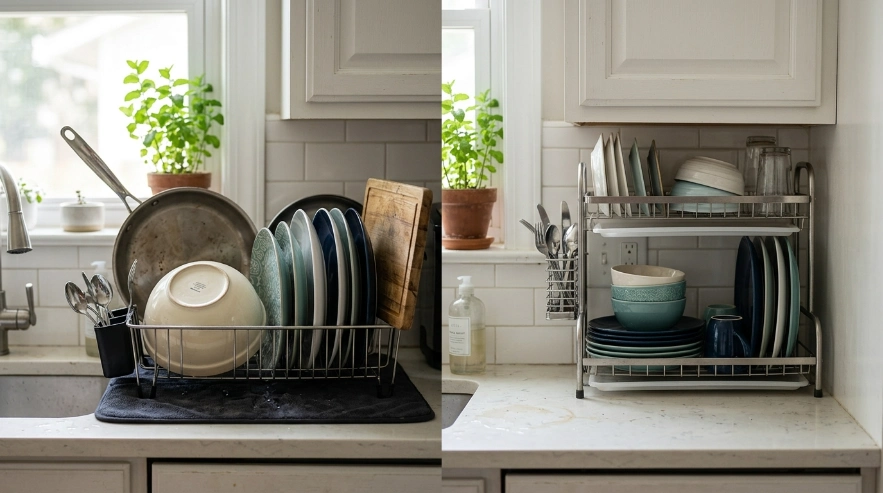
Choose a wider rack when you have generous counter space and regularly dry pans, bowls, or large boards. Choose two tiers when horizontal counter space is more limited.
| Feature | Wide Single-Tier | Two-Tier |
|---|---|---|
| Counter footprint | Larger | Often smaller for similar capacity |
| Vertical clearance | Lower | More important |
| Large cookware | Usually easier to place | May be more restricted |
| Best use | Open countertops | Limited counter width |
If your upper cabinets sit low, measure carefully before choosing two tiers. Vertical capacity is only useful when dishes can be loaded comfortably.
Dish Racks I Would Consider for Common Counter Sizes
If you’re ready to choose one, these three designs cover the most useful size situations: everyday counters, smaller spaces, and fold-away storage.
🏆 Best Overall Size
OXO Good Grips Aluminum Dish Rack
★★★★☆ 4.8/5
Its published 17.9 × 14.9 × 6.6-inch dimensions sit squarely in the useful medium-size range. I like this footprint for kitchens that need everyday capacity without moving into an oversized rack.
💰 Best for Smaller Counters
Rubbermaid Antimicrobial Dish Drainer
★★★★☆ 4.6/5
The roughly 16.13 × 11.75-inch working footprint is easier to fit beside smaller sinks. I would consider this style when straightforward plate and utensil drying matters more than premium accessories.
📦 Best Foldaway Option
OXO Good Grips Foldaway Dish Rack
★★★★☆ 4.7/5
It measures about 19.4 × 15.5 × 5.125 inches when open and becomes shallower when closed. I like this approach when you need full-size drying space but don’t want a permanent rack occupying the counter.
Frequently Asked Questions
What is the average width of a dish rack?
A medium countertop dish rack is commonly about 16–20 inches wide. Compact models often fall around 12–16 inches, while large-capacity racks may measure 20–24 inches or more.
What is the average depth of a dish rack?
Most standard countertop racks need roughly 12–16 inches of depth. Compact designs may be closer to 10–12 inches, while racks designed for cookware can extend to 14–18 inches deep.
How tall is a standard dish rack?
A basic single-tier rack is often around 5–10 inches tall. Two-tier racks can reach approximately 12–18 inches, so always check clearance beneath cabinets before buying.
What size dish rack is best for a small kitchen?
Look for a rack around 12–16 inches wide and 10–12 inches deep. A foldable, roll-up, or compact two-tier design can also preserve more working counter space.
Should a dish rack be bigger than the sink?
A countertop rack doesn’t need to match the sink dimensions because it sits beside the sink. An over-sink rack does need to match or safely span the sink, so its adjustable width and mounting requirements should be checked carefully.
Final Takeaway
For most kitchens, start with a dish rack around 16–20 inches wide and 12–16 inches deep. That’s the closest thing to a practical standard size, although no universal dimension applies to every rack.
Measure your counter, sink position, cabinet clearance, accessories, and largest dishes before ordering. Five minutes with a tape measure can save you from a rack that technically fits but makes your kitchen harder to use.