
When Was the Rice Cooker Invented? The Surprising History

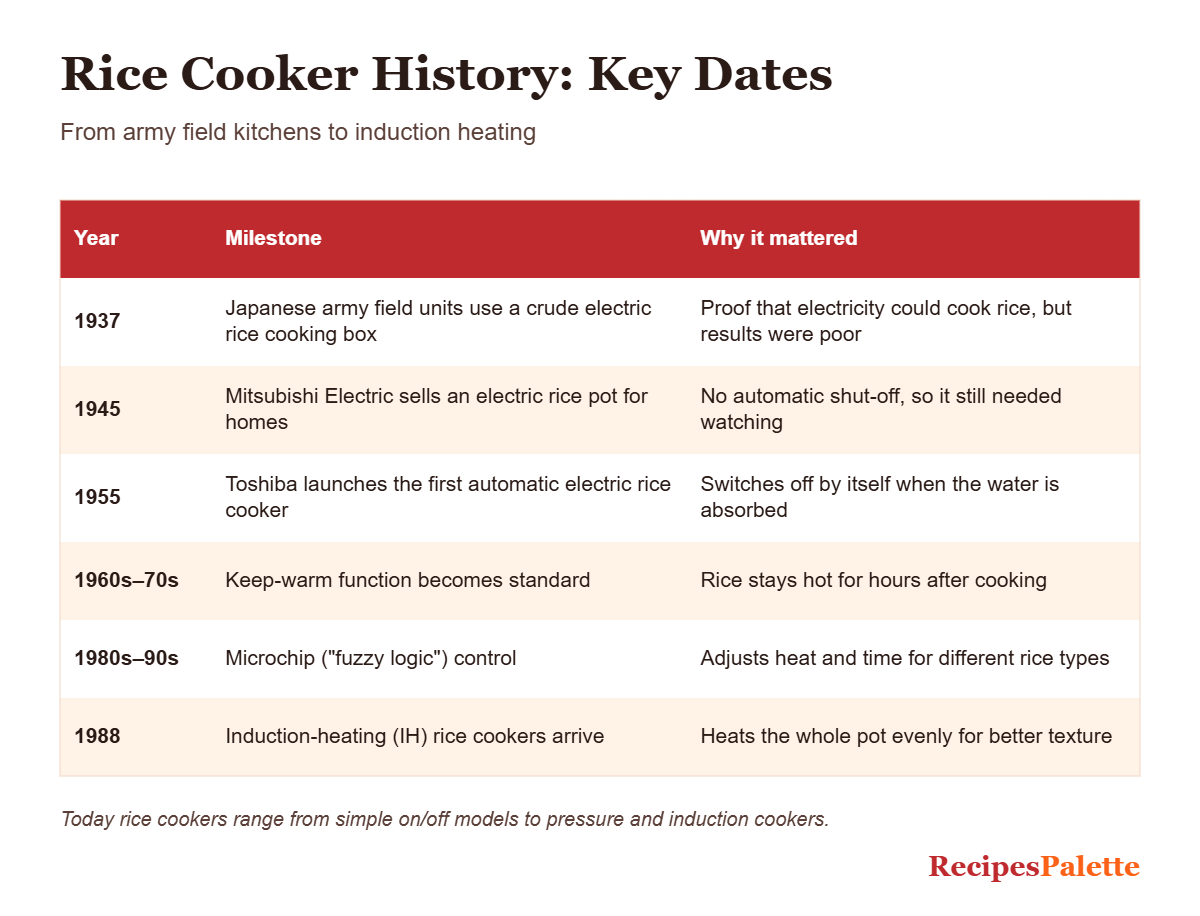
The automatic electric rice cooker was invented in Japan and went on sale in December 1955, when Toshiba launched a model developed with inventor Yoshitada Minami that switched itself off once the rice was cooked. Earlier electric rice pots existed, including a crude Japanese army device from the 1930s and a 1945 Mitsubishi Electric pot, but they had no automatic shut-off. Keep-warm, microchip “fuzzy logic” control and induction heating came later.
Key Takeaways
- Before electricity: Rice was cooked for thousands of years in clay pots, iron pots and bamboo steamers.
- Early attempts: Electric rice pots appeared in Japan from the late 1930s, but they needed constant watching.
- The breakthrough: Toshiba’s 1955 automatic rice cooker was the first to switch off by itself, and it sold in huge numbers.
- Later upgrades: Keep-warm became standard in the 1960s–70s, microchip control in the 1980s–90s, and induction heating from 1988.
- Choosing today: Rice cookers range from simple on/off models to induction and pressure models costing 0 or more.
Introduction: The Humble Appliance That Changed Everything
Have you ever wondered when was rice cooker invented? That simple question opens a door to a fascinating story spanning thousands of years and multiple continents. The rice cooker seems like a modern convenience, but its roots stretch back to ancient civilizations. This guide will walk you through every major milestone in rice cooker history, explaining not just when things happened, but why they mattered. By the end, you’ll understand how this unassuming kitchen tool evolved from basic clay vessels to sophisticated smart appliances that can perfectly cook your rice every single time.
We’ll explore the key inventors, breakthrough technologies, and cultural shifts that made rice cookers the global phenomenon they are today. Whether you’re a kitchen gadget enthusiast or just curious about everyday objects, this journey through rice cooker history will surprise and inform you.
Step 1: Ancient Rice Cooking Methods (Before the Invention)
To understand when the modern rice cooker was invented, we must first travel back to when rice cooking meant pure manual labor. For over 8,000 years, humans cultivated rice and developed clever ways to prepare it without any electricity or automation.
Clay Pots and Open Fires
Early civilizations used heavy clay pots placed directly over open flames. Cooks had to constantly monitor the heat, adjust the fire, and prevent burning. This method required skill and attention, as there was no thermostat or timer. The pot would heat the rice and water until everything evaporated, leaving perfectly steamed grains. However, achieving consistent results was nearly impossible.
Steaming Techniques Emerge
Ancient Chinese cooks developed sophisticated bamboo steamers that sat over boiling water. These tiered baskets allowed multiple foods to cook simultaneously. While not technically a “rice cooker,” this method introduced the concept of automated steam control. The rice would cook gently without direct contact with water, preventing mushiness. This principle of steam cooking would later influence modern rice cooker design.
Practical Tip: You can still use these ancient methods today! A simple pot with a tight-fitting lid and careful heat management can produce excellent rice, though it requires constant attention.
Step 2: The Dawn of Automated Rice Cooking (Early 20th Century)
The race to invent the first automated rice cooker began in the early 1900s as electricity became more common in households. Inventors worldwide recognized that rice cooking was ripe for innovation.
1937: An Army Field Kitchen Experiment
One of the earliest electric rice cookers was a simple wooden box with electrodes, used by Japanese army units in the late 1930s. Electric current passed through the wet rice to heat it. It worked, but results depended heavily on the water and rice, and it was never a practical home appliance.
1945: Mitsubishi’s Electric Rice Pot
After the war, Mitsubishi Electric sold an aluminum pot with a heating coil for home use. It was one of the first electric rice cookers made for households, but it had no automatic shut-off. Someone still had to watch it and turn it off at the right moment, so it did not catch on.
Step 3: The Breakthrough Moment (1950s-1960s)
The question of “when was rice cooker invented” truly finds its answer in post-war Japan. As the country rebuilt, companies invested in consumer electronics that could improve daily life.
Toshiba’s Game-Changing 1955 Model
In December 1955, Toshiba began selling the first automatic electric rice cooker, built on work by inventor Yoshitada Minami. It used an indirect double-pot design and a thermostat that switched off the heat once the water had been absorbed. Because it freed cooks from watching the pot, it quickly became one of Japan’s best-selling home appliances. The keep-warm function that holds rice hot for hours came in later models.
How the First Electric Rice Cooker Actually Worked
The genius was in the simplicity. The cooker had one heating plate at the bottom, a thermal sensor in the center, and a simple mechanical switch. As long as water remained, the temperature stayed at boiling point (212°F or 100°C). Once the water disappeared, the temperature would spike, triggering the sensor to flip the switch. This basic physics principle required no computers or complex electronics.
Practical Tip: If you own a basic rice cooker today, it likely still uses this same 1950s technology. The thermal sensor is why your cooker automatically switches to warm mode without any programming.
Step 4: Global Expansion and Innovation (1970s-1990s)
Once the technology proved successful in Japan, it spread rapidly across Asia and eventually worldwide. The 1970s through 1990s saw fierce competition and rapid innovation.
Japanese Brands Dominate
Companies like Toshiba, National (Panasonic), Zojirushi and Tiger competed with improved designs. Over the following decades they added features like:
– Removable inner lids for easy cleaning
– Non-stick inner pots
– Multiple cooking settings
– Timer functions for delayed cooking
These brands remain leaders today, known for reliability and innovation. Their rice cookers became status symbols in Japanese households, representing modern convenience and technological advancement.
The Arrival of Microchip “Fuzzy Logic” Control (1980s–1990s)
From the late 1980s, makers began adding microchips that adjust heat and timing during cooking instead of relying on one thermostat. Often sold as “fuzzy logic,” these cookers could respond to:
– The amount of rice and water
– The starting temperature of the water
– The rice type or program you chose
This meant perfect rice every time, regardless of conditions. The rice cooker could “think” and make micro-adjustments throughout the cooking process. While expensive initially, fuzzy logic eventually trickled down to mid-range models.
Example: A fuzzy logic rice cooker might detect that you’re using cold rice from the refrigerator and automatically extend cooking time by 5 minutes. That’s intelligence in your kitchen!
Step 5: Modern Rice Cookers (2000s-Present)
The 21st century transformed rice cookers from simple appliances to sophisticated kitchen computers. The question of “when was rice cooker invented” now includes understanding these modern marvels.
Induction Heating Revolution
High-end rice cookers now use induction heating (IH), which National (now Panasonic) brought to rice cookers in 1988 and which spread to more models in the 2000s. Instead of heating a metal plate, induction creates magnetic fields that heat the inner pot directly. This provides:
– More even heating
– Faster cooking times
– Precise temperature control
– Better energy efficiency
Induction rice cookers can maintain exact temperatures throughout the cooking process, resulting in restaurant-quality rice that’s worth the premium price.
Multi-Function Cookers Take Over
Today’s market is dominated by multi-function rice cookers that can also:
– Slow cook stews
– Steam vegetables
– Bake cakes
– Cook porridge
– Prepare sushi rice
Brands like Instant Pot have blurred the lines between rice cookers and pressure cookers, creating hybrid devices that replace multiple appliances. These modern cookers connect to smartphone apps, feature LCD displays, and offer dozens of specialized programs for different rice varieties.
Practical Tip: When shopping for a modern rice cooker, consider what types of rice you cook most often. Different grains require different cooking approaches, and advanced cookers can optimize for each variety.
Step 6: How to Choose Your Perfect Rice Cooker Today
Understanding the history helps you appreciate the options available now. Here’s how to pick the right rice cooker for your needs.
Size Matters
Rice cookers range from 3-cup models perfect for individuals to 10-cup giants that serve large families. Consider:
– How many people do you regularly cook for?
– Do you meal prep rice for the week?
– Is counter space limited?
A 5-cup model works well for most families of 2-4 people. If you frequently entertain guests, go larger.
Feature Selection Guide
Match features to your cooking style:
– Basic models ($20-$50): Simple cook/warm function, perfect for white rice
– Mid-range ($50-$150): Multiple programs, timers, and better build quality
– High-end ($150-$300+): Fuzzy logic, induction heating, and specialized settings
If you only cook white rice, a basic model serves you well. Fuzzy logic shines with brown rice, sushi rice, or mixed grains.
Budget vs. Investment
Think of a rice cooker as a long-term investment. A $100 rice cooker used daily for 5 years costs just 5 cents per use. Premium models often last 10+ years with proper care. Consider the warranty, brand reputation, and availability of replacement parts before purchasing.
Practical Tip: Read reviews specifically mentioning the types of rice you prefer. A cooker that excels with jasmine rice might not perform as well with brown rice.
Troubleshooting Your Rice Cooker Knowledge
Let’s clear up common misconceptions about rice cooker history and usage.
Myth: Rice cookers were invented in China
While China has ancient rice cooking traditions, the modern electric rice cooker was definitively a Japanese invention. The technology emerged from Japan’s post-war electronics boom when companies sought new consumer products.
Myth: All rice cookers work the same way
Nothing could be further from the truth. Basic thermal models use 1950s technology, while fuzzy logic units contain microprocessors more powerful than early computers. The difference in results is dramatic, especially for whole grain rices.
Myth: Rice cookers only cook rice
Modern rice cookers are incredibly versatile. You can prepare rice and beans recipes, steam fish, cook oatmeal, and even bake cakes. The “rice” in the name is largely historical at this point.
Problem: My rice is always mushy
This usually indicates either too much water or a failing thermal sensor. Check your rice-to-water ratio first. If that’s correct, the sensor might need cleaning or replacement. Older units often develop calibration issues after years of use.
Practical Tip: Clean the inner lid and sensor regularly with a soft cloth. Food particles can interfere with temperature readings, causing poor results.
Conclusion: The Invention That Keeps Evolving
The answer to “when was rice cooker invented” isn’t a single date but a story of continuous innovation. From ancient clay pots to today’s smart cookers, this appliance has transformed how the world prepares its most important grain. The 1955 Toshiba automatic model marks the true birth of the modern electric rice cooker, but the journey continues with each new technological advance.
Understanding this history helps you appreciate the engineering behind your kitchen counter. Whether you own a simple $20 cooker using 70-year-old technology or a $300 induction model with artificial intelligence, you’re part of a global tradition that spans millennia. The rice cooker proves that even the simplest kitchen tasks benefit from thoughtful innovation.
Next time you press that cook button, remember: you’re not just making rice, you’re participating in one of humanity’s most successful food technology stories. For perfect rice every time, check out our guide on how to cook rice perfectly every time to make the most of your modern rice cooker.