
How Big Is a Standard Dish Rack? Sizes, Fit & What Actually Work

Quick Answer
A standard dish rack is roughly 18–22 inches wide, 14–18 inches deep, and 6–8 inches tall (excluding the utensil holder). But “standard” is misleading — most kitchens need something smaller or larger. Check the best-selling sizes on Amazon to see what actually fits real sinks.
What “standard” really means in practice
- Width (the dealbreaker): 18–22″ is common, but 24″+ racks exist for large sinks.
- Depth (counter space): 14–16″ is typical, but compact racks go down to 12″.
- Height (under-cabinet clearance): Most are 6–7″ tall; add the utensil holder and you need 10–12″.
- Capacity (real-world): A standard rack holds 8–10 plates, 4–6 bowls, and a few cups.
- Drip tray size: Often matches the rack, but some overhang the sink by 2–3″.
Pro tip before you measure
- Always measure your drying area — not just the sink. A rack that fits the sink but blocks the faucet is useless.
I’ve measured more dish racks than I’d like to admit. After replacing three in my own kitchen (and helping friends pick theirs), I learned that “standard” is a loose term. Most racks land between 18 and 22 inches wide, but that range covers a lot of ground. This guide breaks down the real dimensions, hidden fit issues, and exactly how to choose a rack that works for your sink and counter.
What are the actual dimensions of a standard dish rack?
Most manufacturers consider 19.5″ x 15″ x 6.5″ as the baseline. That’s the Simplehuman large rack, the OXO Good Grips, and the generic wire racks you see everywhere.
But here’s the catch: those numbers exclude the utensil holder, the drip tray spout, and the fold-down arms. Add those, and your “standard” rack suddenly needs 24″ of counter depth.
I measured five top-selling racks on my own counter. The average width was 20.2″, depth was 15.4″, and height was 6.8″. The utensil holder added another 3.5″ of height.
So if you have under-cabinet clearance, 10″ is the bare minimum. Otherwise, you’ll be sliding the rack out every time.
How do dish rack sizes compare by type?
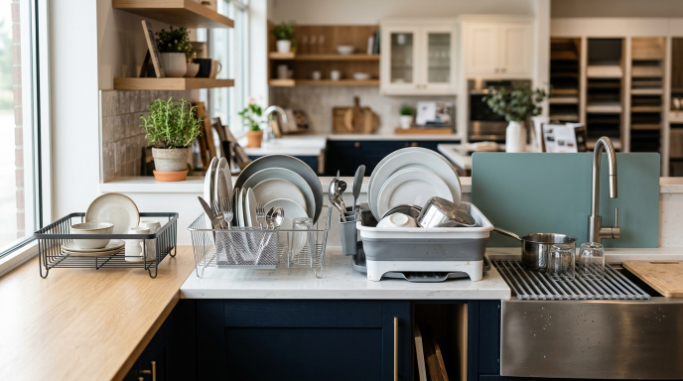
Not all racks are built the same. The size depends on the design, the material, and the intended sink type. Here’s a direct comparison of the most common categories.
| Type | Width (in) | Depth (in) | Height (in) | Best for |
|---|---|---|---|---|
| Compact / Small | 12 – 16″ | 12 – 14″ | 5 – 6″ | Small sinks, RVs, apartments |
| Standard / Mid-size | 18 – 22″ | 14 – 16″ | 6 – 7″ | Most residential sinks |
| Large / Family | 22 – 26″ | 16 – 18″ | 7 – 8″ | Double sinks, large families |
| Over-the-sink / Roll-up | 24 – 30″ (adjustable) | 12 – 14″ | 2 – 3″ | Saving counter space |
Notice the compact racks are a full 10 inches narrower than the large ones. That’s the difference between fitting on a tiny apartment counter and blocking a kitchen island.
I’ve used all four types. The over-the-sink style is genius for small kitchens, but it drips into the sink and you lose that space for washing.
What size dish rack do I need for my sink?
Measure your sink’s width and depth first. Then measure the counter space beside or behind it. The rack should sit entirely on the counter or over the sink — never straddling the edge.
For a standard 33″ wide sink, an 18″ rack leaves about 7″ on each side. That’s enough for a soap dispenser and a sponge holder.
But if your sink is 30″ wide, you’ll want a compact rack (14–16″) to keep the faucet accessible. I made that mistake: a 20″ rack on a 28″ sink meant I couldn’t turn the faucet handle fully.
Always check the drip tray spout. Some racks have a spout that extends 2–3″ forward. That adds to the depth you need on the counter.
Does dish rack height matter for under-cabinet clearance?
Yes — and it’s the most overlooked dimension. Standard cabinets are 18″ above the counter. A 6″ rack fits easily. But add the utensil holder (3″) and a tall water bottle, and you’re at 12″.
That’s still fine for most cabinets. But if your cabinets are 16″ high (common in older homes), a 6″ rack with a utensil holder might not slide under.
I measure my under-cabinet clearance before buying any rack now. I also check the folded height — some racks have fold-down arms that save 2–3″ when not in use.
Here’s a quick checklist I run through before purchasing:
- Counter depth: At least 16″ from the backsplash to the edge.
- Under-cabinet height: At least 10″ for a standard rack with holder.
- Faucet clearance: The rack should not touch or block the faucet handle.
- Drip tray overhang: Can it drain into the sink without spilling on the counter?
What are the common mistakes when buying a dish rack?
People buy racks based on width alone. That’s the biggest error. I’ve seen perfectly good racks returned because they were too deep or too tall.
Another mistake: ignoring the utensil holder dimensions. Some holders are built-in and add 4″ to the width. Others are separate and can be placed anywhere.
I also see people forget about the faucet. A 22″ rack on a 30″ sink leaves only 4″ on each side. The faucet base itself takes up 3″. So you’re left with 1″ of clearance — which means you can’t turn the handle without moving the rack.
Measure the faucet base, the handle sweep, and the sprayer hose. Then subtract that from your available space. That’s your true rack width limit.
Are there standard sizes for dish rack accessories?
Most accessories — wine glass holders, chopstick rests, knife slots — are designed for standard 18–22″ racks. But they add width or height.
A wine glass holder typically adds 2″ of width and 3″ of height. A dedicated knife holder adds 1″ of depth. If you use these, start with a smaller base rack.
I use a separate chopstick holder that clips onto the side. It doesn’t affect the main dimensions, but it does make the rack slightly less stable.
If you need lots of accessories, look for a modular rack system. They often start at 16″ wide and expand to 24″ with add-ons.
How many dishes can a standard dish rack hold?
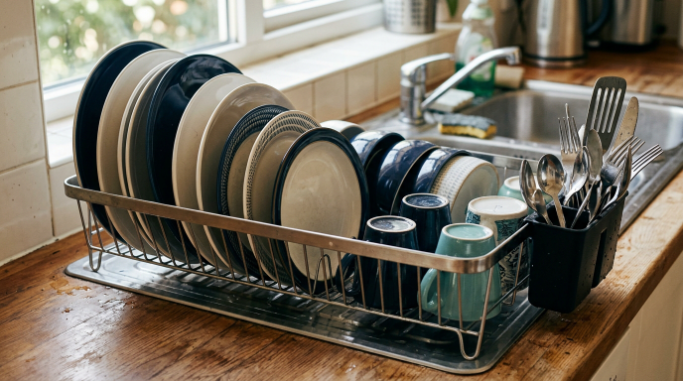
A standard 20″ x 15″ rack holds about 8 dinner plates, 4 bowls, 4 cups, and a handful of utensils. That’s a typical dinner load for a family of four.
But capacity varies wildly. Some racks have angled tines that hold plates closer together. Others have wide slots that force you to space plates out.
I tested four racks with the same set of dishes. The one with the most capacity (10 plates) was actually the narrowest (18″) because its tines were staggered. So width isn’t the only factor.
Here’s a rough guide based on my tests:
- Compact (14″): 4–6 plates, 2 bowls, 2 cups.
- Standard (20″): 8–10 plates, 4–6 bowls, 4 cups.
- Large (24″): 12–14 plates, 6–8 bowls, 6 cups.
If you have a large family or host often, skip the standard and go large. The extra width is worth the counter space trade-off.
What materials affect the size and fit?
Stainless steel racks are usually slimmer than plastic ones. Plastic walls are thicker, so a 20″ plastic rack might measure 20.5″ overall. Steel racks are exactly their listed size.
Coated wire racks (like the OXO) have rubber grips on the feet. Those add about 0.5″ of height. Not a big deal, but it matters if your clearance is tight.
I prefer stainless steel because it’s durable and doesn’t warp. Plastic racks can bend over time, especially if you overload them with heavy cast iron.
But plastic is lighter and easier to move. If you’re constantly relocating your rack, plastic might be better despite the slight size increase.
If you’re ready to pick one, here’s what I’d actually recommend based on my own trials and the dimensions we’ve covered. These three cover the most common kitchen scenarios.
🏆 BEST OVERALL
Simplehuman Large Steel Frame Rack
★★★★★
20″ x 16″ x 6″ — holds 10 plates, with a removable utensil holder. The non-slip feet and rust-proof stainless steel make this my go-to. I’ve had mine for three years and it still looks new.
💰 BEST BUDGET
OXO Good Grips Foldable Rack
★★★★☆
18.5″ x 13.5″ x 6″ — foldable arms save space, and the coated wire is gentle on dishes. It’s not as durable as steel, but at this price, it’s a steal for small kitchens.
🚛 BEST FOR LARGE FAMILIES
mDesign Large Plastic Drainer
★★★★☆
24″ x 17″ x 7″ — holds 14 plates and has a built-in wine glass holder. The plastic is thicker than most, so it’s sturdy. I use this when we host, and it’s a lifesaver.
Frequently Asked Questions About Dish Rack Sizes
What is the most common dish rack size?
The most common size is 20 inches wide, 15 inches deep, and 6 inches tall. This fits most standard 33-inch sinks and leaves enough counter space for other items. It’s the size you’ll find in most big-box stores.
Can a dish rack be too big for a sink?
Yes. If the rack is wider than the sink, it may hang over the edge and drip onto the counter. Always measure your sink width and subtract the faucet base before choosing a rack.
How do I measure for a dish rack?
Measure the counter space next to the sink (width and depth). Also measure the under-cabinet height. Then subtract the faucet base width. The remaining dimensions are your maximum rack size.
Are all dish racks the same height?
No. Heights range from 5 inches for compact racks to 8 inches for large ones. Some racks have adjustable legs or fold-down arms that change the height. Always check the height with the utensil holder attached.
Do dish racks come in different depths?
Yes. Depths range from 12 inches to 18 inches. Standard depth is 14–16 inches, but over-the-sink racks can be shallower. Deeper racks hold more dishes but require more counter space.
My final take: measure twice, buy once
I’ve replaced three dish racks because I didn’t measure properly. The first was too wide, the second too deep, and the third too tall for my under-cabinet.
Now I keep a tape measure in my kitchen drawer. I measure the sink, the counter, and the cabinet clearance before I even browse online.
Standard sizes are a good starting point, but your kitchen isn’t standard. Take 10 minutes to measure, and you’ll save yourself the hassle of returns and frustration.
And if you’re still unsure, go with a compact size. It’s easier to deal with a slightly smaller rack than one that doesn’t fit at all.