
Pull Cord Chopper Chopping Speed: How Many Pulls Do You Need?

Quick Answer
A pull-cord vegetable chopper can chop small portions quickly, but the required pulling speed and number of pulls depend on the food, blade design, and bowl capacity. Start with a few smooth pulls, inspect the texture, and continue gradually until you reach the desired cut.
How to Get Faster, More Consistent Chopping
- Prepare ingredients: Cut large vegetables into smaller, reasonably even pieces before loading the bowl.
- Control the load: Leave enough room for the ingredients to move around the blades.
- Pull smoothly: Use controlled strokes instead of jerking the cord or forcing the handle.
- Check the texture: Stop and inspect the food between short rounds of pulling.
- Match the food: Soft tomatoes, firm carrots, onions, and fibrous vegetables may chop at different rates.
- Protect the mechanism: Never exceed the manufacturer’s fill limit or force ingredients the chopper cannot handle.
A Useful Starting Point
- Begin with two or three controlled pulls for a small batch, then check the result. This is a practical starting point, not a guaranteed setting for every model.
If you use a pull-cord vegetable chopper, you probably want to know how quickly it can turn whole ingredients into evenly chopped pieces. The answer depends on more than how fast you pull the handle.
In this guide, I’ll explain what affects chopping speed, how to choose a suitable pulling rhythm, and why some ingredients need more time than others. I’ll also cover common speed problems, practical comparisons, and what to consider when choosing a chopper in 2026.
What Is Pull Cord Chopper Chopping Speed?
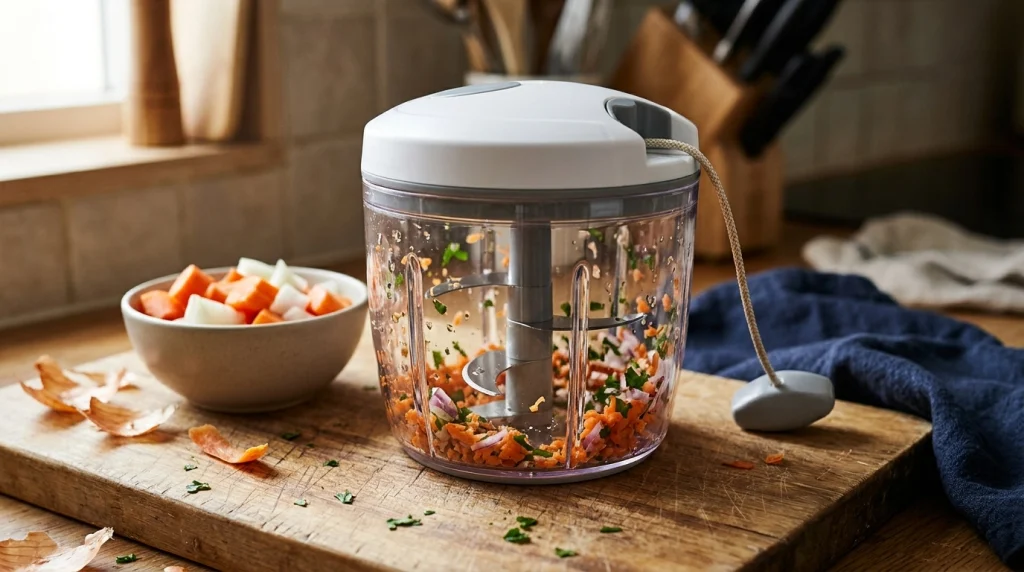
Pull-cord chopper chopping speed describes how quickly a manual chopper’s rotating blades reduce food into smaller pieces during repeated cord pulls. It depends on the mechanism, the ingredient, the amount of food, and the texture you want.
Unlike an electric food processor, a manual pull-cord chopper relies on your hand to power its internal mechanism. Pulling the handle drives the blades through a series of rotations, but the exact number of rotations per pull varies by model.
- Pulling speed: How quickly you draw the cord outward.
- Blade speed: How quickly the internal blades rotate.
- Chopping time: How long it takes to reach your preferred texture.
- Chopping consistency: How evenly the food pieces are reduced in size.
These are related but different measurements. Pulling faster does not automatically produce better chopping, especially when the bowl is crowded or the ingredients are uneven.
How Fast Should You Pull a Vegetable Chopper Cord?
Use smooth, controlled pulls and allow the cord to retract naturally between strokes. The best rhythm is one that rotates the blades effectively without straining the handle, cord, or internal spring.
There is no universal ideal pulling speed in pulls per second. Chopper designs differ, and manufacturers do not always publish comparable blade-speed measurements.
Why Controlled Pulls Work Better
A sharp jerk can place unnecessary stress on the pull-cord mechanism. Smooth strokes help you maintain control and make it easier to stop when the food reaches the desired size.
For a new chopper, begin slowly and observe how the handle responds. If the cord feels unusually stiff, jams, or fails to retract, stop and check the assembly rather than pulling harder.
- Hold the bowl steady on a dry, level surface.
- Keep the lid properly seated according to the manufacturer’s instructions.
- Pull the handle in its intended direction.
- Let the cord return without forcing it.
- Inspect the food after a short series of pulls.
Practical tip: Treat each round as a short chopping cycle rather than trying to finish everything with one long burst. This gives you better control over the final texture.
How Many Pulls Does It Take to Chop Vegetables?
The number of pulls depends on the vegetable, its starting size, the bowl load, the blade assembly, and whether you want coarse chopping or a fine mince. A number that works for onion in one model may not work for carrot in another.
Use the following guide as a starting framework, not a measured performance guarantee.
| Ingredient or Goal | Suggested Approach | What to Watch For |
|---|---|---|
| Onion, coarse pieces | Start with a few pulls and inspect | Large pieces may remain near the bowl wall |
| Onion, fine mince | Add short rounds of pulls | Too many pulls can make it wet or mushy |
| Garlic and herbs | Use short rounds and inspect frequently | Fine pieces can become a paste quickly |
| Tomato | Use gentle, limited chopping cycles | Soft flesh releases juice and breaks down easily |
| Carrot | Cut into small pieces first | Firm pieces can increase resistance |
| Mixed vegetables | Prepare similar-sized pieces and check between rounds | Different textures may chop unevenly |
For a small batch, two or three initial pulls can help you assess how a particular chopper performs. Continue in short increments until the texture is right, following the product’s instructions.
Don’t rely on a fixed pull count copied from another model. Even the same vegetable can produce different results depending on its ripeness, moisture, and size.
What Affects Pull Cord Chopper Chopping Speed?
Several factors determine how quickly the blades turn food into smaller pieces. Improving these conditions is usually more effective than simply pulling harder.
1. Vegetable Size and Shape
Large, irregular chunks can take longer to chop evenly than smaller, similar-sized pieces. Preparing ingredients before loading the bowl helps the blades process them more consistently.
For example, cut a large onion into quarters and divide a thick carrot into manageable pieces. Follow the product’s instructions for suitable piece sizes.
2. Bowl Capacity and Food Quantity
An overloaded bowl restricts the movement of ingredients and can increase resistance against the blades. Too little food may also move around without being chopped consistently, depending on the design.
Stay within the manufacturer’s capacity limit and process larger quantities in batches. Never force the lid closed over an overfilled bowl.
3. Blade Design and Condition
Blade shape, number, spacing, and sharpness influence how a chopper cuts different foods. A damaged or poorly seated blade assembly may also reduce performance.
Check the blade holder and assembly if the results suddenly change. Stop using the chopper if any blade, attachment, or central support appears damaged.
4. Ingredient Firmness and Moisture
Soft tomatoes and ripe vegetables may break down quickly, while firm carrots can require more effort. Moist ingredients can also turn mushy when chopped beyond the desired texture.
Fibrous vegetables may wrap around or resist the blades in some designs. Check your model’s permitted ingredients rather than assuming every vegetable is suitable.
5. Pull-Cord Mechanism
The internal gears, return spring, cord, and handle all affect how smoothly a manual chopper operates. A mechanism that binds or fails to retract properly can make chopping slower and less predictable.
Keep the lid clean and dry according to its care instructions. Do not open or dismantle a sealed mechanism unless the manufacturer provides a safe procedure.
How Can You Chop Vegetables Faster Without Damaging the Chopper?
The most reliable way to improve chopping speed is to reduce unnecessary resistance and check the result as you go. A few simple habits can save time without putting extra strain on the mechanism.
- Prepare first: Wash, peel, and cut large ingredients before loading the bowl.
- Use small batches: Leave room for food to circulate around the blades.
- Fit the blade correctly: Make sure the assembly sits securely in its intended position.
- Close the lid properly: Follow the model’s locking instructions before pulling.
- Pull steadily: Use controlled strokes and let the cord return naturally.
- Check early: Inspect the texture after a short round rather than overprocessing the food.
- Work in batches: Empty the bowl safely when necessary and repeat with the remaining ingredients.
My main practical recommendation is to judge progress by the food, not by the number of pulls. Once the pieces are the right size, additional pulling wastes effort and can damage the texture.
Why Is Your Pull Cord Chopper Chopping Slowly?
If chopping suddenly takes longer, look for a loading, assembly, or maintenance problem before changing your pulling rhythm. A slower result doesn’t necessarily mean the chopper needs replacing.
| Problem | Possible Cause | What to Do |
|---|---|---|
| Large pieces remain | Uneven pieces or insufficient chopping | Check the load and add a few controlled pulls |
| Cord feels stiff | Overloading, a jam, or mechanism trouble | Stop and inspect after the blades have stopped |
| Cord won’t retract | Return mechanism obstruction or damage | Don’t force it; consult the product instructions |
| Food becomes mushy | Too many pulls or a soft ingredient | Use shorter chopping cycles and stop sooner |
| Uneven results | Mixed piece sizes or uneven distribution | Prepare similar-sized pieces and avoid overfilling |
Before inspecting a jam, stop pulling and wait for the blades to stop completely. Remove the lid and blade assembly only as directed, keeping your fingers away from sharp edges.
If the cord frays, the handle cracks, or the mechanism makes unusual grinding noises, stop using the chopper. Don’t try to overcome a mechanical fault with greater force.
Pull Cord vs. Push-Down vs. Electric Chopper: Which Is Faster?
A pull-cord chopper is convenient for small batches, while a push-down model can be useful for repeatable cuts and an electric chopper can reduce manual effort. Which option feels fastest depends on the quantity, ingredient, and result you need.
| Feature | Pull-Cord | Push-Down | Electric |
|---|---|---|---|
| Power source | Hand-pulled cord | Manual pressure | Electric motor |
| Speed control | By pull count and rhythm | By pressure and repeated presses | By controls and pulsing |
| Manual effort | Repeated pulling | Repeated pressing | Usually lower during chopping |
| Best fit | Small everyday batches | Specified cuts and dicing tasks | Frequent or larger preparation jobs |
| Main trade-off | Requires repeated hand effort | Requires downward force | Needs power and motor care |
These are design-level comparisons, not controlled speed-test results. A well-matched manual chopper may be convenient for a small onion, but repeated large batches can make an electric model more practical.
If uniform cubes matter more than fine chopping, a push-down vegetable dicer may suit you better. If you prepare large quantities regularly, compare electric models by capacity, pulse control, cleaning requirements, and the manufacturer’s permitted ingredients.
How Do You Measure Chopping Speed at Home?
You can compare your own results without specialist equipment by timing a repeatable task. The important part is keeping the ingredient quantity, starting size, and desired texture consistent.
- Choose one ingredient: Use the same type and approximate quantity each time.
- Prepare evenly: Cut the ingredient into similar starting pieces.
- Start a timer: Begin when you make the first pull.
- Use a steady rhythm: Pull smoothly and stop to inspect the texture when needed.
- Record the result: Note the elapsed time, number of pulls, and final consistency.
- Repeat if needed: Use the same setup to see whether a different technique improves consistency.
For example, you could compare two small onion batches using the same chopper and starting piece size. Record which technique produces the texture you want with less effort, rather than assuming the fastest cord movement wins.
This is a personal kitchen comparison, not a laboratory test. Your results won’t establish a universal chopping-speed rating for other choppers or ingredients.
What Should You Look for in a Fast Pull-Cord Vegetable Chopper?
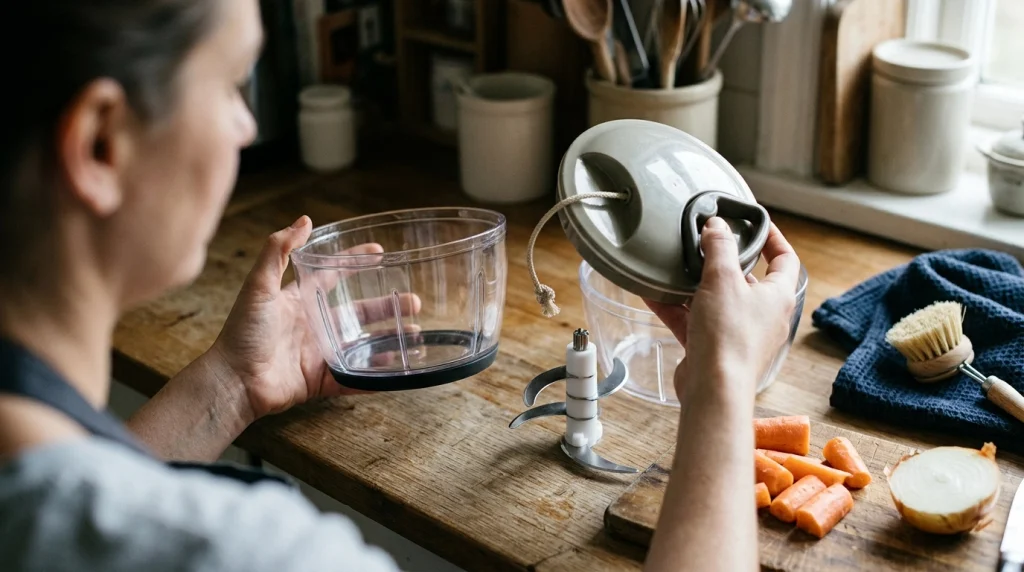
Choose a model that handles your usual ingredients smoothly and safely instead of buying one based on an unsupported speed claim. Practical design features often matter more than a promise of chopping in a fixed number of seconds.
- Blade assembly: Look for secure mounting and clearly described blade materials.
- Bowl capacity: Choose enough room for your typical batch without encouraging overfilling.
- Cord mechanism: Look for a well-fitting handle and clear care instructions.
- Stable base: A secure base helps keep the bowl steady during use.
- Cleaning: Check which parts can be washed and whether the lid must stay dry.
- Replacement parts: Find out whether the seller supports replacement blades or bowls.
- Ingredient guidance: Confirm whether the model supports the firm or fibrous vegetables you cook most often.
In 2026, product listings may use phrases such as “fast chopping” or “seconds to chop.” Treat these as marketing claims unless the seller explains the ingredient, batch size, target texture, and test method.
For practical buying advice, prioritize a suitable capacity, reliable cord return, secure lid, and manageable cleaning routine. Those details help you get consistent results over repeated use.
Safety Tips for Maintaining Chopping Speed
A chopper should operate smoothly without excessive force. Safe handling also helps protect its cord mechanism and blade assembly from avoidable damage.
- Never pull the cord if the lid is loose or incorrectly fitted.
- Keep hands away from the blades during loading, unloading, and cleaning.
- Do not put bones, frozen foods, or unusually hard ingredients into a model unless its instructions explicitly permit them.
- Never pull beyond the mechanism’s intended travel or force a stuck cord.
- Clean and dry food-contact parts according to the manufacturer’s guidance.
- Keep the lid’s pull mechanism out of water unless the instructions specifically state that it is safe to submerge.
After chopping, allow the blades to stop completely before opening the lid. Remove the blade assembly by its designated holder and use a suitable brush or cleaning tool to avoid touching the cutting edges.
If you notice fraying, cracking, a loose blade holder, or a cord that no longer retracts normally, stop using the device. Replacing a damaged chopper is safer than trying to make it work faster.
Product Recommendations: Which Chopper Suits Your Preparation Style?
If you’re choosing a replacement or buying your first chopper, start with the kind of preparation you do most often. The following established product lines are useful comparison starting points, but verify the current model, included accessories, capacity, and care instructions before ordering.
BEST FOR MANUAL CHOPPING
Brieftons QuickPull Manual Food Chopper
A pull-cord style worth comparing if you want hand-powered chopping without a motor. I’d check the current version’s capacity, cord design, and cleaning instructions before deciding whether it suits everyday vegetable preparation.
BEST FOR DICING
Mueller Vegetable Chopper
A push-down vegetable chopper is a different option when repeatable cuts and dicing are more important than cord-driven blade rotation. Check the current model’s included cutting grids and ingredient limitations.
BEST FOR MOTOR-POWERED PREP
Cuisinart Mini-Prep Food Processor
A compact electric food processor is worth comparing if you frequently prepare several batches or prefer not to pull a cord repeatedly. Verify the current model’s capacity, pulse controls, and removable-part cleaning instructions.
These are category-based recommendations rather than hands-on test winners; current prices, stock, specifications, and customer ratings have not been independently verified here. Choose the model that matches your batch size, desired cut, and tolerance for manual effort.
Frequently Asked Questions
1. How many times should I pull a vegetable chopper cord?
Start with two or three controlled pulls for a small batch, then inspect the texture. The exact number depends on the chopper design, vegetable type, starting piece size, and desired result, so continue in short increments rather than following a fixed count.
2. Does pulling the cord faster make vegetables chop faster?
Not always. A smooth, controlled pull helps the mechanism operate as intended, while aggressive jerking can strain the cord and internal parts. Ingredient size, bowl loading, and blade design also affect chopping speed, so focus on steady technique instead of maximum pulling force.
3. Why does my pull-cord chopper leave some vegetables in large pieces?
Uneven starting pieces, an overloaded bowl, or ingredients that do not circulate well can cause inconsistent results. Cut large vegetables into smaller pieces, stay within the recommended capacity, and inspect the mixture between short rounds of chopping.
4. Can I chop carrots quickly with a manual pull-cord chopper?
Some models can chop carrots when you cut them into manageable pieces first, but firm vegetables can create more resistance than soft ingredients. Follow the manufacturer’s ingredient guidance and stop if the cord becomes difficult to pull or the mechanism starts binding.
5. Is a pull-cord chopper faster than an electric chopper?
For a small batch, a pull-cord chopper can be convenient because it needs no electricity or motor setup. For frequent or larger batches, an electric model may reduce manual effort, although actual speed depends on capacity, blade design, food preparation, and the required texture.
Final Takeaway
Pull-cord vegetable choppers can make everyday food preparation quicker, but the best chopping speed comes from using the tool correctly rather than pulling as hard or as fast as possible. Prepare even pieces, avoid overfilling, use smooth strokes, and check the texture regularly.
For a reliable routine, start with a few pulls, inspect the ingredients, and add more only when needed. If the mechanism sticks or the cord stops retracting normally, stop and investigate instead of forcing it.
When shopping for a new vegetable chopper, compare the design, capacity, blade assembly, cord mechanism, and cleaning requirements. A suitable chopper should match your usual ingredients and make preparation easier without compromising safety.
Affiliate disclosure: This article contains affiliate links. If you buy through these links, RecipesPalette may earn a commission at no additional cost to you.