
Vegetable Chopper With Mandoline: Complete Buying and Use Guide

Quick Answer
A vegetable chopper with mandoline combines a push-down dicer with a slicing tool. It can dice onions and peppers, slice cucumbers and potatoes, and sometimes shred or julienne vegetables. For most home kitchens, I recommend a model with interchangeable stainless steel blades, a stable collection container, and a proper food guard. Before buying, check the manufacturer’s blade safety guidance.
What to look for
- Two cutting methods: Choose a model that genuinely dices and slices.
- Useful blade choices: Look for fine and medium dicing grids plus slicing inserts.
- Stable construction: A nonslip base helps keep the tool steady.
- Finger protection: A food holder keeps your hand away from the exposed slicer.
- Simple cleaning: Removable inserts and a cleaning brush make upkeep easier.
My short verdict: A combination tool makes the most sense for frequent meal prep. For occasional chopping, a good knife may be simpler.
A vegetable chopper with mandoline sounds like a perfect shortcut for busy cooking days. Instead of reaching for several tools, you get multiple cutting options in one compact system.
But not every model works equally well. I’ll explain which features matter, which vegetables suit each blade, and how to avoid common buying mistakes.
What Is a Vegetable Chopper With Mandoline?
A vegetable chopper with mandoline is a manual kitchen tool that combines a dicing mechanism with flat slicing blades. It usually uses interchangeable inserts and a container to collect prepared food.
The main benefit is flexibility. You can prepare ingredients for several recipes without switching between separate kitchen gadgets.
How the two cutting systems work
- Push-down chopper: A hinged lid pushes vegetables through a square cutting grid to make diced pieces.
- Mandoline slicer: A vegetable moves across a fixed blade to create slices of a set thickness.
- Julienne attachment: This cuts vegetables into narrow strips for slaws and garnishes.
- Grater attachment: Some sets shred cheese, carrots, or other suitable ingredients.
- Collection container: Cut ingredients fall into a tray instead of spreading across the counter.
The exact functions depend on the model. Some products called mandoline choppers include only a slicer and one dicing grid.
Why the blade system matters
The blade determines the final shape of your food. A chopping grid cannot replace a mandoline when you need thin cucumber rounds.
Likewise, a flat slicer does not produce neat onion cubes by itself. That requires another cutting step or a dedicated dicing attachment.
What Can You Cut With a Mandoline Vegetable Chopper?
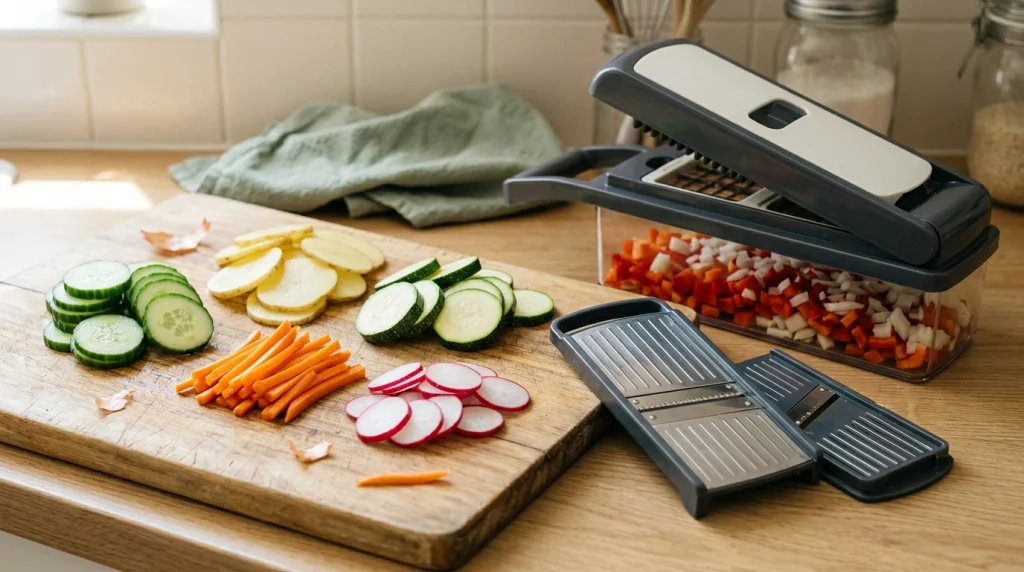
A combination chopper works best with firm, fresh vegetables that fit its cutting openings. The right attachment depends on the recipe and food texture.
I recommend choosing the blade based on the final dish rather than using every attachment in the box.
Best vegetables for dicing
- Onions: Use a fine or medium grid for soups, sauces, and salsa.
- Bell peppers: Remove seeds and ribs, then cut flat sections before dicing.
- Cucumbers: Firm cucumbers are useful for salad cubes and chopped toppings.
- Zucchini: Medium dicing grids create pieces for sautéed dishes.
- Potatoes: Some models handle peeled potato pieces, provided they fit and are not excessively hard.
- Mushrooms: Gentle pressure and a suitable blade may produce small pieces without excessive crushing.
Best vegetables for mandoline slicing
- Cucumbers: Thin rounds for salads and quick pickles.
- Potatoes: Even slices for gratins and baked dishes.
- Carrots: Thin rounds or strips when the model supports dense vegetables.
- Zucchini: Consistent slices for roasting and layering.
- Cabbage: Fine shredding for coleslaw, with a suitable wide attachment.
- Radishes: Thin slices for sandwiches and salad toppings.
Very soft tomatoes may crush on a dicing grid. Dense sweet potatoes and other hard roots can also overload some manual choppers.
Always check the approved food list for your exact model. A sharp blade alone doesn’t mean every vegetable is suitable.
Vegetable Chopper vs. Mandoline Slicer: What’s the Difference?
A vegetable chopper makes diced pieces, while a mandoline produces slices or strips. A combination model provides both functions when the necessary attachments are included.
Here is how the three tool types compare for everyday kitchen work.
| Feature | Vegetable Chopper | Mandoline Slicer | Combination Tool |
|---|---|---|---|
| Main cut | Diced cubes | Flat slices | Dices and slices |
| Typical operation | Press-down lid | Sliding food holder | Both methods |
| Best tasks | Salsa, soup vegetables | Gratins, salads | Mixed meal prep |
| Thickness options | Grid-dependent | Fixed or adjustable | Model-dependent |
| Storage | Body and grid | Often slim | Body and several inserts |
| Main limitation | Limited slicing | No built-in dicing on basic models | More parts to clean |
The main trade-off is convenience versus complexity. A combined system reduces the number of separate tools but often adds blade changes and cleaning.
How Do You Choose the Best Vegetable Chopper With Mandoline?
Start with the foods you prepare most often. A large attachment collection has little value if you only need onion cubes and cucumber slices.
As of 2026, combination sets range from basic models to large systems with several specialized inserts. Compare useful functions before counting accessories.
1. Choose practical blade attachments
Two dicing sizes and one reliable slicer can cover many everyday recipes. Julienne and grating attachments are helpful extras.
- Fine grid for onions and small vegetable pieces.
- Medium grid for peppers, potatoes, and zucchini.
- Slicing blade for cucumber and potato rounds.
- Julienne blade for narrow vegetable strips.
- Grater for carrots, cheese, or suitable ingredients.
2. Check blade materials
Stainless steel is a common choice for removable cutting inserts. Look for clean edges, secure mounting, and replacement availability.
A blade that bends or shifts can produce uneven pieces. It may also make operation less predictable.
3. Consider container capacity
A small container suits single meals and compact kitchens. Larger containers reduce how often you must empty prepared ingredients.
For batch prep, I would prioritize container stability over maximum advertised capacity. A broad, secure base makes handling easier.
4. Look for safe handling features
A mandoline needs more than a sharp blade. The food holder, nonslip feet, and secure blade mount are essential.
- A food guard that grips vegetables firmly.
- A stable base that resists sliding.
- Clearly secured interchangeable inserts.
- A storage case that covers unused blade edges.
- A cleaning tool for removing trapped vegetable pieces.
5. Think about cleanup
Small dicing grids trap onion skins, pepper pieces, and other food scraps. Choose inserts you can remove without touching sharp edges.
Dishwasher claims require careful reading. Some manufacturers permit only specific components on the top rack.
How Do You Use a Vegetable Chopper With Mandoline Safely?
Set the appliance on a dry, level surface and choose the correct blade. Prepare vegetables before placing them in the tool.
The most important rule is simple: keep hands away from cutting edges throughout use and cleaning.
Step-by-step instructions for dicing
- Wash the vegetables. Remove soil and damaged sections before cutting.
- Prepare smaller pieces. Trim food to fit within the manufacturer’s recommended opening size.
- Secure the dicing blade. Confirm the insert has locked into place.
- Position the vegetable. Keep it centered on the cutting grid.
- Close the lid steadily. Use controlled pressure rather than forcing the mechanism.
- Empty the container. Stop before chopped vegetables block the blade opening.
Forcing a stuck vegetable can damage the tool. Open the mechanism safely and remove the obstruction according to the instructions.
Step-by-step instructions for slicing
- Install the correct slicing insert and secure it.
- Set the slice thickness if the model offers adjustment.
- Place the vegetable securely in the food holder.
- Move the holder across the blade with smooth, controlled strokes.
- Stop when the vegetable becomes too small to hold safely.
- Remove the insert carefully before washing or storage.
Never hold the last small piece directly with your fingertips. Use the supplied guard and protective equipment as directed by the manufacturer.
For general kitchen hygiene, follow the four food safety steps before and after preparing fresh produce.
What Are the Most Common Mandoline Chopper Mistakes?
Most problems come from poor food preparation, unsuitable attachments, or excessive pressure. These issues are often avoidable.
Using vegetables that are too large
Oversized onions and potatoes may not pass evenly through a dicing grid. Trim them first to match the cutting opening.
Trying to cut very hard ingredients
Dense vegetables can place high force on plastic hinges and removable blade frames. Check the manual before processing hard roots.
Applying too much force
If a vegetable becomes stuck, pressure alone is not the solution. Stop and inspect the blade opening safely.
Ignoring the food guard
Unprotected fingers can slip toward the blade. The guard should remain in use even for small slicing jobs.
Leaving blades wet
Moisture trapped around metal edges or inside storage cases is best avoided. Dry approved components completely before storing them.
- For uneven slices: Check blade alignment and vegetable stability.
- For crushed tomatoes: Use a suitable sharp knife or an approved slicer attachment.
- For clogged grids: Remove residue with the supplied cleaning tool.
- For slipping: Inspect nonslip feet and dry the countertop.
Is a Vegetable Chopper With Mandoline Worth Buying?
Yes, if you frequently prepare several types of vegetables in one cooking session. A combination tool can simplify repetitive dicing and slicing.
However, owning more attachments doesn’t guarantee less kitchen work. Assembly and cleanup still take time.
Who benefits most?
- Meal-prep cooks: People preparing several meals in one session.
- Salad enthusiasts: Home cooks who regularly need sliced and diced vegetables.
- Families: Households preparing larger batches of ingredients.
- Small-kitchen owners: People who want fewer separate cutting tools, provided the attachments store neatly.
- Beginner cooks: Users seeking repeatable cuts while following safe handling instructions.
When should you skip one?
If you chop only one onion occasionally, a knife and cutting board may be easier. They require fewer parts to wash and store.
Likewise, a dedicated mandoline may suit someone who slices vegetables far more often than they dice them.
How Do You Clean and Store a Mandoline Vegetable Chopper?
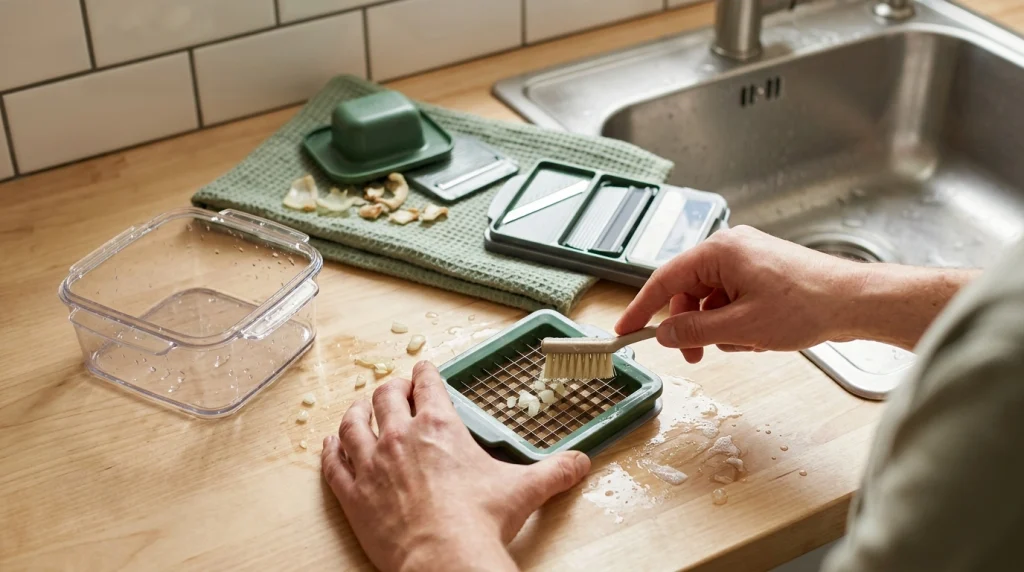
Clean the tool promptly after food preparation. Vegetable residue becomes harder to remove when it dries inside narrow cutting grids.
Handle every removable insert as a sharp object, even when the blade is covered with food.
Cleaning steps
- Remove the tool from the work area after use.
- Disassemble the blade attachments according to the manual.
- Rinse away loose vegetable pieces carefully.
- Use the supplied brush to clean the cutting grid from a safe direction.
- Wash with mild detergent and water, following product instructions.
- Rinse and dry all components before storage.
Avoid running bare fingers along blade edges. Don’t leave exposed sharp inserts loose in a sink full of dishes.
Can you put the blades in a dishwasher?
It depends on the manufacturer and component. Some products allow dishwasher cleaning, while others recommend handwashing individual blades.
Check the product manual rather than relying on a general dishwasher-safe label. Hinges, plastic parts, and cutting inserts may have different care requirements.
How should you store the attachments?
Keep spare blades inside their designated organizer. Cover cutting edges and keep the set away from children.
I favor organized storage over loose attachments in a kitchen drawer. It reduces the chance of accidentally touching an uncovered blade.
The FDA food resources offer broader guidance on food preparation and hygiene.
Best Vegetable Choppers With Mandoline to Consider
These three real product lines cover different kitchen needs. I’ve selected them from available product specifications, rather than claiming hands-on testing.
Confirm the exact attachment list before ordering. Blade bundles and accessories may differ between versions.
🏆 Best Versatile Option
Fullstar All-in-1 Mandoline Slicer and Vegetable Chopper
★★★★☆ Editorial suitability: 4.5/5
Fullstar combination systems offer dicing and mandoline functions, with attachments varying by version. This is my first shortlist choice for mixed preparation jobs because the product family includes cutting accessories, collection containers, and food protection tools.
🥕 Best for Regular Dicing
Mueller 8-Blade Original Vegetable Chopper Pro
★★★★☆ Editorial suitability: 4.4/5
Mueller lists two dicing blades and six additional attachments for slicing, grating, and shredding. I would shortlist this model for cooks who prepare chopped vegetables frequently and want several cutting options.
💰 Best Budget Shortlist
PrepNaturals 8-in-1 Vegetable Chopper and Mandoline
★★★★☆ Editorial suitability: 4.0/5
The PrepNaturals combination system uses a hinged chopping body, catch tray, and stainless steel cutting inserts. It’s worth comparing for smaller budgets, but verify the exact blade bundle and current availability before buying.
Frequently Asked Questions
Can a vegetable chopper with mandoline replace a knife?
It can handle many routine slicing and dicing tasks, but it doesn’t fully replace a knife. You still need to trim vegetables, remove unwanted parts, and cut oversized ingredients before loading them. A good knife is also more flexible for irregular shapes and delicate cuts.
Can you slice potatoes with a mandoline vegetable chopper?
Yes, many mandoline attachments can slice potatoes into even rounds. Choose a model rated for potatoes, use the food holder, and follow its thickness instructions. Very hard potatoes or oversized pieces may require additional preparation before slicing.
Is a mandoline vegetable chopper safe for beginners?
Beginners can use one safely when they understand the instructions and use the supplied guards. However, exposed mandoline blades create a serious cut risk. Never hold small food pieces with bare fingertips, and keep children away from sharp attachments.
Can you put a mandoline vegetable chopper in the dishwasher?
Some models have dishwasher-safe components, but care instructions vary. Check whether the manufacturer approves the container, lid, and cutting inserts separately. Handwashing sharp blades with a suitable cleaning brush may be the recommended method for certain products.
Which is better, a vegetable chopper or a mandoline slicer?
Choose a vegetable chopper if you mainly need diced onions, peppers, and other vegetables. Choose a mandoline if thin, even slices matter most. A combination tool is useful when both tasks appear regularly in your cooking routine.
Final Thoughts: Which Vegetable Chopper With Mandoline Should You Buy?
A good vegetable chopper with mandoline should make ordinary food preparation easier without creating unnecessary cleaning or safety problems. Useful blades, a secure food guard, and a stable collection container matter more than accessory count.
My preferred starting point is a combination model from Fullstar or Mueller, depending on the exact cutting functions you need. Compare the attachment lists carefully before making your choice.
Start with the vegetables you cook most often. Choose the tool that handles those jobs safely, comfortably, and consistently.
For broader food-handling advice, see USDA resources and the CDC food safety guidance.
