
Pull Cord Chopper for Garlic: How It Works and What to Look For

Quick Answer
A pull cord chopper for garlic is a manual kitchen tool that rotates sharp blades inside a bowl when you pull its handle. It can mince peeled garlic cloves, chop onions, and prepare herbs without electricity. For the best results, choose a model with a stable base, a secure lid, removable blades, and a capacity suited to your usual cooking.
See an example of a pull cord chopper.
What matters most when choosing one?
- Blade design: Stainless steel blades can chop garlic into small pieces when they are sharp and properly positioned.
- Bowl capacity: A compact bowl suits a few cloves, while a larger bowl handles garlic and other ingredients together.
- Pull mechanism: Look for a handle and cord that retract smoothly without sticking.
- Chopping control: A few pulls produce a coarser cut; additional pulls usually create finer pieces.
- Easy cleaning: Removable blades and an accessible bowl make food residue easier to remove.
- Safety: The lid should fit securely, and the blade assembly should be easy to handle without touching its sharp edges.
A simple tip for finer garlic
- Peel the cloves, cut unusually large cloves into smaller pieces, and pull the cord a few times before checking the texture. Stop when the garlic reaches the size your recipe needs.
Garlic adds a lot of flavor to everyday cooking, but preparing it can be a fiddly job. A pull cord chopper offers a straightforward alternative to repeatedly chopping cloves with a knife.
When choosing a vegetable chopper, I would look beyond the advertised speed and consider how well it handles small ingredients, how much control it gives you, and how easily you can clean it afterward. This guide covers those details, along with practical buying considerations and a few product options to investigate.
What Is a Pull Cord Chopper for Garlic?
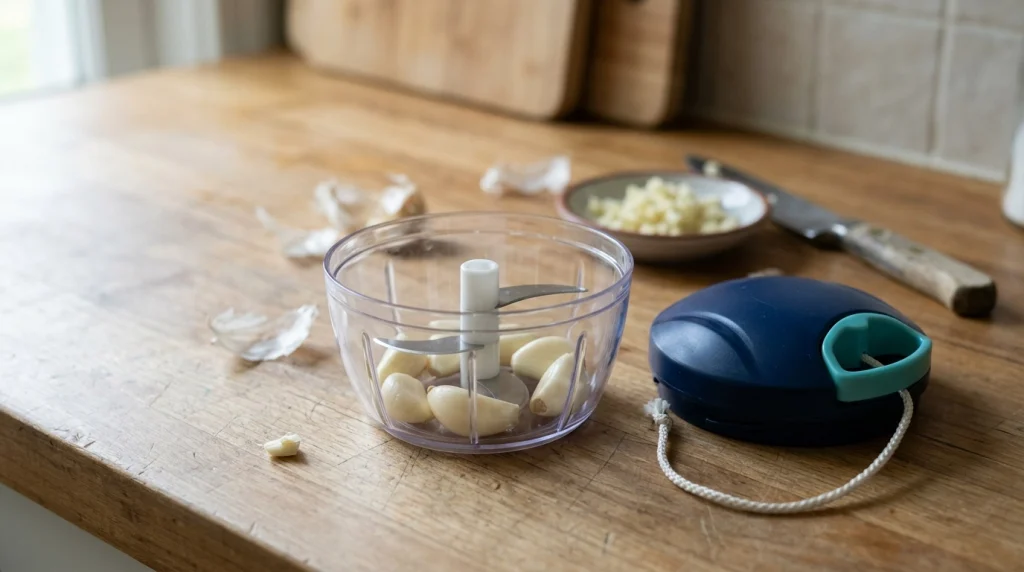
A pull cord chopper for garlic is a hand-operated food preparation tool that uses a retractable cord to spin blades inside a covered container. Each pull turns the blades, breaking garlic cloves into smaller pieces without requiring a powered motor.
Most models have four main parts:
- Chopping bowl: Holds garlic and other ingredients during preparation.
- Blade assembly: Uses sharp rotating blades to cut food into smaller pieces.
- Lid and drive mechanism: Keeps the contents enclosed while transferring the pulling motion to the blades.
- Pull handle and cord: Let you control how many times the blades rotate.
The design is simple, but the results depend on blade placement, ingredient size, bowl loading, and the number of pulls. A compact model can be especially useful when you need only a little minced garlic for a single meal.
How Does a Pull Cord Garlic Chopper Work?
The cord connects to a mechanism inside the lid. When you pull the handle, that mechanism rotates the blade assembly, and the blades cut the ingredients inside the bowl.
After you release the handle, the cord retracts on many models. You can repeat the motion until the ingredients reach your preferred texture.
How to use one for garlic
- Prepare the cloves. Remove the papery skins and discard any damaged portions.
- Load the bowl. Add the cloves without exceeding the manufacturer’s fill limit.
- Secure the lid. Check that the lid and blade assembly sit correctly before pulling the cord.
- Pull the handle. Use controlled pulls while keeping the bowl steady on a flat surface.
- Check the texture. Stop and inspect the garlic when the cord has come to a complete stop.
- Remove the garlic safely. Open the lid and transfer the chopped ingredients with a spoon or spatula, keeping your fingers away from the blades.
There is no universal number of pulls for perfect minced garlic. Different blade systems and clove sizes produce different results, so start with a few pulls and adjust gradually.
Can a Pull Cord Chopper Mince Garlic Finely?
Yes, many pull cord choppers can mince garlic finely enough for sauces, marinades, stir-fries, and everyday cooking. The final texture depends on the chopper’s blade arrangement, the quantity of garlic, and how long you process it.
However, finely chopped garlic and garlic paste are not the same thing. If you keep pulling after the garlic has reached the desired size, you may end up with a wetter, uneven mixture instead of distinct minced pieces.
Choose the right texture for your recipe
| Texture | How to achieve it | Suitable uses |
|---|---|---|
| Coarse chop | Start with a few pulls and check frequently. | Roasted vegetables, chunky sauces, and some marinades. |
| Fine mince | Add controlled pulls until the pieces are small and reasonably even. | Stir-fries, dressings, curries, and garlic butter. |
| Very fine, moist garlic | Process a little longer, checking after each short series of pulls. | Some marinades, dips, and blended sauces. |
| Smooth garlic paste | Use a tool specifically suited to paste-making if a smooth result is essential. | Recipes requiring a uniform garlic paste. |
For a recipe that calls for finely minced garlic, I would prioritize texture control over the number of blades. Being able to stop at the right moment is more useful than processing everything into a paste.
What Should You Look for When Buying a Garlic Chopper?
The best pull cord chopper is one that fits your cooking habits, not necessarily the one with the largest bowl or the most blades. A few practical details make a bigger difference than flashy packaging.
1. Blade material and arrangement
Look for clearly specified stainless steel blades and a sturdy central attachment. Multiple cutting levels can help distribute ingredients through the bowl, although blade count alone does not guarantee evenly minced garlic.
Check whether the blades can be removed for cleaning and whether the assembly feels secure. Avoid a model with loose, bent, or visibly damaged cutting parts.
2. Bowl capacity and shape
A small bowl works well for a few cloves and small seasoning preparations. A larger bowl makes more sense if you regularly chop garlic alongside onions, peppers, herbs, or other vegetables.
Consider how the bowl handles small quantities, too. A very large container may be inconvenient when you’re preparing only one or two cloves, depending on the blade design.
3. Cord quality and handle comfort
The cord should pull smoothly, and the handle should be comfortable to grip. A mechanism that catches, frays, or fails to retract can make a simple task frustrating.
Product listings rarely establish long-term durability on their own. Look for clear warranty information, replacement-part availability, and consistent details about the mechanism.
4. Stability and lid security
A nonslip base can help prevent the bowl from moving while you pull the cord. A lid that fits securely also helps keep ingredients contained during chopping.
Do not operate the chopper if the lid does not fit correctly or the blade assembly seems loose. Never hold the lid down as a substitute for a damaged locking or fitting mechanism.
5. Cleaning and storage
Garlic residue can cling to blades and the central spindle. A bowl with accessible corners and removable cutting parts is often easier to clean than a design with inaccessible food traps.
Check the manufacturer’s cleaning instructions before buying. Some models allow the bowl and blades to go in the dishwasher but require hand-cleaning for the pull-cord lid.
Pull Cord Chopper vs. Garlic Press vs. Electric Chopper
These tools all reduce the effort involved in preparing garlic, but they suit different jobs. The right choice depends on the amount of garlic you use and the texture you want.
| Feature | Pull cord chopper | Garlic press | Electric chopper |
|---|---|---|---|
| Power source | Manual cord | Manual pressure | Electricity or battery |
| Typical texture | Coarse to fine chopped pieces | Crushed or pressed garlic | Chopped to finely processed |
| Best use | Small batches of garlic and vegetables | A few cloves at a time | Larger or repeated batches |
| Main limitation | Requires repeated pulls and texture checks | Limited capacity and a pressed texture | Requires power and more equipment space |
| Cleaning concern | Rotating blades and the lid mechanism | Garlic trapped in small openings | Blade assembly and motor housing |
For everyday home cooking, a pull cord chopper is a sensible middle ground when you want one tool for garlic and several other ingredients. A garlic press may be simpler for a single clove, while an electric model is worth considering for frequent, larger batches.
Can You Use a Pull Cord Vegetable Chopper for Other Ingredients?
Many models can handle more than garlic, making them useful for everyday meal preparation. However, the manufacturer’s approved uses and capacity limits should guide what you put inside.
Common suitable ingredients include:
- Onions and shallots: Cut them into manageable chunks before chopping.
- Fresh herbs: Use short processing intervals to avoid turning delicate leaves into a wet mass.
- Chilies: Chop small quantities while avoiding direct contact with the cut surfaces.
- Ginger: Remove tough portions and cut the root into small pieces first.
- Soft vegetables: Follow the model’s instructions for ingredients such as tomatoes or peppers.
Do not assume that a general-purpose vegetable chopper can handle every food. Hard ingredients, frozen food, bones, or meat may be unsuitable unless the manufacturer explicitly approves those uses.
How Do You Clean a Pull Cord Garlic Chopper Safely?
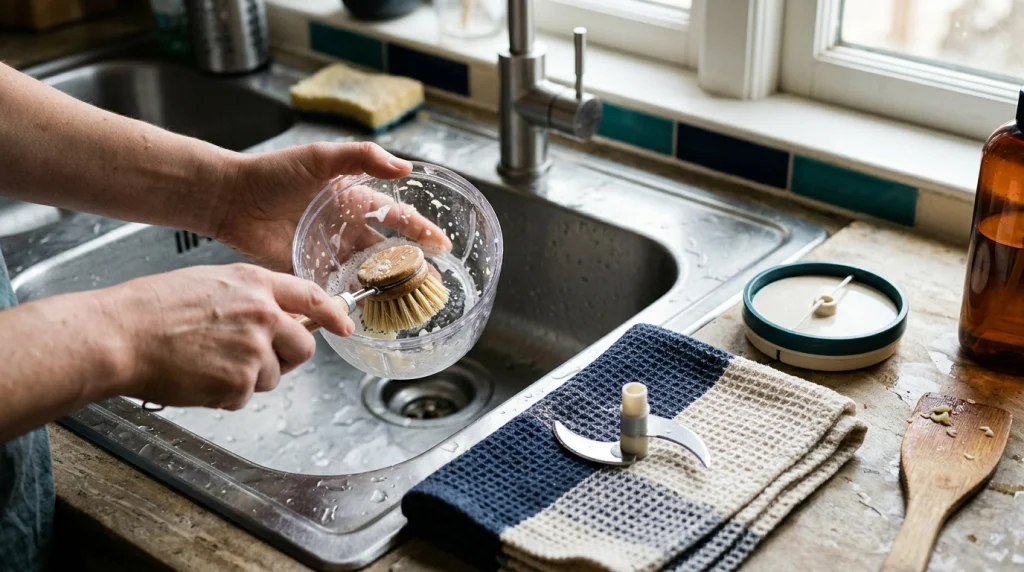
Cleaning immediately after use helps stop garlic residue from drying onto the blades and bowl. The most important rule is to keep your hands away from the cutting edges.
- Disassemble carefully. Remove the lid and blade assembly according to the manufacturer’s instructions.
- Clear the bowl. Use a spatula to remove leftover garlic rather than reaching between the blades.
- Wash approved parts. Use warm water, mild dish soap, and a suitable brush where permitted.
- Clean the lid correctly. Wipe or wash it only as directed, keeping water away from an unsealed cord mechanism.
- Rinse and dry. Let the cleaned parts dry thoroughly before reassembly or storage.
Dishwasher compatibility varies by model and part. Never assume the entire chopper is dishwasher-safe simply because its bowl is made from plastic.
For general food-handling guidance, consult the U.S. Food and Drug Administration’s food resources and the USDA’s food safety guidance. Follow the specific care instructions supplied with your chopper for blade handling and maintenance.
Why Is My Pull Cord Chopper Not Mincing Garlic Properly?
Uneven garlic usually points to a loading, preparation, or blade issue rather than a need to pull the cord as hard as possible. Check the basics before trying again.
- The garlic remains in large pieces: Check that the cloves are small enough for the bowl and blade arrangement, then try a few additional pulls.
- The garlic becomes mushy: Stop earlier and inspect the texture more often.
- The blades appear to miss some pieces: Avoid overfilling the bowl and check whether the blade assembly is installed correctly.
- The cord feels difficult to pull: Stop and check for overloading, oversized ingredients, or a mechanism problem.
- The cord does not retract: Follow the manufacturer’s troubleshooting instructions instead of forcing it.
If the mechanism is damaged or the blades are bent, stop using the chopper. Replacing a faulty unit is safer than attempting to operate it with an unreliable lid or cord.
Product Recommendations: Which Pull Cord Chopper Is Worth Considering?
If you’re ready to choose one, I would start with established models that publish useful product details and care instructions. The following options illustrate different priorities; they are not based on personal hands-on testing, and the ratings below are editorial assessments rather than verified customer ratings.
🏆 Best for Everyday Versatility
Starfrit Pull Chopper
★★★★☆
This manual model uses a three-blade cutting system and a self-retracting cord. I would consider it for cooks who want one tool for garlic, herbs, vegetables, and other manufacturer-approved ingredients.
💡 Best for a Compact Kitchen
Kuhn Rikon Pull Chop, 500 ml
★★★★☆
The 500 ml version offers a compact format for smaller preparation tasks. I would compare its capacity and cleaning instructions with your typical garlic portions before choosing it over a larger model.
🥗 Best for Larger Batches
Kuhn Rikon Pull Chop, 650 ml
★★★★☆
The 650 ml version provides more bowl capacity than the 500 ml model. I would shortlist it for preparing garlic alongside onions or herbs, while checking the manufacturer’s fill guidance and current availability.
Before ordering, compare the exact model name, bowl capacity, included components, return policy, and current price. Product availability and specifications can change, so confirm the details on the retailer’s listing rather than relying on a product name alone.
Frequently Asked Questions
Is a pull cord chopper good for garlic?
Yes, a pull cord chopper can prepare garlic for curries, sauces, marinades, and stir-fries without electricity. Choose a model with sharp, securely fitted blades and a bowl suited to small ingredients, and check the texture regularly to avoid overprocessing.
How many times should I pull the cord to mince garlic?
There is no fixed number that works for every model or garlic clove. Start with a few pulls, inspect the pieces, and continue in short intervals until they reach the desired size. Smaller cloves and different blade arrangements may produce different results.
Can I chop garlic without peeling it first?
Peeling garlic first is the better approach for most pull cord choppers. The papery skin can interfere with the texture and leave unwanted pieces in the bowl. Remove the skin before chopping unless the product instructions specifically recommend another method.
Can I put the pull cord chopper in the dishwasher?
That depends on the model and its individual parts. Some bowls and blade assemblies are dishwasher-safe, while pull-cord lids may require hand-cleaning. Check the manufacturer’s care instructions and keep water away from any mechanism that is not designed to be immersed.
Is a pull cord chopper better than a garlic press?
Neither tool is better for every kitchen. A pull cord chopper can handle garlic and other small ingredients, while a garlic press is convenient for processing a few cloves into a crushed texture. Choose according to the amount you prepare and the consistency your recipes require.
Final Takeaway: Choose a Chopper That Fits Your Cooking
A pull cord chopper for garlic is a practical option if you want to mince small quantities of garlic without using an electric appliance. It can also help with suitable vegetables and herbs, making it more versatile than a single-purpose garlic tool.
My main buying priorities would be a reliable pull mechanism, a secure lid, well-positioned stainless steel blades, manageable bowl capacity, and straightforward cleaning. These details matter more than a high blade count or a broad list of advertised uses.
Start with the ingredients you prepare most often, compare the model’s instructions, and choose a chopper that suits your usual portions. With controlled pulls and careful cleaning, a good manual model can become a useful part of everyday meal preparation.