
Vegetable Chopper vs Chopping by Hand: Which Is Better?
Quick Answer
A vegetable chopper is usually better for quickly preparing larger amounts of onions, peppers, potatoes, and similar produce in consistent pieces. Chopping by hand is better when you need precise sizes, unusual shapes, fewer ingredients, or maximum control. The best choice depends on your workload, and the benefits of using a vegetable chopper become most noticeable during repetitive meal prep.
Main differences
- Speed: A chopper can handle repetitive dicing faster once the ingredients are prepared.
- Precision: A knife gives you more freedom to control thickness, shape, and final size.
- Consistency: Fixed chopper grids naturally produce more uniform pieces.
- Cleanup: A knife and board are usually simpler to wash after a small job.
- Batch prep: Choppers become more useful as the amount of repetitive cutting increases.
My simple rule
- For one tomato or half an onion, I would use a knife. For several vegetables that all need similar cuts, I would reach for a chopper.
A vegetable chopper and a chef’s knife can both turn whole produce into dinner-ready pieces, but they solve different problems. One focuses on repetition and consistency, while the other gives you almost complete control over every cut.
I don’t see this as a contest where one tool replaces the other. The useful question is which method makes more sense for the amount of food, the cut you need, and the cleanup you’re willing to do.
What Is the Difference Between a Vegetable Chopper and Chopping by Hand?
A vegetable chopper uses fixed or rotating blades to cut produce through pressure, pulling, pushing, or electric power. Chopping by hand uses a knife and cutting board, with the cook controlling every movement and cut size.
Definition: A vegetable chopper is a manual or powered kitchen tool designed to chop, dice, mince, slice, grate, or otherwise reduce food into smaller pieces, depending on its blade system.
A fixed-grid manual chopper is especially good at producing repeated cubes. A knife can make cubes too, but it can also create slices, wedges, strips, rough chops, fine dice, and many custom shapes without changing attachments.
If you’re still learning what different models can handle, my guide to what a vegetable chopper can do explains the main chopper styles and their common uses.
Vegetable Chopper vs Chopping by Hand: Side-by-Side Comparison
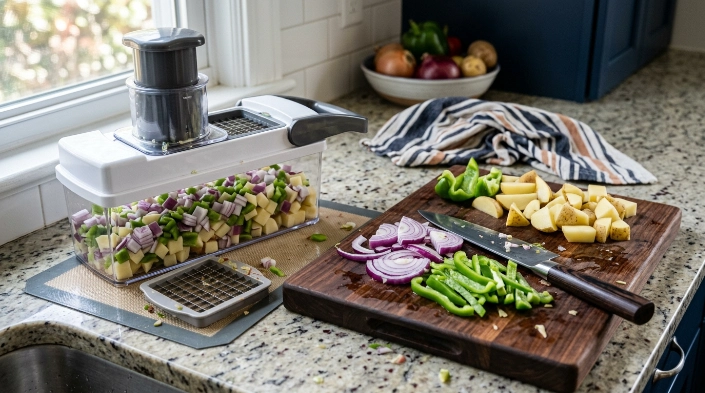
The biggest difference is efficiency versus flexibility. A chopper simplifies repeated cuts, while a knife adapts almost instantly to whatever is on your board.
| Factor | Vegetable Chopper | Chopping by Hand |
|---|---|---|
| Best use | Repeated dicing and batch prep | Small jobs and varied cuts |
| Cut consistency | High with fixed-grid inserts | Depends on knife skill |
| Cut flexibility | Limited by installed blades | Very flexible |
| Typical cleanup | Blade/grid, lid, container | Knife and cutting board |
| Learning curve | Usually short | Technique improves with practice |
| Electricity required | No for manual models; yes for electric models | No |
| Storage | Needs room for body and attachments | Knife storage only |
Is a Vegetable Chopper Faster Than Chopping by Hand?
For repetitive dicing, a vegetable chopper can be faster because one downward press may replace several individual knife cuts. The advantage grows when several ingredients need the same general shape.
Speed is not just cutting speed, though. You also need to consider setup, pre-cutting, changing inserts, emptying the container, and washing the tool afterward.
- One small ingredient: A knife is often quicker from start to finish.
- Several onions or peppers: A grid chopper becomes more efficient.
- Meal-prep batches: Repeated identical cuts favor the chopper.
- Mixed cut styles: A knife avoids stopping to swap attachments.
- Fine adjustment: Hand chopping lets you change size immediately.
My practical rule is to count repetitions rather than ingredients. If I’m about to make the same cut dozens of times, the chopper starts earning its counter space.
Which Method Gives More Consistent Pieces?
A fixed-grid vegetable chopper usually produces more uniform dice because each piece must pass through openings of the same size. Hand chopping can become equally consistent, but that depends more heavily on knife technique.
Uniform pieces aren’t only cosmetic. Similar-size vegetables tend to reach a similar level of doneness at roughly the same time.
- Chili and soup: Consistent onion, carrot, and pepper pieces cook predictably.
- Breakfast potatoes: Similar cubes reduce the mix of burnt edges and undercooked centers.
- Chopped salads: Uniform pieces distribute ingredients more evenly.
- Salsa: Controlled dice gives the finished mixture a more consistent texture.
This is one reason choppers work well for dishes built around several diced vegetables. You can see more examples in my guide to meals you can make with a vegetable chopper.
When Is Chopping by Hand Better?
Hand chopping is better when precision, flexibility, or speed on a tiny task matters more than repetitive efficiency. A good knife moves from one cut style to another without attachments or assembly.
This flexibility becomes especially useful with foods that vary greatly in size, softness, or shape.
- Custom sizes: You can make anything from a rough chop to a tiny dice.
- Wedges and angled cuts: A knife isn’t restricted by a grid pattern.
- Soft produce: You can reduce pressure when cutting ripe tomatoes or delicate fruit.
- Herbs: A knife gives direct control over how finely fresh herbs are chopped.
- Single ingredients: There is no chopper to assemble and dismantle.
- Mixed prep: You can move from slicing carrots to chopping onions without changing inserts.
I also prefer a knife when I want intentionally uneven pieces. A rustic tomato sauce or chunky vegetable soup doesn’t always need machine-like uniformity.
Does a Vegetable Chopper Reduce Knife Skills?
Using a vegetable chopper doesn’t make knife skills unnecessary. A chopper is a shortcut for certain repetitive jobs, while basic knife handling remains useful for trimming, peeling, quartering, and preparing ingredients before they enter the chopper.
Dense or oversized vegetables often need to be cut into smaller sections first. That means many chopper meals still begin with a knife.
Which Is Easier to Clean?
For small jobs, chopping by hand usually wins on cleanup because you only need to wash the knife and cutting board. A vegetable chopper may have a container, lid, grid, pusher, and interchangeable inserts.
That doesn’t automatically make choppers inconvenient. Many current models use dishwasher-safe components, but sharp grids still need careful handling.
- Knife: Fast cleanup after one or two ingredients.
- Grid chopper: More parts, with food sometimes trapped around the cutting grid.
- Rotating chopper: Bowl, blade, and lid usually need cleaning.
- Electric chopper: Bowl and removable parts may be washable, while the motor base stays dry.
Cleanup matters enough that it should affect your buying decision. My full look at whether vegetable choppers are worth it covers this trade-off in more detail.
Is a Vegetable Chopper Safer Than Using a Knife?
Neither method is automatically safe. Both involve sharp blades, so the safest method is the one you use correctly and clean carefully.
Choppers can keep your hands farther from the cutting edge during normal operation. However, exposed grid inserts can be extremely sharp during assembly, cleaning, and storage.
- Keep fingers away from blades: Use supplied pushers, guards, or cleaning tools.
- Don’t force food: Cut dense vegetables smaller if the mechanism needs excessive pressure.
- Stabilize the tool: Place manual choppers on a flat, dry work surface.
- Clean carefully: Don’t push fingertips into a sharp grid to remove trapped food.
Food hygiene matters too. The FDA’s produce safety guidance recommends washing produce under running water and keeping it separate from utensils used for raw meat, poultry, and seafood.
The USDA’s cutting-board guidance also recommends cleaning boards after use and separating fresh-produce preparation from raw animal foods when possible.
- Clean: Wash food-contact surfaces and utensils after use.
- Separate: Avoid cross-contamination between raw animal foods and ready-to-eat produce.
- Inspect: Replace badly worn cutting boards and damaged chopper components.
- Store safely: Keep exposed blades where fingers cannot accidentally contact them.
The CDC food-safety section summarizes the same basic pattern: keep hands and surfaces clean, separate risky foods, cook properly, and refrigerate promptly.
Which Is Cheaper Over Time?
A knife can be the simpler long-term purchase because one versatile chef’s knife handles many jobs. A vegetable chopper adds another tool, and multifunction models may include several components that need storage.
Cost still depends on what you already own. If faster prep helps you cook more often, a chopper can provide practical value even though it isn’t necessary equipment.
- Choose a knife first: If you’re building a basic kitchen from scratch.
- Add a chopper: If repetitive vegetable prep is a regular frustration.
- Skip extra attachments: If you only need simple dicing.
- Choose multifunction: If you’ll genuinely use slicing, julienne, grating, or spiralizing inserts.
As of 2026, I would still choose based on tasks rather than attachment count. The best tool is the one that solves the preparation job you repeat every week.
Who Should Choose a Vegetable Chopper?
A vegetable chopper makes the most sense for cooks who regularly prepare several vegetables in similar sizes. Families, batch cooks, and meal-prep routines tend to create exactly that kind of repetitive work.
- People who frequently dice onions, peppers, potatoes, celery, or cucumbers
- Meal preppers making several portions at once
- Families cooking large soups, curries, salads, or casseroles
- Cooks who value highly consistent pieces
- Anyone who dislikes repetitive knife work
If those points sound familiar, my guide on why people use vegetable choppers goes deeper into the everyday advantages.
Who Should Keep Chopping by Hand?
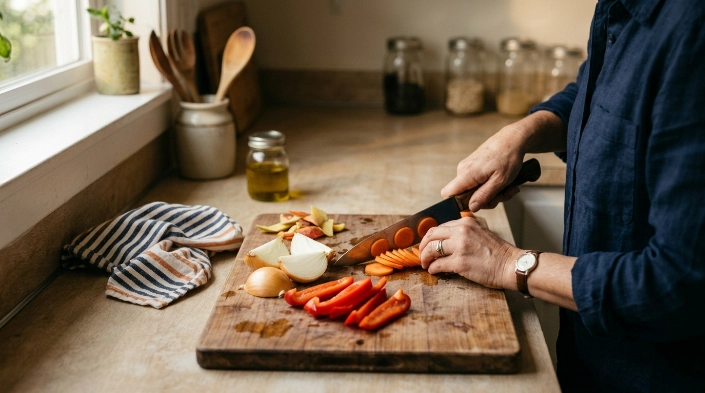
Hand chopping remains a strong choice for cooks who usually prepare small amounts or enjoy controlling each cut. It’s also the more adaptable option for recipes that move between several cutting styles.
- People who normally prepare one or two vegetables at a time
- Cooks comfortable with basic knife skills
- Small kitchens with limited storage
- Recipes needing wedges, angled slices, thin cuts, or irregular shapes
- Anyone who values minimal cleanup
You don’t need to choose one method permanently. I use the workload as the deciding factor: small and varied means knife, while repetitive and uniform means chopper.
Vegetable Chopper vs Chopping by Hand: My Practical Verdict
A vegetable chopper is the more convenient tool for repetitive batch preparation, especially when you want consistent dice. Chopping by hand remains more flexible, easier to clean after small tasks, and better for precise or unusual cuts.
The two tools work best together rather than as replacements for one another.
- Choose the chopper: Several vegetables, repeated cuts, uniform pieces.
- Choose the knife: Small jobs, custom shapes, soft foods, precise control.
- Use both: Pre-cut large produce with a knife, then finish repetitive dicing with the chopper.
If you’re still deciding whether another kitchen tool deserves space in your cabinet, focus on how often you repeat the same chopping motion. Frequency tells you more than a long list of accessories.
If you’re ready to pick one, here are three current styles I would consider:
🏆 Best for Batch Dicing
Fullstar Pro Original Vegetable Chopper
★★★★½ 4.5/5 editorial fit
The Pro Original line uses interchangeable 420J stainless-steel inserts, a catch container, grip handle, and anti-slip base. I would choose this style when onions, peppers, potatoes, and other repeated dice make up most of the job.
🥗 Best Simple Manual Pick
OXO Good Grips Vegetable Chopper
★★★★½ 4.5/5 editorial fit
OXO’s model uses a stainless-steel blade pattern, recessed cutting area, catch container, and easy-pour opening. I like this straightforward design for cooks who want quick vegetable chopping without collecting many attachments.
⚡ Best for Chopping and Mixing
KitchenAid 3.5 Cup Food Chopper
★★★★½ 4.6/5 editorial fit
This 3.5-cup electric model offers two speeds plus pulse and is designed to chop, mix, and purée. I would choose it when herbs, garlic, sauces, dressings, and softer mixtures matter as much as uniform vegetable prep.
Frequently Asked Questions
Is a vegetable chopper better than a knife?
A vegetable chopper is better for repetitive, uniform cuts and larger batches. A knife is better for small jobs, custom shapes, delicate produce, and situations where you want complete control over the size and direction of each cut.
Does a vegetable chopper really save time?
It can save time when several ingredients need the same cut because the blade grid handles many cutting actions at once. For one small ingredient, a knife may still be faster because it requires less setup and cleanup.
Can a vegetable chopper completely replace a knife?
No. Many vegetables need trimming or pre-cutting before they fit a chopper, and fixed blades cannot produce every shape. A chef’s knife remains useful for trimming, slicing, portioning, and making cuts that the chopper’s inserts cannot create.
Are vegetable choppers good for onions?
Yes. Firm onions are one of the most practical foods for manual grid choppers because they can be quartered and pushed through a fixed blade pattern for consistent dice. The exact preparation depends on the size of the onion and chopper.
Is hand chopping more precise?
Yes, when the cook has reasonable knife control. Hand chopping lets you adjust thickness, direction, shape, and size from one cut to the next, while a chopper generally limits the result to its installed blade or chopping mechanism.
Final Takeaway
The vegetable chopper vs chopping by hand comparison doesn’t have one universal winner. A chopper makes repetitive prep easier, while a knife gives you freedom that fixed blades cannot match.
Use a knife when the job is small or precise. Bring out the chopper when the cutting becomes repetitive, and let each tool do the work it handles best.
That combination keeps meal prep practical without turning your kitchen into a drawer full of gadgets you rarely use.
“`
