
What Is the Best Compact Dish Rack? 3 Space-Saving Picks for 2026

Quick Answer
The simplehuman Compact Steel Frame Dishrack is my best overall compact dish rack for 2026 because it combines a relatively small footprint with direct-to-sink drainage, stable construction, and useful capacity. If storage matters more than permanent counter placement, the OXO Fold Flat is a better fit, while the Joseph Joseph Extend suits kitchens that need adjustable capacity. Whichever style you choose, keep the rack and surrounding drying area clean as part of normal kitchen food-safety practices.
What I would prioritize
- Best overall: simplehuman Compact Steel Frame Dishrack for reliable drainage and everyday counter use.
- Best fold-flat: OXO Good Grips Aluminum Fold Flat Dish Rack when cabinet storage is important.
- Best expandable: Joseph Joseph Extend Steel Dish Rack for small counters and changing dish loads.
- Measure first: Check usable counter length, depth, faucet clearance, and nearby cabinet height.
- Check drainage: A compact rack should manage water without creating another puddle to wipe up.
I’ve learned that “compact” can be misleading when you’re shopping for a dish rack. A rack may look small online but still consume most of the prep space beside a narrow sink.
For me, the best compact dish rack is the one that disappears into the kitchen workflow. It should hold a normal hand-washed load without making the countertop harder to use.
What Makes a Dish Rack Truly Compact?
A compact dish rack is a drying rack designed to reduce the amount of permanent countertop space needed for plates, bowls, cups, and utensils. The strongest designs do this through a smaller footprint, folding parts, expandable trays, or efficient vertical organization.
I don’t judge compactness by width alone. Depth can matter just as much on a narrow counter.
- Small resting footprint: The rack should leave useful prep space beside the sink.
- Efficient capacity: Plate slots and utensil holders should use the available footprint intelligently.
- Controlled drainage: Water should collect safely or flow toward the sink.
- Easy storage: Folding, collapsing, or removable parts help when counters serve several purposes.
- Stable construction: Saving space is pointless if tall plates make the rack tip or slide.
My practical rule is to measure the actual wet zone beside the sink rather than the entire countertop. That tells you how much room you can realistically dedicate to drying dishes every day.
Which Compact Dish Rack Is Best in 2026?
For most kitchens, I would choose the simplehuman Compact Steel Frame Dishrack. Its strongest advantage is that it treats drainage as part of the rack rather than an afterthought.
The compact version measures about 15.5 inches long by 15 inches wide and 7.5 inches high. Its swivel drainage spout lets you position the rack beside the sink while directing runoff toward the basin.
- Best for: Daily countertop use.
- Material: Steel frame with plastic drainage components.
- Drainage: Integrated tray and pivoting or swivel spout.
- Stability: Anti-slip feet and a low-profile design.
- Warranty: Five years according to simplehuman.
The tradeoff is storage. Unlike a fold-flat design, this is a rack I would buy when I expect it to remain beside the sink most of the time.
How Do the Best Compact Dish Racks Compare?
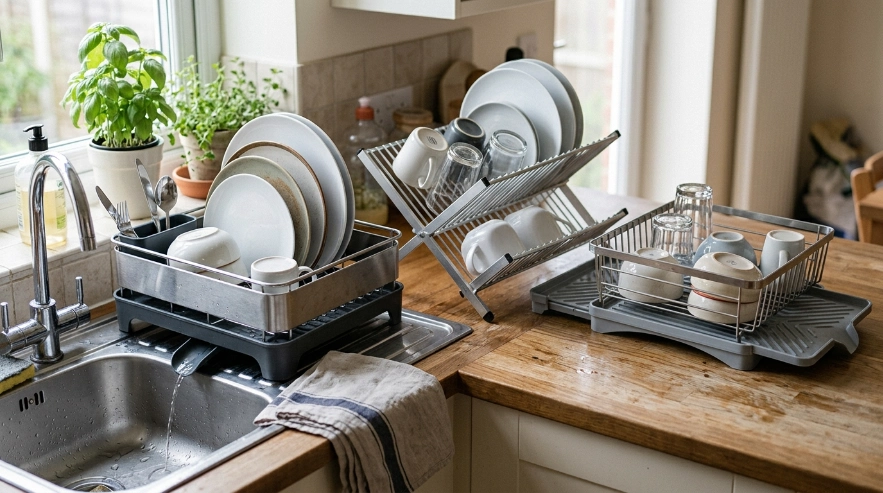
The simplehuman, OXO, and Joseph Joseph racks solve the same space problem in different ways. One stays compact, one folds down, and one expands when you need more drying room.
| Dish Rack | Approx. Size | Space-Saving Method | Drainage | Best For |
|---|---|---|---|---|
| simplehuman Compact Steel Frame | 15.5 × 15 × 7.5 in | Compact permanent footprint | Swivel spout to sink | Everyday use |
| OXO Good Grips Aluminum Fold Flat | About 16.4 × 14.6 × 9.5 in upright | Folds flat for storage | Built-in drainboard | Multi-use counters |
| Joseph Joseph Extend Steel | About 13.9 × 12.2 × 6.6 in closed | Sliding expandable tray | Three-position spout | Variable dish loads |
The numbers reveal an important point. The smallest rack is not automatically the most space-efficient choice for every household.
A fold-flat rack can reclaim the entire counter after breakfast, while an expandable rack can stay narrow until you wash a larger dinner load.
Is a Fold-Flat or Expandable Dish Rack Better?
A fold-flat rack is better when you need the counter back after washing dishes, while an expandable rack is better when your dish load changes throughout the day. Think about how you use the space rather than choosing based on appearance alone.
Choose a fold-flat rack when:
- You prepare food on the same counter where dishes dry.
- You live in a studio, RV, dorm, or compact apartment.
- You usually wash small batches.
- You have cabinet or pantry space for the folded rack.
The OXO Good Grips Aluminum Fold Flat Dish Rack fits this situation well. Its aluminum frame folds down, and the removable utensil cup can move from one side to the other.
Choose an expandable rack when:
- Breakfast loads are small but dinner loads are larger.
- You occasionally wash pans, serving bowls, or extra glasses.
- You want the rack to remain on the counter.
- You need more capacity without buying a permanently large rack.
The Joseph Joseph Extend is particularly useful here. Its sliding design grows when necessary and returns to a narrower footprint afterward.
What Size Compact Dish Rack Should You Buy?
Measure the available counter area before choosing a rack. You need the length and depth, but overhead clearance can also matter when cabinets sit low above the sink.
I like to measure with the faucet, soap dispenser, cutting boards, and other permanent items still in place. That gives a more realistic picture than measuring an empty countertop.
- Measure the counter length beside the sink where the rack will sit.
- Measure the usable depth from backsplash to counter edge.
- Check sink position so a drainage spout can actually reach the basin.
- Check overhead clearance if plates or cutting boards will stand vertically.
- Estimate your normal load instead of planning around the largest holiday meal of the year.
If your counter is extremely narrow, an over-sink or roll-up rack may make more sense than any countertop model. Those styles use sink space rather than dedicated counter space.
Which Dish Rack Material Is Best for a Small Kitchen?
Stainless steel and aluminum are strong choices when durability and a slim structure matter. Plastic can also work well when low weight and easy washing are higher priorities.
- Stainless steel: Strong, attractive, and commonly used in premium racks.
- Aluminum: Lightweight and naturally resistant to rust, making it useful for folding designs.
- Plastic: Lightweight, affordable, and easy to mold into integrated drainage trays.
- Silicone components: Useful for non-slip feet, protected contact points, and foldable accessories.
Material quality matters most at joints, coated wires, hinges, and drainage areas. These are the places that repeatedly encounter water and movement.
Why Does Drainage Matter So Much on a Compact Rack?
Drainage determines whether your space-saving rack also saves cleanup time. A rack that leaves water trapped underneath creates another chore on an already crowded counter.
I prefer a spout that reaches the sink or a tray that is simple to remove and empty. Raised surfaces beneath cups and bowls also help keep items away from collected water.
- Look for a directional or swivel drain spout when the rack sits beside a sink.
- Check whether the tray removes without dismantling the entire rack.
- Avoid designs with difficult corners that trap residue.
- Make sure the rack sits level enough for its drainage system to work properly.
The CDC recommends keeping kitchen surfaces and utensils clean as part of basic food-safety practices. That makes cleanable drainage parts worth considering alongside capacity and dimensions.
How Should You Clean a Compact Dish Rack?
Clean the rack whenever you notice residue, buildup, or trapped food debris, and wash removable parts according to the manufacturer’s instructions. The drying area should stay clean enough that freshly washed dishes are not sitting over old residue.
The FDA also advises washing kitchen dishes, utensils, cutting boards, and counters with hot, soapy water during food preparation. Regular attention to the drying zone fits naturally into that routine.
- Remove utensils, cups, and detachable accessories.
- Empty or rinse the drain tray.
- Wash parts using the care method specified by the manufacturer.
- Clean the countertop beneath the rack.
- Let components dry before reassembly when required.
If you use a dedicated household cleaner, follow its label directions. The EPA Safer Choice program can also help consumers identify cleaning products that meet its ingredient criteria.
Which Compact Dish Rack Would I Choose for Different Kitchens?
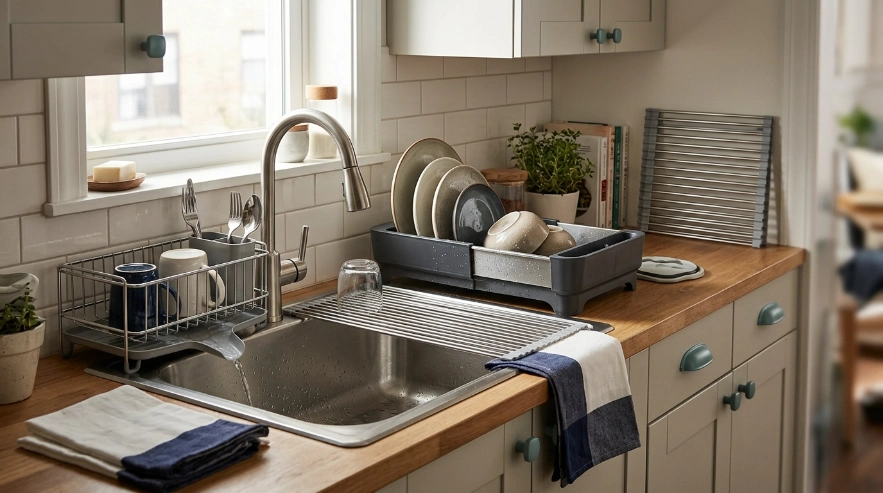
I would match the rack to the kitchen’s daily space problem. The best model changes when storage, drainage, or expandable capacity becomes the priority.
- Small apartment: OXO Fold Flat when the counter must switch between drying and meal prep.
- Permanent sink station: simplehuman Compact for integrated drainage and a stable everyday setup.
- Couple with changing loads: Joseph Joseph Extend because it can remain compact until extra space is necessary.
- Extremely narrow counter: Consider an over-sink or roll-up design instead of forcing a countertop rack into the space.
My biggest mistake to avoid is buying for maximum capacity instead of normal capacity. A rack used for one unusually large load each month can waste useful counter space every other day.
If you’re ready to choose one, these are the three models I would put at the top of the shortlist.
🏆 Best Overall
simplehuman Compact Steel Frame Dishrack
★★★★☆ 4.7/5
About 15.5 × 15 × 7.5 inches with a swivel drain spout, anti-slip feet, and a five-year manufacturer warranty. I like it most for kitchens where the rack stays beside the sink every day.
📦 Best Fold-Flat
OXO Good Grips Aluminum Fold Flat Dish Rack
★★★★☆ 4.0/5
Roughly 16.4 × 14.6 inches across with a rust-resistant aluminum frame, two-level configuration, removable utensil cup, and fold-flat design. I would choose it when reclaiming the counter after dishes dry matters most.
↔️ Best Expandable
Joseph Joseph Extend Steel Dish Rack
★★★★☆ 4.5/5
About 13.9 × 12.2 × 6.6 inches in its compact configuration, with an expandable tray, movable cutlery holder, and three-position drainage spout. I like it when a household alternates between small and larger washing loads.
Frequently Asked Questions
What is the best compact dish rack for a small kitchen?
The simplehuman Compact Steel Frame Dishrack is my best overall choice for a small kitchen because it combines a compact footprint with stable construction and direct-to-sink drainage. Choose a fold-flat model instead if recovering counter space after every load matters more.
Are two-tier dish racks better for small spaces?
Two-tier racks can increase drying capacity without using much additional counter area. However, measure the height beneath cabinets and check stability before choosing a tall design, especially if you frequently dry heavy plates or cookware.
Is a roll-up dish rack better than a countertop dish rack?
A roll-up rack is often better when counter space is extremely limited because it sits across the sink and stores compactly. A traditional countertop rack usually offers better organization for plates, cutlery, cups, and larger mixed loads.
Should a dish rack drain directly into the sink?
Direct drainage is convenient because you do not have to empty a separate tray as often. A removable drip tray can still work well when the rack cannot be positioned close enough for a drain spout to reach the sink.
How do I know if a compact dish rack will fit?
Measure the usable counter length and depth beside your sink, then compare those numbers with the rack’s assembled dimensions. Also check faucet position, backsplash clearance, cabinet height, and the space required for any expandable sections.
Final Takeaway
If I were buying one compact rack for an everyday kitchen in 2026, I would start with the simplehuman Compact Steel Frame Dishrack. Its drainage system and stable footprint make it the most complete permanent countertop option of the three.
For a counter that doubles as food-prep space, I would switch to the OXO Fold Flat. If dish loads constantly change, the Joseph Joseph Extend gives you the most useful flexibility without keeping a large rack open all day.