
Hand Crank Vegetable Chopper: How to Choose and Use One

Quick Answer
A hand crank vegetable chopper is a manual kitchen tool that uses a rotating handle to cut, shred, or slice vegetables without electricity. It works especially well for everyday meal preparation, small kitchens, and controlled vegetable cutting. The best choice depends on its blade design, stable base, cleaning requirements, and the texture you want. Proper vegetable preparation also helps keep ingredients safe before chopping.
What matters most?
- Cutting mechanism: Choose rotating chopping blades for small pieces or interchangeable drums for slicing and shredding.
- Vegetable compatibility: Firm carrots, onions, and cucumbers may need different blades and preparation methods.
- Stable operation: A secure suction base or reliable non-slip feet help prevent unwanted movement.
- Simple cleaning: Removable blades and accessible cutting surfaces make maintenance easier.
- Useful capacity: Match the hopper or bowl size to your usual cooking portions.
Best practical advice
- Start small: Prepare manageable vegetable pieces, select the correct attachment, and rotate the handle steadily without forcing it.
Chopping vegetables should be simple, but cutting board work can become tiring during busy meal preparation. A hand crank vegetable chopper offers a practical alternative when you want mechanical assistance without another electric appliance.
In this guide, I’ll explain how these tools differ, which vegetables they handle, and what features deserve attention. I’ll also cover the mistakes that can make an otherwise useful chopper frustrating.
What Is a Hand Crank Vegetable Chopper?
A hand crank vegetable chopper is a manually powered cutting device that uses a turning handle to operate its cutting mechanism. Depending on the design, it can chop ingredients into pieces or process them into slices and shreds.
Unlike an electric food processor, it doesn’t require a motor or power outlet. That makes it useful for smaller kitchens, camping setups, and everyday vegetable preparation.
How does the cutting mechanism work?
Most crank-operated models rely on a mechanical connection between the handle and cutting assembly. Turning the handle moves blades or a cutting drum against the vegetables.
However, not all manual vegetable choppers work the same way.
- Rotary blade choppers: Spinning blades repeatedly cut food inside an enclosed container.
- Drum-style cutters: Rotating drums slice or grate ingredients as they pass through the cutting surface.
- Hand-crank food mills: A rotating mechanism pushes softened ingredients through a perforated plate.
- Pull-cord choppers: A retractable cord spins internal blades rather than using a crank handle.
- Push-down choppers: Repeated downward pressure activates the cutting blades.
These designs produce different textures. A rotary grater that shreds carrots isn’t necessarily suitable for making uniformly diced onions.
Is a Hand Crank Vegetable Chopper Better Than an Electric Chopper?
A hand crank vegetable chopper is often better for modest portions, simple storage, and electricity-free preparation. Electric choppers are generally more convenient when processing larger quantities or ingredients that require sustained cutting power.
The right choice depends on how often you cook and what you prepare.
| Feature | Hand Crank Chopper | Electric Chopper |
|---|---|---|
| Power | Manual rotation | Electric motor |
| Typical preparation | Small to moderate portions | Small or larger portions, depending on model |
| Noise | Mostly mechanical noise | Motor and blade noise |
| Speed control | Controlled by turning speed | Depends on motor settings |
| Portability | No outlet needed | Requires power or charged battery |
| Physical effort | Requires repeated hand movement | Usually less manual cutting effort |
For an occasional onion or carrot, a compact manual tool can be sufficient. For several pounds of vegetables, an electric processor may save more effort.
Remember that cutting results depend heavily on the specific blade arrangement. Neither category guarantees perfectly uniform pieces.
Which Vegetables Can You Chop With a Hand Crank Chopper?
Hand crank vegetable choppers can handle many everyday vegetables, provided their blades suit the ingredient. Firm produce usually works best when it’s fresh, trimmed, and prepared in manageable portions.
Soft or watery ingredients need more care. Aggressive processing can crush them instead of producing clean cuts.
Vegetables that usually work well
- Onions: Useful for chopped mixtures, with consistency depending on the blade type.
- Carrots: Suitable for slicing and shredding with a compatible cutting drum.
- Cucumbers: Good for thin slices, although excessive pressure may damage soft centers.
- Bell peppers: Can be chopped into small pieces after removing stems and seeds.
- Cabbage: A suitable slicing drum can prepare thin strips for slaws.
- Zucchini: Works for slices or shreds, particularly when the vegetable is firm.
- Radishes: Small, firm pieces can work with appropriate slicing attachments.
What ingredients should you avoid?
Don’t assume every manual chopper can process hard roots, frozen vegetables, or unusually dense ingredients. Forcing the crank against resistance can damage the cutting assembly.
- Frozen vegetables: Avoid unless the manufacturer explicitly approves them.
- Large hard pieces: Cut them smaller before loading.
- Very soft tomatoes: Use a sharp slicing blade or a knife if the chopper crushes them.
- Fibrous stalks: Remove tough sections that can wrap around blades.
- Whole nuts: Process only if the specific model supports them.
For delicate herbs, a sharp knife may preserve texture better than repeated rotary cutting. Match the tool to the result you want.
How Do You Use a Hand Crank Vegetable Chopper Correctly?
Using a crank chopper is straightforward once the base, blade, and food-loading mechanism are correctly assembled. The safest approach is to follow the manufacturer’s instructions and avoid applying excessive force.
Step-by-step vegetable chopping
- Prepare the work area. Place the appliance on a clean, level countertop and secure its base.
- Wash the produce. Rinse vegetables under running water and remove damaged sections.
- Choose the blade. Select a chopping, slicing, or shredding attachment that matches your recipe.
- Cut oversized ingredients. Make pieces small enough for the hopper or bowl without forcing them.
- Assemble the chopper. Lock the cutting assembly and other components according to the manual.
- Load the vegetables. Stay within the manufacturer’s capacity limit and use the provided pusher where applicable.
- Turn the handle steadily. Maintain controlled pressure while keeping fingers away from cutting openings.
- Check the texture. Stop when the ingredients reach the desired size.
- Disassemble safely. Remove the finished food and clean the blades before residue dries.
Cranking faster doesn’t necessarily improve cutting. A consistent turning motion usually provides better control over the process.
How can you get more even results?
Uniform preparation begins before the vegetables reach the blades. Similar-sized starting pieces help enclosed choppers produce more consistent results.
- Process firm and soft vegetables separately when their cutting needs differ.
- Avoid overcrowding a chopping container.
- Use the designated slicing drum for consistent slices.
- Remove finished ingredients before adding more food.
- Stop immediately if the handle suddenly becomes difficult to turn.
For recipes requiring exact knife-cut cubes, a dedicated dicing grid may be more suitable. Many rotary choppers create irregular chopped pieces instead.
What Should You Look for When Buying a Hand Crank Vegetable Chopper?
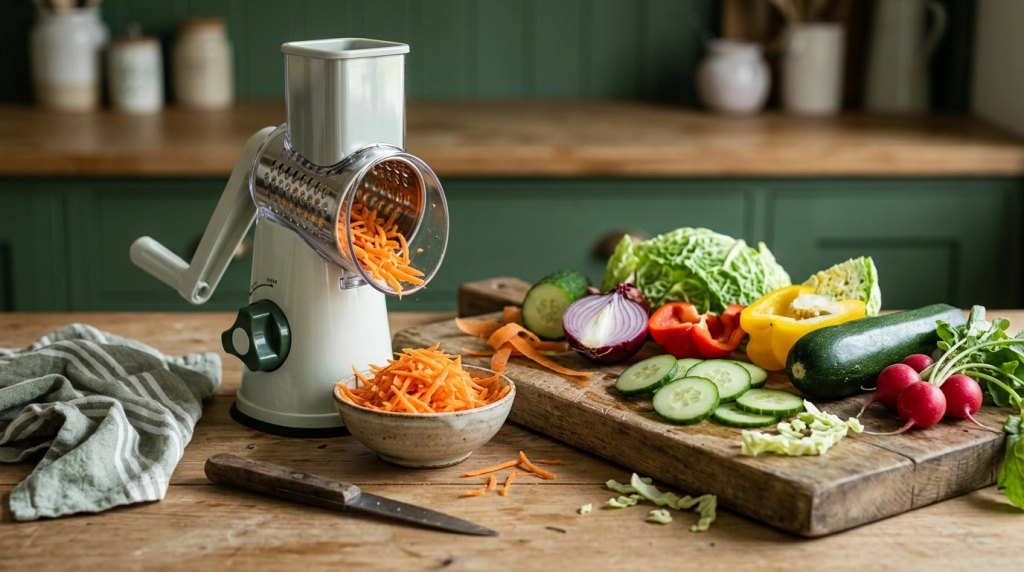
The best hand crank vegetable chopper is the one that performs your most frequent preparation task reliably. Focus on cutting design and ease of use rather than the number of advertised functions.
1. Cutting blades and attachments
Stainless steel cutting surfaces are common, but blade sharpness and geometry matter more than material claims alone. Interchangeable drums are useful when you regularly alternate between slicing and shredding.
Check whether replacements are available. A versatile tool becomes less useful when a damaged attachment cannot be replaced.
2. Comfortable crank handle
A comfortable handle should allow smooth rotation without awkward wrist positioning. Consider the amount of force needed for firmer vegetables.
People with limited grip strength may prefer a powered alternative. Manual operation doesn’t always mean effortless operation.
3. Stable base and mounting system
A rotating appliance needs a secure foundation. Suction feet, rubberized supports, or a compatible countertop clamp can help maintain stability.
Suction systems generally require a clean, smooth surface. Test the grip before adding vegetables.
4. Bowl or hopper size
Small chopping bowls suit quick ingredient preparation. Larger feeding openings are useful for vegetables that would otherwise require extensive precutting.
Think about the portions you normally prepare. Bigger isn’t automatically better when storage space is limited.
5. Cleaning and maintenance
Food can collect around cutting drums, blade connections, and narrow plastic channels. Easy disassembly matters more than an impressive accessory count.
Check the care instructions before putting parts in a dishwasher. Some models require handwashing or have components that should never be submerged.
Hand Crank vs. Pull-Cord Vegetable Chopper: What’s the Difference?
A hand crank chopper uses continuous handle rotation, while a pull-cord chopper uses repeated pulls to spin internal blades. Both are manually powered, but their cutting mechanisms and results differ.
This distinction is important when comparing products online. Retail listings sometimes group different manual mechanisms together.
| Use Case | Hand Crank | Pull-Cord |
|---|---|---|
| Carrot shredding | Suitable with shredding drum | Usually produces chopped bits |
| Onion mincing | Depends on blade design | Common application |
| Cucumber slicing | Suitable with slicing drum | Not designed for uniform slices |
| Salsa ingredients | Depends on chopping mechanism | Often well suited |
My practical selection rule is simple: decide on the finished texture before shopping. Choose a rotary slicing system for slices and shreds, or a chopping-bowl mechanism for finely chopped mixtures.
Why Is My Hand Crank Vegetable Chopper Not Working Properly?
Most everyday problems involve food preparation, blade installation, overloading, or an unstable base. Stop using the chopper if a component appears damaged or the mechanism jams repeatedly.
Common problems and solutions
- Handle feels stuck: Stop turning, unload the appliance, and inspect the mechanism according to the manual.
- Vegetables cut unevenly: Prepare more consistent pieces or change to the appropriate blade.
- Food gets crushed: Try firmer produce, reduce pressure, or use a sharper compatible attachment.
- Chopper moves around: Clean the suction surface and check that the base is properly secured.
- Pieces remain too large: Check for incorrect blade selection or poor food contact.
- Food collects around blades: Stop, disassemble safely, and clear residue using a suitable cleaning brush.
Never place fingers inside the cutting mechanism to clear stuck vegetables. Disconnect the moving parts and follow the appliance’s safety instructions first.
How Do You Clean a Hand Crank Vegetable Chopper?
Clean the chopper after each use to remove vegetable residue from blades and food-contact surfaces. Follow the model’s care instructions because washing requirements vary significantly.
Safe cleaning routine
- Remove remaining vegetables and separate removable components.
- Handle exposed blades carefully and keep their cutting edges away from your hands.
- Rinse permitted food-contact parts to loosen residue.
- Wash components with warm water and dish detergent, following the manufacturer’s instructions.
- Use a cleaning brush for blade openings and narrow channels.
- Rinse thoroughly and allow all components to dry.
- Reassemble only after parts are clean and completely dry.
Don’t assume every mechanism is dishwasher-safe. Some crank housings and geared assemblies need special care.
The FDA’s food cleaning guidance explains why regularly cleaning utensils and kitchen surfaces matters. Proper cleaning also helps prevent old food residue from contaminating fresh ingredients.
Are Hand Crank Vegetable Choppers Safe to Use?
Hand crank vegetable choppers can be safe when assembled, operated, and cleaned according to their instructions. However, sharp blades and moving mechanisms still require careful handling.
- Use the pusher: Never feed vegetables directly toward cutting surfaces with your fingers.
- Secure the appliance: Check the base before rotating the crank.
- Keep children away: Store exposed blade attachments securely.
- Avoid forcing: Stop immediately when unusual resistance occurs.
- Inspect regularly: Replace damaged or cracked components before further use.
Food preparation starts with clean ingredients. The FoodSafety.gov website provides additional guidance on preventing contamination in home kitchens.
For general appliance-related safety information, you can also consult the Consumer Product Safety Commission. Check for product recalls when purchasing used equipment.
When Is a Hand Crank Vegetable Chopper Worth Buying?
A hand crank vegetable chopper is worth considering when you prepare vegetables frequently but don’t need a full-sized electric food processor. Its greatest advantage is convenient mechanical assistance for specific cutting tasks.
Good reasons to buy one
- You regularly prepare shredded carrots or sliced vegetables.
- You want an electricity-free kitchen tool.
- Your kitchen has limited countertop space.
- You need a portable option for an RV or camping setup.
- You prefer direct control over cutting speed.
- You want fewer electric appliances for basic preparation.
When should you skip it?
A manual crank chopper may disappoint if you routinely process very large quantities. Repetitive turning can also become uncomfortable during extended preparation.
It’s not a replacement for every knife technique, food processor function, or precision dicing tool. Buy it for the cutting jobs it actually supports.
Recommended Manual Vegetable Choppers and Cutters
For 2026, these three products represent different manual cutting priorities. They are manufacturer-described options rather than products I’ve personally tested or assigned customer ratings.
Note that the Westmark model is primarily a rotary slicer and grater, while the Zyliss alternative uses a pull cord rather than a hand crank.
🏆 Best for slicing and shredding
Westmark Schnitzel Mouli Rotary Grater
☆☆☆☆☆ Customer rating not verified
This hand-operated rotary cutter includes three stainless steel discs for slicing, fine grating, and coarse grating. Its foldable design and rubber suction feet make it a sensible option to investigate for vegetable slicing and shredding rather than fine dicing.
🥕 Best dedicated crank-style option
Splashis C355 Hand Crank Vegetable Chopper
☆☆☆☆☆ Customer rating not verified
The C355 is advertised as a manual hand-crank model for slicing, dicing, and shredding. Its multifunction design is worth considering if you want one tool for several vegetable preparation styles, but confirm the attachments and cutting results before buying.
🥗 Best pull-cord alternative
Zyliss Easy Pull Food Chopper
☆☆☆☆☆ Customer rating not verified
This manual food processor uses a pull cord and three blades inside an 800 ml bowl. I’d consider its chopping-bowl design for onions, salsa ingredients, and finely chopped mixtures when slicing isn’t the priority.
Affiliate disclosure: As an Amazon Associate, this website may earn from qualifying purchases made through eligible affiliate links.
Frequently Asked Questions
Can a hand crank vegetable chopper cut onions?
Yes, many manual choppers can cut onions, although the finished texture depends on the blade design. An enclosed rotary blade chopper may produce smaller, irregular pieces, while a dedicated slicing attachment creates onion slices. Check the manufacturer’s recommended uses before buying.
Can you use a hand crank vegetable chopper for carrots?
Yes, carrots work particularly well with a suitable slicing or shredding drum. Very large carrots may need cutting into smaller pieces first. Avoid forcing hard vegetables through an attachment that isn’t designed to handle them.
Does a hand crank vegetable chopper need electricity?
No, a genuine hand crank vegetable chopper operates through manual handle rotation. This makes it useful for camping, RV cooking, power outages, and kitchens with limited outlets. The trade-off is the physical effort required to operate it.
Is a hand crank vegetable chopper dishwasher-safe?
Dishwasher compatibility depends on the product. Some manufacturers approve certain removable parts, while others recommend handwashing. Always check the instructions for cutting blades, plastic components, handles, and gear housings before placing anything in a dishwasher.
Can a manual vegetable chopper replace a food processor?
A manual vegetable chopper can replace some basic chopping and shredding tasks, but not every food processor function. Electric processors generally offer more power and may support larger batches, specialized mixing, and tougher ingredients. Choose according to your usual recipes.
Final Takeaway: Choosing the Right Hand Crank Vegetable Chopper

A hand crank vegetable chopper can make everyday preparation more convenient without relying on electricity. The most important decision is choosing the cutting mechanism that matches your recipes.
For shredded vegetables and regular slices, start by comparing rotary drum cutters. For minced ingredients and chopped mixtures, an enclosed manual chopping system may suit you better.
Before purchasing, examine the base stability, blade attachments, cleaning instructions, and replacement-part availability. A simple, reliable tool that handles your favorite vegetables is usually more valuable than unnecessary extra functions.
