
What Is a Vegetable Chopper Used For? A Practical Kitchen Guide

Quick Answer
A vegetable chopper is used to cut vegetables into smaller pieces quickly, usually for salads, soups, stir-fries, salsa, sauces, casseroles, and meal prep. It can reduce repetitive knife work and help produce more consistent pieces, making it useful when you want to save time while cooking daily meals.
Common vegetable chopper uses
- Dicing vegetables: Cut onions, peppers, potatoes, zucchini, and similar produce into smaller pieces.
- Preparing salads: Quickly chop several ingredients into similar-sized pieces.
- Making salsa: Prepare tomatoes, onions, peppers, and other ingredients with less repetitive cutting.
- Meal prepping: Process larger amounts of vegetables for several meals at once.
- Mincing ingredients: Pull-cord and electric models can handle herbs, garlic, nuts, and softer vegetables.
One important tip
- Match the chopper type to the food because grid, pull-cord, rotating-blade, and electric choppers produce different results.
I think of a vegetable chopper as a shortcut for the repetitive part of meal preparation. It doesn’t replace every knife job, but it can make a pile of vegetables feel much less intimidating.
The most useful question isn’t simply whether a chopper works. It’s whether its cutting mechanism matches what you’re preparing.
What Exactly Is a Vegetable Chopper?
A vegetable chopper is a manual or electric kitchen tool that cuts produce into smaller pieces using one or more blades. Depending on the design, it may dice, chop, mince, slice, shred, or roughly process food.
Simple definition: A vegetable chopper reduces repetitive hand cutting by pushing, pulling, spinning, or electrically moving food against sharp blades.
A push-down grid model makes defined pieces by forcing food through a blade grid. A pull-cord or rotating-blade model cuts ingredients repeatedly inside a bowl.
Electric food choppers work more like compact food processors. They are useful for rapid chopping and mincing, although they don’t usually create the square dice produced by grid choppers.
What Is a Vegetable Chopper Used For Most Often?
A vegetable chopper is most useful for repetitive preparation jobs involving several pieces of produce. I find the biggest advantage comes when a recipe calls for several chopped ingredients rather than one small garnish.
- Onions: Useful for salsa, soup bases, tacos, omelets, stuffing, curries, and sauces.
- Bell peppers: Handy for salads, fajitas, stir-fries, pizza toppings, and casseroles.
- Celery: Speeds preparation for soups, stuffing, chicken salad, and mirepoix-style mixtures.
- Zucchini: Works well in salads, sautés, soups, pasta dishes, and mixed vegetable recipes.
- Potatoes: Compatible grid models can prepare cubes for roasting, soups, breakfast potatoes, and stews.
- Tomatoes: Firmer tomatoes can be prepared for salsa, salads, toppings, and fresh sauces.
- Carrots: Some stronger choppers can handle smaller carrot sections, although hard carrots require more force.
- Garlic and herbs: Pull-cord and rotating-blade choppers are especially useful for fine chopping.
That range makes a vegetable chopper useful for beginners and experienced cooks alike. If you’re still building confidence, these basic cooking tips for beginners can help you combine convenient tools with good kitchen habits.
Which Type of Vegetable Chopper Is Best for Each Job?
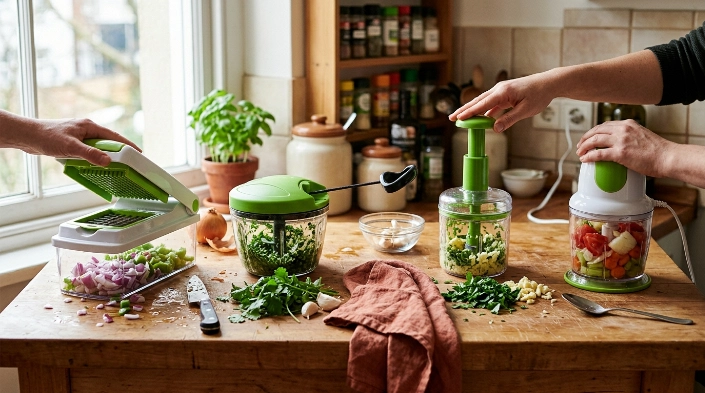
The right chopper depends on the result you want. Uniform cubes, rough chopped vegetables, and finely minced herbs require different blade actions.
| Chopper Type | How It Works | Best Uses | Practical Batch Example | Main Limitation |
|---|---|---|---|---|
| Push-grid chopper | Food is pressed through a fixed blade grid | Onions, peppers, potatoes, zucchini | 1 onion + 2 peppers for fajitas | Hard produce may require considerable pressure |
| Pull-cord chopper | A cord spins stacked blades inside a bowl | Herbs, onions, garlic, nuts, salsa | 1 small onion + herbs for a sauce | Doesn’t make precise square dice |
| Rotating/pump chopper | Repeated pressing rotates an internal blade | Small vegetables, garlic, herbs | Garlic + parsley for a quick topping | Usually better for smaller quantities |
| Electric chopper | A motor spins a blade at high speed | Mincing, rough chopping, sauces, dips | Several vegetables for soup or salsa | Easy to over-process soft ingredients |
Those batch examples show how I decide whether reaching for a chopper is worthwhile. For one garlic clove, I usually prefer a knife; for several vegetables, the time savings become more noticeable.
Can a Vegetable Chopper Replace a Knife?
No. A vegetable chopper can replace some repetitive cutting, but a chef’s knife remains more flexible and precise.
A knife lets you control shape, thickness, angle, and size with each cut. It’s also better for trimming produce before it goes into a chopper.
- Use a chopper when you want repeated cuts of similar ingredients quickly.
- Use a knife when you need precise slices, wedges, decorative cuts, or irregular shapes.
- Use both when larger vegetables must be trimmed into chopper-sized portions first.
That combination is often the most practical. Learning essential cooking skills everyone should know still matters even when convenient preparation tools do part of the work.
How Do You Use a Vegetable Chopper Correctly?
The basic process is simple, but a little preparation gives cleaner cuts. Never force a vegetable that clearly exceeds your chopper’s size or recommended food range.
- Wash the produce. Rinse fresh vegetables under running water before cutting them.
- Trim unwanted parts. Remove stems, roots, bruised areas, seeds, or thick ends when appropriate.
- Pre-cut large vegetables. Make pieces small enough to sit securely on or inside the chopper.
- Place the chopper securely. Use a flat, stable work surface.
- Use the intended mechanism. Press, pull, pump, or pulse according to the chopper’s design.
- Stop at the desired texture. With spinning blades, extra pulls or pulses make the food progressively finer.
- Clean the blades carefully. Remove trapped pieces with the supplied cleaning tool when available.
The FDA recommends rinsing produce under running water before preparation and keeping produce away from surfaces contaminated by raw meat. You can review its produce safety guidance for more detail.
What Foods Should You Not Put in a Vegetable Chopper?
Not every food belongs in every chopper. The manufacturer’s instructions should always take priority because blade strength and mechanisms vary.
- Bones: Standard vegetable choppers aren’t designed for bones.
- Frozen solid foods: They can put excessive stress on blades and plastic components unless specifically approved.
- Oversized hard vegetables: Large potatoes, beets, or thick carrot sections may need pre-cutting.
- Hot food: Avoid putting steaming ingredients into plastic containers unless the manufacturer permits it.
- Large fibrous stalks: Thick fibers may jam certain rotating mechanisms.
- Too much food at once: Overloading can create uneven results and increase the force required.
My rule is simple: if the lid won’t close naturally or the food doesn’t sit securely, I stop and cut the ingredient smaller. Forcing the mechanism isn’t worth damaging the tool or risking a hand injury.
Is a Vegetable Chopper Safer Than Using a Knife?
A chopper can reduce direct knife work, but its blades remain sharp enough to cause serious cuts. Safety depends more on how you handle the tool than on whether it has a lid.
I treat exposed chopper blades exactly like knife blades. That means holding them by safe edges, keeping fingers away from cutting grids, and never blindly reaching into soapy water for a blade.
- Keep the chopper on a stable counter.
- Use the handle or pusher rather than your fingers.
- Keep children away from loose blades.
- Don’t use your fingertip to clear food from a cutting grid.
- Store blade inserts where they can’t be grabbed accidentally.
For broader precautions, my guide to kitchen safety tips for home cooks covers cutting, appliance, fire, and food-handling habits.
FoodSafety.gov’s four food-safety steps also emphasize cleaning hands, surfaces, utensils, and cutting equipment between food-preparation tasks.
How Should You Clean a Vegetable Chopper?
Clean the chopper soon after use because dried onion, herbs, potato starch, and vegetable fibers become harder to remove. Check the manual before assuming every component is dishwasher-safe.
- Separate the container, lid, blade insert, and cleaning tool.
- Empty loose food before rinsing the components.
- Keep your fingers away from sharpened edges.
- Use the supplied brush or pick for food trapped in a grid.
- Wash dishwasher-safe parts according to manufacturer instructions.
- Dry components before reassembling or storing the chopper.
Cross-contamination matters too. The USDA explains that utensils and surfaces can transfer harmful bacteria between foods, so clean equipment that has contacted raw meat before using it around fresh vegetables.
You can read the USDA’s food washing and cross-contamination guidance for practical safety details.
When Is a Vegetable Chopper Worth Using?
A vegetable chopper makes the most sense when preparation volume is high enough to justify cleaning another tool. It can be especially convenient for meal prep, family dinners, salads, salsa, soups, and vegetable-heavy recipes.
- Weekly meal prep: Prepare several vegetables in one session.
- Large salads: Keep cucumbers, onions, peppers, and other ingredients closer in size.
- Soup preparation: Speed repetitive chopping of onions, celery, potatoes, and similar ingredients.
- Taco nights: Prepare toppings and salsa ingredients efficiently.
- Batch cooking: Reduce repeated knife work when preparing several servings.
A chopper may be less useful if you cook small portions or enjoy knife work. In that case, a sharp chef’s knife and cutting board may be quicker to wash and store.
What Should You Look for When Choosing One in 2026?
As of 2026, I would focus less on attachment count and more on the jobs you’ll actually perform. A complicated tool isn’t a bargain if half its blades stay in the cupboard.
- Blade style: Choose grids for uniform dice and spinning blades for rough chopping or mincing.
- Container size: Larger containers suit batch preparation but require more storage space.
- Cleaning access: Removable parts and cleaning tools make a noticeable difference.
- Base stability: A secure base matters when you’re applying downward pressure.
- Storage: Check whether blades can be safely stored inside the unit.
- Replacement value: Fewer useful, sturdy attachments can be better than many rarely used ones.
One overlooked benefit is that easier preparation can make vegetables more convenient to add to everyday meals. My guide to the benefits of vegetables in a daily diet explains why keeping produce practical and accessible can support better eating habits.
Vegetable Choppers I Would Consider
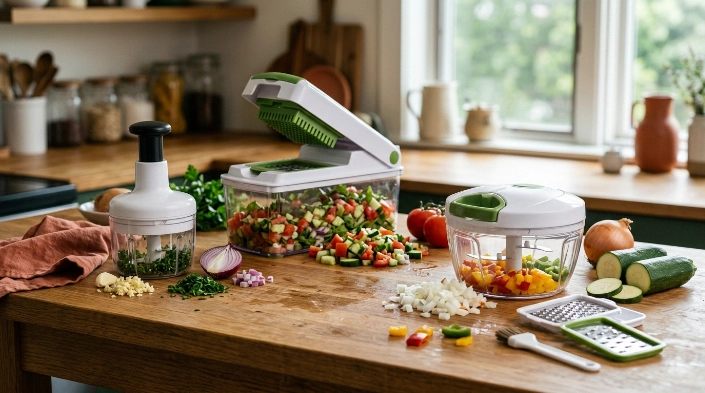
If you’re ready to pick one, these three designs cover different preparation styles without making the choice unnecessarily complicated.
🏆 Versatile Manual Pick
Mueller Pro-Series 10-in-1 Vegetable Chopper
★★★★★ 4.8/5 editorial fit
This manual system uses multiple interchangeable blades and a collection container for dicing, slicing, and other prep jobs. I like this style for cooks who want one tool to handle several vegetable-prep formats.
🥗 Meal-Prep Pick
Fullstar Pro Original Vegetable Chopper
★★★★☆ 4.7/5 editorial fit
The Pro Original style combines push-grid chopping with additional preparation attachments and a roughly four-cup collection container. It suits salads, salsa, tacos, and batch vegetable prep when consistent pieces matter.
🏠 Compact Pick
OXO Good Grips Vegetable Chopper
★★★★☆ 4.4/5 editorial fit
This compact manual chopper uses a rotating blade system instead of a large interchangeable grid set. I would consider it when storage space and straightforward cleanup matter more than handling big meal-prep batches.
Frequently Asked Questions
What vegetables can you put in a vegetable chopper?
You can commonly chop onions, peppers, zucchini, celery, potatoes, tomatoes, cucumbers, and smaller carrot pieces. The exact range depends on the blade design, so check the manufacturer’s instructions before processing especially hard or fibrous vegetables.
Can a vegetable chopper be used for fruit?
Yes, many choppers can handle firm fruits such as apples, pears, melon, and some strawberries. Softer fruit can become crushed or watery, especially in grid choppers that require downward pressure.
Can you use a vegetable chopper for meat?
Some electric or rotating food choppers are designed for certain meat-preparation tasks, but a standard vegetable grid chopper may not be. Only process meat when the manufacturer’s instructions specifically say the model is suitable for it.
Does a vegetable chopper save time?
It can save preparation time when a recipe requires repeated chopping or several vegetables. For one small ingredient, a knife may be faster because a chopper creates extra components that must be cleaned afterward.
Is an electric or manual vegetable chopper better?
Manual grid choppers are better when you want defined, similar-sized pieces. Electric choppers are better for fast rough chopping, mincing, dips, and softer mixtures, so the better choice depends on the texture you need.
Final Takeaway
A vegetable chopper is mainly used to make repetitive food preparation faster and more consistent. It works especially well for onions, peppers, potatoes, zucchini, celery, herbs, salsa ingredients, salads, soups, and weekly meal-prep vegetables.
I wouldn’t treat it as a complete replacement for a good knife. I see it as a task-specific helper that earns its counter space when it makes the foods you already cook easier to prepare.
Choose the cutting mechanism first, then consider capacity, cleaning, storage, and attachments. The best chopper is the one that matches your normal recipes rather than the one with the longest feature list.
