
How Much Does a Dish Rack Cost? 2026 Price Guide

Quick Answer
A dish rack can cost about $3 to $110 or more, depending on its material, capacity, drainage system, and brand. Basic plastic racks can stay below $15, while many practical countertop racks fall around $15 to $50. Premium stainless-steel models can reach $80 to $110. You can compare current examples in IKEA’s dish rack collection.
Typical Dish Rack Price Ranges
- Basic plastic: Around $3–$15 for simple countertop drainers.
- Standard countertop: Roughly $15–$35 for more capacity and better organization.
- Folding or upgraded: About $35–$60 for improved materials or space-saving features.
- Premium steel: Around $60–$110+ for stronger construction and advanced drainage.
- Best value range: For most kitchens, I would start around $20–$50.
Before You Buy
- Measure the space beside your sink before comparing prices because a bargain rack is wasted money if it does not fit.
Dish racks look simple, but their prices vary more than many people expect. A small plastic drainer and a premium stainless-steel rack perform the same basic job yet can differ in price by nearly $100.
I usually recommend setting the budget only after measuring the sink area and estimating your normal dish load. That approach makes it much easier to avoid paying for capacity or features you will never use.
How Much Does a Dish Rack Cost in 2026?
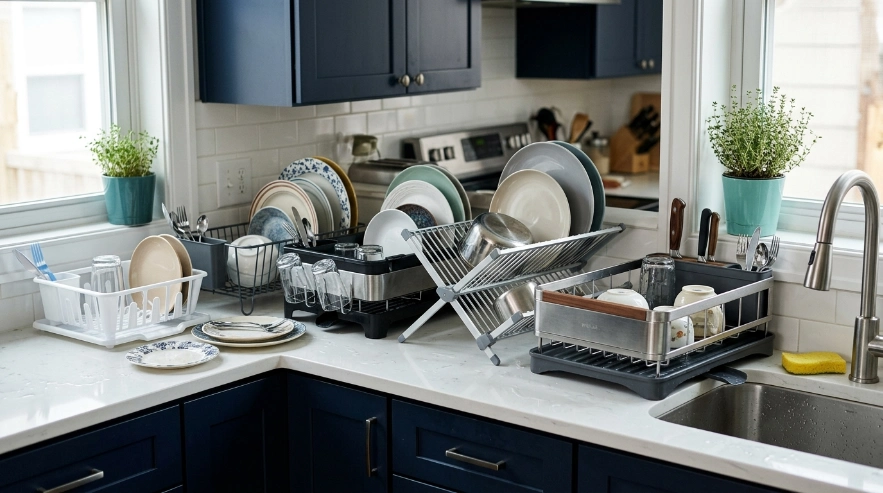
For most U.S. shoppers, a realistic dish rack budget is about $15 to $50. That range includes many useful countertop, metal, and multifunctional designs without moving into luxury pricing.
At the low end, current retail listings include basic drainers costing less than $5. At the premium end, sophisticated steel-frame racks can reach $100 or more.
| Current Example | Approx. Price | Price Level | Best Fit |
|---|---|---|---|
| IKEA FLUNDRA Dish Drainer | $4.99 | Budget | Simple everyday drying |
| IKEA KVOT Dish Drainer | $14.99 | Budget | Low-cost metal rack |
| IKEA LILLHAVET Multifunctional Dish Rack | $19.99 | Value | Versatile daily use |
| OXO Aluminum Fold Flat Dish Rack | $46.99 | Mid-range | Compact storage |
| Simplehuman Compact Steel Frame Dishrack | $80 | Premium | Small premium kitchens |
| Simplehuman Standard Steel Frame Dishrack | $100 | Premium | Higher capacity |
Prices were checked in August 2026 and can change with promotions, finishes, or availability. Use them as reference points rather than permanent prices.
What Makes One Dish Rack Cost More Than Another?
The biggest price differences come from material, size, drainage design, capacity, and construction quality. Brand positioning also matters, especially once you enter the premium category.
A $10 rack does not automatically dry dishes worse than an $80 rack. You are often paying more for durability, organization, drainage control, appearance, and convenience.
- Material: Simple plastic usually costs less than aluminum or substantial stainless-steel construction.
- Capacity: Larger racks need more material and often include dedicated glass, plate, or utensil sections.
- Drainage: Removable trays and directional drain spouts can raise the price.
- Adjustability: Folding, expanding, or modular racks commonly cost more than fixed designs.
- Finish: Premium coatings and decorative finishes may add cost without increasing capacity.
- Warranty: Higher-end manufacturers may provide longer warranty coverage.
Definition: A dish rack, also called a dish drainer or drying rack, is a raised organizer that holds washed dishes apart so water can drain and air can circulate around them.
That airflow is one reason racks remain useful even when a kitchen has a dishwasher. The FDA Food Code also recognizes air-drying or adequate draining as the appropriate drying method for cleaned and sanitized equipment and utensils in food-service settings.
Is a Cheap Dish Rack Worth Buying?
Yes, a cheap dish rack can be a smart purchase when your needs are basic. Someone drying a few plates, mugs, and utensils does not necessarily benefit from a $100 system.
Current IKEA listings show that basic drainers can still cost under $5. That makes the budget category practical for students, rentals, secondary kitchens, or people with small dish loads.
Choose a cheaper rack when:
- You wash only a few dishes by hand.
- You mainly use a dishwasher.
- You have limited countertop space.
- You are furnishing a temporary apartment or dorm.
- You do not need a built-in drain spout.
The important thing is stability. I would rather buy a simple rack that sits securely than a feature-packed model that flexes when loaded with plates.
Spend more when:
- You wash dishes by hand every day.
- You regularly dry pots and larger bowls.
- Countertop water is a recurring problem.
- You want separate storage for glasses and utensils.
- You expect to keep the rack for several years.
For those kitchens, paying for a better frame and drainage system can make sense. The extra money should solve a real daily annoyance.
How Much Should I Spend on a Good Dish Rack?
I would set a starting budget of $20 to $50 for a good general-purpose dish rack. This is where you begin seeing better organization and more thoughtful space-saving features without automatically entering premium territory.
The OXO Aluminum Fold Flat Dish Rack is a useful example. Its current $46.99 price sits close to the upper end of this middle category, while its folding construction helps justify the increase over a fixed budget rack.
OXO describes its current sinkware lineup on its official sinkware collection. Comparing manufacturer specifications can be more useful than comparing price alone.
A sensible budget by household type
- One person: $5–$25 is often enough for a compact setup.
- Couple: $15–$40 provides more room without dominating the counter.
- Family: $25–$60 can be worthwhile if several dishes are washed together.
- Heavy hand-washing: Consider $40–$100+ if drainage and capacity matter every day.
These are shopping budgets rather than fixed market rules. Your sink size and washing habits matter more than household size alone.
Are Stainless-Steel Dish Racks More Expensive?
Stainless-steel racks are often more expensive than basic plastic models, although the price range overlaps. Current IKEA examples include stainless-steel dish-draining products from roughly $10 to $45, while premium steel-frame products go considerably higher.
Simplehuman currently lists its compact brushed steel-frame model at $80 and standard version at $100. Different finishes can cost even more.
You can review the current construction and drainage features on the Simplehuman Steel Frame Dishrack page. Its standard model also carries a five-year warranty.
What are you paying extra for?
- Structural strength: A stronger frame can support heavier dishes more confidently.
- Water management: Premium models may direct drainage toward the sink.
- Dedicated storage: Cup holders, utensil caddies, and glass racks improve organization.
- Appearance: Brushed metal and coordinated finishes suit kitchens where the rack stays visible.
- Longer warranty: Warranty coverage can add value if you plan to keep the rack.
I would not pay the premium for stainless steel based on appearance alone. I would pay more when the stronger structure or drainage system solves something I deal with every day.
Is a $100 Dish Rack Really Worth It?
A $100 dish rack can be worth it for the right kitchen, but it is unnecessary for many shoppers. Premium pricing makes the most sense when you use the rack heavily and care about drainage, capacity, build quality, and countertop appearance.
Simplehuman’s current $100 standard rack illustrates this category well. It includes a swivel drainage spout, substantial frame, utensil storage, and space intended for larger loads.
Before spending $80–$110, ask yourself:
- Will I use this rack almost every day?
- Does my current rack leave water on the counter?
- Do I regularly run out of drying space?
- Will the premium model fit beside my sink?
- Do its extra features solve problems I already have?
If most answers are no, I would stay in the $20–$50 range. That price tier offers plenty of practical choices.
How Can You Avoid Overpaying for a Dish Rack?
Start by buying for your normal workload instead of your largest possible dish pile. Oversized racks waste both money and counter space when they spend most of the week half empty.
The second step is comparing usable features. A utensil cup, stable plate slots, and effective drainage usually matter more than the number of accessories printed on the box.
- Measure first: Check width, depth, and clearance around the faucet.
- Check drainage direction: Make sure the tray or spout can actually reach your sink.
- Consider storage: A folding model can justify a higher price in a small kitchen.
- Inspect materials: Look at the manufacturer’s cleaning and care instructions.
- Compare total cost: Include shipping and optional accessories.
- Watch promotions: Retail prices often move during sales.
Also keep the rack itself clean. The FDA provides broader kitchen cleaning and food-safety guidance, including washing dishes, utensils, and food-contact surfaces with hot soapy water.
Dish Rack vs. Drying Mat: Which Costs Less?
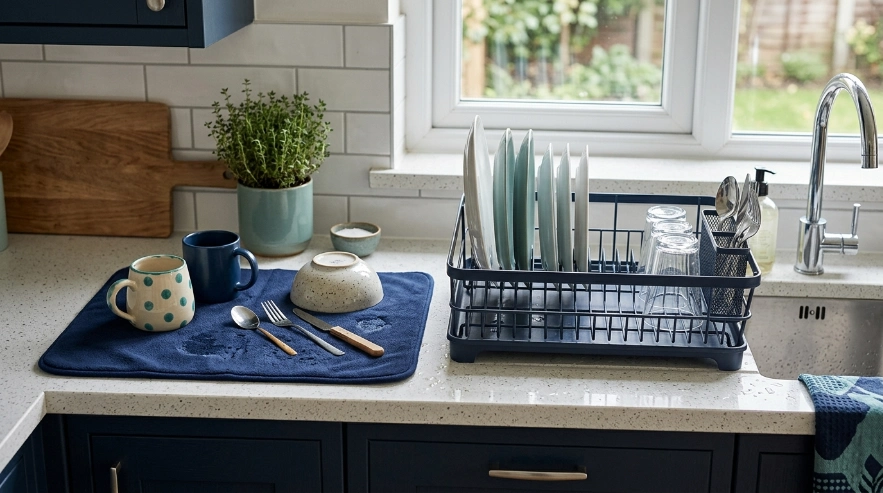
A drying mat is usually the cheaper starting option. Current retail examples can cost only a few dollars, while structured racks become more expensive as capacity and drainage features increase.
| Option | Typical Advantage | Main Limitation |
|---|---|---|
| Drying mat | Low cost and easy storage | Less separation between dishes |
| Basic rack | Keeps plates upright | May lack advanced drainage |
| Premium rack | Better organization and drainage | Higher purchase price |
I prefer a proper rack when plates are washed frequently because upright spacing makes the drying area easier to organize. A mat makes more sense when storage space or price is the main concern.
What Dish Racks Would I Consider at Different Budgets?
If you’re ready to choose one, these are three models I would compare first. They represent distinct budget and feature levels rather than three versions of the same idea.
💰 Best Value
IKEA LILLHAVET Multifunctional Dish Rack
★★★★☆ 4.4/5 retailer rating
A practical multifunctional design at a much lower price than premium racks. I would consider it first when keeping the budget near $20 matters more than luxury finishes.
🏆 Best for Small Kitchens
OXO Good Grips Aluminum Fold Flat Dish Rack
★★★★☆ 4.6/5 editorial score
Its aluminum construction and fold-flat design make storage the standout feature. I would pick it for a kitchen where a permanent bulky rack consumes too much counter space.
✨ Best Premium
Simplehuman Compact Steel Frame Dishrack
★★★★☆ 4.5/5 editorial score
The compact model combines a substantial steel frame with a swivel drain spout and removable caddy. I would consider it when drainage and long-term everyday use justify a premium budget.
Frequently Asked Questions
How much should I pay for a decent dish rack?
For most households, $20 to $50 is a sensible target. That budget can provide useful capacity, more organized storage, and better materials without paying the $80–$110 price attached to some premium designs.
Can I get a dish rack for under $10?
Yes. Basic plastic and simple drainers can cost well below $10, with current retail examples around $3–$5. They work best for smaller dish loads where advanced drainage and large capacity are not priorities.
Why are some dish racks $80 or $100?
Premium racks may use heavier steel frames, integrated drain systems, removable caddies, glass holders, better finishes, and longer warranties. The higher price makes the most sense when those features solve everyday problems in a heavily used kitchen.
Is stainless steel worth paying extra for?
It can be if you want a stronger frame and regularly wash heavier dishes. However, stainless steel alone does not guarantee a better rack, so check the drainage design, dimensions, stability, warranty, and cleaning requirements as well.
Should I buy a dish rack or a drying mat?
Choose a drying mat when low cost and easy storage matter most. Choose a rack when you want dishes separated, plates held upright, and water managed more neatly around the sink.
Final Takeaway
So, how much does a dish rack cost? In 2026, you can spend about $3 for a basic drainer or $100+ for a premium steel system, while the most useful shopping range for many households sits around $20–$50.
Measure your countertop, think about how many dishes you normally wash, and pay extra only for features you will use. A well-matched $20 rack is a better purchase than a $100 rack that does not fit your kitchen.