
How Much Is a Kitchen Dish Rack? 2026 Price Guide

Quick Answer
A kitchen dish rack usually costs about $5 to $100, although specialized models can cost more. Basic plastic or wire racks often stay under $20, while $20 to $60 buys better drainage, materials, capacity, and accessories. Premium stainless steel and designer racks often reach $70 to $100 or more. You can compare current dish drying rack prices before deciding how much to spend.
Typical Dish Rack Price Ranges
- Budget racks: Around $5 to $20 for basic plastic, coated-wire, or compact designs.
- Mid-range racks: Around $20 to $60 for stronger materials, drainboards, cup holders, and larger capacity.
- Premium racks: Around $60 to $100+ for stainless steel, adjustable drainage, premium finishes, and better organization.
- Over-sink systems: Prices vary widely, with large adjustable or multi-tier designs sometimes exceeding $100.
- Best value: Most households can find a practical everyday rack between $20 and $50.
Before You Buy
- Measure your counter or sink first, then pay for features you will use rather than the largest rack available.
If you’re wondering how much a kitchen dish rack costs, the answer depends more on design than size alone. Material, drainage, capacity, accessories, and brand can move the price from a few dollars to well over $100.
As of August 2026, I’ve found the useful middle of the market sits around $20 to $60. That range gives most kitchens enough durability and organization without paying heavily for appearance or specialty features.
What Is a Kitchen Dish Rack?
A kitchen dish rack is a holder that keeps washed dishes separated while water drains and air circulates around them. It may sit beside the sink, inside the sink, or across the top of the sink.
Traditional racks hold plates upright and provide areas for cups and utensils. More elaborate versions add drainboards, rotating spouts, knife holders, glass holders, or second tiers.
- Countertop rack: Sits beside the sink and usually includes a drainage tray.
- In-sink rack: Fits inside the sink so water drains directly away.
- Over-sink rack: Spans part or all of the sink to save counter space.
- Two-tier rack: Adds vertical storage for households washing many dishes.
- Roll-up rack: Uses coated bars that roll away when not needed.
- Collapsible rack: Folds or compresses for easier storage.
That variety explains why two products called “dish racks” can have dramatically different prices. You’re often paying for the way the rack uses space, not simply the amount of metal or plastic in it.
How Much Does a Kitchen Dish Rack Cost in 2026?
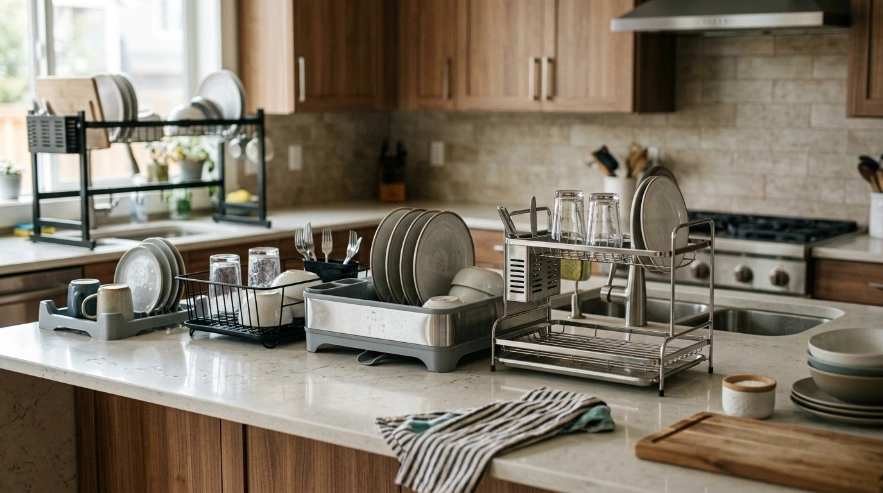
Expect to spend about $5 to $100 for most household dish racks. Large premium and over-sink organizers can go beyond that range.
Current listings from major U.S. retailers show simple plastic racks near the bottom of the range. Premium stainless steel models can approach $100 before you enter specialized oversized systems.
| Dish Rack Type | Typical Price | Usually Best For | What You Usually Get |
|---|---|---|---|
| Basic plastic | $5–$15 | Light daily use | Simple plate slots and open drainage |
| Basic metal | $10–$25 | Budget-conscious households | Wire frame and utensil cup |
| Mid-range countertop | $25–$60 | Most everyday kitchens | Drainboard, spout, better capacity, accessories |
| Premium stainless steel | $60–$100+ | Heavy use and visible countertops | Better finish, drainage, stability, and organization |
| Large over-sink system | $30–$150+ | Limited counter space | Adjustable frame, multiple baskets, vertical storage |
These ranges are shopping guidelines rather than fixed prices. Sales, rack dimensions, finish, and included accessories can change the final cost.
You can also compare the broader selection at Walmart’s dish rack section. It helps show how quickly prices change when you move from a simple drainer to an adjustable system.
Why Are Some Dish Racks So Expensive?
Expensive dish racks usually cost more because they combine stronger materials with better drainage and more specialized storage. Branding and appearance can add another premium.
A $10 rack may dry plates perfectly well. A $90 rack may perform the same basic job while handling water, cookware, glasses, and countertop appearance more elegantly.
- Stainless steel: Usually costs more than basic plastic or coated wire.
- Drainage systems: Sloped trays and movable spouts make water management easier.
- Expandable sections: Let the rack handle different loads without permanently occupying more space.
- Special holders: Separate areas for knives, wine glasses, cutting boards, cups, and utensils add cost.
- Compact engineering: Folding and collapsible designs require more moving parts.
- Finish and appearance: Premium racks are often designed to remain visible on the counter.
Good Housekeeping’s dish rack evaluations consider factors such as capacity, drainage, stability, ease of cleaning, and the amount of counter space a rack occupies. Those are more useful buying criteria than appearance alone.
You can review its dish rack testing and buying guidance if you’re comparing different styles.
Is a $20 Dish Rack Good Enough?
Yes, a $20 dish rack can be enough for many households. You don’t need premium stainless steel if your main goal is holding plates, bowls, cups, and utensils while they dry.
Budget models make the most sense when you wash small loads. They’re also practical when the rack spends most of its time inside a sink or hidden after use.
Choose a budget rack when:
- You mostly use a dishwasher.
- You hand-wash only a few items after meals.
- You don’t need a built-in drainage spout.
- You have space for a separate drying mat or drainboard.
- Appearance isn’t a major part of your kitchen design.
My rule is simple: don’t pay $80 for a feature you won’t notice during daily use. A stable $15 to $25 rack can be the smarter purchase in a simple kitchen.
What Do You Get for $25 to $60?
The $25 to $60 range is where dish racks usually become more convenient. This is the price bracket I’d check first for a primary household rack.
You start seeing drainage trays, movable spouts, sturdier frames, separate utensil holders, and more usable capacity. Expandable and folding models also become easier to find.
- More secure plate spacing
- Dedicated utensil compartments
- Removable or angled drainboards
- Better cup and glass placement
- Larger usable drying capacity
- Stainless steel or mixed-material construction
- Collapsible or expandable designs
Consumer Reports has also evaluated dish racks and mats with attention to factors such as space, storage, cleaning, and everyday usability. Its dish drying rack testing is useful when you want performance information beyond product photos.
When Is a Premium Dish Rack Worth $70 to $100?
A premium rack makes sense when you use it every day and its extra features solve a real problem. Heavy hand-washing, limited drainage space, and a highly visible counter are common reasons to spend more.
Current Home Depot listings, for example, include premium simplehuman and Joseph Joseph models around the upper end of the normal household range. You can compare those with less expensive options in the retailer’s dish rack category.
A premium rack can be worthwhile if you need:
- Large capacity: You hand-wash cookware and full meal loads regularly.
- Better drainage: Standing water around the sink is a constant annoyance.
- Greater stability: Heavy pans or glassware need stronger support.
- Better organization: You want separate zones for utensils, cups, plates, and cookware.
- A cleaner appearance: The rack remains permanently visible in an open kitchen.
I wouldn’t choose a premium model because it has the longest feature list. I’d choose it only when two or three of those features improve something I deal with every day.
Does Dish Rack Material Affect the Price?
Yes. Material is one of the biggest factors affecting dish rack cost. Plastic is usually inexpensive, while stainless steel and premium mixed-material designs tend to cost more.
| Material | Cost Level | Main Advantage | Watch For |
|---|---|---|---|
| Plastic | Low | Affordable and lightweight | Staining and bulky construction |
| Coated steel | Low to medium | Good strength for the price | Damaged coating can expose metal |
| Stainless steel | Medium to high | Durable, clean appearance | Higher purchase price |
| Bamboo or wood | Medium | Warm appearance and foldable options | Needs proper drying and care |
How Much Should You Spend on a Dish Rack?
For most households, I would budget $20 to $50. That is usually enough for a solid rack with useful organization and water control.
The right budget depends on how often you hand-wash dishes. It also depends on how expensive a poor fit would be in terms of lost counter space and daily frustration.
- Measure first. Record the available counter width and depth or the exact sink dimensions.
- Estimate your normal load. Don’t size the rack around the biggest dinner you’ve hosted all year.
- Decide how water should drain. Choose a tray, sink drainage, or built-in spout.
- List your must-have holders. Consider knives, utensils, cutting boards, glasses, and pans.
- Set the budget last. Compare only products that solve your first four requirements.
I measure before comparing finishes or brands. A beautiful rack that steals too much prep space becomes annoying surprisingly fast.
What Features Are Worth Paying Extra For?
Good drainage and the right capacity are usually worth more than decorative extras. A rack should first make washing and drying easier.
- Rotating drain spout: Helpful when the rack can sit in more than one position.
- Sloped drainboard: Reduces water collecting beneath dishes.
- Removable utensil holder: Makes loading and cleaning easier.
- Expandable tray: Gives extra capacity without taking permanent counter space.
- Folding frame: Valuable in apartments and small kitchens.
- Pan and cutting-board slots: Useful for people who hand-wash large cookware.
I’d be less willing to pay extra for a finish alone. Function matters more because this tool deals with water every day.
Dish Rack Recommendations at Three Price Levels
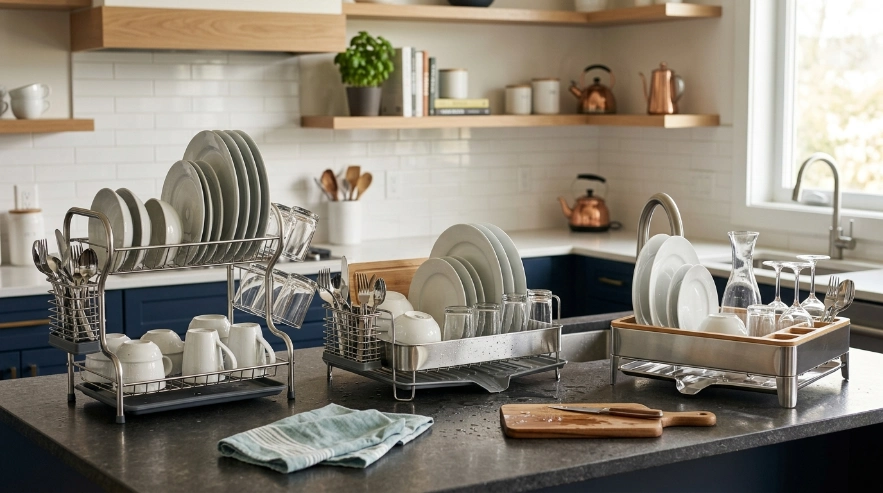
If you’re ready to pick one, these are the types of models I’d compare first. Prices and availability change, so check the retailer before buying.
💰 Best Budget
Sakugi 2-Tier Stainless Steel Dish Rack
★★★★☆
A two-tier layout adds vertical capacity without moving straight into premium pricing. I’d consider this style when counter width is limited but you still wash a fair number of dishes.
⚖️ Best Everyday Pick
OXO Large Capacity Dish Rack
★★★★☆
This type of rack focuses on practical capacity and organized countertop drying. I like the price class for households that want more convenience without jumping to a $100 rack.
🏆 Premium Pick
simplehuman Standard Dish Rack
★★★★★
This premium stainless steel design focuses on drainage, capacity, and a polished countertop appearance. I’d pay this much only when the rack stays out permanently and gets heavy daily use.
Frequently Asked Questions
What is the average price of a dish rack?
A standard household dish rack commonly falls around $20 to $50. Basic models can cost less than $20, while larger stainless steel, expandable, and premium designs can cost $60 to $100 or more.
Are expensive dish racks worth it?
Expensive dish racks can be worth it when you need stronger construction, excellent drainage, large capacity, or better space management. If you only wash a few dishes by hand, a simple lower-cost rack may provide better value.
How much does a stainless steel dish rack cost?
Many stainless steel or steel-heavy dish racks cost around $20 to $100. Price depends on the size, steel construction, drainage system, accessories, finish, and whether the design expands or folds.
How much does an over-the-sink dish rack cost?
Small roll-up or compact over-sink racks may cost around $10 to $30. Larger adjustable racks with multiple shelves and holders often cost $30 to $100+, while specialized oversized systems can go much higher.
Should I buy a dish rack or a drying mat?
A rack is better when you need plates and glasses held upright with good airflow. A drying mat costs less and stores easily, but it provides less organization and may not support larger loads as securely.
Final Takeaway: How Much Should a Kitchen Dish Rack Cost?
A kitchen dish rack can cost anywhere from roughly $5 to $100 or more, but most people don’t need either extreme. For an everyday household kitchen, the $20 to $50 range is a sensible place to start.
Spend more when better drainage, stronger materials, compact storage, or larger capacity solves a real daily problem. Measure your space first, choose the features you need, and then compare prices within that category.
The best-value dish rack isn’t automatically the cheapest one. It’s the rack that fits your sink area, handles your normal dish load, and stays convenient enough that you don’t regret seeing it every day.