
Manual Vegetable Chopper Blades: Complete Guide

Quick Answer
Manual vegetable chopper blades are cutting components that slice, dice, mince, or chop vegetables using hand-powered movement. Common designs include rotating curved blades, straight dicing grids, slicing inserts, and interchangeable cutting plates. The right blade depends on the cut you need, the vegetables being prepared, and the chopper’s mechanism. Keep blades clean and dry, and replace damaged or incompatible assemblies rather than forcing them to work.
Manual vegetable choppers may look similar, but their blades can produce very different results. A pull-cord chopper breaks ingredients into increasingly small pieces, while a grid-style chopper produces more defined cubes. A slicing insert creates thin pieces instead of chopped fragments.
Understanding these differences helps you use the correct attachment, avoid unnecessary cutting resistance, and recognize when a blade needs attention.
What Types of Blades Do Manual Vegetable Choppers Use?
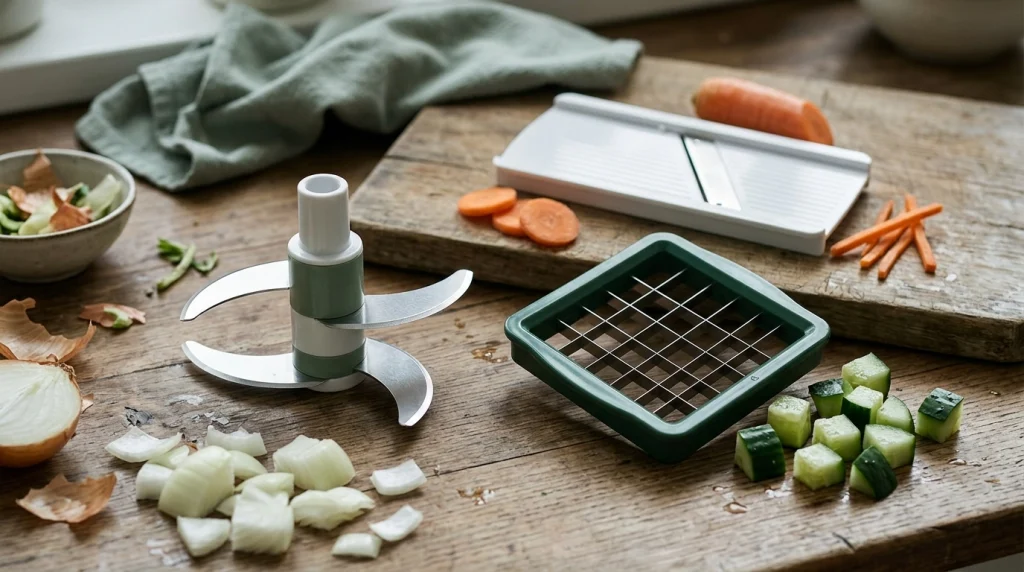
Manual choppers use different blade shapes depending on how force reaches the food. Some blades rotate inside a container, while others stay fixed as vegetables are pushed through them.
Rotating Curved Blades
Rotating blades are common in pull-cord and hand-crank choppers. Several cutting edges may be arranged around a central shaft, often at different heights.
As the mechanism rotates, the edges repeatedly cut food inside the bowl. Additional rotations generally produce smaller pieces, although ingredients do not always become evenly sized.
These blades suit onions, garlic, peppers, herbs, and other ingredients intended for minced or roughly chopped mixtures.
The main limitation is texture control. A rotating blade can leave some large pieces while repeatedly cutting smaller ones, particularly when the bowl is overcrowded.
Straight Dicing Grid Blades
Dicing blades consist of multiple straight cutting edges arranged in a grid. The vegetable is pushed through the openings using a hinged or downward-pressing mechanism.
The grid determines the approximate width and length of the resulting pieces. Larger openings create chunkier cuts, while smaller openings produce finer dice.
These blades are especially useful when consistent pieces matter for salads, soups, and vegetable preparation.
However, a small grid can require substantial pressure when handling dense vegetables. Food should be prepared according to the manufacturer’s instructions rather than forced through the blades.
Slicing and Julienne Inserts
Some manual vegetable cutters include interchangeable slicing or julienne blades.
A slicing blade creates flat pieces, while a julienne insert cuts vegetables into narrow strips. These attachments operate differently from rotating chopping assemblies.
They are useful for cucumbers, zucchini, carrots, and other vegetables when the recipe calls for a particular shape.
Models with exposed cutting surfaces require additional attention to finger placement. Use the supplied food holder or guard when specified.
Which Blade Type Works for Different Vegetables?
Vegetable texture and desired cut matter more than blade count alone. A blade that handles soft onions easily may struggle with a very firm carrot.
The following table shows typical applications, not universal compatibility guarantees.
| Vegetable | Suitable Blade | Practical Consideration |
|---|---|---|
| Onions | Rotating or grid | Cut into manageable sections first. |
| Garlic | Rotating | Small batches help avoid uneven mincing. |
| Carrots | Grid or suitable slicing insert | Firm texture increases cutting resistance. |
| Tomatoes | Sharp grid or slicer | Dull edges can crush soft flesh. |
| Cucumbers | Slicing or grid | Choose according to slice or dice requirements. |
| Fresh herbs | Rotating | Avoid excessive processing into a wet mixture. |
For example, diced cucumber for a salad calls for a different cutting action than finely chopped onion for a sauce. Even when both ingredients fit inside the same container, the blade mechanism determines the result.
How Do Blade Shape and Sharpness Affect Cutting Performance?
Blade performance depends on edge condition, cutting geometry, vegetable texture, and the force applied through the mechanism.
A sharp edge penetrates vegetable surfaces more readily. A dull or damaged edge can increase resistance and may crush softer ingredients rather than cutting them cleanly.
Blade count also needs context. More cutting edges can create additional cutting contact during rotation, but they do not automatically guarantee faster or more uniform chopping.
For rotating assemblies, blade placement and the movement of food inside the bowl influence consistency. For grid cutters, opening size, edge alignment, and the pressing mechanism become more important.
Key Insight
The number of blades is not a reliable standalone measure of performance. Edge sharpness, blade arrangement, food movement, and the mechanical design all influence chopping results.
How to Use Manual Chopper Blades for More Even Cuts
Even chopping starts with preparing the ingredients properly and keeping the mechanism within its intended operating range.
- Inspect the blade assembly. Check for visible damage, loose components, or a poorly seated central shaft before adding food.
- Prepare the vegetables. Remove unsuitable hard portions and cut large vegetables into manageable pieces.
- Avoid overcrowding. Leave enough room for ingredients to move around a rotating blade, or follow the loading limits for a grid cutter.
- Secure the assembly. Fit the lid or pressing mechanism according to the manufacturer’s instructions.
- Apply controlled movement. Use short pulls, turns, or presses rather than excessive force.
- Check the result. Stop the mechanism completely before opening the container. Continue only if additional chopping is needed.
With rotating blades, stopping periodically helps prevent ingredients from becoming too finely processed. With grid blades, consistent ingredient placement can reduce uneven pressure.
Never hold food directly against an exposed cutting edge while operating the tool. Follow the model’s instructions for guards, pushers, and safe hand placement.
Why Are Manual Vegetable Chopper Blades Not Cutting Properly?
Poor chopping does not always mean the blade is dull. The problem may involve loading, ingredient preparation, assembly, or a damaged mechanism.
Vegetables Are Being Crushed Instead of Cut
Check whether the cutting edge is dull or damaged and whether the ingredient is appropriate for the blade. Very soft produce can also deform under pressure.
If cleaning and correct loading do not improve performance, inspect the blade for wear or damage.
Some Pieces Remain Large
Uneven cutting often occurs when ingredients cannot circulate freely around rotating blades.
Try a smaller batch with more evenly sized starting pieces. Stop and inspect the contents before continuing.
The Blade Jams or Stops Moving
Stop operating the chopper immediately. A hard ingredient, excessive loading, or misaligned assembly may be obstructing movement.
Open the unit only after movement has stopped, then remove the blade safely according to its instructions. Never force a stuck pull cord or pressing handle.
Warning
Stop using a blade assembly with cracks, bent cutting edges, loose fasteners, or visible metal damage. Do not try to straighten or reshape a damaged blade while it remains installed.
How to Clean Manual Vegetable Chopper Blades Safely
Clean the blade assembly after use to remove trapped food and reduce contamination risks. The exact washing method depends on the model and its materials.
- Disassemble carefully. Remove the lid and lift the blade using its designated grip, handle, or central shaft.
- Rinse loose residue. Keep the cutting edges visible while rinsing and avoid directing them toward your hands.
- Wash with mild detergent. Use warm, soapy water and a suitable soft cleaning brush, keeping fingers away from sharp edges.
- Check difficult areas. Food can collect around the blade hub, grid openings, and attachment joints.
- Rinse and dry thoroughly. Follow the manufacturer’s drying instructions before reassembly and storage.
The FoodSafety.gov cleaning and separation guidance recommends washing utensils and food-contact surfaces after use and preventing raw-food contamination from reaching ready-to-eat ingredients.
Dishwasher compatibility varies. Some removable blades can be machine-washed, while other assemblies require handwashing. Follow the product instructions rather than assuming stainless steel components are dishwasher-safe.
Pull-cord lids may also contain mechanisms that should not be submerged.
Can Manual Chopper Blades Be Sharpened?
Some metal cutting edges can technically be sharpened, but sharpening is not automatically practical or safe for every manual chopper.
Small curved blades, multi-level assemblies, and closely spaced cutting grids may be difficult to sharpen without altering their geometry.
Incorrect sharpening can leave uneven edges, remove excessive material, or damage the blade’s attachment points.
Before attempting maintenance, check whether the manufacturer permits sharpening or recommends replacement. Never sharpen a blade while installed in the chopper.
For complicated, inexpensive, or non-serviceable assemblies, obtaining a compatible manufacturer-approved replacement may be the safer choice.
When Should You Replace a Manual Vegetable Chopper Blade?
Replace a blade when physical damage or persistent cutting problems make normal operation unreliable.
Warning signs include:
- Chipped, bent, or broken cutting edges.
- Cracked blade hubs or plastic attachment points.
- Loose blades that no longer sit securely.
- Severe corrosion or pitting that cannot be safely resolved.
- Continuing cutting problems after proper cleaning and loading.
Replacement blades are not universally interchangeable. Matching the number of blades or the apparent diameter is not enough.
Check the exact model number, central attachment shape, locking mechanism, blade dimensions, and manufacturer compatibility information.
The OXO Good Grips Chopper use and care booklet illustrates how blade removal and reassembly can require a specific sequence. That sequence should not be assumed to apply to other choppers.
If the original manufacturer cannot confirm a replacement’s compatibility, avoid modifying the attachment to make it fit.
How to Store Chopper Blades Without Damaging Them
Clean, dry storage helps protect blade edges and prevents accidental contact.
Keep removable blades in their intended holder, protective cover, or secured container. Avoid leaving uncovered cutting assemblies loose inside a utensil drawer.
Store the chopper away from children and ensure that loose accessories cannot fall when a cabinet opens.
For models with removable blade cartridges, follow the recommended storage position. Do not assume that leaving exposed blades assembled is always the safest option.
Common Blade Mistakes That Reduce Chopping Performance
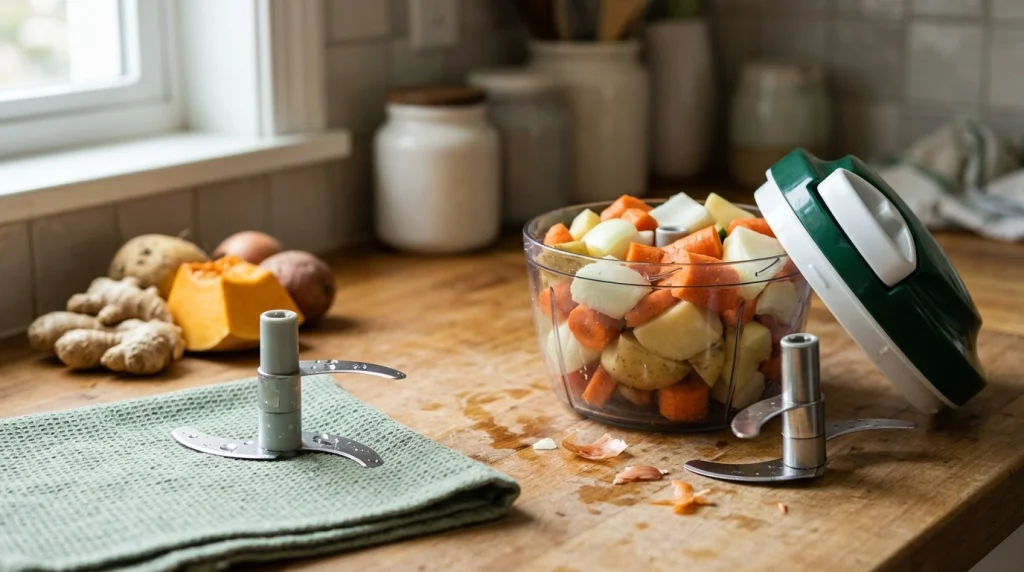
Most avoidable problems involve treating the tool as more versatile than its design allows.
- Forcing hard foods: Ice, bones, and other unsuitable ingredients can damage cutting edges or mechanisms.
- Overfilling the bowl: Packed ingredients restrict movement and produce inconsistent cuts.
- Ignoring attachment alignment: A misplaced blade may jam or damage its mounting components.
- Using excessive pressure: More force does not compensate for a damaged edge or an unsuitable grid.
- Storing parts while wet: Trapped moisture may contribute to staining or corrosion.
- Handling exposed edges during cleaning: Blade removal and washing require the same caution as active cutting.
Correcting the simple issues first can restore performance without unnecessary sharpening or replacement.
Related Product
Manual Vegetable Chopper with Removable Blades
A chopper with removable, easy-to-clean blades can simplify routine food preparation when its cutting style matches your needs.
As an Amazon Associate, we earn from qualifying purchases.
Frequently Asked Questions
Are all manual vegetable chopper blades made of stainless steel?
No. Stainless steel is common, but blade materials and grades vary. Check the manufacturer’s specifications instead of relying on appearance alone.
Can replacement blades from another brand fit my chopper?
Only if compatibility is explicitly confirmed. Similar-looking blades may use different attachment systems, dimensions, or locking mechanisms.
Why do onions become watery in a manual chopper?
Repeated cutting damages more onion cells and releases moisture. Reduce the number of rotations and avoid overprocessing when a coarse texture is desired.
Can I put manual chopper blades in the dishwasher?
Only when the manufacturer identifies the blade assembly as dishwasher-safe. Some models permit machine washing, while others require careful handwashing.
Are three-blade choppers better than two-blade models?
Not necessarily. Blade geometry, sharpness, movement, and bowl design all affect performance. Blade count alone cannot establish which model chops more effectively.
How long should manual vegetable chopper blades last?
There is no universal lifespan. Durability depends on blade construction, usage, cleaning, and the ingredients processed. Inspect the assembly regularly and replace damaged components regardless of age.
Conclusion
Manual vegetable chopper blades work best when their cutting mechanism matches the ingredient and the result you want. Rotating blades are useful for chopping and mincing, while grid and slicing attachments produce more defined shapes.
For consistent performance, prepare ingredients in manageable portions, avoid excessive force, and keep cutting assemblies clean and correctly fitted. Inspect blades periodically for wear, damage, and attachment problems.
If cutting quality declines, check loading and assembly before assuming the blade is dull. When replacement becomes necessary, use a compatible part rather than modifying an unsuitable blade.