Pull Cord Vegetable Chopper: A Simple Guide to Faster Food Prep

Quick Answer
A pull cord vegetable chopper uses a retractable cord to spin sharp blades inside a covered bowl. It works well for quickly chopping onions, garlic, carrots, peppers, herbs, nuts, and similar ingredients without electricity. For more ways to speed up prep, see these practical meal-prep cooking hacks.
How to get better results
- Pre-cut large foods: Cut onions, carrots, and peppers into manageable chunks before loading the bowl.
- Don’t overfill: Leave room for ingredients to move around the spinning blades.
- Pull in short strokes: A few pulls create a coarse chop, while more pulls create finer pieces.
- Keep the base steady: Hold the lid or bowl securely while operating the cord.
- Clean carefully: Remove the blade by its center support rather than touching the cutting edges.
Best suited for
- Small and medium batches where you want fast chopping without setting up an electric food processor.
If chopping one onion feels like too much setup for a full-size food processor, a pull cord vegetable chopper fills a useful middle ground. It’s compact, quiet, cordless, and simple enough for everyday meal prep.
I especially like the amount of texture control this design gives you. You can stop after a few pulls for chunky salsa or continue pulling when you want ingredients much finer.
What Is a Pull Cord Vegetable Chopper?
A pull cord vegetable chopper is a manual food-preparation tool with a bowl, removable blade assembly, lid, retractable cord, and handle. Pulling the handle rotates the blades rapidly around the bowl.
You provide the power instead of an electric motor. That means there are no batteries to charge and no outlet to find.
- Bowl: Holds the vegetables or other ingredients.
- Blade assembly: Usually uses two or more stainless-steel cutting edges.
- Pull mechanism: Converts each cord pull into blade rotation.
- Lid: Covers the blade and contains food while chopping.
- Non-slip base: Helps keep many models stable during operation.
The result isn’t normally a perfectly square dice. A pull chopper produces a chopped or minced texture similar to pulsing ingredients in a small food processor.
How Does a Pull Cord Vegetable Chopper Work?

Pulling the handle extends a cord connected to an internal mechanism. That mechanism spins the blade assembly rapidly before the cord retracts for the next pull.
Think of each pull as a manual food-processor pulse. More pulls generally mean smaller pieces.
- Wash and prepare the vegetables.
- Cut oversized ingredients into smaller chunks.
- Install the blade assembly inside the bowl.
- Add ingredients without packing the container tightly.
- Lock or securely position the lid.
- Hold the chopper steady with one hand.
- Pull the cord smoothly with the other hand.
- Check the texture after several pulls.
- Continue until you reach the consistency you want.
Kuhn Rikon, for example, recommends only a few pulls for coarse chopping and about 20 pulls for a finer result on its Pull Chop. Exact results vary with the ingredient, batch size, and chopper design.
That adjustable texture is useful when a recipe doesn’t require perfectly uniform cubes. Salsa, chopped herbs, onions, nuts, sauces, and dips are good examples.
What Can You Chop in a Pull Cord Vegetable Chopper?
A pull chopper works best with foods that can move freely around its rotating blades. Firm vegetables may need to be cut into smaller chunks first.
Common ingredients include:
- Onions: Useful for soups, curries, sauces, and sautéed dishes.
- Garlic: Several cloves can be chopped together in seconds.
- Bell peppers: Good for salsa, omelets, sauces, and stir-fries.
- Carrots: Cut them into smaller chunks before processing.
- Celery: Useful for soup bases and stuffing mixtures.
- Fresh herbs: Parsley, cilantro, and similar herbs chop quickly.
- Nuts: Short pulls help avoid turning them into an overly fine meal.
- Mushrooms: Useful when you need finely chopped mushrooms for fillings.
Garlic is one of the easiest jobs for a small manual chopper. If garlic is your main concern, my guide to whether a garlic press is worth it compares another useful option.
What should you avoid putting in one?
Don’t assume a small pull chopper can handle everything a full-size food processor can. Extremely hard, frozen, oversized, or bone-containing foods may damage the blades or mechanism.
- Whole large carrots or oversized vegetable pieces
- Ice unless the manufacturer specifically allows it
- Bones or bone-in meat
- Large quantities of dense food packed tightly into the bowl
- Hot ingredients unless the manufacturer approves them
Check the instructions for your particular model before processing unusual ingredients.
Pull Cord Chopper vs Push Chopper vs Electric Food Processor
A pull cord chopper prioritizes compact size and simple chopping. Push-grid choppers create more consistent cubes, while electric processors make more sense for frequent or larger-volume work.
| Feature | Pull Cord Chopper | Push-Grid Chopper | Electric Mini Processor |
|---|---|---|---|
| Power | Manual pull cord | Manual downward pressure | Electric motor |
| Typical result | Chopped to finely minced | Defined cubes or slices | Chopped to puréed |
| Electricity | None | None | Required or rechargeable |
| Texture control | Controlled by number of pulls | Determined by blade grid | Controlled by pulse time |
| Best fit | Quick everyday prep | Uniform diced vegetables | Frequent or larger batches |
If exact cubes matter, a grid-style chopper has the advantage. If you mainly want onions, garlic, herbs, peppers, and similar foods chopped quickly, the pull-cord design is simpler.
A broader understanding of prep technique also helps. These essential cooking skills for home cooks cover cutting, organization, and other useful fundamentals.
How Many Times Should You Pull the Cord?
There isn’t one correct number because ingredients behave differently. The easiest approach is to start slowly and inspect the food before making it finer.
- 3–5 pulls: Start here when you want a rough, chunky result.
- 6–10 pulls: Often suitable for an everyday medium chop.
- 10–15 pulls: Moves many ingredients toward a finer mince.
- Up to about 20 pulls: Some models recommend this range for particularly fine chopping.
Those numbers are guidelines, not guarantees. A quartered onion and a handful of parsley won’t respond identically.
My practical rule is simple: stop earlier than you think you need to. You can always pull again, but you can’t turn an over-processed onion back into larger pieces.
How Do You Get Even Results?
Uneven chopping usually comes from overfilling, oversized pieces, or expecting the tool to create perfect dice. Give the ingredients room to circulate around the blades.
- Start with similar sizes: Quarter onions and cut long carrots into chunks first.
- Use smaller batches: Two moderate batches often work better than one packed bowl.
- Use controlled pulls: Check the bowl instead of pulling continuously without looking.
- Redistribute when needed: If permitted by the manufacturer, stop and reposition larger pieces before continuing.
- Match the tool to the recipe: Use a knife or grid chopper when exact cubes matter.
Uniform ingredient size can affect cooking because differently sized pieces may cook at different rates. Avoiding inconsistent prep is one of several common cooking mistakes worth correcting.
How Do You Use a Pull Chopper Safely?
The enclosed design keeps the blade covered during chopping, but the removable blade itself is still extremely sharp. Most accidents are more likely during loading, unloading, or washing than while pulling the cord.
- Place the chopper on a stable, dry countertop.
- Make sure the blade is seated correctly before adding food.
- Secure the lid before pulling.
- Keep one hand on the lid or bowl as the manufacturer directs.
- Never reach into the bowl while the blade assembly is installed.
- Lift the blade using its center stem or designated grip.
- Keep loose cords, blades, and small parts away from children.
Wash fresh produce before cutting it. The FDA’s produce-safety guidance recommends rinsing fruits and vegetables under running water rather than using soap or detergent.
It’s also smart to keep produce-prep surfaces separate from raw meat when possible. The USDA’s cutting-board guidance explains how cleaning and separation help reduce cross-contamination.
How Do You Clean a Pull Cord Vegetable Chopper?
Clean the chopper shortly after use so onion pieces, herbs, and other foods don’t dry onto the bowl or blades. Always check the model’s care instructions first.
- Remove the lid.
- Lift the blade assembly by its center section.
- Empty the chopped food.
- Wash the bowl and approved removable pieces with warm, soapy water.
- Clean around the blade carefully without gripping its cutting edges.
- Wipe the pull-cord lid if it isn’t immersible.
- Dry everything completely before reassembly or storage.
Some bowls and blades are dishwasher-safe while pull-cord lids often are not. For example, Zyliss specifies that its Easy Pull bowl and blades are dishwasher-safe but its cord lid should be hand cleaned.
General FDA safe-food-handling guidance also recommends washing food-contact utensils and surfaces with hot, soapy water after preparation.
What Should You Look for When Buying One?
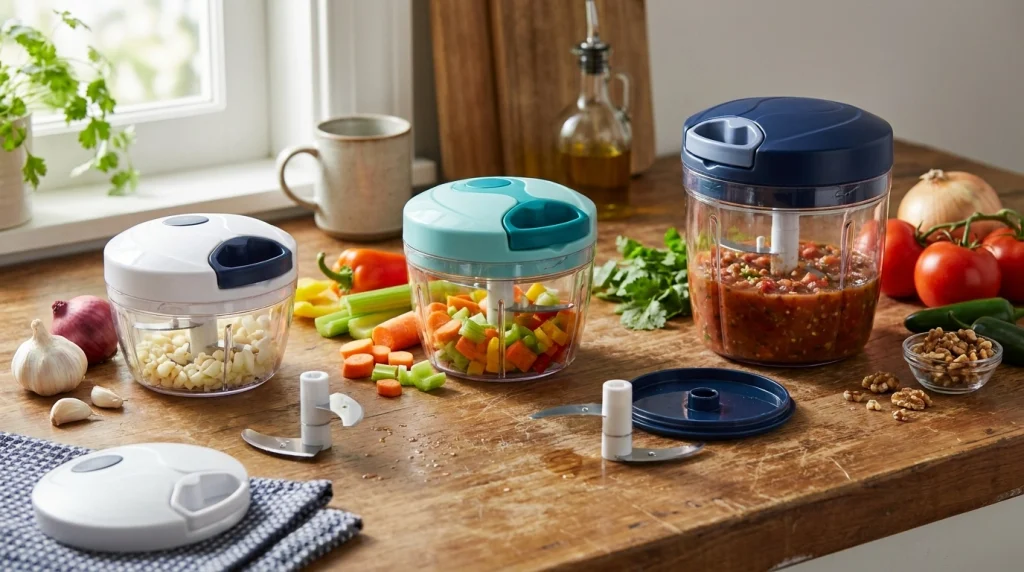
The mechanism matters, but capacity and cleanup usually make a bigger difference in daily use. A cheap chopper isn’t useful if it’s too small for your normal recipes.
- Capacity: Small bowls suit garlic and single onions, while larger bowls help with salsa and meal prep.
- Blade arrangement: Multiple blades at different heights can contact ingredients throughout the bowl.
- Non-slip base: Helpful because pulling the cord creates sideways force.
- Comfortable handle: A larger grip can make repeated pulls easier.
- Simple disassembly: Fewer awkward crevices usually make cleanup easier.
- Replacement parts: Check whether blades or other components can be replaced.
- Clear care instructions: Know whether the bowl, blade, and lid are dishwasher-safe.
How much capacity do you need?
For garlic, herbs, and one small onion, a compact bowl may be enough. Larger batches benefit from extra capacity because ingredients need space to move.
| Model | Published Capacity | Good Fit For |
|---|---|---|
| Kuhn Rikon Pull Chop | 2-cup model available | Compact everyday chopping |
| Zyliss Easy Pull | 800 ml / 27 oz | General household prep |
| Brieftons QuickPull Large | 4 cups | Larger manual batches |
Are Pull Cord Vegetable Choppers Worth It in 2026?
Yes, for the right kitchen. A pull cord vegetable chopper is most useful when you regularly need a small amount of chopped food but don’t want the setup and cleanup of an electric processor.
It’s less convincing if you need precise cubes, process large batches daily, or dislike repetitive pulling. In those situations, a sharp knife, push-grid dicer, or electric processor may suit you better.
I see the pull chopper as a convenience tool rather than a knife replacement. It earns its storage space when it handles the repetitive jobs you would otherwise postpone.
If you’re ready to choose one, these are three practical pull-cord styles worth comparing:
🏆 Best All-Around Pick
Zyliss Easy Pull Food Chopper & Processor
★★★★★
The current U.S. model has an 800 ml (27 oz) bowl and three stainless-steel blades. I like this size for cooks who want enough capacity for everyday prep without moving into full-size food-processor territory.
🥕 Best Compact Pick
Kuhn Rikon Pull Chop
★★★★☆
Kuhn Rikon offers compact pull-chop models with steel blades, a non-slip base, and cord-powered operation. I’d consider it when storage space matters and most jobs involve onions, garlic, herbs, carrots, or mushrooms.
🥗 Best for Bigger Batches
Brieftons QuickPull 4-Cup Food Chopper
★★★★☆
The 4-cup bowl gives you more working room than many compact pull choppers, and the design includes stainless-steel blades and an anti-skid base. It makes sense when salsa, salads, nuts, or larger vegetable batches are common.
Frequently Asked Questions
Are pull cord vegetable choppers good for onions?
Yes. Onions are one of the most practical foods for a pull cord vegetable chopper. Cut the onion into several chunks first, avoid overfilling the bowl, and use short pulls until you reach the texture you need.
Can a pull cord chopper mince garlic?
Yes. Most pull choppers can handle several peeled garlic cloves at once. More pulls generally create a finer result, although the final texture may still differ from garlic crushed through a press or grated with a microplane.
Can you put carrots in a pull cord chopper?
Yes, if the manufacturer’s instructions allow them. Cut firm carrots into relatively small chunks first instead of putting a whole carrot into the bowl. Smaller pieces reduce strain on the blade mechanism and usually produce more even results.
Can a pull chopper make salsa?
Yes. Pull-cord choppers work particularly well for chunky salsa because you control texture through the number of pulls. Add appropriately sized tomato, onion, pepper, cilantro, and other ingredients, then stop frequently to check the consistency.
Is a pull cord chopper better than a food processor?
Neither is universally better. A pull chopper is compact, quiet, manual, and convenient for smaller jobs. An electric food processor is usually better for frequent processing, larger quantities, thick mixtures, or recipes requiring more sustained power.
Final Takeaway
A pull cord vegetable chopper is a simple way to shorten repetitive prep without adding another electric appliance to your counter. It works particularly well for onions, garlic, herbs, peppers, carrots, nuts, and small batches of ingredients.
Choose enough capacity for your normal recipes, don’t overfill the bowl, and treat each pull like a food-processor pulse. With the right technique, this little tool can become one of the quickest shortcuts in your everyday kitchen.
