Manual Vegetable Chopper Capacity: Size Guide

Quick Answer
Manual vegetable chopper capacity is the volume of its bowl, usually shown in milliliters or cups. A compact 250–350ml chopper suits garlic and small garnishes; approximately 500ml is convenient for small everyday batches; and 900ml or more offers room for larger preparations. These are sizing guides, not guaranteed chopping quantities. Always follow your model’s fill line and leave enough space for ingredients to move around the blades.
What Does Manual Chopper Capacity Actually Measure?
A manual chopper’s stated capacity usually describes the internal volume of its container. It tells you roughly how much space the bowl holds, not necessarily how much food its blades can chop evenly in one operation.
That distinction matters because vegetables need room to shift and tumble. If chunks are packed tightly against the lid or around the blade shaft, the blade may repeatedly cut the same lower pieces while leaving larger pieces untouched above.
Capacity also depends on the type of food and the result you want. Loose herb leaves occupy a lot of space before chopping. Diced carrots pack more densely. Tomatoes release juice, which introduces a separate spill or liquid-fill consideration.
Think of bowl capacity as a size label and working capacity as the practical batch limit. They are connected, but they are not interchangeable.
Manual Vegetable Chopper Sizes Compared
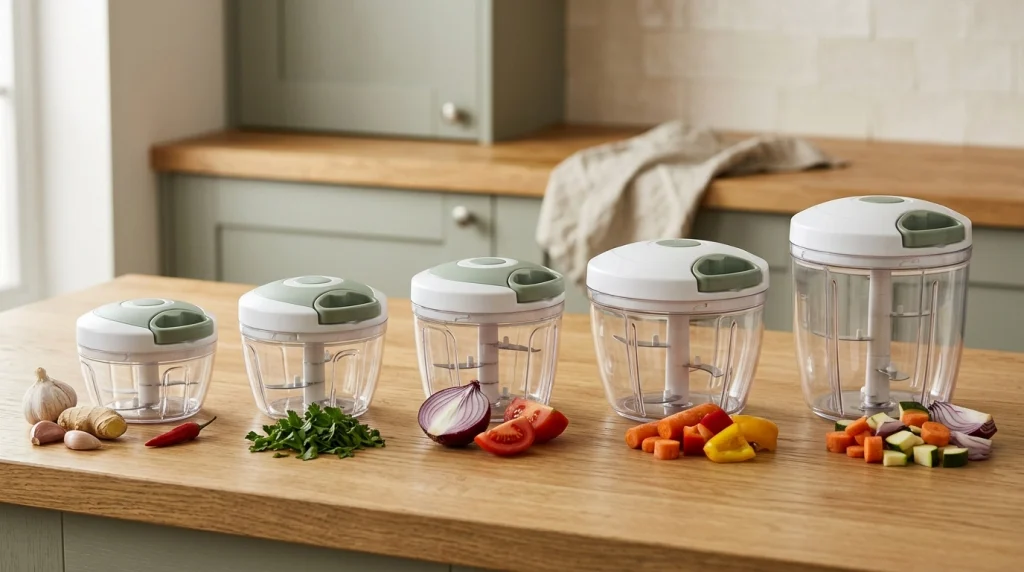
Manual pull-cord choppers are sold in a wide range of sizes, including compact 500ml and larger 900ml versions. The following guide translates approximate container volume into typical kitchen tasks rather than promising an exact number of vegetables.
| Rated bowl size | Approx. US cups | Practical use |
|---|---|---|
| 250ml | 1.1 cups | Garlic, ginger, chili and small garnishes |
| 350ml | 1.5 cups | Small servings of aromatics or chopped herbs |
| 500ml | 2.1 cups | Modest onion, tomato or salad-prep batches |
| 900ml | 3.8 cups | Larger batches of chopped vegetables and dip ingredients |
| 1,000ml+ | 4.2+ cups | Larger preparation jobs, if supported by the mechanism |
The cup equivalents are mathematical conversions of bowl volume, not measured vegetable yields. A large bowl may still require multiple batches when processing firm, bulky ingredients.
How Much Can You Actually Chop at Once?
The safe and effective load is the smaller of two limits: the manufacturer’s permitted fill level and the amount that leaves the blades free to move through the food. There is no reliable fill percentage that applies to every manual chopper.
For example, the Salter press chopper instructions advise filling that specific press-style device no more than one-quarter full for best results. That recommendation should not be treated as a universal limit for pull-cord bowls, whose blade arrangement and operation differ.
Some models display a MAX line or state a quantity in their instructions. Follow that instruction first. If your model provides neither, start with a modest, loosely arranged batch and observe whether the blades turn smoothly and distribute the food evenly.
Why a 500ml bowl cannot always chop 500ml of vegetables
A 500ml bowl already includes space occupied by its central blade assembly. When you add chunky vegetables, gaps remain between pieces. The blade needs additional clearance for cutting and circulating those pieces.
Filling the container to its brim could block movement, make the lid hard to close, or overload the pull mechanism. So a larger listed capacity is not permission to pack the bowl completely.
Why the same load behaves differently with different vegetables
Carrots are firm and need smaller starting pieces than soft tomatoes. Onion layers may separate as chopping proceeds, while fluffy herbs shrink dramatically once cut. Wet mixtures can splatter or rise toward the lid.
Two bowls filled to the same visible level therefore may produce very different chopping results. Judge the load by texture, movement, and the model’s instructions—not volume alone.
Which Capacity Makes Sense for Your Cooking?
Choose according to the quantities you usually prepare at one time, rather than the largest bowl available.
Small aromatics: approximately 250–350ml
If your main tasks involve a few garlic cloves, sliced ginger, chilies, or herb garnishes, a small bowl is convenient. Ingredients can stay closer to the blades instead of spreading thinly across a large container.
The tradeoff is frequent emptying when you prepare vegetables for a full meal. A tiny unit is less practical for chopping several onions or preparing a large salad.
Everyday small batches: approximately 500ml
A 500ml pull-cord chopper offers a useful middle ground for a modest portion of onion, tomato, cucumber, or mixed aromatics. It occupies less storage space than a large machine and can be emptied quickly between ingredients.
If you frequently prepare multiple cups of chopped vegetables, however, you will probably need several rounds. The amount per round depends on how the food is cut and the chopper’s allowed working load.
Larger prep sessions: approximately 900ml or above
A larger bowl is useful for preparing salsa ingredients, mixed vegetable bases, or food for more than one serving. For a real example of this size class, Tefal lists a 900ml manual food chopper with pull-cord operation.
Key Insight
A capacity that matches your usual single chopping batch is more useful than a larger capacity you rarely fill effectively.
How to Estimate the Capacity You Need
You can evaluate your real preparation habits without guessing how many onions fit into a particular model.
- Choose a representative meal. Think about a recipe you prepare regularly, such as a vegetable filling, soup base, or chopped salad.
- Prepare ingredients first. Peel, core, and cut them into pieces suitable for the chopper design.
- Measure the amount. Place the prepared pieces loosely in a measuring jug. Do not compress them.
- Compare with bowl volume. Remember that the chopper cannot necessarily process the measured amount in one load, even if the volumes match.
- Plan realistic batches. Choose a bowl that allows free blade movement under the manufacturer’s fill guidance.
This method is more useful than a claim such as “one chopper holds two onions,” because onion sizes and cut sizes vary substantially.
How to Fill a Manual Chopper for Even Results
Correct loading can improve chopping consistency even when the bowl is comparatively small.
- Seat the blade assembly correctly. Follow the manufacturer’s assembly instructions and keep fingers away from sharp edges.
- Cut large pieces down. Make pieces small enough to sit around, rather than jam against, the blade.
- Add a loose batch. Stay below the marked fill limit and avoid packing ingredients down.
- Close and lock the lid. Ensure the container is stable before operating it.
- Use controlled pulls or presses. Stop and check the texture instead of assuming one long session produces even pieces.
- Empty before the next batch. Wait for movement to stop, then open and remove the blade as instructed.
Different models require different operating motions. Do not force a stuck cord, crank, or press mechanism. Stop and check for overfilling or lodged food according to the instructions.
Signs Your Batch Is Too Large
If a manual chopper performs poorly, excess food may be the issue rather than insufficient blade sharpness. Watch for several practical signs:
- Uneven texture: some pieces become finely minced while others remain large.
- Restricted movement: the handle or cord feels unusually difficult to operate.
- Poor lid fit: ingredients prevent the top from seating securely.
- Food trapped above the blades: upper pieces do not reach the cutting zone.
- Leaks: wet ingredients rise toward openings or spill while chopping.
When these appear, stop, open the unit only after the blades have stopped, and reduce the batch. Never reach into the bowl while the blade assembly can move.
Capacity Versus Other Features That Affect Chopping
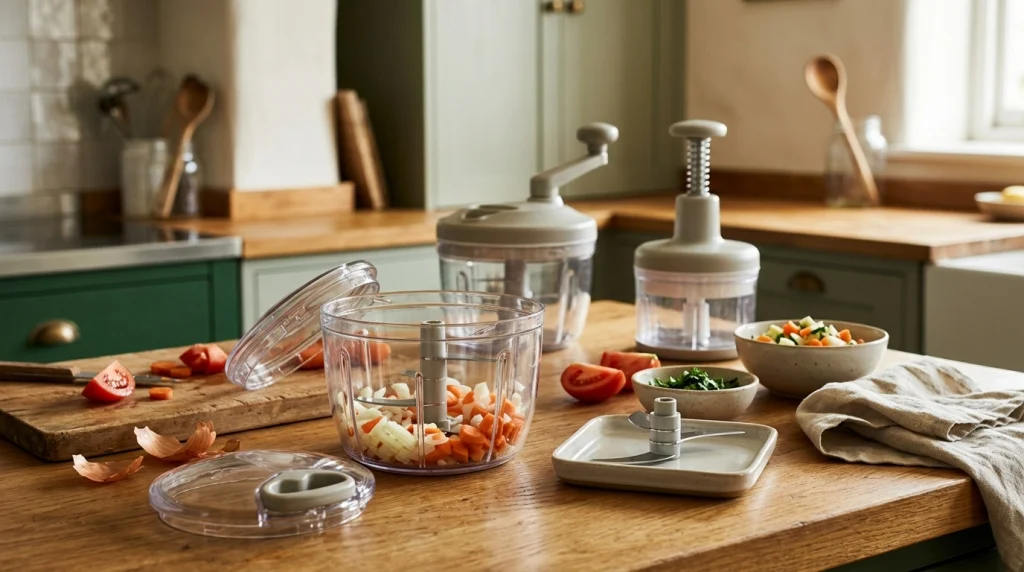
Bowl volume is only one aspect of usability. Before judging a model by its capacity label, consider the cutting system and your expected foods.
Blade arrangement: the position and number of cutting edges affect which parts of the bowl are reached. A larger bowl with poor circulation can leave more uneven pieces than a smaller, well-matched design.
Manual mechanism: pull-cord, rotating-handle, and press-style choppers operate differently. Their fill guidance may differ substantially, even at the same nominal bowl size.
Ingredient suitability: manufacturers may exclude ice, frozen foods, bones, or particularly hard ingredients. More capacity does not expand the list of permitted foods.
Cleaning and storage: a larger bowl takes up more room and may involve more awkward blade handling. Choose one you can disassemble and clean safely after each use.
Liquid limits: the capacity of a bowl for dry vegetables may differ from the permitted level for sauces or watery mixtures. Do not assume a 900ml container safely handles 900ml of liquid.
Warning
Never bypass the fill line, force a jammed mechanism, or push vegetables toward a moving blade with your fingers. Stop the chopper and follow its disassembly instructions before clearing a blockage.
Common Capacity Mistakes to Avoid
One mistake is treating the listed milliliters as a guaranteed quantity of chopped food. The stated volume may be a bowl specification rather than an operational load rating.
Another is choosing the biggest available size without considering the smallest batches you prepare. If you mostly mince garlic, a large bowl may leave those cloves scattered away from effective blade contact.
A third is using the same amount for every ingredient. Half a bowl of herbs may behave differently from half a bowl of firm carrot chunks, and watery tomatoes require more attention to leakage.
Finally, avoid using conversion tables as filling instructions. Knowing that 900ml is about 3.8 US cups helps compare product sizes. It does not mean you should pour 3.8 cups of salsa into the chopper or process 3.8 cups of raw vegetables in one batch.
Related Product
Manual Pull-Cord Vegetable Choppers
Compare bowl sizes and manufacturer fill guidance when selecting a chopper for your usual vegetable-prep batches.
As an Amazon Associate, we earn from qualifying purchases.
Frequently Asked Questions
Is a 500ml vegetable chopper big enough for one onion?
It may be suitable for a small or medium onion cut into manageable pieces, but there is no guaranteed onion count. Onion sizes and fill limits vary. If the lid or blades are crowded, chop the onion in batches.
Is 900ml the same as four cups?
Not exactly. 900ml is approximately 3.8 US measuring cups. This converts the bowl’s volume; it does not establish how many cups of ingredients the chopper can safely process.
Does a larger chopper make food chop faster?
Not necessarily. A larger bowl can reduce the number of batches, but cutting speed also depends on blade design, the manual drive mechanism, food texture, and how freely the ingredients circulate.
Can I use the full bowl capacity for salsa?
Only if your model explicitly permits that amount and type of mixture. Chopped tomatoes release juice, so liquid-fill restrictions may apply. Follow the model’s limit and leave room for movement.
Why does my manual chopper leave big pieces on top?
Overfilling, oversized chunks, or poor ingredient circulation can keep food away from the cutting area. Try a smaller batch with more evenly sized pieces, and verify that the blade is installed correctly.
How do I find the capacity of a chopper I already own?
Check the model number, packaging, bowl markings, or instruction manual first. If none is available, water measured into the empty bowl can estimate its physical volume, but that measurement must not be treated as a safe chopping or liquid-fill limit.
Final Takeaway
For small aromatics, a compact manual chopper may be enough; for everyday vegetables, 500ml is a practical size to consider; and for larger preparation sessions, 900ml or more can reduce batch changes. The right capacity is the one that handles your usual ingredients comfortably below its permitted fill limit, not the one with the largest number on the label.