Why Use a Vegetable Chopper? Practical Benefits for Everyday Cooking

Quick Answer
A vegetable chopper is useful when you want to prepare onions, peppers, potatoes, cucumbers, and similar ingredients faster and with more consistent sizing. It can make large meal-prep jobs less repetitive, although you still need to wash produce and keep the tool clean according to basic produce safety guidelines.
Why people use vegetable choppers
- Faster prep: A press-style chopper can dice several pieces with one downward motion.
- Uniform pieces: Grid blades make similarly sized cubes for salads, soups, tacos, and meal-prep bowls.
- Less repetition: You avoid making dozens of individual knife cuts when preparing larger batches.
- Contained mess: Many models collect chopped food directly inside a container.
- Beginner friendly: A chopper can produce predictable shapes without advanced knife skills.
- Useful for batches: It becomes especially convenient when several vegetables need the same dice size.
One limitation to remember
- A chopper does not replace a good knife completely, and its sharp inserts still require careful handling and cleaning.
If you regularly cook with fresh vegetables, chopping can become one of the most repetitive parts of dinner prep. A vegetable chopper gives you another way to handle that job without replacing every knife in your kitchen.
I see it as a specialized prep tool rather than a magic shortcut. Used for the right ingredients, it can make salads, soups, stir-fries, tacos, and weekly meal prep feel much more manageable.
What is a vegetable chopper?
A vegetable chopper is a kitchen tool designed to cut produce into smaller, more uniform pieces. Manual versions commonly press food through a sharp grid, while other designs use rotating blades or pulling mechanisms.
The press-style version is especially useful for dicing. You position a manageable piece of food over the blade grid, close the lid, and the cut pieces fall into a container underneath.
- Grid choppers: Best for cubes and repeated dicing.
- Pull choppers: Best for rough chopping herbs, onions, garlic, and softer ingredients.
- Electric choppers: Better when you want powered chopping or finer textures.
- Multi-blade choppers: Add slicing, julienne, grating, or spiralizing inserts.
The best style depends on what you cook. Someone making chopped salads may prefer a grid chopper, while a cook making salsa might prefer a pull-style model.
Why use a vegetable chopper instead of a knife?
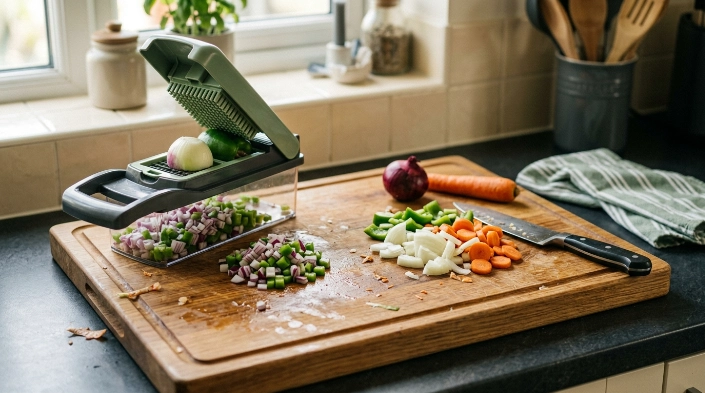
The main reason is speed during repetitive prep. A knife offers more control, but a chopper can handle repeated same-size cuts with fewer individual motions.
That difference becomes more noticeable as the amount of produce grows. Chopping half an onion may not justify another tool, but preparing onions, peppers, cucumbers, and potatoes for several meals can.
| Feature | Vegetable chopper | Chef’s knife |
|---|---|---|
| Repeated dicing | Fast and consistent | Depends on knife skills |
| Cut-size control | Limited by blade inserts | Highly flexible |
| Irregular ingredients | Can require pre-cutting | Easy to adapt |
| Cleanup | Several parts may need washing | Knife and board only |
| Best use | Batch preparation | Precision and versatility |
My practical rule is simple: the more repeated cuts a recipe needs, the more useful a chopper becomes. For one tomato, I reach for a knife; for a large bowl of evenly diced vegetables, a chopper makes more sense.
What are the main benefits of using a vegetable chopper?
A vegetable chopper can improve convenience rather than the food itself. Its strongest benefits are speed, consistency, reduced repetitive cutting, and easier collection of prepared ingredients.
1. It can speed up meal preparation
Grid-style choppers cut an ingredient in several places during one press. That can reduce the number of individual cuts needed for a large batch.
This is helpful when preparing ingredients for several meals at once. Onions, bell peppers, cucumbers, zucchini, and similar produce are common candidates.
2. It produces more consistent pieces
Fixed blade grids create pieces with fairly similar dimensions. That makes salads look neater and can help similarly sized pieces cook at a more similar rate.
A chopper will not create perfect results with every ingredient. Soft tomatoes may crush, while extremely hard vegetables can require smaller starting pieces.
3. It can reduce repetitive knife work
Dicing vegetables by hand requires the same wrist and knife movements many times. A press-style chopper changes that process into fewer, larger motions.
This does not make a chopper risk-free. The inserts are sharp, so fingers should stay away from blade openings during use and cleaning.
4. It can keep chopped food contained
Many choppers place a collection container below the blade. Vegetables fall directly into that container instead of spreading across the cutting board.
I find this design most useful with onions and peppers. It makes transferring several cups of diced ingredients into a pan or storage container straightforward.
5. It makes consistent chopping easier for beginners
Good knife technique takes practice. A fixed grid removes much of the judgment involved in creating repeated cubes of the same approximate size.
That can make recipes with instructions like “finely dice” or “cut into even cubes” feel less intimidating. You still need a knife for trimming and pre-cutting larger pieces.
6. It can be useful for weekly meal prep
A chopper becomes more valuable when you prepare several servings at once. The setup and washing time are easier to justify when the tool handles a larger quantity.
- Chopped onions for several dinners
- Bell peppers for omelets and stir-fries
- Cucumber for salads and lunch bowls
- Potatoes for soups or roasting
- Celery for soups and meal-prep containers
If you cook only one small portion at a time, the extra parts may feel less convenient. A knife may remain faster once cleanup is included.
Does a vegetable chopper make cooking safer?
A vegetable chopper changes how your hands interact with the cutting process, but it should not be treated as automatically safer. The blades are extremely sharp and need the same respect you would give a knife.
Press-style designs can keep fingers farther from repeated knife strokes during normal chopping. However, injuries can still happen when installing, removing, or washing the blade inserts.
- Use the lid or food pusher: Never force food through exposed blades with your fingers.
- Use stable placement: Put the chopper on a flat, dry surface before pressing.
- Pre-cut large produce: Smaller pieces need less force and fit the blade area properly.
- Clean carefully: Use the supplied cleaning tool or a brush around tight blade grids.
- Store inserts securely: Loose blades in a drawer can create an avoidable hazard.
Food safety matters too. The FDA’s safe food-handling guidance recommends washing utensils, cutting boards, and food-contact surfaces after preparation.
Keep equipment used for produce away from contamination from raw meat, poultry, and seafood. The USDA’s cutting-board guidance also stresses cleaning and preventing cross-contamination.
What vegetables work best in a vegetable chopper?
Firm vegetables that can sit flat against the blade grid usually give the easiest results. Extremely soft, fibrous, or oversized ingredients may need another cutting method.
| Ingredient | Chopper suitability | Preparation tip |
|---|---|---|
| Onion | Excellent | Quarter large onions first |
| Bell pepper | Excellent | Remove stem, seeds, and ribs |
| Cucumber | Excellent | Cut into sections before dicing |
| Potato | Good | Slice into manageable slabs first |
| Carrot | Good with care | Use smaller pieces to avoid excessive force |
| Ripe tomato | Mixed | Use a sharp grid and gentle pressure |
Wash fresh produce under running water before cutting it. The FDA advises against using soap or household detergent on fruits and vegetables.
When is a vegetable chopper not worth using?
A vegetable chopper is less useful when you need precision, unusual shapes, or only a tiny amount of food. It also loses convenience if cleaning its grid takes longer than the chopping job.
- Small quantities: One shallot or half a pepper is usually faster with a knife.
- Precision cuts: A knife gives better control over thickness, angles, and decorative cuts.
- Very soft produce: Delicate tomatoes or ripe fruit may crush instead of cutting cleanly.
- Large hard vegetables: Sweet potatoes and similar foods can require too much pressure unless pre-cut.
- Limited storage: Multi-blade sets can occupy more cabinet space than expected.
- Cleanup-sensitive cooks: Blade grids often trap small vegetable pieces.
A good chef’s knife remains more versatile overall. I would treat a vegetable chopper as a companion tool for repetitive jobs rather than a replacement for basic knife skills.
How do I get better results from a vegetable chopper?
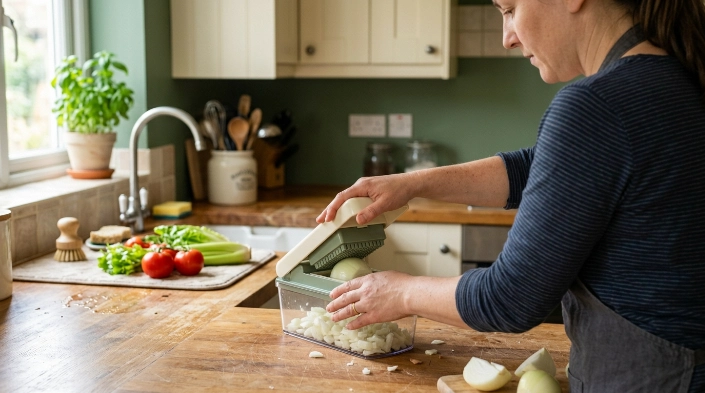
Good results come from matching the ingredient size to the blade and avoiding unnecessary force. A few preparation habits also make cleaning easier.
- Wash the produce first. Rinse vegetables under running water before cutting.
- Trim unusable parts. Remove stems, seeds, tough ends, or damaged areas.
- Cut large ingredients down. Make pieces small enough to fit flat across the blade grid.
- Place the food flat-side down. Stable food tends to pass through the grid more cleanly.
- Press firmly and smoothly. Avoid slowly forcing a hard ingredient through an unsuitable blade.
- Empty the container before it overfills. Extra food underneath can interfere with the next cut.
- Clean soon after use. Fresh vegetable residue is easier to remove than dried pieces.
One mistake I would avoid is using maximum force whenever food gets stuck. Resistance often means the piece is too large, too hard, or poorly positioned.
Is a vegetable chopper worth buying in 2026?
A vegetable chopper is worth considering if you regularly dice several vegetables, batch-prep meals, or value consistent pieces more than precision knife work. It makes less sense for occasional cooks who prepare only small amounts.
The deciding factor is frequency. A tool that saves effort three or four times each week is easier to justify than one that stays in a cabinet for months.
- Good fit: Meal preppers, salad makers, families, beginner cooks, and anyone who frequently dices onions or peppers.
- Less useful: Minimalist kitchens, highly skilled knife users, and cooks who prepare small portions.
- Look for: Sharp stainless steel blades, a stable base, manageable storage, and parts that are easy to clean.
As of 2026, both simple single-purpose choppers and multi-blade systems are widely available. I prefer choosing the simplest model that covers the cuts I genuinely make.
If you’re ready to pick one, here are two styles I would consider based on how much versatility you need:
🏆 Best simple design
OXO Good Grips Vegetable Chopper with Easy-Pour Opening
★★★★☆
OXO uses a stainless steel blade pattern, recessed cutting area, collection container, and easy-pour opening. I like this style for cooks who mainly want straightforward chopping without managing a large collection of inserts.
🥗 Best for versatile prep
Fullstar Original Vegetable Chopper
★★★★☆
Fullstar offers configurations with interchangeable stainless steel blades for chopping, slicing, and other prep tasks, plus a catch container and non-skid base. I would choose this approach when one compact tool needs to handle several vegetable-prep styles.
Frequently asked questions
Does a vegetable chopper really save time?
It can save time when you need many similar cuts, especially for onions, peppers, cucumbers, potatoes, and meal-prep vegetables. For one small ingredient, a knife may still be quicker once assembling and washing the chopper are included.
Can a vegetable chopper replace a knife?
No. A chopper handles repetitive cutting well, but you will still need a knife for trimming produce, cutting large ingredients into manageable sections, making precise cuts, and preparing foods that do not fit the chopper.
Are vegetable choppers good for onions?
Yes, onions are one of the most practical ingredients for grid-style choppers because they can be quartered and diced quickly into consistent pieces. Choose an appropriate grid size and avoid overloading the cutting area.
Can I put a vegetable chopper in the dishwasher?
It depends on the specific model and component. Some manufacturers label their choppers dishwasher-safe, while others recommend hand washing certain blades or parts, so always follow the care instructions supplied with your chopper.
What should I look for when buying a vegetable chopper?
Look for sharp stainless steel blades, a stable non-slip base, blade sizes that match your cooking habits, comfortable leverage, and parts that are easy to clean. A simple chopper you use regularly is usually more useful than a complicated set you dislike washing.
Final takeaway
So, why use a vegetable chopper? Its strongest advantage is making repetitive vegetable prep faster, more consistent, and easier to organize.
It will not replace a sharp chef’s knife, and it does create extra parts to clean. For frequent salads, soups, tacos, stir-fries, and meal-prep sessions, though, it can earn a permanent place in your kitchen.
Start with the vegetables you already chop most often. If you regularly face a cutting board full of onions, peppers, cucumbers, or potatoes, a well-designed chopper may remove one of the most repetitive jobs from your cooking routine.
