
Pull Cord Chopper for Herbs: How to Choose and Use One

Quick Answer
A pull cord chopper for herbs is a manual kitchen tool that spins sharp blades inside a bowl when you pull a handle attached to a retractable cord. It works well for chopping small batches of parsley, cilantro, mint, and other suitable herbs without electricity. For the best results, dry the leaves, remove tough stems, use small batches, and pull the cord until you reach your preferred texture.
What to look for in an herb chopper
- Sharp blades: Stainless steel blades can chop tender leaves and suitable aromatics efficiently.
- Compact bowl: A smaller container helps keep a modest quantity of herbs near the blades.
- Secure lid: A lid that locks firmly onto the bowl helps prevent spills during chopping.
- Easy cleaning: Removable blades and a washable bowl simplify cleanup after preparing herbs.
- Controlled pulls: Short, repeated pulls let you check the texture before the leaves become too fine.
One important tip
- Check the manufacturer’s instructions before washing the lid, because water can damage some pull-cord mechanisms.
Fresh herbs can transform a simple soup, salad, sauce, or homemade chutney, but chopping them by hand takes time. I would look at a pull cord chopper when I wanted a compact, electricity-free way to prepare small amounts for everyday cooking.
In this guide, I’ll explain how these choppers work, which herbs they handle best, and what to check before buying one. I’ll also compare them with knives and other choppers so you can choose a tool that fits your kitchen.
What Is a Pull Cord Chopper for Herbs?
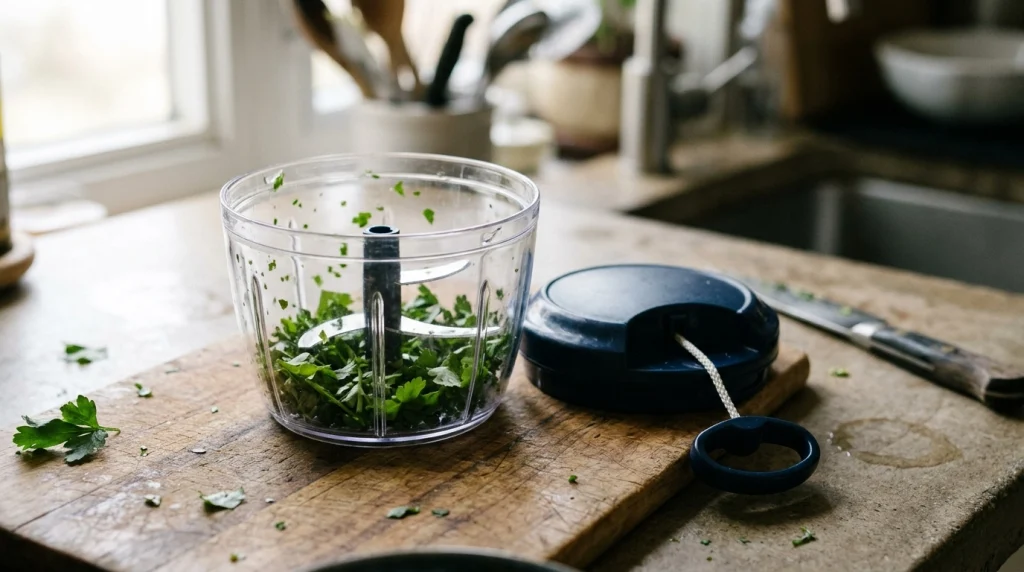
A pull cord chopper for herbs is a manual food-preparation tool with a bowl, a blade assembly, and a lid containing a retractable cord mechanism. Pulling the handle spins the blades inside the bowl, cutting herbs into smaller pieces without a motor or electrical connection.
Most models let you adjust the texture by changing how many times you pull the cord. Fewer pulls generally produce a coarser chop, while more pulls create finer pieces, although results depend on the herbs, quantity, blade design, and model.
How does the pull cord mechanism work?
The cord connects to a mechanism inside the lid, which turns the blade assembly when you pull the handle. Many designs retract the cord automatically when you release it, preparing the mechanism for another pull.
The process is simple, but the details vary by model. A chopper with multiple blades may cut differently from one with a single blade, so check the manufacturer’s specifications rather than assuming every model performs identically.
Which Herbs Can You Chop With a Pull Cord Chopper?
A pull-cord chopper is useful for many fresh culinary herbs, especially when you prepare a small quantity for a single meal. Drying the leaves after washing them helps prevent excess moisture from collecting in the bowl.
| Herb | Suitability | Preparation tip |
|---|---|---|
| Parsley | Good | Remove thick stems and dry the leaves. |
| Cilantro or coriander leaves | Good | Use dry leaves and tender stems if desired. |
| Mint | Good | Use gentle, controlled pulls to avoid overchopping. |
| Basil | Suitable | Use small batches and stop before the leaves become pasty. |
| Dill | Suitable | Separate large, tough stems before chopping. |
| Rosemary | Model-dependent | Remove woody stems and check the manufacturer’s guidance. |
This comparison describes general suitability, not a guarantee for every chopper. Always follow the product instructions, especially when working with fibrous herbs or ingredients that could strain the mechanism.
Can you chop garlic, onions, and chilies too?
Many pull-cord choppers handle small pieces of garlic, onion, and chili as well as herbs. These ingredients can be useful when preparing a quick salsa, marinade, dressing, or chutney base.
Cut larger ingredients into smaller chunks first. Avoid hard, frozen, or unusually tough foods unless the specific model explicitly supports them.
How Do You Use a Pull Cord Chopper for Fresh Herbs?
The key is to prepare the herbs properly, avoid overfilling the bowl, and check the texture as you work. You don’t need to pull the cord as many times as possible to get a good result.
- Wash the herbs. Rinse away visible dirt and discard damaged leaves.
- Dry them thoroughly. Use a salad spinner or clean kitchen towel to remove excess water.
- Remove tough stems. Keep tender stems only when suitable for the herb and recipe.
- Install the blade assembly. Position it as directed, keeping your fingers away from the cutting edges.
- Add a small batch. Follow the model’s fill limit rather than packing the bowl tightly.
- Lock the lid. Make sure it fits securely before placing the chopper on a stable surface.
- Pull the cord steadily. Use controlled pulls and let the mechanism retract as intended.
- Check the texture. Stop when the herbs reach the size your recipe requires.
- Remove the herbs safely. Open the lid and remove the blade assembly carefully before scraping out the chopped ingredients.
Some manufacturers recommend pausing to redistribute ingredients after a few pulls. Follow that advice when your model’s instructions call for it, and never reach into the bowl while the blade assembly remains in place.
What Features Matter Most When Buying One?
For herbs, I would prioritize control, safe handling, and easy cleaning over a large collection of accessories. A simple model can be more practical than a bulky set if you mainly prepare fresh garnishes and small amounts of aromatics.
1. Bowl capacity
A compact bowl suits small herb portions, while a larger bowl offers more room for ingredients such as onion and garlic. However, a larger container isn’t automatically better for a handful of leaves.
Check the stated capacity and the recommended maximum fill level. Some models advise filling the bowl only partly, while herb-specific designs may require even smaller batches.
2. Blade design and material
Look for clearly described stainless steel blades and a securely fitted blade holder. Blade count can influence chopping performance, but it doesn’t guarantee a more even result on its own.
Sharp blades also require careful handling. Check whether the blade assembly lifts out easily and whether the manufacturer explains how to clean and store it safely.
3. Cord and handle quality
The pull handle should feel comfortable, and the cord should extend and retract smoothly during normal use. A non-slip base can help keep the bowl steady on a dry countertop.
Don’t yank the cord or force it when resistance increases. Check the ingredients, fill level, and assembly if the mechanism becomes difficult to operate.
4. Cleaning and storage
Herb leaves can cling to blades and collect under the lid, so easy access to the bowl and blade assembly matters. Dishwasher-safe parts are useful, but the lid often has different cleaning requirements.
For example, the Starfrit Pull Chopper has a 900 mL bowl and a three-blade system, with hand-washing recommended for its lid. Check the current product instructions before cleaning any model.
Pull Cord Chopper vs. Knife vs. Electric Chopper
The best tool depends on how much you chop, how precise the cuts need to be, and whether you want to use electricity. For small herb portions, a manual pull-cord model can be convenient, but a sharp knife remains useful for more controlled cuts.
| Feature | Pull-cord chopper | Chef’s knife | Electric chopper |
|---|---|---|---|
| Power | Manual | Manual | Electricity or battery, depending on model |
| Best quantity | Small batches | Small to large batches | Often small to medium batches |
| Texture control | Adjust by number of pulls | Direct visual control | Adjust by pulsing or processing time |
| Cleaning | Bowl, blades, and lid care vary | Knife and board | Bowl, blade, lid, and motor-base care |
| Main limitation | Can struggle with overfilled or tough ingredients | Requires knife skills | Needs power and extra storage |
These are general comparisons, not results from a controlled performance test. Actual capacity, cleaning requirements, and cutting quality depend on the particular product.
When is a pull-cord model the better choice?
- Everyday garnishes: You regularly chop small amounts of parsley, cilantro, or mint.
- Simple preparation: You want a manual tool without a motor or power cable.
- Compact storage: You prefer a small kitchen tool that fits inside a cupboard or drawer.
- Multi-purpose chopping: You want one bowl for herbs and other ingredients permitted by the manufacturer.
How Can You Avoid Mushy or Unevenly Chopped Herbs?
Herbs can turn into a wet, uneven mixture when you overprocess them or add too much moisture. A pull-cord chopper works best when you start with dry leaves and stop as soon as you reach the desired texture.
- Dry the leaves first: Excess water can collect at the bottom and make chopped herbs clump together.
- Use smaller portions: Overfilling can prevent ingredients from moving freely around the blades.
- Check between pulls: Open the chopper only after the blades have stopped and you can remove the lid safely.
- Redistribute when needed: Follow the manufacturer’s directions if herbs collect above or away from the blades.
- Match the texture to the recipe: Stop earlier for a coarse garnish and continue cautiously for finer herbs.
For delicate basil, I would pay particular attention to texture rather than trying to achieve the finest possible chop. A few controlled pulls are easier to manage than repeatedly processing the leaves without checking them.
How Do You Clean and Maintain a Pull Cord Herb Chopper?
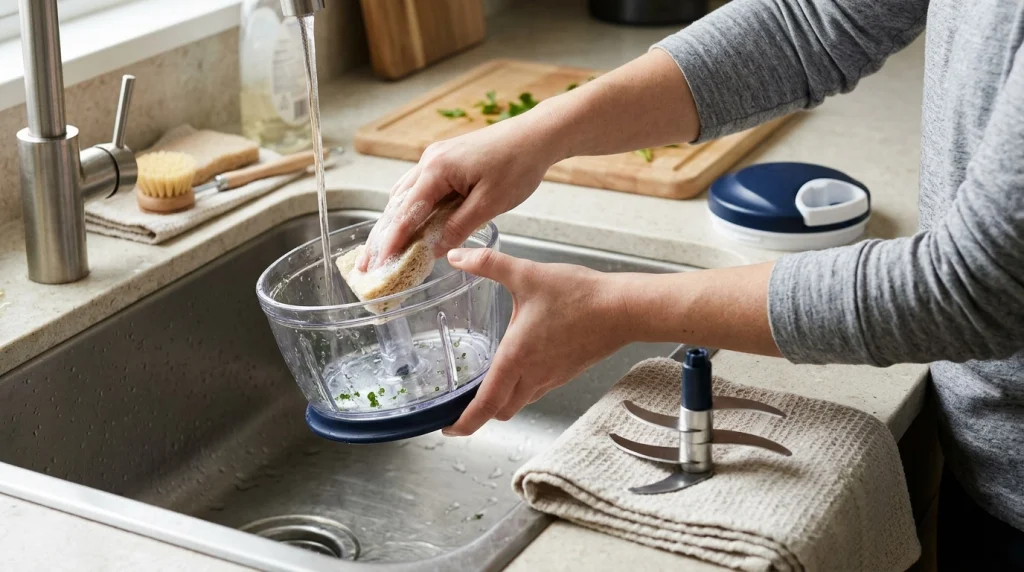
Clean the food-contact parts soon after use, before herb residue dries onto the bowl or blades. The correct method depends on the model, particularly around the pull-cord lid.
- Disassemble carefully. Remove the lid and lift the blade assembly by its designated handle or central stem.
- Wash the bowl. Use warm water and mild dish soap if the manufacturer’s instructions permit it.
- Clean the blades cautiously. Use a suitable soft brush and keep your fingers away from the cutting edges.
- Wipe the lid as directed. Don’t immerse a pull-cord lid unless the manufacturer explicitly says it’s safe.
- Dry before storage. Allow washable parts to dry completely and store the blade assembly securely.
Care instructions differ between products. The Tupperware Time Savers Herb Chopper manual, for example, describes hand-washing the blades and wiping the mechanism’s top cover.
Never pull apart a sealed lid to repair the cord unless the manufacturer provides a service procedure. If the cord stops retracting or the mechanism becomes damaged, stop using the chopper and consult the product’s support guidance.
What Should You Check Before Buying a Pull Cord Chopper in 2026?
Product listings can make similar choppers look interchangeable, but capacity, blade arrangements, included accessories, and washing instructions may differ. Read the specifications and care instructions before choosing one.
- Actual capacity: Check the stated volume and recommended fill level.
- Blade arrangement: Confirm the number of blades and whether the assembly removes from the bowl.
- Construction: Review the listed materials for the bowl, lid, handle, and blades.
- Cleaning guidance: Check which parts are dishwasher-safe and which need hand-washing.
- Replacement support: Check whether the seller or manufacturer offers replacement parts or warranty support.
- Current reviews: Look for specific feedback about cord retraction, chopping consistency, and cleaning rather than relying only on star averages.
As of 2026, the Starfrit Pull Chopper and Tupperware Time Savers Herb Chopper are two identifiable examples of manual pull-cord designs. Confirm current availability, pricing, and model-specific instructions before ordering, because these details can change.
For general food preparation and produce-handling guidance, you can also consult the FDA’s food safety resources.
Pull Cord Chopper for Herbs: Recommended Options
If you’re ready to choose one, I’d start with the way you cook most often. The options below represent different priorities, but their current prices, ratings, availability, and exact configurations should be checked before purchase.
🏆 BEST FOR GENERAL USE
Starfrit Pull Chopper, 900 mL
Rating: Check current customer reviews
This manual model has a 900 mL bowl, a three-blade cutting system, and a retractable cord. I’d consider it for herbs, garlic, and small vegetable-preparation tasks when a larger bowl is useful.
🌿 BEST HERB-FOCUSED OPTION
Tupperware Time Savers Herb Chopper
Rating: Check current customer reviews
This herb-focused design uses a multi-blade assembly and a manual pull mechanism. I’d investigate it if fresh parsley, basil, and cilantro are the main ingredients you prepare, while confirming current availability and included parts.
💡 ALTERNATIVE TO COMPARE
SALTER Pull Chopper
Rating: Check current customer reviews
SALTER offers a manual pull-cord design intended for small ingredients such as garlic, chili, and spring onion. I’d compare its bowl size and hand-washing requirements with other options before deciding whether it suits regular herb preparation.
My selection advice: Don’t choose by blade count or promotional claims alone. Compare the fill limit, how easily you can remove the blade assembly, and whether the lid is simple to clean without damaging the cord mechanism.
Frequently Asked Questions
1. Is a pull cord chopper good for fresh herbs?
Yes, a pull-cord chopper can prepare small quantities of parsley, cilantro, mint, basil, and other suitable herbs. Dry the leaves first and use controlled pulls to avoid turning them into a wet paste. Results depend on the blade design, herb type, and amount you place in the bowl.
2. How many times should I pull the cord to chop herbs?
There’s no universal number because blade designs and ingredients vary. Start with a few controlled pulls, then check the texture once the blades have stopped. Continue gradually until the herbs reach your preferred size, following the manufacturer’s directions for opening and redistributing ingredients.
3. Can I put the entire pull-cord chopper in the dishwasher?
Not necessarily. Some models have dishwasher-safe bowls and blade assemblies but require hand-washing or wiping for the lid. Water can damage an unsealed cord mechanism. Check the specific manufacturer’s cleaning instructions before placing any component in a dishwasher or immersing it in water.
4. Can a pull cord chopper replace a kitchen knife?
A pull-cord chopper can reduce repetitive chopping for small batches of herbs, garlic, and suitable vegetables. However, a kitchen knife offers more direct control over slices, strips, and precise cuts. Keeping both tools available gives you greater flexibility for different recipes and ingredient quantities.
5. Why won’t my pull-cord chopper retract properly?
A cord that stops retracting may indicate a damaged mechanism, improper operation, or a problem with the internal spring or gearing. Don’t force the handle or dismantle a sealed lid. Stop using the chopper if the mechanism is damaged and consult the manufacturer’s troubleshooting or warranty guidance.
Final Takeaway: Is a Pull Cord Herb Chopper Worth Buying?
A pull-cord chopper is worth considering if you regularly prepare small portions of fresh herbs and want a manual alternative to chopping everything with a knife. Its compact design and adjustable chopping action can make everyday preparation more convenient.
Before buying, focus on bowl capacity, blade safety, cord quality, and cleaning requirements. Choose a model that suits your actual cooking habits rather than paying for features you won’t use.
If you frequently make chutneys, salad dressings, soups, or herb-based sauces, a pull-cord chopper may become a useful addition to your kitchen. Start with small batches, keep the leaves dry, and stop chopping as soon as you reach the texture your recipe needs.