Vegetable Choppers With Containers: A Practical Guide for Faster, Cleaner Prep

A vegetable chopper with container is a simple idea with a useful purpose: cut vegetables into smaller pieces and catch them in a built-in bin instead of sending them across a cutting board. For home cooks, that usually means less mess, fewer transfers, and a more organized prep process.
These tools are especially appealing when you are making everyday meals like stir-fries, soups, salads, tacos, or lunch boxes. They are not a replacement for every knife task, but they can reduce repetitive chopping when you are working with onions, peppers, cucumbers, celery, carrots, or similar ingredients.
What a Vegetable Chopper With Container Is
At its core, this tool combines two functions: cutting and collecting. The blades chop the food, and the container holds the pieces as they fall. That built-in collection space is what separates it from a basic chopper or a knife on a board.
In practical terms, the container can help in three ways:
- It keeps chopped food from scattering across the counter.
- It makes it easier to pour ingredients directly into a bowl, pan, or storage container.
- It can help keep small batches organized during prep.
A typical use case is a weeknight dinner where you need diced onion, bell pepper, and celery for a skillet meal. Instead of moving each ingredient from board to bowl, the pieces stay contained until you are ready to use them.
How the Container Changes Everyday Prep
The container is not just a convenience feature. It changes the workflow.
With a knife, you usually chop on a board, gather the pieces, and move them into a bowl or pan. That creates extra steps and often leaves bits on the counter. With a vegetable chopper with container, the chopped food collects in one place, which can save time during small and medium prep jobs.
That matters most when:
- You cook several times a week and want fewer dishes.
- You prep ingredients for lunch containers in advance.
- You want to keep wet ingredients like tomatoes or cucumbers from spreading juice across the board.
There is also a portion-control benefit when you are dividing ingredients into multiple containers. The trade-off is that the container adds bulk and another part to clean, so the convenience is real only if you use it often enough.
How These Choppers Work: Manual, Push-Down, Pull-Cord, and Rotary Designs
Not all vegetable choppers with containers operate the same way. The cutting mechanism affects how much effort you need, how consistent the pieces are, and how much control you have.
Manual push-down choppers
These usually use a lid or plunger that presses food through a blade grid or chopping surface. They are straightforward and often compact. They work well for small batches, but they can require repeated pressing if you are chopping a lot. In general, they are a good choice when you want a simple, hands-on tool and do not mind a bit of repetition.
Pull-cord choppers
These use a cord that spins blades when you pull it. They are common in small manual choppers and can work quickly for soft to medium-firm vegetables. They are useful when you want a simple tool that does not need electricity. For many home cooks, a pull-cord model is best for quick, occasional prep rather than larger batches.
Rotary choppers
These use a turning motion, often through a crank or rotating blade system. They can be easier on the hands than repeated pressing, but the design varies a lot by model. Some are better suited to lighter prep and smaller batches, especially when you want a little more control without using a knife for everything.
Multi-blade designs
Some choppers use multiple blades to speed up processing or create more even pieces. That can be helpful, but more blades can also mean more places for food to collect and more parts to clean.
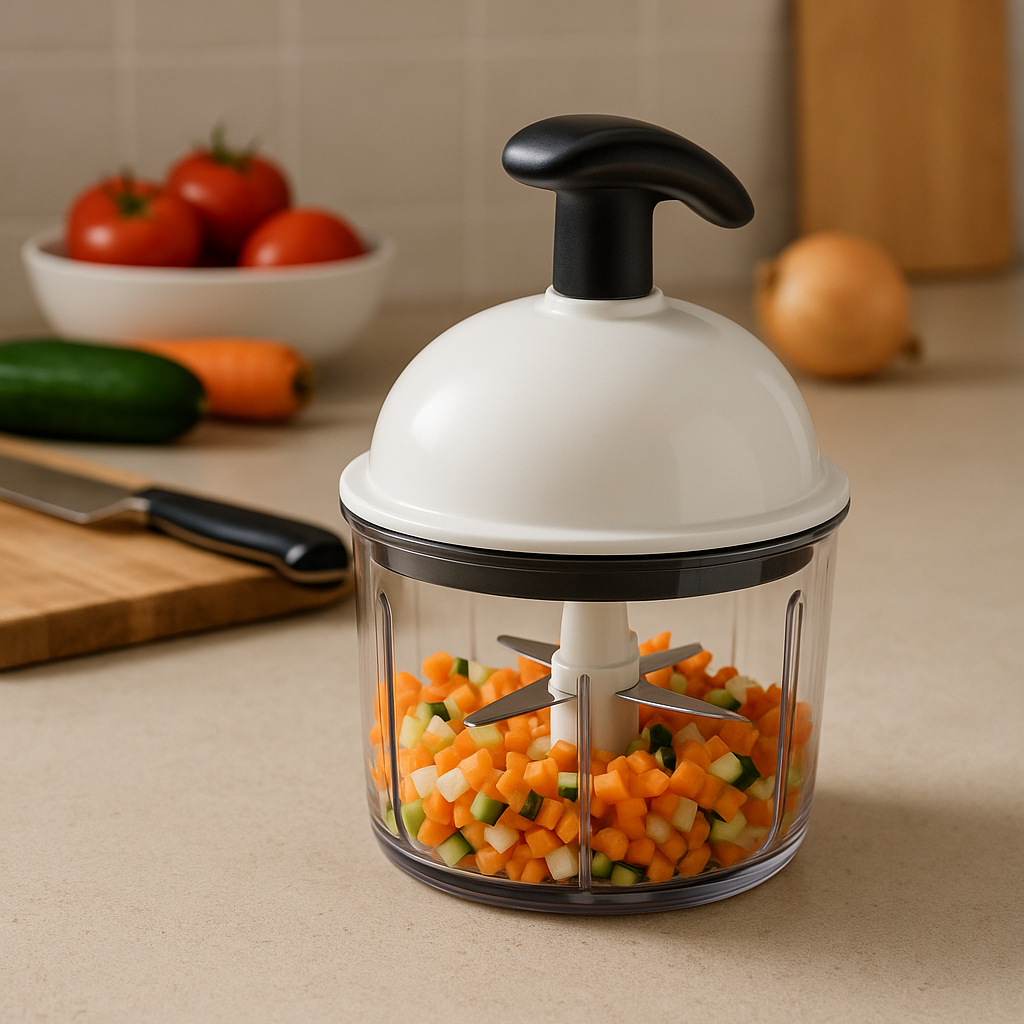
For a busy kitchen, the best design is usually the one that matches your most common prep task. If you mostly chop small amounts of onions, peppers, or similar vegetables, a pull-cord or push-down model is often the most practical. If you want steadier control and do not mind a little more effort, a push-down design can be a better fit. Rotary models make the most sense when you want a lighter-duty option for smaller jobs.
What Vegetables They Handle Well—and What Can Jam or Cut Poorly
A vegetable chopper with container tends to do best with produce that is firm enough to cut cleanly but not so hard or fibrous that it resists the blade.
Commonly suitable ingredients include:
- Onions
- Bell peppers
- Cucumbers
- Celery
- Zucchini
- Cooked or softened vegetables
- Some herbs, depending on the model
Foods that may be more difficult include:
- Very hard vegetables in large pieces
- Fibrous produce that can catch on blades
- Very soft tomatoes, which may crush rather than cube cleanly
- Sticky or wet ingredients that cling to the blade assembly
A useful rule: if the ingredient tends to bend, smear, or string when cut, a manual chopper may struggle. For example, a chopper can be handy for onions in a salsa base, but a very ripe tomato may turn mushy and leave more residue around the blades.
If you regularly prep harder vegetables like large carrots or potatoes, check the product instructions before assuming the tool can handle them. Some models are better suited to soft or medium-firm produce than to dense root vegetables.
Key Buying Factors: Blade Quality, Container Size, and Stability
The most important features are usually not the marketing claims. They are the practical details that affect how the tool behaves on your counter.
Blade quality
Stainless steel blades are common because they are durable and resist rust better than many lower-grade materials. Blade sharpness matters because dull blades can crush food instead of cutting it cleanly. That often leads to uneven pieces and more force required from the user.
More blades do not automatically mean better performance. A multi-blade design can improve speed or consistency, but it can also create more cleanup and more chances for clogging.
Container size
Container capacity should match the amount you usually chop at one time. If the bin is too small, you will empty it constantly. If it is too large, the tool may take up more storage space than you want and feel awkward for small jobs.
Stability
A non-slip base or another stability feature matters more than many buyers expect. If the unit slides while you press or pull, the tool becomes harder to control and less safe to use. Stability is especially important on smooth countertops.
Dishwasher-safe parts
Dishwasher-safe parts can make cleanup easier, but they do not always solve the whole problem. Blades, lids, and corners may still need attention by hand, especially if food gets trapped around the cutting mechanism.
Small Container vs Large Container: Which Size Fits Your Prep Habits?
Container size affects real-world usability more than many shoppers realize.
A smaller container can be the better choice if you:
- Cook for one or two people.
- Chop vegetables for a single recipe at a time.
- Want compact storage.
- Prefer a lighter tool that is easy to handle and clean.
A larger container makes more sense if you:
- Prep ingredients for several meals at once.
- Cook for a family.
- Want to chop onions, peppers, and other vegetables in one batch.
- Prefer fewer empty-and-refill cycles.
The trade-off is simple: smaller containers are easier to store and wash, while larger ones reduce batch interruptions. If you typically dice just one onion or one pepper at a time, a huge container is probably unnecessary. If you meal prep on Sundays, a tiny bin may become frustrating quickly.
Quick comparison table
| Chopper style | Best for | Cleaning effort | Main trade-off |
|---|---|---|---|
| Small container manual chopper | Single recipes, small kitchens | Lower | More frequent emptying |
| Large container manual chopper | Family cooking, batch prep | Moderate | Bulkier storage |
| Multi-blade model | Faster chopping, more uniform pieces | Higher | More parts to clean |
| Simple single-blade design | Basic everyday prep | Lower | Less versatility |
| Pull-cord design | Quick small batches | Moderate | Less control over cut size |
| Push-down design | Direct chopping control for small jobs | Moderate | Can require more effort |
Safety and Ease of Use: What to Watch For
Sharp blades and moving parts make safety worth paying attention to, even with a simple manual tool.
The main risks are usually:
- Fingers near blades during setup or cleaning
- Slipping on a wet countertop
- Pinching from lid or plunger mechanisms
- Overfilling the container and forcing food into a jam
A stable base helps, but it does not replace careful handling. Keep the unit on a dry, flat surface before you start. Cut larger vegetables into pieces that fit the opening rather than forcing them through. That reduces strain on the mechanism and lowers the chance of uneven results.
To avoid clogging and uneven cuts, keep pieces close to the size the manufacturer recommends, and do not pack the container too tightly. If the food starts to wedge around the blades, stop and clear it before continuing. Softer ingredients often work better when they are added in smaller amounts, while firmer vegetables usually cut more cleanly when they are trimmed into manageable pieces first.
If a model is difficult to hold steady, that is a warning sign, not a minor inconvenience. A tool that moves around the counter can slow you down and make cleanup less pleasant.
Cleaning, Dishwasher Safety, and Maintenance
Cleaning is one of the biggest deciding factors for a vegetable chopper with container. A tool that looks convenient can become annoying if food gets stuck around the blades or in the corners of the container.
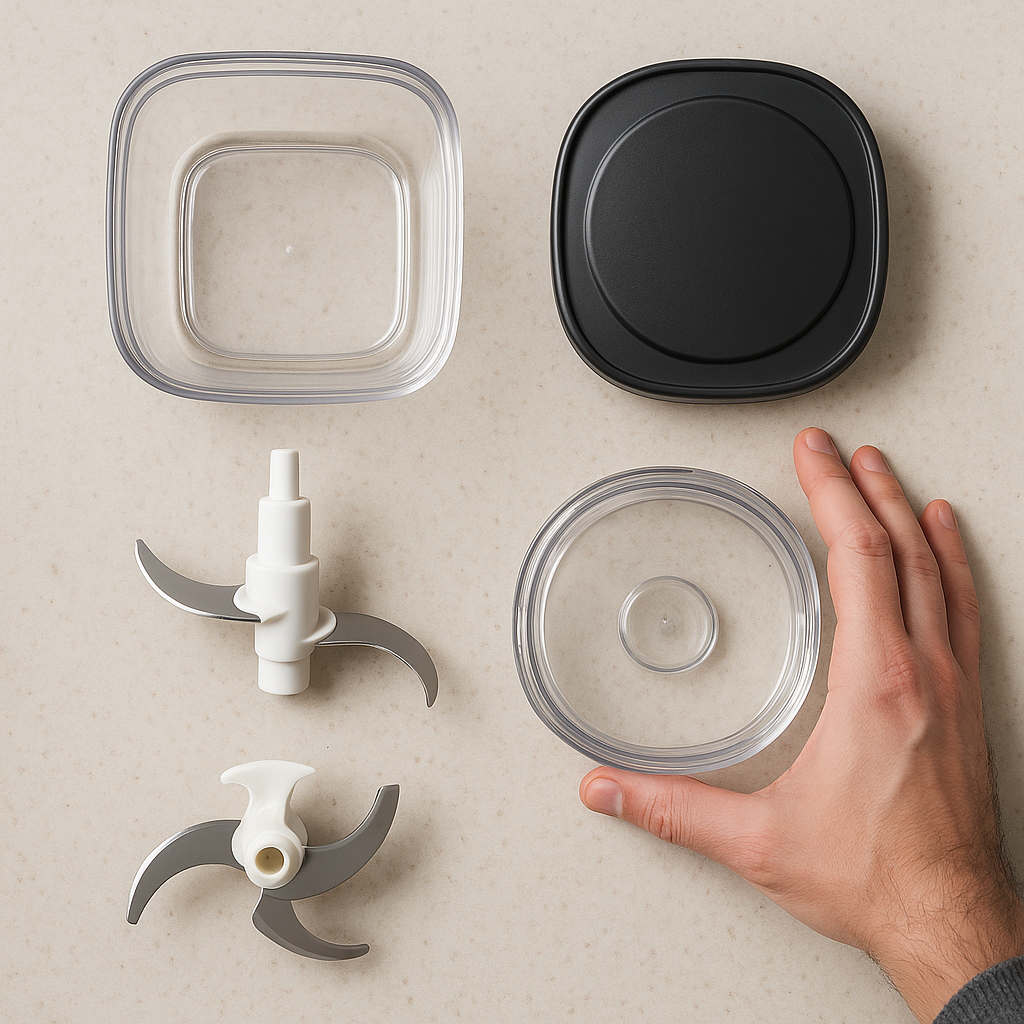
Pay attention to three areas:
Blade assembly
This is where residue often collects. Even if a part is dishwasher-safe, food buildup around the cutting edges may still need a rinse or brush before washing. Small bits can also lodge where the blades meet the housing.
Lid and hinges
If the lid has moving parts or a snapping mechanism, small bits of food can hide where they are hard to see.
Container corners and seams
Rounded containers are usually easier to rinse than models with sharp inside corners. Seams around the rim and any gasket-like parts can also trap food if the design includes them.
For maintenance, dry the blades and metal parts promptly if the manufacturer recommends it. Store the tool disassembled only if that makes the parts dry faster and fit better in your cabinet. If you notice the blades becoming dull or food starting to tear instead of cut, it may be time to replace the unit rather than keep forcing it.
Vegetable Chopper With Container vs Knife, Mandoline, and Food Processor
This tool is useful, but it is not automatically the best tool for every job.
Versus a knife
A knife gives you the most control and the best precision. It is better for fine chopping, delicate herbs, and tasks where size consistency matters a lot. A chopper with container is usually faster for repetitive, everyday prep, especially if you are making a basic mix of vegetables.
Versus a mandoline
A mandoline is better when you need thin, even slices. It is not a general-purpose chopping tool. If your goal is sliced cucumbers, potatoes, or other uniform rounds, the mandoline is usually the better choice. If you want diced onions or mixed vegetable prep, the chopper is usually more practical.
Versus a food processor
A food processor is stronger and better for larger batches, but it takes more setup, more space, and usually more cleanup. For small to medium prep, a manual chopper can be easier to grab, use, and wash. For large salsa batches, shredded vegetables, or repeated bulk prep, a food processor is often the better tool.
Manual versus electric
Manual models are usually the better choice when you want a compact tool for small daily prep, easy storage, and simple cleanup. Electric models make more sense if you prepare larger amounts often and want to reduce hand effort, but they add cords, motors, and more parts to wash. If you chop vegetables only occasionally or in small batches, manual is usually the better buy. If you prep frequently and value convenience over simplicity, electric can be worth considering.
When a Vegetable Chopper With Container Is Worth Buying
This tool makes the most sense if your cooking habits are repetitive and moderate in volume. It is a good fit for:
- Weeknight cooking with onions, peppers, celery, and cucumbers
- Small meal-prep batches
- Kitchens where counter space is limited
- Cooks who want a simple tool for everyday chopping
It is less compelling if you:
- Chop large quantities at once
- Need highly precise cuts
- Work with very hard or fibrous vegetables often
- Prefer the control of a knife and board
Buying checklist
Before you buy, prioritize the features that match how you actually cook:
- Prep volume: Choose a small manual model for one or two servings at a time; choose a larger container or electric model only if you regularly prep bigger batches.
- Storage space: Pick the most compact design that still fits your usual batch size.
- Cleaning tolerance: If you dislike hand-washing, look for fewer crevices, simpler blade assemblies, and dishwasher-safe parts.
- Cut consistency: If you want the most even results, favor a design with a stable base and sharp, well-supported blades.
- Ingredient mix: If you mainly chop onions, peppers, cucumbers, and celery, a manual chopper is usually enough; if you often process harder or larger quantities, a knife or food processor may be a better fit.
A simple decision rule helps: if you regularly prep vegetables for one to four servings and want a straightforward tool, a vegetable chopper with container may be worthwhile. If you often prep larger batches or want exact knife-style cuts, a knife or food processor will usually be the better investment.
For readers comparing different styles of choppers, it can also help to review how a grid-style model differs from other designs. Our guide to grid vegetable choppers explains one common style in more detail, while what a vegetable chopper does breaks down the broader uses and limits of these tools.
Final Take
A vegetable chopper with container is not a magic shortcut, but it can make everyday prep cleaner and more manageable. The built-in container is most useful when you want a simple way to keep small batches organized and move ingredients into a pan or bowl without extra steps.
It is a good buy for people who cook often, prep modest amounts, and want a low-fuss helper for onions, peppers, cucumbers, and similar vegetables. It is probably not the best choice if you regularly process large batches, need highly uniform cuts, or already prefer the control of a knife, mandoline, or food processor.
If the model is stable, easy to clean, and sized for the amount you usually cook, it can become one of those tools you reach for often. If not, a good knife may still do the job better.
FAQ
What is the main advantage of a vegetable chopper with container?
The main advantage is convenience. It catches chopped food in one place, which can reduce mess and make transfer to a bowl or pan easier.
Are these choppers good for meal prep?
Yes, especially for small to medium batches. They are useful when you want consistent pieces for lunch containers or several quick recipes.
Can a vegetable chopper with container replace a knife?
Not completely. A knife is still better for precision, very small jobs, and delicate ingredients.
What vegetables work best?
Onions, peppers, cucumbers, celery, and similar medium-firm vegetables usually work well. Very soft, fibrous, or very hard produce may be less suitable.
Is a manual model better than an electric one?
Manual models are usually the better choice for small daily prep, simple cleanup, and compact storage. Electric models make more sense for frequent, larger-volume prep.
How do I keep it from slipping?
Use it on a dry, flat surface and look for a non-slip base or other stability feature. Avoid overfilling, which can increase resistance and movement.
Is it easy to clean?
Often, yes, but that depends on the design. Models with fewer crevices and dishwasher-safe parts are usually easier to maintain, though blades still need careful handling.
Should I choose a small or large container?
Choose the size that matches your typical batch. Small containers are better for quick daily prep; larger ones suit family cooking and meal prep.
