What Does a Vegetable Chopper Do? Uses, Benefits, and Limits

Quick Answer
A vegetable chopper cuts vegetables into smaller, more consistent pieces with less repetitive knife work. Depending on the design, it can dice onions, chop peppers, slice cucumbers, shred cabbage, julienne carrots, or collect prepared food directly in a container, making it useful when you want to save time while cooking daily meals.
What a vegetable chopper helps you do
- Dice vegetables: Grid-style blades can turn onions, potatoes, peppers, and similar foods into uniform cubes.
- Reduce prep work: One pressing or chopping action can replace several repeated knife cuts.
- Create even pieces: Similar-sized vegetables tend to cook more consistently than randomly sized chunks.
- Contain the mess: Models with collection bowls keep chopped ingredients from spreading across the counter.
- Handle extra cuts: Multi-blade models may also slice, grate, shred, or julienne vegetables.
One important limitation
- A vegetable chopper does not completely replace a good kitchen knife because many ingredients still need trimming or pre-cutting before they fit the chopper.
If you’ve watched someone push an onion through a grid and produce a container full of neat cubes in seconds, you’ve already seen the main appeal of a vegetable chopper. It turns repetitive prep into a much simpler motion.
I find the tool most useful when a recipe contains several cups of chopped vegetables. Below, I’ll explain exactly what vegetable choppers do, where they save effort, and when a knife still works better.
What Is a Vegetable Chopper?
A vegetable chopper is a kitchen tool that cuts produce into smaller pieces using one or more fixed or moving blades. Manual versions usually work by pressing, pulling, or pushing food through blades, while electric models use a motor.
The term covers several designs, so two products labeled “vegetable chopper” may work quite differently.
- Grid choppers: Push vegetables through square stainless-steel blades to create cubes.
- Push choppers: Use a spring-loaded mechanism that moves a blade with repeated downward presses.
- Pull-cord choppers: Spin internal blades when you pull a cord.
- Multi-blade prep tools: Combine chopping grids with slicers, graters, julienne blades, or spiralizers.
- Electric mini choppers: Use a motor to rapidly chop or mince ingredients.
That distinction matters because a grid chopper produces defined pieces, while a spinning blade gives a more irregular mince.
What Does a Vegetable Chopper Actually Do?
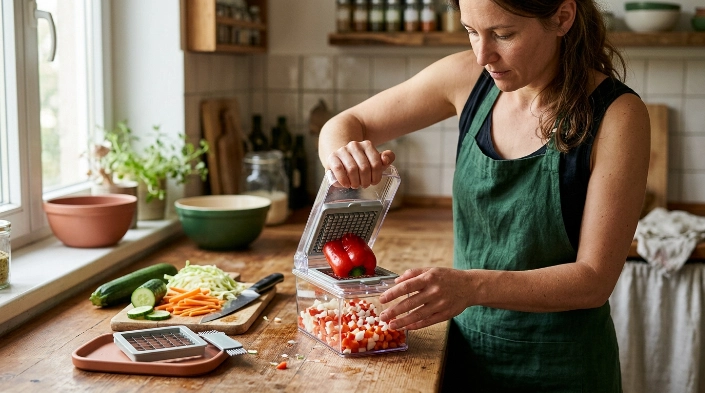
A vegetable chopper mainly reduces the amount of individual cutting you need to perform by hand. It can also improve size consistency and keep prepared ingredients contained.
1. It dices vegetables quickly
Dicing is where grid-style vegetable choppers shine. You place a manageable piece over the blade grid, close or press the lid, and the vegetable passes through the openings.
This works especially well with firm ingredients that hold their shape.
- Onions
- Bell peppers
- Potatoes
- Zucchini
- Cucumbers
- Carrots cut into smaller sections
- Celery
Some models include multiple grids. For example, Mueller’s MC-780 chopper includes both 1/4-inch and 1/2-inch chopping blades, giving you two cube sizes.
2. It creates more consistent pieces
Uniform pieces aren’t only attractive. Vegetables of similar thickness usually reach the same stage of doneness more predictably.
Imagine sautéing onions cut into tiny fragments beside large chunks. The small pieces can brown before the large ones soften.
A fixed grid takes much of that variation away. That’s handy for salsa, soups, omelets, casseroles, stir-fries, and batch meal prep.
3. It can slice, shred, grate, or julienne
A basic chopper may only chop, but multi-function models can replace several prep tools. Interchangeable inserts are what make this possible.
- Slicing blade: Creates flat cucumber, potato, zucchini, or onion slices.
- Julienne blade: Produces thin matchstick-style vegetables for slaws and stir-fries.
- Grater: Shreds carrots, cabbage, vegetables, or cheese.
- Spiralizer: Creates vegetable ribbons or noodles on compatible models.
- Wavy blade: Makes crinkle-style slices for presentation or roasting.
That versatility is one reason a chopper can fit into the same workflow as other practical cooking hacks for easier meal preparation.
4. It collects chopped food as you work
Many modern choppers position a container beneath the blade. The prepared vegetables drop straight into it instead of scattering across your cutting board.
I especially like this design when prepping onions and peppers together. I can empty one container into the skillet instead of chasing small pieces around the counter.
Vegetable Chopper vs Knife: Which Is Better?
A vegetable chopper is usually more convenient for repetitive, uniform cuts, while a knife gives you greater control and flexibility. Neither tool wins every kitchen task.
| Task | Vegetable Chopper | Chef’s Knife |
|---|---|---|
| Large batch of diced onions | Fast and consistent | Flexible but requires repeated cuts |
| Custom-size cuts | Limited by blade size | Excellent control |
| Herbs | Depends on chopper type | Excellent for precise chopping |
| Large vegetables | Usually requires pre-cutting | Handles almost any size |
| Uniform cubes | Excellent with a grid blade | Depends on knife skill |
| Cleanup | Several blade and container parts | Knife plus cutting board |
I still reach for a knife when I want wedges, rough rustic cuts, thin hand-controlled slices, or tiny amounts of an ingredient. A chopper makes more sense when repetition becomes the annoying part of the job.
Whichever tool you choose, basic kitchen safety practices for home cooks matter because chopper inserts can be extremely sharp.
What Foods Can You Put in a Vegetable Chopper?
Most choppers work best with firm or moderately firm produce that can pass cleanly through the blade. Softer foods can work, but results depend heavily on blade style.
Foods that usually work well
- Onions
- Bell peppers
- Potatoes
- Carrots
- Celery
- Cucumbers
- Zucchini
- Cabbage with compatible shredding blades
- Firm tomatoes
- Apples and similar firm fruits
Wash fresh produce before chopping it. The FDA’s produce safety guidance recommends rinsing fruits and vegetables under running water before cutting or eating them.
Foods that may need extra preparation
Dense vegetables can require pre-cutting. A whole potato or large onion may be too wide for the chopping grid even though the tool can easily process smaller sections.
Hard foods also demand more downward force. I prefer making two smaller pieces rather than forcing an oversized ingredient through a blade.
Foods a manual chopper may struggle with
- Very ripe tomatoes that crush instead of cut
- Large whole sweet potatoes
- Extremely hard squash
- Long fibrous stalks that haven’t been trimmed
- Frozen-solid vegetables
- Ingredients larger than the blade area
Never force a food through simply because the tool is marketed for vegetables. Follow the manufacturer’s instructions for your specific model.
Does a Vegetable Chopper Save Time?
It can save meaningful active prep time when you need many repeated cuts, although the benefit becomes smaller for one or two ingredients. Cleanup also needs to be included in the equation.
If I need half an onion for a sandwich, washing a multi-piece chopper afterward makes little sense. A knife is faster from start to finish.
The situation changes when I’m preparing several vegetables for salsa, curry, soup, meal-prep bowls, or a large salad.
- Small job: A knife may be quicker because cleanup is minimal.
- Medium job: A chopper becomes useful when several vegetables need the same cut.
- Large batch: Consistent grid chopping can reduce repetitive knife work substantially.
A recipe such as this easy vegetable curry is exactly where faster vegetable preparation can make the entire meal feel easier.
What Are the Main Benefits of Using a Vegetable Chopper?
The biggest advantages are speed, consistency, convenience, and less repetitive cutting. A collection container can also reduce countertop mess.
- Faster batch preparation: Useful when several cups of vegetables need similar cuts.
- Consistent size: Fixed grids remove much of the variation between individual pieces.
- Less scattered food: Catch containers hold ingredients immediately after cutting.
- Multiple functions: Some models combine dicing, slicing, shredding, grating, and julienne functions.
- Meal-prep convenience: Repeating one motion is helpful when preparing several portions at once.
Convenient preparation can also make vegetables easier to keep ready for meals. My guide to the benefits of vegetables in a daily diet explains why keeping a varied selection around is worthwhile.
For broader dietary guidance, MyPlate’s Vegetable Group guidance includes fresh, frozen, canned, dried, cooked, and raw vegetables as options.
What Are the Disadvantages of a Vegetable Chopper?
A vegetable chopper isn’t automatically easier for every recipe. It adds parts to wash, limits your cut size to available blades, and still requires careful handling.
Cleanup can take longer
Food can lodge between grid blades, particularly onion skins, carrot fragments, or fibrous vegetables. Models with removable inserts and cleaning brushes are easier to manage.
Cleaning immediately is simpler than allowing vegetable residue to dry inside the grid.
You lose some cutting flexibility
A 1/4-inch grid always produces roughly the cut dictated by that grid. You can’t instantly decide you want rustic 3/4-inch chunks without changing tools or using a knife.
That limitation is why I view a chopper as a supplement to a chef’s knife rather than its replacement.
The blades demand respect
Removable chopper inserts can be sharper than they look. Hold them by their frames or designated grip areas rather than touching cutting edges.
The same food-safety mindset applies after prep. FoodSafety.gov’s four-step guidance emphasizes cleaning hands, utensils, and food-contact surfaces and separating foods to reduce cross-contamination.
How Do You Use a Vegetable Chopper Safely?
Use the chopper on a stable surface, prepare food to the correct size, keep fingers away from exposed blades, and clean the blade using a brush or supplied tool. Never push stuck food toward a sharp grid with your fingertips.
- Wash the produce. Rinse vegetables under running water before cutting.
- Trim oversized pieces. Cut vegetables small enough to sit flat over the chopping area.
- Lock the blade securely. Check that removable inserts are seated according to the manufacturer’s directions.
- Place the chopper on a stable counter. Anti-slip feet only help when the surface itself is clean and level.
- Apply controlled pressure. Don’t slam the lid or force an ingredient that clearly resists the blade.
- Empty the container before it becomes overfilled. Crowding can interfere with normal operation.
- Clean carefully. Use the supplied brush or cleaning tool around sharp grids.
The FDA’s safe food handling guidance also recommends washing hands and food-contact surfaces and keeping produce separate from raw meat, poultry, and seafood.
Who Should Buy a Vegetable Chopper?
A vegetable chopper makes the most sense for people who prepare substantial quantities of produce and value consistent cuts more than custom knife work. It can be particularly useful for batch cooking.
- Home cooks who prepare vegetables most days
- People making large salads or salsa
- Families preparing several servings at once
- Meal preppers who need repeated cuts
- Beginners who struggle to make uniform dice with a knife
- Cooks who want a container to catch ingredients during preparation
Skip the bulky multi-blade version if you rarely chop more than one vegetable at a time. A knife or compact push chopper may suit that routine better.
Three Vegetable Choppers Worth Considering
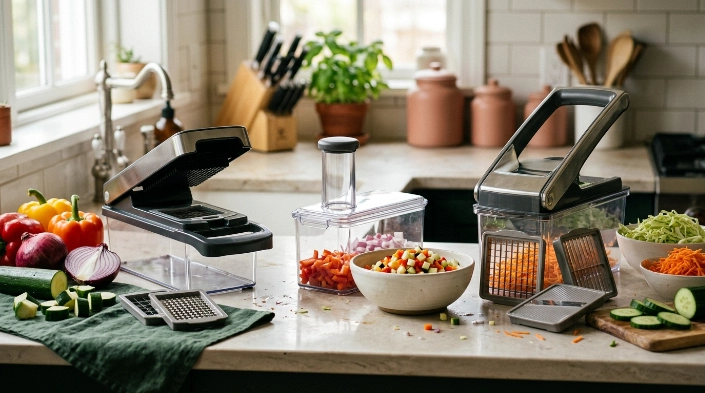
If you’re ready to pick one, these three designs cover different priorities, from straightforward chopping to multi-blade meal prep.
🏆 Best for Everyday Meal Prep
Fullstar Original Vegetable Chopper
★★★★½ 4.6/5
Fullstar offers interchangeable stainless-steel inserts, a catch container, and configurations for dicing and other prep tasks. I like this style for onions, peppers, zucchini, and larger Sunday meal-prep sessions.
🥕 Best Simple Design
OXO Good Grips Vegetable Chopper
★★★★☆
OXO’s easy-pour model uses a stainless-steel blade grid and recessed cutting area with an integrated container. I’d choose it when straightforward chopping matters more than having a drawer full of interchangeable attachments.
🥗 Best Multi-Blade Option
Mueller 8-Blade Original Vegetable Chopper Pro
★★★★½
The Mueller MC-780 includes 1/4-inch and 1/2-inch chopping grids plus slicing, julienne, grating, and shredding attachments with a 7.5-cup container. I prefer this format when one tool needs to handle several different salad and meal-prep jobs.
Frequently Asked Questions
Can a vegetable chopper replace a knife?
No. A vegetable chopper handles repetitive chopping and uniform cuts well, but a knife remains better for trimming, dividing large vegetables, making custom-size pieces, and performing delicate cuts. I consider the two tools complementary rather than interchangeable.
Can you put tomatoes in a vegetable chopper?
Yes, especially when the tomato is firm and the blade is sharp. Very ripe tomatoes may crush, release excessive juice, or become mushy instead of producing clean pieces, so I usually reserve softer tomatoes for a knife.
Can a vegetable chopper cut potatoes and carrots?
Yes, many grid choppers can cut potatoes and carrots once they’re trimmed to fit the chopping surface. Because both vegetables are dense, smaller sections require less force and are easier on the tool than attempting to press oversized pieces through the blade.
Is a vegetable chopper worth buying?
It can be worthwhile if you regularly prepare several vegetables, make large salads, batch-cook, or want consistent dice. If you only chop small quantities occasionally, a chef’s knife may be quicker because it has fewer parts to clean afterward.
How do you clean a vegetable chopper?
Remove leftover food promptly and follow the manufacturer’s washing instructions. Use the included brush or cleaning tool around blade grids rather than your fingertips, then allow all components to dry completely before reassembly or storage.
Final Takeaway
A vegetable chopper does one simple thing exceptionally well: it makes repetitive produce preparation easier. The best models turn onions, peppers, potatoes, cucumbers, and other vegetables into consistent pieces while catching them neatly underneath.
It isn’t a replacement for knife skills, and it isn’t automatically faster for tiny jobs. For larger meals and batch prep, though, a good chopper can become one of those kitchen tools you reach for several times a week.
Choose a simple grid model if you mainly want diced vegetables. Pick a multi-blade version if slicing, shredding, grating, and julienne cuts would genuinely replace other tools in your normal cooking routine.