
What Does “Dish Rack” Mean? Definition, Uses, Types, and Examples

Quick Answer
A dish rack is a rack designed to hold washed dishes while they drain and air-dry. It usually sits beside or over a kitchen sink and keeps plates, bowls, cups, utensils, and sometimes cookware separated so water can drain away. That matches the standard dish rack definition.
What a dish rack does
- Holds dishes: Keeps freshly washed items upright and organized.
- Helps them dry: Separates items so air can move around wet surfaces.
- Controls drips: A tray, mat, or drain spout catches or redirects water.
- Protects counter space: Prevents wet dishes from being spread across the worktop.
- Organizes utensils: Many models include removable cutlery holders.
Simple meaning
- If someone says, “Put the plates in the dish rack,” they normally mean the drying rack beside the sink.
If you’ve heard someone say “dish rack” and wondered exactly what they meant, the answer is simple. It’s one of those everyday kitchen terms that sounds obvious until you compare it with a dish drainer, drying mat, or dishwasher rack.
I’ve found that the easiest way to understand the term is to focus on its job. A dish rack gives wet dishes a stable, ventilated place to sit until they’re dry.
What Does “Dish Rack” Mean?
A dish rack is a kitchen rack used to hold washed dishes while they drain and dry. In normal American English, the term usually describes a freestanding or sink-mounted drying rack rather than the rack inside a dishwasher.
Definition: A dish rack is an open holder with slots, prongs, shelves, or compartments that separates wet dishes and allows water to drain away.
You may see one made from stainless steel, coated metal, plastic, silicone, bamboo, or a mix of materials. The design changes, but the purpose stays similar.
- Plates usually stand vertically in slots or between prongs.
- Bowls and cups sit on open sections or raised ribs.
- Forks and spoons go into a utensil cup.
- Water drains into a tray, mat, or directly into the sink.
As of 2026, you’ll also find expandable, fold-flat, two-tier, over-the-sink, and roll-up versions. These are still dish racks because they perform the same basic drying job.
What Is a Dish Rack Used For?
A dish rack is mainly used for draining and air-drying hand-washed kitchen items. It also creates an organized landing area between washing something and putting it back into a cabinet.
That makes it useful even in homes with automatic dishwashers.
Drying hand-washed dishes
This is the most common use. Plates, mugs, bowls, utensils, and glasses can sit separately instead of being stacked while wet.
The open design exposes more of each item to surrounding air. It also gives dripping water somewhere to go.
Keeping wet dishes off the countertop
Putting several wet plates directly on a counter creates puddles. Stacking them on a towel can also leave water trapped between items.
A rack keeps the washing area more contained. Models with drainboards or spouts can direct water toward the sink.
Holding items that you wash by hand
Not every kitchen item goes through an automatic dishwasher every time. A dish rack gives hand-washed items a designated drying space.
- Chef’s knives
- Wooden utensils
- Travel mugs
- Large mixing bowls
- Some pots and pans
- Delicate glassware
- Reusable bottles and lids
Always follow the care instructions for the individual item. A rack helps with drying, but it doesn’t determine whether an item should be hand-washed.
Is a Dish Rack the Same as a Dish Drainer?
Usually, yes. “Dish rack” and “dish drainer” are commonly used for the same type of kitchen product, although the wording can emphasize slightly different features.
“Dish rack” emphasizes the structure that holds dishes. “Dish drainer” emphasizes what happens to the water.
| Term | Usually Means | Main Emphasis |
|---|---|---|
| Dish rack | A structure for holding washed dishes | Holding and organizing |
| Dish drainer | A rack that lets water drain from dishes | Drainage and drying |
| Drying rack | A broader term for a rack used to dry items | Air-drying |
| Drying mat | An absorbent or quick-drying flat surface | Compact storage |
In everyday conversation, you normally don’t need to worry about the distinction. If someone asks for a dish drainer, they’ll usually recognize a standard dish drying rack.
What Are the Main Types of Dish Racks?
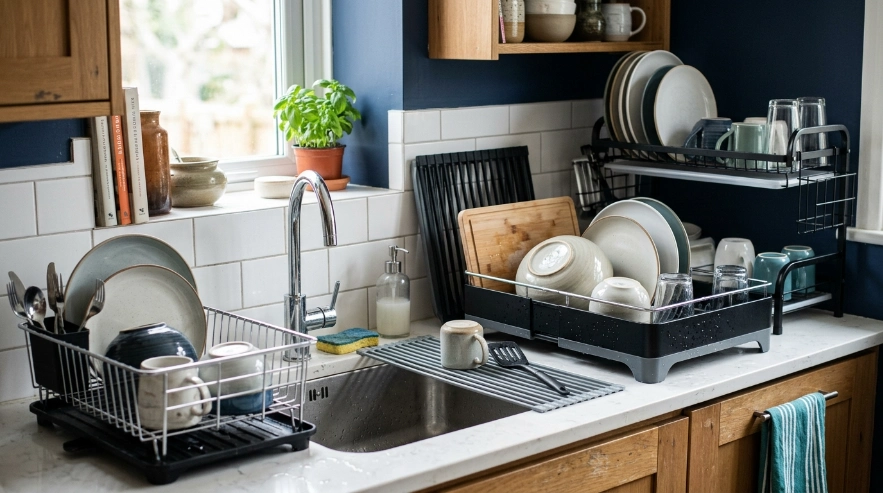
Dish racks come in several forms because kitchens have different amounts of counter and sink space. The right style depends more on your washing routine than on the name printed on the package.
Countertop dish racks
This is the classic design. It sits beside the sink and usually has plate slots, open space for bowls, and a cutlery holder.
Countertop racks work well when you wash several items at once. The trade-off is permanent or semi-permanent counter use.
Expandable dish racks
An expandable rack becomes larger when you need more drying room. You can slide it back into a smaller footprint after unloading the dishes.
For example, the Joseph Joseph Extend Steel model is about 12¾ inches wide by 14½ inches deep when closed and extends to about 20¾ inches wide. Its adjustable design is useful when the number of dishes changes from meal to meal.
Fold-flat racks
These are designed for kitchens where the rack shouldn’t stay on display all day. The structure folds down so it can be stored more easily after use.
The OXO Good Grips Aluminum Fold Flat Dish Rack, for example, has an unpackaged footprint of about 16.4 by 14.6 inches. Its removable utensil cup can sit on either side.
Over-the-sink racks
Over-the-sink designs use the space above the sink instead of taking over the counter. Water can drip directly into the basin.
This style can be especially practical in a compact kitchen. Measure your sink carefully before buying one.
Roll-up sink racks
A roll-up rack usually consists of parallel bars joined by flexible silicone edges. It rests across part of the sink and rolls into a narrow bundle for storage.
These models are useful for cups, produce, and a smaller number of dishes. They don’t provide the upright plate organization of a traditional rack.
Two-tier dish racks
A two-tier rack uses vertical space to increase capacity. One level may hold plates while another holds cups, bowls, or containers.
The extra height can save counter area, but stability matters. Heavy cookware should sit where the manufacturer’s instructions recommend.
How Does a Dish Rack Work?
A dish rack works by combining support, separation, airflow, and drainage. There is no motor or complicated mechanism in a standard rack.
- You wash and rinse the item. Excess water remains on its surface.
- You place it in the rack. Slots or prongs keep dishes from lying flat against each other.
- Water moves downward. It falls onto a drainboard, mat, or into the sink.
- Air reaches the wet surfaces. The remaining moisture gradually evaporates.
- You unload the dry dishes. They can then return to cabinets or drawers.
Drainage design makes a noticeable practical difference. A rack that leaves standing water in its base creates more cleanup than one that sends water toward the sink.
Independent testing from Serious Eats has likewise focused on drainage, stability, usable space, and utensil organization when comparing racks.
Do You Need a Dish Rack If You Have a Dishwasher?
You may still find one useful. A dishwasher and a dish rack handle different parts of kitchen cleanup.
The dishwasher washes and dries compatible loads. The dish rack provides somewhere to place items you wash manually.
- Small loads: A mug and breakfast bowl may not justify running a dishwasher.
- Oversized items: Large pans and mixing bowls may occupy too much dishwasher space.
- Special-care items: Some products are labeled for hand washing.
- Between cycles: The dishwasher may already be full or running.
- No dishwasher: The rack becomes the main drying station.
I think of the rack as part of the sink area rather than as a replacement for a dishwasher. Even a small one can make hand washing feel more orderly.
How Do You Choose the Right Dish Rack?
The best dish rack is the one that fits your available space, normal dish load, and drainage setup. Start by measuring before comparing extra features.
My rule is simple: measure the space when the sink is being used, not when the entire counter is empty. That gives a more realistic picture of how much room the rack can occupy every day.
Check the dimensions
Measure the width and depth beside or above your sink. Also check cabinets, faucets, windowsills, and anything else that could interfere with a taller rack.
Look at drainage
Some racks collect water in a removable tray. Others use a sloped drainboard or movable spout that directs water into the sink.
Expandable Joseph Joseph models, for example, use a sloping base and adjustable drainage system. You can review the manufacturer’s Extend dish rack design before deciding whether that setup matches your sink.
Match capacity to your household
- One or two people: A compact or roll-up rack may be enough.
- Family use: A full-size countertop or expandable rack provides more flexibility.
- Frequent cooking: Look for strong support for bowls, pans, and utensils.
- Limited counter space: Consider fold-flat, over-sink, or vertical designs.
Think about storage
If you hate seeing a rack on the counter, choose something that folds or rolls away. A permanent full-size rack makes more sense when you wash dishes throughout the day.
Current dish rack testing from Bon Appétit also highlights the practical differences between expandable and folding designs.
How Do You Keep a Dish Rack Clean?
A dish rack repeatedly receives water and residue from freshly washed items, so it also needs regular cleaning. Don’t treat the rack as a surface that cleans itself.
Emptying it frequently makes maintenance easier.
- Remove trapped debris: Check corners, utensil cups, and drainage channels.
- Wash removable pieces: Follow the manufacturer’s directions for trays and holders.
- Clear the drain path: Make sure a drain spout isn’t blocked.
- Dry the rack: Let components dry before storing a foldable model.
- Check the surface below: Wipe moisture from the counter or drying mat.
Material matters here. A stainless-steel frame, plastic tray, bamboo rack, and silicone roll-up model can have different care requirements.
For example, OXO describes its fold-flat model as having a rustproof aluminum frame and removable utensil cup. Its official Fold Flat Dish Rack specifications are useful when comparing construction and cleaning needs.
Dish Rack vs. Drying Mat: Which Is Better?
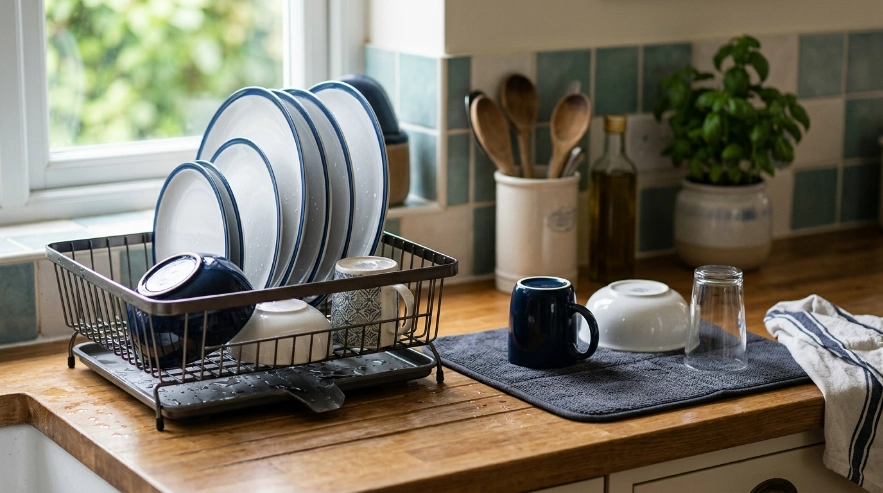
A rack is usually better for separating plates and increasing usable drying space. A drying mat is better when compact storage and a completely flat surface matter more.
| Feature | Dish Rack | Drying Mat |
|---|---|---|
| Plate separation | Usually excellent | Limited |
| Vertical storage | Yes | No |
| Storage after use | Varies by design | Usually easy |
| Best for | Regular dish loads | Small or occasional loads |
You don’t necessarily have to choose one. Some people place a rack over a drying mat when the rack itself doesn’t include a drainboard.
If you’re ready to choose a rack, these are three practical styles I’d consider first:
🏆 Best Expandable
Joseph Joseph Extend Steel Dish Rack
★★★★★
The expandable base gives you extra room when a larger washing-up load appears, while its draining system directs water toward the sink. I like this format for kitchens where drying needs change throughout the day.
📦 Best Fold-Away
OXO Good Grips Aluminum Fold Flat Dish Rack
★★★★☆
This aluminum rack measures about 16.4 by 14.6 inches and folds down when you want the counter back. I’d prioritize it for a smaller kitchen where permanent countertop clutter is a bigger concern than maximum capacity.
🍽️ Best for Bigger Loads
KitchenAid Full-Size Dish Rack
★★★★☆
The full-size format gives plates, cookware, cups, and utensils more dedicated room than compact racks. I’d look at this style first for a family kitchen where capacity and stability matter more than folding the rack away.
Frequently Asked Questions
What is another name for a dish rack?
A dish rack is also commonly called a dish drainer or dish drying rack. The exact wording varies by region and manufacturer, but all three usually describe a rack that holds washed dishes while water drains and the dishes air-dry.
Where should a dish rack be placed?
A dish rack normally sits beside the kitchen sink or spans part of the sink if it is designed for that purpose. Position it where water can drain safely without creating puddles, blocking the faucet, or taking more food-preparation space than necessary.
Can you put pots and pans in a dish rack?
Yes, if the rack is large and stable enough for them. Put heavy cookware where the rack manufacturer recommends and avoid overloading lightweight shelves or attachments. Large pots may be easier to dry on an open section instead of narrow plate slots.
Is a dish rack better than drying dishes with a towel?
A dish rack is convenient because it holds multiple items separately while they air-dry without continuous handling. A towel is still useful for wiping counters or drying an item immediately, but a rack is usually more practical for an entire hand-washed load.
Does “dish rack” mean the rack inside a dishwasher?
Not usually in everyday conversation. A “dish rack” normally means the drying rack near a sink. Inside a dishwasher, people more often say dishwasher rack, upper rack, lower rack, or third rack.
Final Takeaway
So, what does “dish rack” mean? It’s simply a rack that holds washed dishes while they drain and air-dry.
The basic idea is simple, but today’s versions range from compact roll-up racks to full-size, expandable, and multi-level systems. Choose yours based on your sink, counter space, normal dish load, and how easily you want to store it.
If you’re short on room, start with a foldable or over-the-sink style. If you regularly hand-wash a full meal’s worth of dishes, a larger countertop or expandable rack will usually make more sense.