
Which Dish Rack Is Best? Top Choices for 2026

Quick Answer
For most kitchens, the Simplehuman Steel Frame Dishrack is the best dish rack because it combines strong support, effective sink-directed drainage, and useful spaces for dishes, utensils, glasses, and stemware. If counter space matters more, the OXO Aluminum Fold Flat Dish Rack is easier to store, while a Rubbermaid Sink Dish Drainer is a simpler budget-friendly choice. Proper air drying also fits the food-safety guidance described by the FDA’s safe food handling guidance.
My Quick Picks
- Best overall: Simplehuman Steel Frame Dishrack for frequent hand-washing and larger loads.
- Best space-saver: OXO Aluminum Fold Flat Dish Rack for small counters and easy storage.
- Best simple option: Rubbermaid Sink Dish Drainer for basic everyday drying without extra features.
- Best material: Rust-resistant metal or aluminum generally offers a strong balance of durability and airflow.
- Most important feature: Choose a rack that drains water instead of letting it collect underneath your dishes.
Before You Buy
- Measure the usable counter area beside your sink, including the direction a drain spout must face.
A dish rack looks like one of the simplest tools in the kitchen. Yet the wrong one can leave you with puddled water, unstable plates, crowded utensils, and less counter space than you started with.
I judge a dish rack by what happens after it is fully loaded, not by how attractive it looks empty. Drainage, stability, usable capacity, cleaning, and footprint matter far more than decorative extras.
Which Dish Rack Is Best for Most Kitchens?
The Simplehuman Steel Frame Dishrack is my best overall choice for most people who regularly wash dishes by hand. Its biggest advantages are sturdy construction, a swivel drainage spout, dedicated glassware storage, and flexible space for mixed loads.
The drain design is especially useful. Water can flow toward the sink rather than sitting underneath your clean dishes or spreading across the counter.
- Large mixed-load capacity: Useful for plates, bowls, cookware, mugs, utensils, and glasses.
- Swivel drain spout: Lets you position the rack beside the sink in more than one orientation.
- Wine-glass holder: Keeps fragile stemware separate from heavier dishes.
- Silicone-capped supports: Help hold dishes without hard metal pressing directly against them.
- Removable components: Make routine cleaning easier than on many one-piece racks.
The tradeoff is size. This is a substantial countertop rack, so it makes more sense in a kitchen where hand-washing is frequent than in a tiny apartment where every inch matters.
If you mainly use a dishwasher and wash only a few items by hand, I would choose something smaller. Paying for unused capacity only creates permanent counter clutter.
What Is a Dish Rack and What Should a Good One Do?
A dish rack is an open drying structure that holds washed dishes apart while excess water drains and air circulates around them. Its purpose is not just storage.
A well-designed rack should keep items stable while creating enough separation for water to leave the surfaces. That makes drainage design just as important as the number of plates it can hold.
The CDC recommends allowing cleaned or sanitized items to air dry thoroughly in situations where hygiene is important. It also warns that rubbing items dry with a used towel can transfer germs back to a cleaned surface.
- Hold dishes securely: Plates should not lean into glasses or slide when another item is added.
- Separate wet surfaces: Bowls and plates need enough space for air to move between them.
- Manage drainage: Water should reach the sink or a removable tray instead of pooling.
- Organize utensils: A caddy keeps forks, spoons, and tools from filling the main rack.
- Clean easily: Trays and cups should be accessible because mineral deposits and food residue collect over time.
For more general kitchen-safety guidance, the CDC food safety resource explains why keeping kitchen surfaces and utensils clean matters.
How Do the Best Dish Racks Compare?
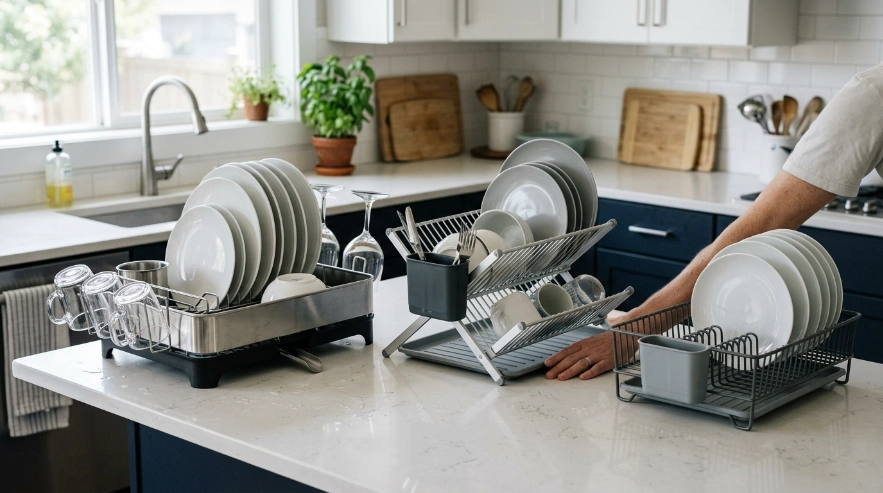
The three choices below solve different problems rather than competing on features alone. Simplehuman prioritizes capacity, OXO prioritizes storage flexibility, and Rubbermaid keeps the design basic and compact.
| Dish Rack | Approx. Size | Standout Feature | Best For | Main Drawback |
|---|---|---|---|---|
| Simplehuman Steel Frame | About 22.3 × 20.2 × 11.5 in. | Swivel drain and glassware storage | Large, frequent loads | Large footprint and premium price |
| OXO Aluminum Fold Flat | About 16.4 × 14.6 × 9.5 in. expanded | Folds flat for storage | Small kitchens | Less specialized glassware storage |
| Rubbermaid Sink Dish Drainer | About 14.31 × 12.49 × 5.39 in. | Simple 13-slot design | Basic everyday use | Fewer premium drainage features |
Those measurements also show why buying by appearance alone is risky. A rack that looks modest in a product photo can occupy a surprising amount of space once cups and side attachments are included.
What Should You Look for When Choosing a Dish Rack?
Start with counter space and drainage, then consider capacity, materials, and how easily the rack comes apart for cleaning. Those five factors determine whether you will still like the rack after the novelty disappears.
1. Measure the Actual Counter Space
Measure from the sink edge to anything that could block the rack, including walls, backsplashes, appliances, and faucets. Leave space to lift a plate without hitting an upper cabinet.
My practical rule is simple: do not buy a rack that uses every available inch. A little open counter around it makes cleaning and loading much easier.
2. Check How the Water Drains
A direct-to-sink drain is ideal for a permanent countertop rack. It reduces how often you need to lift a heavy tray filled with water.
If you choose a separate drainboard, look for a noticeable slope. A nearly flat tray tends to leave droplets sitting in corners.
3. Match Capacity to Your Washing Habits
A family that hand-washes cookware after every meal needs a different rack than someone who owns a dishwasher. Think about your largest normal load rather than the lightest one.
- Singles and couples: A compact or fold-flat rack is usually enough.
- Families: Look for a large main basket plus separate utensil and glass storage.
- Frequent bakers: Wide open sections handle mixing bowls and sheet-pan accessories better.
- Wine drinkers: Dedicated stemware support can reduce crowding and accidental knocks.
4. Pick Materials That Fit Your Routine
Stainless steel and aluminum are common because they provide strength without requiring bulky supports. Coated wire can also work well when you want a lighter, simpler rack.
Even corrosion-resistant materials need cleaning. Soap film, hard-water minerals, grease, and food particles can collect wherever water repeatedly drains.
5. Make Sure You Can Clean the Rack
Removable trays, utensil cups, and drain fittings make maintenance much easier. Complex racks can become frustrating if residue collects inside sections you cannot reach.
Simplehuman recommends cleaning its rack with appropriate hand-cleaning methods rather than assuming every component belongs in a dishwasher. Always check the care instructions for your specific model.
Is a Stainless Steel Dish Rack Better Than Plastic?
Neither material automatically wins, but a well-made stainless-steel or aluminum rack is usually my preference for a permanent countertop setup. Metal offers excellent rigidity and allows manufacturers to create thinner supports with good airflow.
Plastic still has advantages. It is light, does not develop conventional iron rust, and can be molded into integrated trays and drain channels.
- Stainless steel: Strong, attractive, and suited to heavier loads.
- Aluminum: Lightweight and naturally resistant to rusting like iron or ordinary steel.
- Coated wire: Affordable and usually light enough to move easily.
- Plastic: Easy to mold into trays, cups, channels, and compact designs.
- Bamboo: Attractive and foldable in many designs, but it needs proper drying and care.
Do not assume the most expensive material automatically gives better drainage. A brilliantly designed plastic tray can keep a counter drier than a poorly designed stainless-steel rack.
Which Dish Rack Is Best for a Small Kitchen?
The OXO Good Grips Aluminum Fold Flat Dish Rack is my preferred choice when storage space is the main problem. Its frame can be folded flat, so the rack does not have to live permanently on the counter.
OXO lists a rustproof aluminum frame, movable utensil cup, raised ridges, and non-slip feet. The expanded footprint is roughly 16.4 by 14.6 inches.
This design makes sense for apartments, RV kitchens, small condos, or households that use a dishwasher most of the time. You can bring the rack out for pots and delicate items, then store it after everything dries.
An over-the-sink roll-up rack is another space-saving idea, but it sacrifices part of the sink while in use. Measure your sink opening carefully before choosing that style.
Which Dish Rack Is Best on a Budget?
A basic Rubbermaid Sink Dish Drainer is a sensible option when you want function without a complicated drainage system. The current model has a coated metal frame, detachable silverware cup, and slots for up to 13 dishes.
Its compact footprint also makes it easier to pair with a separate drainboard. That lets you replace either part independently if one wears out.
Rubbermaid also offers dish racks with antimicrobial product protection. That feature concerns the rack material itself and does not replace normal washing and maintenance.
How Should You Clean and Maintain a Dish Rack?
Clean the rack before visible buildup becomes heavy. Frequent light cleaning is easier than removing layers of dried mineral deposits, grease, and residue later.
- Remove the dishes: Empty the rack and detach removable cups, trays, and drain parts.
- Wash accessible surfaces: Use warm water and a suitable dishwashing detergent.
- Clean corners: Use a small brush around joints, slots, and drain openings.
- Rinse thoroughly: Remove remaining detergent and loosened residue.
- Let everything dry: Reassemble the rack only after the pieces have drained and dried.
The USDA’s kitchen-sink food safety guidance also stresses cleaning and sanitizing the sink area. Your rack sits in the same splash-prone zone, so keeping that whole area clean makes sense.
If your home has hard water, mineral spots may appear faster. Cleaning the drain tray regularly prevents deposits from narrowing small drainage channels.
If you’re also caring for cast iron, avoid leaving unprotected iron cookware wet on a rack for long periods. Our guide to why cast iron skillets rust explains why lingering moisture matters.
For smaller kitchen tools, drying matters too. See our guide on whether a garlic press can go in the dishwasher for another example of why material-specific care instructions matter.
Do You Need a Dish Rack If You Own a Dishwasher?

Yes, many kitchens still benefit from a small dish rack even with a dishwasher. Knives, wooden tools, oversized cookware, delicate glasses, and hand-wash-only pieces still need somewhere safe to drain.
The difference is capacity. Dishwasher owners can usually choose a compact, folding, or roll-up model rather than sacrificing space to a full-size rack.
- Use a compact rack for knives and delicate glassware.
- Choose fold-flat storage if the rack is used only a few times per week.
- Use a drying mat for very light loads.
- Choose a full-size rack only if you regularly hand-wash pots and pans.
The EPA Safer Choice program can also help when selecting household cleaning products, including products used around kitchen cleanup areas.
My Recommended Dish Racks for 2026
If you’re ready to pick one, these are the three designs I would put at the top of the list based on space, drainage, and everyday usability.
🏆 Best Overall
Simplehuman Steel Frame Dishrack
★★★★★ Editorial pick
The swivel spout, sturdy frame, and separate glassware area make this the most complete option here. I would choose it for a household that hand-washes a meaningful load every day.
🏠 Best for Small Kitchens
OXO Good Grips Aluminum Fold Flat Dish Rack
★★★★★ Editorial pick
The aluminum frame folds flat and the utensil cup can be repositioned. I like it for apartments and dishwasher-equipped kitchens where the rack needs to disappear between uses.
💰 Best Simple Pick
Rubbermaid Sink Dish Drainer
★★★★☆ Editorial pick
This coated metal rack holds up to 13 dishes and includes a removable silverware cup. I would pick it when uncomplicated drying and a smaller footprint matter more than premium features.
Frequently Asked Questions
Which type of dish rack is best?
For most households, a sturdy countertop rack with direct sink drainage is the most practical type. It handles mixed dishes well while reducing standing water, although a fold-flat model is usually better when counter space is limited.
Are stainless steel dish racks worth it?
Yes, a well-made stainless-steel rack can be worth the extra cost if you use it daily. Stainless steel provides strength and a clean appearance, but drainage design and ease of cleaning matter just as much as the material itself.
What is the best dish rack for a small kitchen?
A folding rack such as the OXO Aluminum Fold Flat Dish Rack is a strong choice for small kitchens because it can be stored when not needed. Over-the-sink racks are another option if your sink dimensions suit the design.
How often should I clean my dish rack?
Clean it whenever you notice residue, slime, mineral deposits, odors, or trapped food. A quick regular wash of the tray, utensil cup, drain area, and frame prevents buildup from becoming much harder to remove.
Is it better to air dry dishes or use a towel?
Air drying avoids rubbing cleaned items with a potentially contaminated towel. CDC and food-safety guidance support thorough air drying in hygiene-sensitive cleaning situations, provided the drying surface itself is kept clean.
Final Verdict: Which Dish Rack Should You Buy?
For most households, I would choose the Simplehuman Steel Frame Dishrack. Its drainage system, capacity, stability, and separate glassware storage solve the problems that usually make hand-drying dishes frustrating.
Choose the OXO Aluminum Fold Flat Dish Rack instead if counter space is precious. Pick the Rubbermaid Sink Dish Drainer when you want a simpler setup without paying for features you will not use.
The best dish rack is ultimately the one that fits beside your sink, drains reliably, handles your normal load, and is easy enough to clean that you will maintain it. Measure first, match the rack to your routine, and you are far less likely to regret the purchase.