
What Can I Use as a Dish Rack? 8 Easy Alternatives That Work

Quick Answer
If you don’t have a dish rack, you can use a clean drying mat, folded dish towel, cooling rack over a rimmed tray, large colander, or an over-sink drying surface. The best substitute keeps dishes separated, catches or drains water, and allows airflow. You can also compare different dish rack styles and names before choosing a permanent setup.
Best Dish Rack Alternatives
- Drying mat: Simple, absorbent, and easy to fold away after use.
- Cooling rack: Place it over a rimmed baking sheet to create airflow and catch drips.
- Dish towel: Fine for a few cups or plates when you need a temporary solution.
- Large colander: Handy for utensils, mugs, lids, and other small items.
- Over-sink rack: Saves counter space and lets water drip into the sink.
- Dishwasher rack: A clean empty dishwasher can hold hand-washed dishes while they drain.
One Rule I Follow
- Never use a substitute that is dirty, rusty, unstable, or likely to trap water beneath clean dishes.
I don’t think a dedicated rack is essential for every kitchen. I’ve managed small dish loads with things I already had in a drawer or cabinet.
The trick is making the substitute behave like a proper rack. It needs to control water, support the dishes, and give wet surfaces room to dry.
What Makes a Good Dish Rack Substitute?
A good dish rack substitute creates a clean place where washed dishes can drain without sitting in puddles. It should also keep fragile items stable.
Definition: A dish rack substitute is any clean, stable surface or holder that supports wet dishes while water drains or gets absorbed and air reaches the dishes.
I look for four things before using anything as a temporary drying station.
- Clean surface: It should not carry grease, crumbs, dust, or old food residue.
- Water control: Drips should reach a tray, absorbent material, or the sink.
- Airflow: Plates, bowls, and cups should not stay tightly nested together.
- Stability: Nothing should slide, tip, bend, or collapse under wet dishes.
Water management matters more than appearance. My least favorite setups are the ones that look tidy on top while hiding a puddle underneath.
If that happens in your kitchen, my guide on what to put under a dish rack covers drainboards, silicone mats, and absorbent surfaces in more detail.
What Can I Use Instead of a Dish Rack?
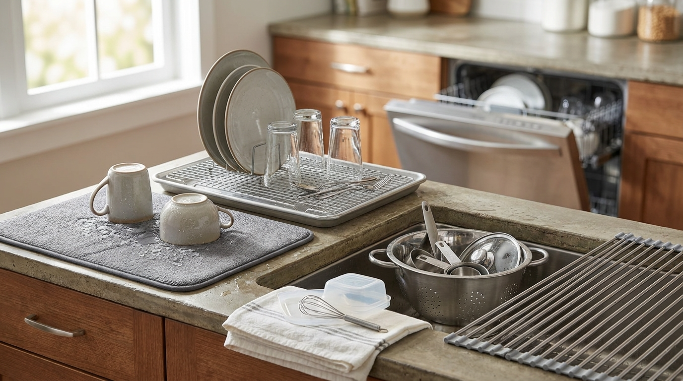
You have several practical options. The best one depends on how many dishes you wash and how much counter space you have.
| Alternative | Water Handling | Plate Support | Storage | Best For |
|---|---|---|---|---|
| Microfiber drying mat | Absorbs drips | Low | Folds flat | Small daily loads |
| Cooling rack + rimmed tray | Tray catches water | Medium | Stacks with bakeware | Plates, bowls, cups |
| Clean dish towel | Absorbs drips | Low | Very compact | Temporary use |
| Large colander | Drains through holes | Low | Stores with cookware | Utensils and small items |
| Over-sink surface | Drains into sink | Medium | Depends on design | Tiny counters |
| Empty dishwasher rack | Drains inside machine | High | Built in | Larger mixed loads |
1. Use a Microfiber Drying Mat
A microfiber drying mat is the easiest dish rack replacement for light washing. Spread it on a clean counter and place dishes on top with space between them.
I like this method for mugs, cereal bowls, lunch plates, and food containers. The mat folds away when the counter needs to become prep space again.
- Keep cups upside down or slightly tilted.
- Do not nest wet bowls together.
- Move the mat if water reaches its edges.
- Wash and dry the mat regularly.
The weakness is obvious. A flat mat does not hold plates upright like a rack.
2. Put a Cooling Rack Over a Rimmed Baking Sheet
This is my favorite homemade dish rack because the two pieces solve different problems. The wire rack creates airflow while the baking sheet catches dripping water.
Use a clean cooling rack that fits securely inside or over the tray. Avoid a warped rack that rocks when you touch it.
- Wash the cooling rack and tray first.
- Set the rack securely over the rimmed pan.
- Place plates and bowls where they cannot slide.
- Keep glasses away from unstable edges.
- Empty the collected water when you’re finished.
This setup works especially well for cups and bowls. Flat plates may need to lean carefully against a stable object instead of standing freely.
3. Use a Clean Dish Towel for Small Loads
A clean cotton towel works when you only have a few items. I use this as a temporary answer, not a permanent drying system.
Spread the towel completely flat rather than piling dishes on a thick folded mound. Give wet items room so their surfaces stay exposed.
- Best for one or two place settings.
- Useful while traveling or staying in temporary housing.
- Easy to replace with a fresh towel.
- Poor choice for heavy pots or a full sink of dishes.
Replace the towel once it becomes soaked. Don’t leave a wet towel trapped against the countertop all day.
4. Turn a Large Colander Into a Mini Drainer
A large colander already has drainage holes, so it can handle small wet kitchen items surprisingly well. Set it inside a clean sink or on a tray.
I wouldn’t try to balance dinner plates inside one. It works better for utensils, measuring cups, lids, small bowls, and sturdy mugs.
- Place the heaviest items at the bottom.
- Keep sharp knives separate.
- Do not pack cups tightly together.
- Let drainage holes stay uncovered.
5. Use Your Empty Dishwasher as a Drying Rack
If you own a dishwasher, its racks already support plates, bowls, glasses, and utensils. You can place hand-washed dishes inside the clean machine to drain.
This keeps the countertop clear. It also gives plates better separation than a flat towel.
Make sure the dishwasher itself is clean before using it for freshly washed dishes. Don’t mix dirty items with the clean ones.
Can I Make an Over-the-Sink Dish Rack?
Yes, but the surface must span the sink safely. A purpose-made roll-up rack is safer than balancing random boards, trays, or wire shelves over the basin.
I care about fit here. Anything bridging a sink can become dangerous if one edge slips while holding glassware.
- Measure the sink opening before choosing a rack.
- Make sure both ends have solid support.
- Avoid smooth objects that can slide when wet.
- Keep heavy cookware off a questionable setup.
- Never block the faucet in a way that causes dishes to fall.
The benefit is excellent drainage. Water falls into the sink instead of collecting across your counter.
How Should I Arrange Dishes Without a Real Rack?
Arrange dishes for drainage first and capacity second. Trying to squeeze everything into one small drying area usually leaves more surfaces wet.
The same principles apply whether you’re using a rack, mat, towel, or tray. My guide to organizing dishes in a dish rack covers the full loading method.
- Plates: Keep them upright when your substitute safely supports them.
- Bowls: Angle the open side downward so water can escape.
- Mugs: Turn them upside down or place them at a steep angle.
- Glasses: Keep them stable and away from heavy pans.
- Utensils: Spread them apart rather than leaving them in a wet pile.
- Cookware: Give large pots and pans their own open drying area.
I often dry bulky cookware separately. One large frying pan can take the space needed for several plates and glasses.
Is Drying Dishes on a Towel Sanitary?
It can be, provided the towel starts clean and doesn’t stay damp for long periods. A dirty or constantly wet towel is not something I want touching freshly washed dishes.
The FDA’s home food-safety guidance recommends washing dishes, utensils, and kitchen surfaces with hot, soapy water.
The USDA also advises cleaning kitchen utensils and surfaces with warm, soapy water and allowing cleaned surfaces to air-dry or using appropriate clean materials.
- Start with a freshly washed towel or mat.
- Don’t reuse something that smells musty.
- Keep raw-meat preparation away from the drying zone.
- Wash absorbent drying materials regularly.
- Let the counter underneath dry too.
If you notice standing water or a stale smell, fix the moisture problem instead of covering it. The CDC’s mold guidance also stresses correcting moisture conditions when mold appears.
I follow the same principle around the sink. You can see my routine for keeping the area under a dish rack dry if puddles keep returning.
What Should You Not Use as a Dish Rack?
Some improvised solutions cause more trouble than they solve. If I can’t clean it, stabilize it, or control the water, I don’t use it.
- Cardboard: It absorbs water, softens, and becomes difficult to keep clean.
- Paper towels for large loads: They become saturated quickly and offer no support.
- Dirty oven racks: Grease, baked residue, and corrosion make them a poor drying surface.
- Rusty metal shelves: Rust or damaged coatings don’t belong beside freshly washed dishes.
- Unstable boards over the sink: A slipping board can send glasses into the basin.
- Bath towels: Their thick fabric holds a large amount of water and can take longer to dry.
- Wooden surfaces with no protection: Repeated soaking can be hard on unfinished or unsuitable wood.
A clean dish rack itself also needs maintenance. If hygiene is your main concern, see whether dish racks are sanitary and how to clean them.
When Is a Real Dish Rack Worth Buying?
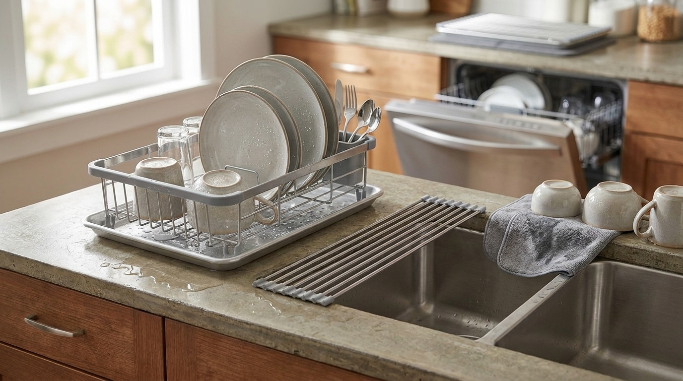
A substitute is enough when you hand-wash only a few dishes. A proper rack becomes more useful when your temporary setup stays on the counter every day.
I would consider buying one when at least two of these problems keep happening.
- Your drying towel is soaked after most meals.
- Plates keep falling against each other.
- Water regularly reaches the countertop.
- You wash several glasses or bowls every day.
- Your temporary setup takes too long to assemble.
- You need more counter space after dishes dry.
As of 2026, fold-flat, rack-and-mat, and roll-up designs make more sense to me than a bulky permanent rack in many small kitchens.
If you’re ready to stop improvising, these are three styles I’d consider:
🏆 Best Fold-Flat Pick
OXO Good Grips Aluminum Fold Flat Dish Rack
★★★★★ 4.8/5 Editor Fit
The aluminum frame folds flat and includes a removable utensil cup plus a ridged draining surface. I like this style when the main goal is getting the counter back after the dishes dry.
🧺 Best Rack-and-Mat Setup
Umbra UDry Dish Drying Rack with Mat
★★★★☆ 4.6/5 Editor Fit
UDry combines a removable rack with an absorbent microfiber mat that folds for storage. I prefer this approach when a flat drying mat feels too loose but a full-size rack feels excessive.
🚰 Best for Saving Counter Space
Surpahs Over-the-Sink Roll-Up Dish Drying Rack
★★★★☆ 4.5/5 Editor Fit
The silicone-wrapped metal-bar design rolls away when you’re done and lets drips fall into the sink. I would choose this style for a small kitchen where a permanent countertop rack gets in the way.
Frequently Asked Questions
Can I use a towel instead of a dish rack?
Yes. A clean dish towel works for small loads if you spread dishes apart and replace the towel when it becomes wet. I would not use one as a permanent solution for heavy daily dishwashing because it offers little plate support and can remain damp.
Can I use a cooling rack as a dish rack?
Yes. A clean wire cooling rack works well when you place it over a rimmed baking sheet or another waterproof tray. The raised wire improves airflow, while the tray catches water that would otherwise drip onto the countertop.
Can dishes air-dry without a rack?
Yes. Dishes can air-dry on a clean mat, towel, tray, or other suitable surface as long as water can drain and wet surfaces are not tightly stacked together. Cups and bowls should be positioned so water does not remain trapped inside them.
What is the cheapest alternative to a dish rack?
A clean dish towel is usually the simplest option if you already own one. For a better reusable setup, a cooling rack placed over a rimmed baking sheet gives you more airflow without requiring a dedicated dish-drying rack.
What is the best dish rack alternative for a small kitchen?
An over-sink roll-up rack or foldable drying mat is usually the most practical choice for limited counter space. Both can be stored after use, while an over-sink design also sends dripping water directly into the basin.
Final Takeaway
If you’re asking, “What can I use as a dish rack?” you probably don’t need to buy something immediately. A clean drying mat, towel, cooling rack and tray, colander, or dishwasher rack can handle the job.
For me, the cooling-rack-and-tray method is the best homemade option. It gives wet dishes airflow while keeping the countertop protected.
Whatever you choose, focus on three things: cleanliness, drainage, and stability. If your temporary setup handles those well, it can work perfectly until you decide whether a dedicated rack is worth the space.