
Hinge Vegetable Chopper: How to Choose and Use One

Quick Answer
A hinge vegetable chopper is a manual kitchen tool that dices vegetables by pressing a hinged lid against a sharp cutting grid. It’s especially useful for onions, carrots, cucumbers, and potatoes. For everyday cooking, choose a stable model with stainless steel blades, removable cleaning parts, and a cutting grid that matches your recipes. The Alligator vegetable chopper range offers several examples of this design.
What matters most when buying
- Cutting grid size: Smaller openings create finer dice, while larger openings make chunkier pieces.
- Hinge strength: A sturdy joint helps transfer pressure evenly across the cutting grid.
- Blade quality: Sharp stainless steel blades make cutting easier and reduce crushing.
- Easy cleaning: Removable grids and cleaning inserts help clear trapped vegetable pieces.
- Stable base: A nonslip design helps keep the chopper steady during use.
Best everyday approach
- Prepare ingredients: Wash vegetables, trim them to fit, and place manageable portions on the grid.
- Press carefully: Keep fingers clear and apply controlled pressure rather than forcing the lid.
- Clean promptly: Remove trapped pieces, wash according to the instructions, and dry the blades.
Chopping a pile of onions or potatoes by hand can take more attention than the rest of a simple recipe. A hinged vegetable chopper offers a different approach, using a pressing motion instead of repeated knife cuts.
I’m Daniel Hartman, and I approach kitchen gadgets with one practical question: will this tool make everyday preparation easier? This guide explains the mechanics, the tradeoffs, and how to pick a chopper that earns its storage space.
What Is a Hinge Vegetable Chopper?
A hinge vegetable chopper is a manual vegetable dicer with a hinged pressing arm and a fixed cutting grid. Closing the arm pushes ingredients through the grid, producing pieces shaped by its blade openings.
Some models collect the chopped vegetables in an attached container. Others require you to empty the pieces from a smaller compartment.
What are the main parts?
- Hinged pressing lid: Moves downward to push ingredients against the blades.
- Cutting grid: Contains intersecting sharp blades that determine the cut size.
- Pressing teeth: Help guide food through the grid when the lid closes.
- Collection container: Catches diced pieces on compatible models.
- Cleaning insert: Helps release pieces stuck between the pressing teeth or blades.
- Supporting base: Holds the mechanism steady during chopping.
The hinge is the feature that distinguishes this tool from pull-cord choppers and handheld knives. It creates a controlled pressing action over a defined cutting area.
How Does a Hinged Vegetable Chopper Work?
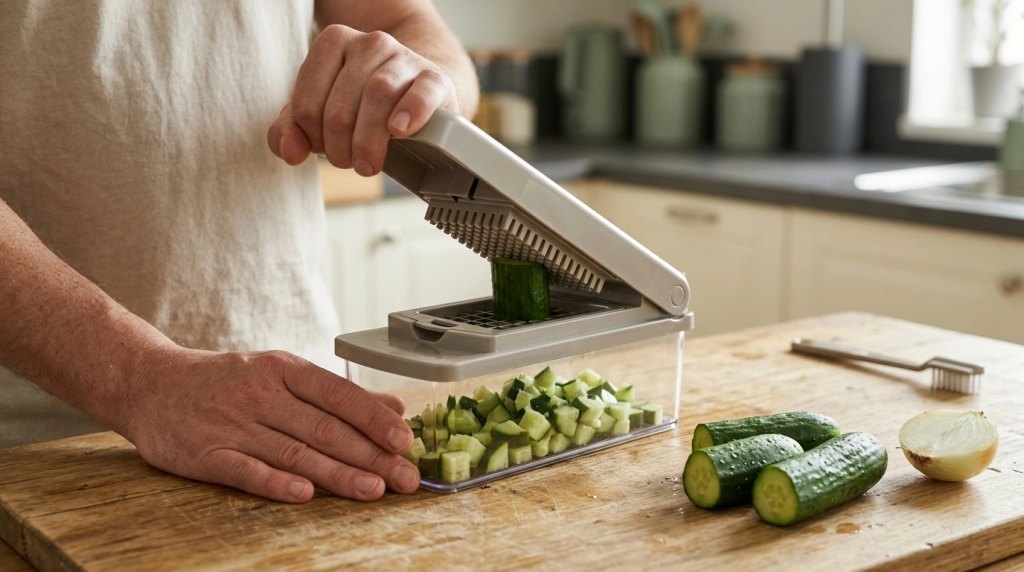
A hinged vegetable chopper uses leverage to press food through stationary blades. The blades divide the ingredient as the lid closes, creating regular strips or diced pieces depending on the preparation.
Unlike a spinning-blade food processor, the cutting grid does not repeatedly rotate through the food. That difference makes a hinged chopper useful when distinct, similarly sized pieces matter.
How to use one step by step
- Prepare the surface. Put the chopper on a clean, level countertop with enough room to operate the lid.
- Wash the vegetables. Rinse produce under running water and remove damaged sections.
- Trim oversized ingredients. Cut large vegetables into portions that fit comfortably across the grid.
- Position the food. Place a manageable piece over the cutting area without overloading it.
- Close the hinged lid. Apply steady pressure with your hand positioned on the designated handle.
- Collect the pieces. Empty the container or cutting area before it becomes crowded.
- Clean the blades. Use the supplied cleaning tool or a suitable brush instead of your fingers.
Start with ingredients that cut easily, such as cucumber or onion. They make it easier to learn how much pressure the mechanism needs.
Why vegetable size matters
A large vegetable can exceed the cutting grid even when the chopper looks spacious. Oversized pieces create uneven pressure and may jam the mechanism.
Cutting a large onion into halves or quarters is often more practical than attempting to force it through whole. Similar preparation helps when working with potatoes or thick carrots.
Which Vegetables Work Best in a Hinge Chopper?
Firm vegetables that hold their shape generally produce the neatest results. Softer ingredients can also work, but very ripe produce may collapse or release excess liquid.
The correct grid matters as much as the ingredient itself. A coarse grid often handles thicker vegetables more comfortably than an extremely fine one.
Good ingredients for everyday chopping
- Onions: Useful for soups, sauces, burgers, and cooked fillings.
- Cucumbers: Produce tidy pieces for salads and cold dishes.
- Carrots: Work well when cut into manageable sections and matched with a suitable grid.
- Potatoes: Larger cutting grids can create pieces for roasting or cooking.
- Bell peppers: Flattened sections can be diced for salads or stir-fries.
- Zucchini: Firm sections can be chopped for soups and skillet meals.
- Shallots: Smaller grids help produce finer pieces for sauces.
Which ingredients should you avoid?
Frozen vegetables, hard pits, and ingredients that exceed the manufacturer’s cutting capacity should stay out of the chopper. Excessive force can damage blades or the hinge.
Very soft tomatoes can crush instead of cutting cleanly, especially with dull or crowded blades. Raw sweet potatoes may also need a larger, heavy-duty grid or a different cutting tool.
My practical rule is simple: if the lid resists strongly, stop and reassess. Pre-cut the ingredient, switch grids, or use a knife rather than increasing force.
Hinge Vegetable Chopper vs. Other Kitchen Choppers
A hinged chopper is best suited to repeatable, grid-shaped cuts. Other chopping tools may be better for irregular mincing, very large ingredients, or recipes requiring slices of different thicknesses.
| Tool | Cutting method | Best use | Main limitation |
|---|---|---|---|
| Hinge chopper | Presses food through a blade grid | Uniform dicing | Limited by grid size |
| Chef’s knife | Manual slicing and chopping | Flexible cuts | Requires knife skills |
| Pull-cord chopper | Spinning blades | Chopping small mixed batches | Less consistent piece sizes |
| Food processor | Motor-driven blades or discs | Larger processing tasks | More components to clean |
| Mandoline slicer | Slides food across a blade | Consistent slices | Usually needs extra cuts for dice |
For salsa, soup vegetables, and meal-prep containers, a grid chopper offers a useful balance of consistency and simplicity. For herbs or ingredients that need fine mincing, I would lean toward a knife or a suitable mini processor.
What Blade Grid Size Should You Choose?
The blade grid controls the size of the vegetable pieces. Smaller grids produce fine dice, while larger grids are more suitable for chunky vegetables and thicker cuts.
Some Alligator choppers offer approximately 3 × 3 mm, 6 × 6 mm, or 12 × 12 mm grids. These measurements describe grid openings, not a universal standard shared by every manufacturer.
| Grid size | Cut style | Typical use |
|---|---|---|
| 3 × 3 mm | Fine dice | Shallots, garlic, fine onion preparations |
| 6 × 6 mm | Small dice | Onions, cucumbers, salad vegetables |
| 12 × 12 mm | Chunky cuts | Potatoes, carrots, larger vegetable pieces |
There’s one detail worth understanding: a square grid does not automatically guarantee perfect cubes. The ingredient’s thickness and how you orient it determine the final shape.
For example, placing a thick onion wedge through a fine grid can create pieces of different lengths. Pre-slicing to a consistent thickness improves the final result.
How Do You Choose the Best Hinge Vegetable Chopper?
The best hinge vegetable chopper is not necessarily the model with the most accessories. It is the one that matches your usual ingredients, chopping volume, storage space, and cleaning preferences.
1. Check the hinge and pressing mechanism
The hinge should move smoothly without excessive sideways play. A poorly aligned pressing plate can make the chopper difficult to close evenly.
Look for a secure attachment between the lid and base. Check whether the mechanism remains stable when opened and closed.
2. Examine the cutting blades
Sharp stainless steel grids generally offer dependable cutting performance when maintained correctly. Replaceable blade assemblies can also make long-term ownership more practical.
A fine grid is not automatically better. Choose the smallest openings your ingredients and recipes genuinely require.
3. Consider cleaning access
Chopped onions and potatoes can become trapped between pressing teeth. Removable cleaning plates are helpful because reaching into a sharp grid is unsafe.
Before buying, inspect whether the grid can be removed and whether a cleaning tool is included. Also check the specific model’s dishwasher instructions.
4. Look for a stable base
A chopper that moves across the countertop creates an unnecessary safety problem. Nonslip feet or a sturdy base can help maintain control.
Try to choose a model with a handle that gives your hand a comfortable pressing position. A larger appliance is not automatically more comfortable.
5. Evaluate capacity and storage
Collection containers are convenient when preparing several servings. However, container capacity does not tell you how much food the cutting grid can handle at once.
Measure your cabinet space before choosing a large model. Compact hinged choppers can be more convenient in small kitchens.
Are Hinge Vegetable Choppers Safe?
Hinged vegetable choppers can be used safely when handled according to their instructions. However, their cutting grids contain sharp blades, and moving lids can pinch fingers.
Never put your fingers beneath the pressing mechanism or inside the blades. Use cleaning inserts or brushes when removing trapped food.
Important kitchen safety habits
- Keep the base steady: Use the chopper on a level countertop.
- Respect the blades: Never test sharpness with your fingers.
- Avoid overloading: Process smaller portions when a vegetable resists cutting.
- Use proper handles: Keep hands on the intended gripping surfaces.
- Follow age guidance: Keep sharp components away from children unless supervised appropriately.
- Inspect the mechanism: Stop using a chopper with cracked plastic, loose blades, or a damaged hinge.
The FoodSafety.gov food safety guidance also recommends separating produce from raw meat and poultry during preparation. I recommend reserving this type of chopper primarily for vegetables and other compatible foods.
How Do You Clean a Hinged Vegetable Chopper?
Clean a hinged vegetable chopper after each use using the manufacturer’s care instructions. Prompt cleaning helps prevent vegetable residue from drying inside the grid.
First remove loose pieces without touching exposed blades. Then wash accessible surfaces and dry the components before storage.
Simple cleaning routine
- Open the lid carefully. Keep the blades facing away from your hands.
- Empty the collection compartment. Remove the chopped food and loose scraps.
- Remove compatible parts. Detach the grid and cleaning plate only as instructed.
- Brush away trapped residue. Use a manufacturer-supplied tool or an appropriate cleaning brush.
- Wash thoroughly. Use warm, soapy water unless the instructions specify another method.
- Rinse and dry. Pay attention to the hinge and blade assembly before putting everything away.
The USDA cutting board guidance recommends cleaning food-contact surfaces after use. The same basic hygiene principle applies to removable cutting grids and collection containers.
Dishwasher compatibility varies by model and component. Never assume the complete chopper belongs in the dishwasher simply because its collection box is dishwasher-safe.
Why Does a Vegetable Chopper Get Stuck?
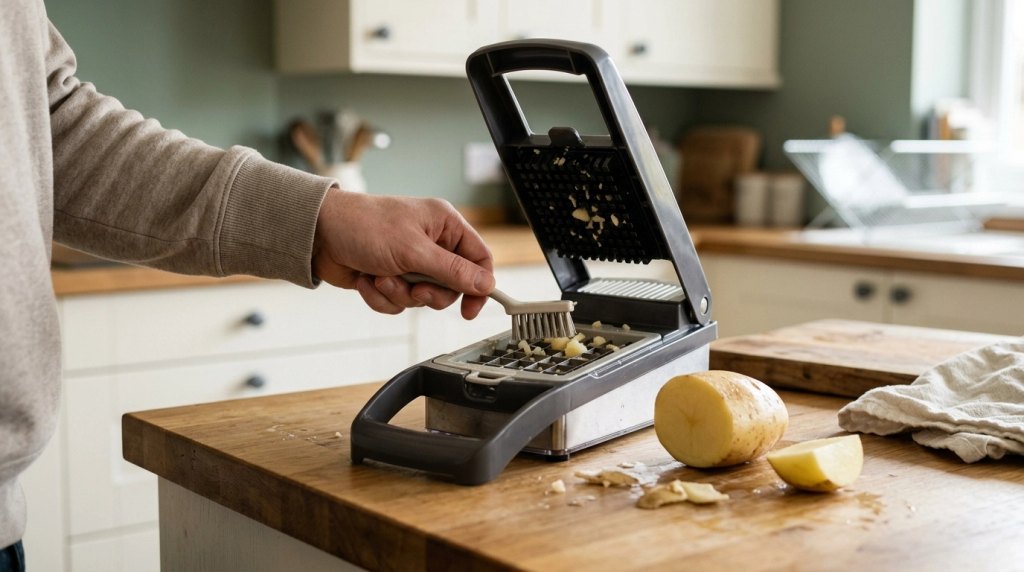
A hinge chopper usually becomes difficult to close when food is too thick, too hard, or packed unevenly against the blade grid. Residue around the pressing teeth can also interfere with operation.
Common problems and practical fixes
- Lid will not close: Remove the ingredient and check whether it exceeds the available cutting area.
- Vegetables become crushed: Try firmer produce, smaller portions, or a sharper compatible grid.
- Pieces remain trapped: Use the removable cleaning insert or a brush.
- Uneven dice: Cut ingredients to a more consistent thickness before pressing.
- Chopper slides: Check the nonslip base and keep the countertop dry.
- Hinge feels loose: Inspect the joint and stop using the appliance if it appears damaged.
Do not strike the lid, twist the hinge, or apply sudden excessive pressure. These approaches can create damage rather than solve the problem.
Is a Hinged Vegetable Chopper Worth Buying in 2026?
A hinged vegetable chopper is worth considering if you frequently prepare diced vegetables and prefer consistent cuts. It becomes less useful when your meals require many different slicing techniques.
For weekly cooking, I would prioritize a durable cutting grid and easy cleanup over an oversized accessory bundle. Simple, repeatable tasks are where the design makes the most sense.
Who benefits most?
- Meal-prep cooks: Helpful when preparing onions, peppers, and other vegetables in batches.
- Small households: Compact models can handle everyday chopping without electrical equipment.
- Salad enthusiasts: Consistent pieces improve presentation and ingredient distribution.
- Busy home cooks: The pressing action may simplify repetitive dicing tasks.
- Beginner cooks: A grid provides predetermined cut widths, although a knife may still be needed for initial preparation.
When should you skip it?
A hinged chopper may not justify its storage space if you only chop vegetables occasionally. A reliable chef’s knife can perform a wider variety of cutting jobs.
It also cannot completely replace knife work. Large vegetables still require trimming, and recipes calling for thin slices or irregular cuts may need different tools.
Recommended Hinge Vegetable Choppers
If you’re choosing a manual hinged chopper, these three verified Alligator models cover distinct preparation needs. The ratings below are editorial suitability assessments based on features, not customer-review averages or hands-on test results.
🏆 Best for everyday dicing
Alligator Original Chopper With Collector 3079G
★★★★½ 4.5/5 editorial fit
This hinged chopper uses a 6 × 6 mm cutting grid and includes a collector for the finished pieces. I would put this format first for cooks who mainly dice onions and everyday salad ingredients, without needing several grid sizes.
🥕 Best for versatile cuts
Alligator 2-in-1 Chopper Set 3008G
★★★★½ 4.5/5 editorial fit
This model includes 6 × 6 mm and 12 × 12 mm cutting grids. I favor the flexibility for households preparing both small onion dice and larger vegetable pieces, although the additional parts need storage.
🔪 Best premium choice
Alligator Stainless Steel Chopper 3094
★★★★☆ 4.0/5 editorial fit
The stainless steel model comes in a three-grid configuration and is positioned as a higher-end option. I would consider it for frequent vegetable preparation, while recognizing that its premium construction may be unnecessary for occasional chopping.
Frequently Asked Questions
Can a hinge vegetable chopper cut potatoes?
Yes, suitable hinged vegetable choppers can cut potatoes, especially when fitted with larger blade grids. The potato must fit within the cutting area, and very hard pieces may require pre-cutting. Always check the model’s approved ingredients and avoid forcing the mechanism.
Is a hinged vegetable chopper better than a knife?
A hinged chopper can be more convenient for repetitive, uniform dicing, while a knife offers greater cutting flexibility. Neither tool is universally better. Choose the chopper for suitable repeated cuts and use a knife when recipes require slicing, trimming, or detailed control.
Can you put a hinge vegetable chopper in the dishwasher?
Some models have dishwasher-safe removable parts, but care instructions vary. Check the manufacturer guidance for the specific cutting grid, collection container, and body. Handwashing and thorough drying may help preserve components when dishwasher use is not recommended.
Why does my vegetable chopper crush onions?
Onions may crush when the blades are dull, the cutting grid is crowded, or the pieces are poorly positioned. Try smaller portions and ensure the grid is clean. If the chopper still requires unusual force, inspect the blades and hinge before continuing.
Are hinge vegetable choppers good for meal prep?
Yes, particularly when meals require repeated portions of similarly sized vegetables. They can simplify preparing diced onions, carrots, peppers, and cucumbers. Their usefulness depends on batch size, cleaning time, and the ingredients you commonly prepare.
Final Takeaway
A hinge vegetable chopper can make repetitive vegetable preparation more manageable, especially when you value consistent pieces. Its greatest advantages are the fixed cutting grid, manual pressing mechanism, and simple operation.
Choose the grid size for your recipes, check the hinge construction, and prioritize easy cleaning. A reliable everyday chopper is more valuable than a complicated gadget that rarely leaves the cupboard.
Start with the vegetables you prepare most often, then choose a model designed to handle them comfortably.
