Pull String Vegetable Chopper: How It Works, Uses, and Best Picks

Quick Answer
A pull string vegetable chopper is a compact manual food chopper that spins sharp blades when you repeatedly pull a cord in the lid. I like it for quickly chopping onions, garlic, herbs, peppers, nuts, and other small ingredients without electricity, especially when I want more speed than a knife but less cleanup than a food processor. If garlic is your main prep job, you can also compare it with the methods in my guide to pressing garlic without a garlic press.
What a pull chopper does best
- Fast small batches: A few pulls can turn onion, herbs, or garlic into evenly chopped pieces.
- No electricity: The cord supplies all the power, so there is no plug, charging cable, or motor.
- Texture control: Fewer pulls leave ingredients coarse, while extra pulls produce a finer chop.
- Compact storage: Most models take up much less cupboard space than a full food processor.
- Simple cleanup: The bowl and blade assembly usually separate from the pull-cord lid.
Before you buy
- Look for sharp stainless-steel blades, a stable base, a comfortable handle, and enough bowl capacity for your normal batch size.
I reach for a pull string chopper when I have half an onion, a few garlic cloves, or a handful of herbs to prep. Those are exactly the jobs where setting up a large food processor feels like more work than the chopping itself.
The design looks simple, but choosing the right one matters. Blade position, bowl size, grip, and cord quality can change how pleasant the tool is to use.
What Is a Pull String Vegetable Chopper?
A pull string vegetable chopper is a manually powered chopping bowl with rotating blades connected to a retractable cord. Pulling the handle spins the blades rapidly through the ingredients.
Think of it as a miniature food processor without a motor. Your hand supplies the energy instead.
- Bowl: Holds the vegetables, herbs, nuts, or other ingredients.
- Blade assembly: Usually uses two or more sharp blades at different heights.
- Lid: Contains the cord and internal spinning mechanism.
- Pull handle: Extends the cord and turns the blades.
- Non-slip base: Helps keep the bowl steady while you pull.
The concept is especially useful in small kitchens because it combines several chopping jobs in one compact tool. It also keeps preparation quieter than an electric processor.
How Does a Pull String Vegetable Chopper Work?

Pulling the cord rotates the blade shaft inside the bowl. A spring or recoil mechanism then draws the cord back into the lid so you can pull again.
Each pull creates another burst of blade rotation. That gives you direct control over the final texture.
- Cut large ingredients into manageable chunks.
- Place them inside the chopping bowl without overfilling it.
- Fit the blade and lid securely.
- Hold the bowl steady on the counter.
- Pull the handle with short, controlled strokes.
- Stop and inspect the texture after several pulls.
- Continue pulling only if you want a finer result.
I normally check early rather than pulling continuously. Herbs and onions can go from chopped to almost paste-like surprisingly fast.
What Can You Chop With a Pull String Chopper?
A pull chopper works best with ingredients that can move freely around rotating blades. Small vegetables, aromatics, herbs, and nuts are especially practical.
I still use a knife when exact slices or perfectly shaped cubes matter. A pull chopper is designed for speed, not geometric precision.
| Ingredient | How It Performs | Best Preparation |
|---|---|---|
| Onions | Excellent | Quarter or roughly chunk first |
| Garlic | Excellent | Peel cloves before chopping |
| Bell peppers | Very good | Remove stem and seeds first |
| Fresh herbs | Very good | Dry excess surface water |
| Carrots | Good | Cut into smaller pieces first |
| Nuts | Good | Use short pulls and check often |
| Ripe tomatoes | Fair | Use only a few pulls |
Great for Onions and Garlic
Onions are probably the ingredient I chop most often in mine. Quartering the onion first gives the blades enough room to circulate the pieces.
Garlic also works well when I need several cloves minced quickly. For tiny amounts, however, a knife or garlic press can still be faster.
If you frequently switch between those methods, my guide on whether you really need a garlic press explains the trade-offs.
Useful for Herbs and Quick Sauces
Parsley, cilantro, basil, and similar herbs can be chopped in seconds. Start with only a few pulls because delicate leaves break down fast.
You can also combine herbs with garlic, oil, seasonings, or nuts for simple dressings and coarse sauces. Stop before the ingredients become smoother than your recipe needs.
Pull String Chopper vs Food Processor: Which Is Better?
A pull chopper is usually better for quick, small jobs, while an electric food processor makes more sense for larger or demanding batches. Neither tool replaces the other completely.
| Feature | Pull String Chopper | Electric Food Processor |
|---|---|---|
| Power | Manual | Electric motor |
| Best batch size | Small | Medium to large |
| Noise | Low | Higher |
| Storage | Compact | Needs more room |
| Hard ingredients | More hand effort | Usually easier |
| Texture control | Excellent for coarse-to-fine chopping | Excellent but easier to overprocess |
For soup prep, I often need only one onion, a carrot, and a little celery. A pull chopper handles those small quantities without creating a pile of processor parts to wash.
You can see why consistent ingredient preparation matters in my guide to common cooking mistakes and how to avoid them.
How Many Times Should You Pull a Vegetable Chopper?
There is no universal number of pulls because ingredient firmness, blade design, and bowl fullness all affect the result. The easiest method is to start with a few pulls and inspect the texture.
- Coarse chop: Use a few controlled pulls and stop early.
- Medium chop: Continue until the pieces circulate evenly around the bowl.
- Fine chop: Use more pulls, pausing occasionally to check the consistency.
- Very fine mixture: Continue carefully, because moist ingredients may become paste-like.
I avoid trying to hit a specific pull count. Watching the food gives me far more reliable results.
Why Is My Pull String Chopper Not Chopping Evenly?
Uneven chopping usually happens because the bowl is too full, the ingredients are too large, or food is trapped above or below the blades. Smaller batches normally fix the problem.
These are the checks I make first:
- Reduce the batch: Ingredients need room to tumble past the blades.
- Pre-cut large vegetables: Big carrot or onion chunks may resist the first few rotations.
- Mix ingredient sizes: Avoid placing one huge piece among many tiny pieces.
- Check blade seating: Make sure the blade shaft is properly positioned.
- Use controlled pulls: Jerking the handle excessively can strain the cord without improving the chop.
When I am preparing a recipe with several vegetables, I often chop dense ingredients separately. Softer vegetables need fewer pulls.
How Do You Clean a Pull String Vegetable Chopper?
Clean the bowl and blade soon after use so food does not dry around the cutting surfaces. The lid deserves special care because it contains the cord mechanism.
- Remove the lid before handling the blade.
- Lift the blade assembly by its center post, not its sharp edges.
- Rinse loose food from the bowl and blade.
- Wash removable food-contact parts according to the manufacturer’s directions.
- Wipe the pull-cord lid if the manufacturer says it should not be submerged.
- Dry every component thoroughly before reassembling or storing it.
Blade edges can be extremely sharp. I never reach blindly into soapy water when the blade assembly is inside.
For general food-handling guidance, the USDA Food Safety and Inspection Service, U.S. Food and Drug Administration, and CDC food safety resources are useful reference points.
What Should You Look for When Buying a Pull String Chopper?
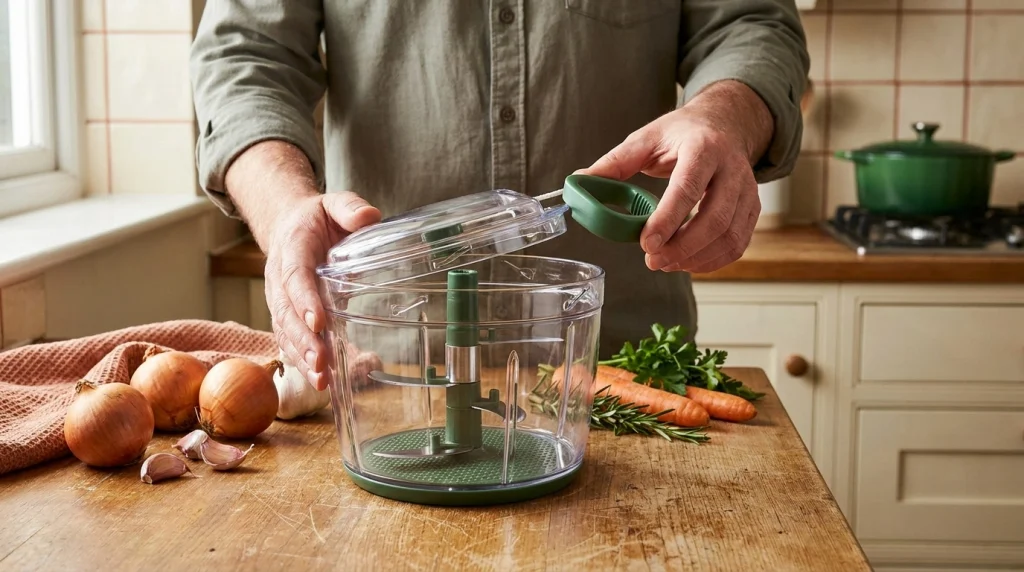
The best pull string chopper should feel stable, easy to pull, and simple to clean. I pay more attention to those basics than to a long list of accessories.
- Blade layout: Blades at different heights can reach food throughout the bowl.
- Bowl capacity: A small bowl suits garlic and onions; larger bowls are easier for meal prep.
- Non-slip base: This helps keep the chopper from moving while you pull.
- Large handle: A comfortable handle gives you a more secure grip.
- Simple construction: Fewer complicated parts usually make cleanup easier.
- Clear bowl: Being able to see the texture prevents accidental over-chopping.
As of 2026, pull-cord designs remain one of several common manual chopper styles. Press-down, pump, and grid-style choppers solve slightly different prep problems.
Learning a few basic knife skills is still worthwhile even if you use gadgets. My guide to essential cooking skills every home cook should know covers those foundations.
Is a Pull String Vegetable Chopper Worth It?
A pull string chopper is worth considering if you regularly prepare small amounts of vegetables and want something faster than hand chopping. It is especially practical when counter space is limited.
I find it most useful for repetitive prep rather than precision work.
- Worth it for: onions, garlic, herbs, peppers, nuts, quick sauces, and small meal-prep jobs.
- Less useful for: perfect cubes, thin slices, large batches, frozen ingredients, or very hard foods.
- Best advantage: fast chopping without electricity.
- Main limitation: you still provide the pulling force.
A chopped salad is a good example of where the tool earns its place. Recipes such as these boiled chickpea meal ideas often use onions, herbs, cucumbers, or similar vegetables that benefit from fast prep.
If you’re ready to pick one, here are the pull-style choppers I would start comparing:
🏆 Best Overall
Zyliss Easy Pull Food Chopper
★★★★★
This compact manual chopper uses stacked blades and a pull-cord mechanism for controlled chopping. I like its straightforward design for onions, herbs, garlic, and other everyday small-batch prep.
🥕 Best Compact Pick
Kuhn Rikon Pull Chop
★★★★☆
The Kuhn Rikon is another compact pull-cord design aimed at small chopping jobs. I would choose this style when cupboard space matters and most batches involve one onion, herbs, garlic, or a modest amount of vegetables.
💰 Alternative Pull-Cord Pick
Chef’n Hand-Powered Food Chopper
★★★★☆
Chef’n offers the same basic hand-powered idea in another well-known manual-chopper design. I would compare its current bowl size, handle comfort, and cleaning instructions with the other two before choosing.
Frequently Asked Questions
Can a pull string chopper chop carrots?
Yes, a pull string chopper can handle carrots when you cut them into smaller chunks first. Because carrots are dense, avoid filling the bowl too heavily and use controlled pulls rather than forcing the cord against oversized pieces.
Can you put tomatoes in a pull string vegetable chopper?
Yes, but tomatoes need a light touch. Firm tomatoes usually tolerate a few pulls, while very ripe tomatoes can quickly become watery or crushed. Stop and inspect the texture after each short set of pulls.
Can a pull chopper replace a food processor?
A pull chopper can replace a food processor for many small chopping jobs, but not every task. An electric processor is better for large batches, prolonged processing, and recipes that need significant motor power.
Can you wash a pull string chopper in the dishwasher?
It depends on the model. Bowls and removable blades may be dishwasher-safe, while lids containing the cord mechanism often have different cleaning instructions. Always check the manufacturer’s directions before putting any component in the dishwasher.
Why does my pull chopper cord feel hard to pull?
The bowl may be overloaded, the ingredient pieces may be too large, or something may be blocking the blades. Remove some food, cut hard ingredients smaller, reseat the blade, and never force a cord that suddenly feels jammed.
Final Takeaway
A pull string vegetable chopper fills a useful gap between a chef’s knife and an electric food processor. It is fast, compact, quiet, and gives you direct control over how finely ingredients are chopped.
I would buy one mainly for onions, garlic, herbs, peppers, nuts, and everyday small-batch prep. Choose a stable bowl, sharp blades, and a comfortable pulling mechanism, then let the texture—not a fixed pull count—tell you when the food is ready.
