Push Down Vegetable Chopper: How It Works, Uses & Best Picks

Quick Answer
A push down vegetable chopper is a manual kitchen tool that cuts produce when you press a lid or handle downward. Grid-style models are especially useful when you want fast, uniform cubes for onions, peppers, potatoes, cucumbers, and similar foods, although you should always start with properly washed produce following FDA produce-safety guidance.
What matters most
- Blade style: A fixed grid creates more uniform cubes than a spinning blade.
- Cut size: Interchangeable grids give you more control over fine or coarse dicing.
- Container size: A larger catch box reduces how often you need to empty the chopper.
- Hand effort: Tough vegetables require more downward pressure than onions or peppers.
- Cleaning: Removable grids and cleaning tools make trapped food easier to remove safely.
Best quick-use tip
- Cut oversized vegetables into manageable sections before pressing instead of forcing an overloaded grid.
A good push down vegetable chopper can make everyday prep feel much less repetitive. Instead of dicing one onion piece by piece, you can often create a tray of similarly sized pieces with a few deliberate presses.
I still think a sharp chef’s knife belongs in every kitchen. However, a push chopper earns its space when consistent cubes and contained mess matter more than traditional knife work.
What Is a Push Down Vegetable Chopper?
A push down vegetable chopper is a non-electric cutting tool operated by downward hand pressure. Depending on the design, that pressure either forces food through a blade grid or moves a rotating blade inside a small container.
The grid version is what most people picture when searching for a manual vegetable dicer. You place food over the blade insert, lower the hinged top, and press until the pieces fall into the catch container.
- Grid chopper: Produces defined cubes or strips using fixed blades.
- Pump chopper: Spins a blade when you repeatedly push a plunger.
- Pull-cord chopper: Spins internal blades when you pull a cord.
- Mandoline combination tool: Adds slicing, shredding, or julienne inserts to a chopper base.
If your goal is neat dice for salads, salsa, soups, or meal prep, I usually look first at a grid-style design. The fixed grid controls the shape instead of relying on how long you operate a spinning blade.
How Does a Push Down Vegetable Chopper Work?
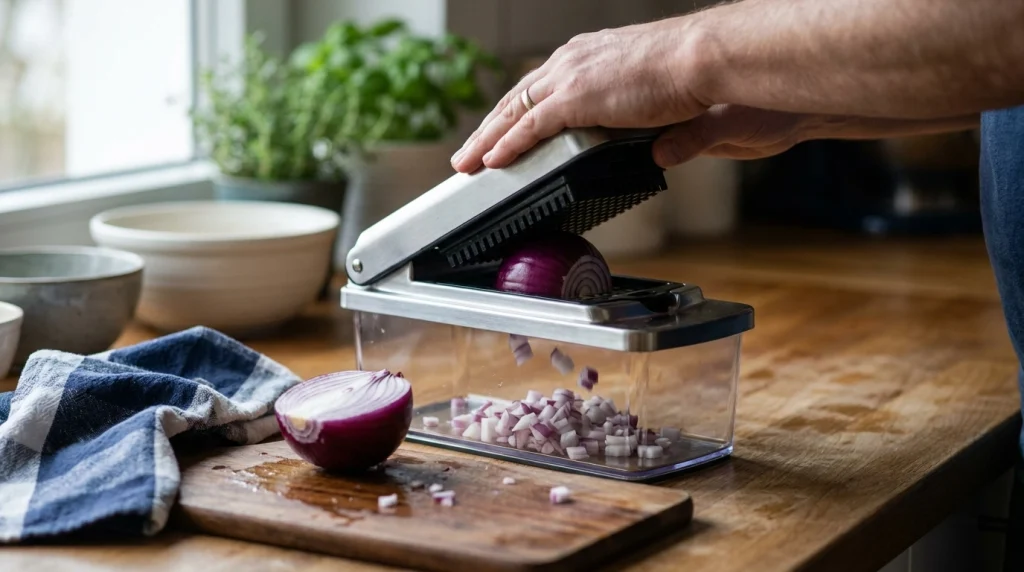
A grid-style push chopper works by applying downward force across food positioned above several intersecting blades. The vegetable passes through those blades and drops directly into the container underneath.
The process is simple, but your results improve when the ingredient fits the grid properly.
- Wash the vegetable under running water when appropriate.
- Remove stems, peels, pits, or damaged sections as needed.
- Cut large ingredients into sections that fit the cutting area.
- Place one manageable section over the selected blade grid.
- Close the lid and press firmly using controlled pressure.
- Empty the container before it becomes excessively full.
- Remove the blade insert carefully before cleaning.
One mistake I avoid is treating the lid like a hammer. Controlled pressure is easier on the hinge, blade frame, and your hands.
If something will not pass through the grid with reasonable force, remove it and make the piece smaller. Forcing stubborn food rarely improves the result.
What Can You Cut With a Push Down Vegetable Chopper?
Push choppers perform best with produce that is firm enough to hold its shape but not so hard that it overloads the cutting grid. Onions, peppers, cucumbers, zucchini, and many potatoes are common examples.
Different foods behave differently, so I don’t expect one blade insert to handle everything equally well.
| Food | Typical Result | Best Approach |
|---|---|---|
| Onion | Excellent uniform dice | Quarter or halve first |
| Bell pepper | Clean cubes or strips | Remove stem and seeds |
| Cucumber | Fast, even pieces | Cut thick cucumbers lengthwise first |
| Potato | Good dice with more pressure | Use pieces that fit the grid |
| Tomato | Variable depending on firmness | Choose firm tomatoes and a sharp grid |
| Hard carrot | Requires noticeably more force | Use smaller sections or another cutting method |
Uniform pieces are useful for more than appearance. Similar-sized vegetables tend to cook at a more similar rate, which makes timing easier in skillets, soups, casseroles, and roasted dishes.
For example, evenly chopped beans and vegetables are easier to manage when following a recipe such as my guide on cooking green beans in a frying pan.
Is a Push Down Chopper Better Than a Knife?
A push chopper is better for certain repetitive cutting jobs, while a knife gives you far more control. I see them as complementary tools rather than direct replacements.
The chopper’s biggest advantage is repeatability. Once you choose a grid, nearly every piece passing through it has a similar width.
| Feature | Push Down Chopper | Chef’s Knife |
|---|---|---|
| Uniform dice | Easy with fixed grids | Depends on knife skill |
| Cut variety | Limited to included inserts | Highly flexible |
| Small batch cleanup | More parts to wash | Knife and board only |
| Learning curve | Low | Higher for consistent cuts |
| Hard ingredients | Can require substantial force | More controlled with proper technique |
I reach for a knife when I need thin slices, irregular shapes, or only half an onion. I prefer a chopper when several vegetables need the same dice.
Whichever method you use, avoiding rushed prep prevents many common kitchen problems. My guide to common cooking mistakes and how to avoid them covers several habits that matter after the chopping is finished.
What Should You Look for When Buying One?
The best push down vegetable chopper is not automatically the model with the most attachments. Blade quality, stability, usable capacity, and cleanup matter more in everyday use.
- Sharp blade grids: Cleaner blades require less crushing and excessive force.
- Multiple dice sizes: A coarse and fine grid covers most common prep jobs.
- Stable base: Non-slip feet help keep the container planted during a firm press.
- Strong hinge: Grid choppers put repeated load through the lid and hinge.
- Useful container: Pick a capacity suited to the amount you normally prep.
- Cleaning tool: Small brushes or grid cleaners help remove pieces without using your fingers.
- Simple storage: Extra blades are useful only if you can organize them safely.
As of 2026, multi-function models commonly combine dicing grids with julienne, slicing, grating, or spiralizing attachments. That flexibility sounds appealing, but every extra insert also becomes another part to store and wash.
My practical rule is simple: buy for the two or three cuts you make every week. Don’t choose a twelve-function gadget just because the number looks impressive.
Push Down Chopper vs Pull-Cord Chopper: What’s the Difference?
A push-down grid chopper makes defined pieces, while a pull-cord chopper repeatedly spins blades through food. That difference changes both texture and the jobs each tool handles best.
- Choose push-down: When you want cubes for salsa, salads, potatoes, onions, or meal prep.
- Choose pull-cord: When you want rough chopped herbs, garlic, nuts, or softer mixtures.
- Choose pump style: When you prefer repeated pressing over closing a large grid lid.
- Choose a knife: When precision, thin slicing, or minimal cleanup matters most.
Garlic is a good example of where another tool can make more sense. If that’s one of your main ingredients, see whether you really need a garlic press before buying another multi-purpose gadget.
How Do You Use a Push Down Chopper Safely?
The blades inside a vegetable chopper are sharp enough to cause serious cuts, even when the tool is not moving. Keep your fingers away from cutting grids during both assembly and cleaning.
The FDA recommends washing hands, utensils, cutting surfaces, and countertops as part of safe food preparation. It also recommends separating produce and equipment from raw meat, poultry, seafood, and their juices.
- Start clean: Wash your hands and food-contact surfaces before preparing produce.
- Rinse produce: Use running tap water rather than soap or detergent.
- Use the cleaning tool: Never push trapped food from sharp grids with your fingertips.
- Keep the base stable: Operate the chopper on a flat, dry countertop.
- Don’t overload: Use pieces that fit comfortably inside the cutting area.
- Separate raw foods: Prevent raw meat juices from contacting chopped vegetables.
You can review the broader four steps to food safety for guidance on cleaning, separating, cooking, and chilling.
The FDA safe food handling guide also explains how to clean kitchen tools and avoid cross-contamination.
How Do You Clean a Vegetable Chopper?
Clean the chopper shortly after use so vegetable pieces do not dry inside the grid. Dried onion or potato can be much harder to remove later.
- Empty the catch container completely.
- Separate removable blade inserts according to the manufacturer’s instructions.
- Use the included brush or cleaning comb around the grid.
- Wash food-contact parts according to the product’s care directions.
- Let all components dry before reassembly or storage.
Don’t assume every component can tolerate the dishwasher simply because the catch container is plastic. Some manufacturers limit certain pieces to top-rack cleaning or recommend hand washing blade assemblies.
For general produce preparation, USDA guidance also recommends cleaning food-contact utensils and surfaces to help reduce cross-contamination.
When Is a Push Down Vegetable Chopper Worth Buying?
A push chopper makes the most sense when you regularly prepare several portions of diced vegetables. It is especially convenient for meal prep, salsa, soups, omelets, salads, casseroles, and taco toppings.
It may be unnecessary if you usually chop one small ingredient at a time.
- Worth considering: You dice onions, peppers, potatoes, or cucumbers several times each week.
- Worth considering: Consistent piece size matters to you.
- Worth considering: You want chopped food contained instead of scattered across a board.
- Think twice: You dislike washing multi-part tools.
- Think twice: You mainly prepare hard vegetables requiring substantial hand force.
- Think twice: A knife already handles your typical small batches quickly.
For me, the strongest reason to own one isn’t saving a few seconds. It’s turning repetitive dicing into a predictable process with fewer pieces escaping across the cutting board.
Push Down Vegetable Choppers I’d Consider in 2026

If you’re ready to choose one, these three designs cover different priorities. I would match the mechanism to the food you prepare most often rather than buying solely by attachment count.
🏆 Versatile Pick
Fullstar Pro Original Vegetable Chopper
★★★★½ 4.5/5
This popular manual model combines a roughly 5-cup container with multiple cutting functions, including dicing and spiralizing. I like this format for cooks who want a push-down dicer without dedicating drawer space to several separate prep gadgets.
🔪 Most Blade Options
Mueller Pro-Series 10-in-1 Vegetable Chopper
★★★★½ 4.5/5
The Mueller uses several interchangeable inserts for jobs such as dicing, slicing, julienne cutting, and grating. I would consider it when cut variety matters more than having the simplest possible set of parts.
👌 Simple Pump Style
OXO Good Grips Vegetable Chopper
★★★★½ 4.5/5
OXO takes a different approach with a push-operated rotating blade instead of a square dicing grid. I prefer this style for garlic, herbs, and smaller ingredients when an exact cube is less important.
Frequently Asked Questions
What is the best push down vegetable chopper for onions?
A grid-style chopper with sharp interchangeable blades is usually a practical choice for onions because it creates consistently sized pieces in one press. Choose a model with a stable base and a catch container, and cut unusually large onions into halves or quarters before chopping.
Can you put raw carrots in a push down vegetable chopper?
Some choppers can cut raw carrots, but dense pieces may require significant pressure and can stress fine grids. Cutting carrots into smaller sections helps, although a sturdy knife or another cutting method may be more comfortable for especially hard vegetables.
Are push down vegetable choppers safe?
They can be used safely when kept stable and handled according to the manufacturer’s instructions. The greatest risk comes from touching exposed blade grids during assembly or cleaning, so use the supplied cleaning tool rather than pushing trapped food out with your fingers.
Is a manual vegetable chopper dishwasher safe?
It depends on the model and component. Some containers and removable pieces are dishwasher safe, while blade assemblies or lids may have different care requirements, so always check the manufacturer’s instructions before placing the complete chopper in a dishwasher.
Is a push vegetable chopper better than an electric chopper?
A push chopper is better when you want defined cubes, quiet operation, and no electrical power. An electric model usually requires less physical effort and can handle chopping or processing tasks where exact cube shape is not important.
Final Takeaway
A push down vegetable chopper is most useful when you want repeatable dice without spending several minutes on knife work. Grid-style models stand out for onions, peppers, cucumbers, potatoes, and other foods that fit their blades comfortably.
Choose a model based on blade quality, stability, cleanup, and the cuts you genuinely use. A simple chopper that fits your routine will usually serve you better than a complicated one filled with attachments that stay in the drawer.
