
How Does a Manual Vegetable Chopper Work? Explained

Quick Answer
A manual vegetable chopper works by converting your hand movement into cutting force. Depending on its design, pulling a cord spins sharp blades, pressing a handle moves or rotates a blade, or pushing a lid forces vegetables through a cutting grid. It requires no electricity. The chopping result depends on the mechanism, vegetable size, and how many times you operate it.
What Happens Inside a Manual Vegetable Chopper?
A manual vegetable chopper uses mechanical force rather than an electric motor to cut food. Your hand supplies the energy, while the internal mechanism transfers that movement to a blade or cutting grid.
Most enclosed manual choppers contain a food container, a cutting assembly, and a lid or handle that operates the blades. Some also have gears, springs, or a rotating shaft.
The basic cutting process involves three actions:
- Force is applied: You pull a cord, press a knob, or push down a lever.
- The mechanism transfers motion: A shaft, gear assembly, or pressing surface moves the cutting blades.
- The blades cut the vegetables: Repeated cuts or a single push divide the ingredients into smaller pieces.
With rotating-blade designs, each blade pass may cut ingredients into smaller pieces. Food movement inside the container influences how evenly those pieces are chopped.
With grid-style choppers, vegetables are forced through fixed openings. The grid largely determines the resulting piece dimensions, provided the food is positioned and prepared correctly.
How Do Different Manual Chopper Mechanisms Work?
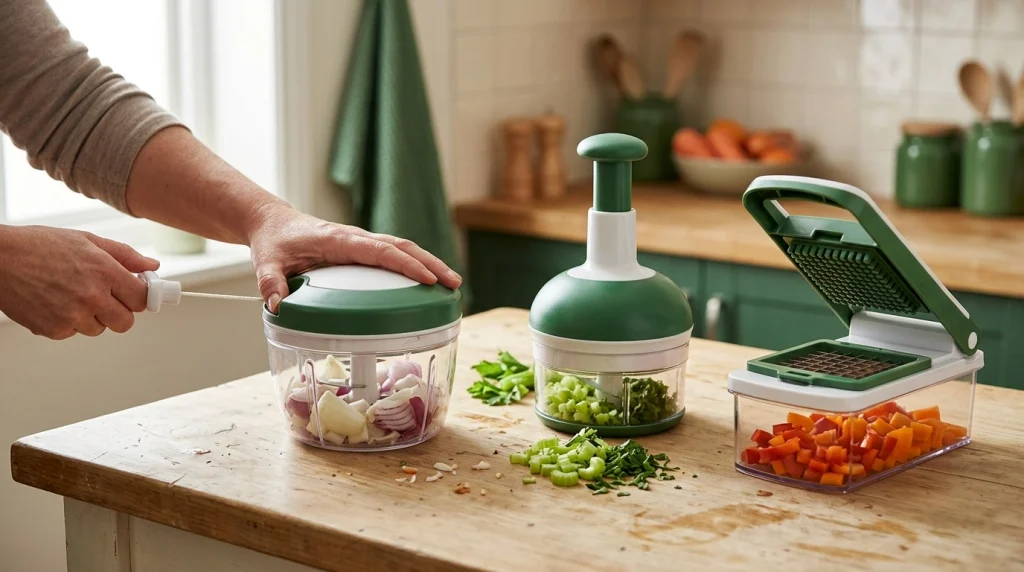
Not every manual vegetable chopper uses the same cutting process. Understanding the mechanism helps explain why one model produces finely chopped onions while another makes relatively uniform cubes.
1. Pull-Cord Vegetable Choppers
A pull-cord chopper contains rotating blades connected to a mechanism inside the lid. Pulling the handle draws out the cord and turns the blade assembly.
When you release the handle, a spring-loaded retraction mechanism pulls the cord back into its housing. Repeating the action spins the blades again.
The chopping sequence is straightforward:
- Place prepared vegetables inside the bowl.
- Fit and secure the lid.
- Hold the container steady.
- Pull the cord smoothly using its handle.
- Release it so the cord can retract.
- Repeat until the desired texture is reached.
More pulls generally produce smaller pieces. However, very long chopping sessions can turn soft, watery ingredients into an uneven mash rather than a clean dice.
For example, a pull-cord chopper can roughly chop onion pieces for a cooked sauce with a few pulls. Additional pulls produce a finer texture for mixing into dressings or fillings.
Manufacturer instructions for the Kuhn Rikon Pull Chop confirm that pulling its cord rotates the blades and that additional pulls create finer results.
2. Pump-Action or Press-Down Choppers
A pump-action chopper has a vertical knob or handle that you press repeatedly. Its internal mechanism converts the downward movement into cutting motion.
In some designs, the blade assembly turns slightly with each press, changing its position within the food. In others, a blade moves vertically through the ingredients.
The mechanism determines the actual cutting pattern, so two similarly shaped pump choppers may behave differently.
The OXO Good Grips Chopper, for example, uses a blade that rotates with each press of its knob. This helps the blade reach different portions of the ingredients during repeated operation.
Pump-action choppers are useful for preparing small quantities of onions, celery, herbs, and similar ingredients without repeatedly pulling a cord.
3. Push-Down Grid Vegetable Choppers
A grid-style vegetable chopper operates differently from rotating-blade models.
It typically contains a fixed arrangement of intersecting cutting blades beneath a hinged lid or pressing plate.
When you push down:
- The pressing surface applies force to the vegetable.
- The vegetable meets the sharpened cutting grid.
- The grid divides the ingredient into pieces.
- The cut vegetables pass into a collecting container.
This design is especially useful when a recipe calls for more consistent diced vegetables.
For accurate cubes, the ingredient’s starting thickness matters. A cutting grid divides the food in two directions, but the thickness of a pre-cut slice determines the third dimension.
Key Insight
A rotating-blade chopper controls texture mainly through repeated chopping. A grid chopper controls the width and length of each piece through its fixed blade openings. These mechanisms produce different results even when both are called manual vegetable choppers.
How to Use a Manual Vegetable Chopper Step by Step
For most enclosed rotating-blade choppers, the following process provides a reliable starting point. Always follow the specific assembly and capacity instructions for your model.
Step 1: Wash and Prepare the Vegetables
Rinse fresh vegetables under running water and remove any damaged areas. The FDA’s produce safety guidance recommends cleaning produce before cutting, even when the peel will be discarded.
Peel ingredients when appropriate and remove tough stems, large pits, or other parts unsuitable for the blades.
Step 2: Cut Large Vegetables Into Smaller Pieces
Large whole vegetables may not fit properly or move freely inside the container.
Cut an onion into quarters or smaller sections if needed. Divide carrots into manageable pieces, and remove thick stalks from vegetables that your model cannot handle easily.
Pre-cutting also helps prevent one large piece from obstructing the rotating blade assembly.
Step 3: Assemble the Chopper Correctly
Position the blade assembly in its designated mounting point and check that it sits securely.
Add the vegetables without exceeding the manufacturer’s recommended fill level. Position the lid correctly and engage any required locking mechanism.
Do not operate a chopper when its lid or blade assembly is loose.
Step 4: Operate the Cutting Mechanism
Place the container on a stable work surface.
For a pull-cord design, hold the lid or bowl firmly and pull the cord smoothly in the recommended direction. Let it retract before pulling again.
For a pump-action model, press the knob with controlled, repeated movements. For a grid chopper, position the prepared vegetable over the blades and press the lid according to its instructions.
Avoid applying excessive force if the mechanism becomes stuck.
Step 5: Check the Chopping Texture
Stop the mechanism completely before opening the lid. Inspect the pieces to determine whether they are coarse enough or need additional cutting.
With rotating-blade models, begin with a few strokes or pulls, check the result, and continue gradually. There is no universal number of pulls that guarantees a particular texture.
Step 6: Empty and Clean the Container
Remove the lid and blade assembly carefully, following the manufacturer’s instructions.
Transfer the vegetables with a suitable utensil rather than using your fingers near the cutting edges.
Wash the food-contact components after use and let them dry completely before storage.
Which Vegetables Work Best in a Manual Chopper?
Manual choppers usually handle vegetables best when the ingredients are cut into manageable pieces and their firmness is appropriate for the mechanism.
The following comparison shows practical starting points rather than guaranteed performance for every model.
| Ingredient | Preparation | Expected Result |
|---|---|---|
| Onions | Peel and quarter | Coarse to fine chopping |
| Carrots | Cut into small pieces | Small pieces if the model supports hard vegetables |
| Bell peppers | Remove core and seeds | Chopped pieces or grid-cut dice |
| Tomatoes | Use firm pieces | Soft chopped texture; may become watery |
| Garlic | Peel cloves | Minced pieces, especially in small batches |
| Fresh herbs | Remove unsuitable tough stems | Chopped leaves; may cling to the bowl |
For very small amounts of garlic, a dedicated press may be simpler. Our guide explaining how garlic presses work covers the different crushing mechanism.
Hard vegetables require more cutting force than soft produce. Some choppers handle them well after pre-cutting, while lightweight mechanisms may jam or struggle.
Large quantities of leafy greens can also be difficult because the leaves may compress or collect around the blades instead of chopping consistently.
What Determines How Finely Vegetables Are Chopped?
Four practical factors influence chopping results: the cutting mechanism, the amount of food, the starting piece size, and the number of cutting actions.
- Number of pulls or presses: Additional cutting actions generally create finer pieces in rotating-blade choppers.
- Blade design: Blade shape, sharpness, and movement affect how food is cut.
- Container loading: Excess food restricts movement and makes consistent chopping more difficult.
- Vegetable texture: Firm produce resists cutting differently from juicy or soft ingredients.
Consider preparing onions for two different dishes. For a chunky salsa, stop while recognizable pieces remain. For a smoother sauce base, continue chopping in small increments.
A grid chopper does not offer the same continuous texture adjustment. Changing the dice size typically requires a different cutting grid or changing how the ingredients are prepared.
Tip
For more consistent results, start with similar-sized vegetable pieces and chop in smaller batches. Check the texture before adding more pulls or presses. This gives you more control than trying to correct an overchopped mixture.
Why Is My Manual Vegetable Chopper Not Working Properly?
If your chopper stops cutting effectively, first check the ingredient load, assembly, and condition of the mechanism. Many apparent cutting problems come from overloaded bowls or ingredients that are too large.
The Blades Are Not Spinning
Make sure the blade assembly is properly seated and connected to its drive mechanism. Check whether the lid is locked as intended.
For pull-cord models, inspect for obvious cord damage or failure to retract. Do not open a spring-loaded cord housing unless the manufacturer specifically provides a safe repair procedure.
The Vegetables Are Chopping Unevenly
Try reducing the amount of food and making the starting pieces more similar in size.
If food sticks to the sides of the bowl, stop and carefully redistribute it using a suitable utensil after opening the chopper safely.
The Cord Feels Difficult to Pull
Stop rather than forcing it. Remove some ingredients, check for obstruction, and confirm the blade assembly is seated correctly.
Hard vegetables or an overfilled container can increase the resistance that the mechanism encounters.
The Vegetables Become Mushy
Reduce the number of pulls or presses and work in shorter bursts. Soft ingredients can quickly lose their distinct shape when repeatedly struck by rotating blades.
For tomato cubes or similarly delicate ingredients, a grid cutter or knife may offer better shape control.
How to Clean a Manual Vegetable Chopper Safely

Cleaning matters because food residue can collect around blades, inside containers, and beneath removable components.
- Make sure the chopper is no longer operating.
- Remove the lid and detachable parts according to the instructions.
- Carefully separate the blade assembly, avoiding the sharp edges.
- Wash washable food-contact parts with warm water and dish soap.
- Use a suitable cleaning brush for areas where fingers cannot safely reach.
- Rinse and dry the components before reassembly and storage.
Do not automatically submerge a pull-cord lid. Some lids contain enclosed springs or mechanical components that require different cleaning methods.
Similarly, dishwasher safety varies between products and individual components. Check the manufacturer’s directions before placing the lid, blade, or bowl in a dishwasher.
The FDA’s safe food handling recommendations emphasize cleaning food preparation equipment and separating raw meat from ingredients that will be eaten without further cooking.
For additional prevention practices, review these kitchen safety tips before your next food preparation session.
When Is a Manual Chopper Better Than Using a Knife?
A manual chopper is useful when you want repeated small cuts without manually guiding a knife through every piece of food.
It may be particularly convenient when preparing small portions of onions, herbs, garlic, and vegetables for mixed dishes.
However, a knife remains more versatile when precise slices, attractive presentation, or specific shapes are essential.
- Choose a pull-cord chopper: For adjustable coarse-to-fine chopping in a bowl.
- Choose a pump-action chopper: For repeated chopping through downward presses.
- Choose a grid chopper: For relatively consistent diced pieces.
- Choose a knife: For precise slices, irregular shapes, delicate ingredients, or very large vegetables.
The best method is the one that produces the texture the recipe needs without unnecessary preparation or cleanup.
Understanding proper cutting techniques is part of broader essential cooking skills, particularly when coordinating several ingredients for one meal.
Related Product: Kuhn Rikon Pull Chop
This manual pull-cord chopper is a practical example of the rotating-blade mechanism explained above. Its manufacturer describes adjustable chopping fineness based on repeated pulls. Check the exact model and available specifications before purchasing.
Affiliate disclosure: We may earn a commission from qualifying purchases.
Frequently Asked Questions
1. Does a manual vegetable chopper need electricity?
No. A manual chopper relies on hand-powered mechanisms such as cords, pumping handles, or pressing levers. It does not need an electrical outlet or battery to operate.
2. Can a manual vegetable chopper cut raw carrots?
Many models can chop raw carrots when the carrots are cut into sufficiently small pieces first. However, very hard or oversized pieces may strain lightweight mechanisms. Follow the model’s ingredient guidance.
3. Can a manual chopper make vegetable puree?
Some rotating-blade models can finely process soft ingredients until they approach a paste-like consistency. However, they do not always produce the smooth, uniform puree achievable with a blender or suitable food processor.
4. Why does a pull-cord chopper have a spring?
The spring helps retract the cord into the lid after each pull. This allows the user to repeat the pulling motion without manually rewinding the cord.
5. Can I use a manual vegetable chopper for nuts?
Some manual choppers are designed to chop nuts, but suitability depends on the model and the hardness of the ingredients. Consult the manufacturer’s permitted-food instructions rather than assuming every chopper can handle them.
6. Can I sharpen the blades of a manual vegetable chopper?
Blade maintenance depends on the design. Many compact choppers have specialized detachable blade assemblies that should be replaced rather than sharpened at home. Follow the manufacturer’s maintenance instructions and avoid using damaged blades.
Final Thoughts
A manual vegetable chopper turns simple hand movements into mechanical cutting action. Pull-cord and pump-action models repeatedly move blades through food, while grid-style choppers push ingredients through fixed cutting edges.
For better results, match the mechanism to the texture you need, prepare vegetables in manageable pieces, avoid overfilling, and clean the cutting components carefully. Those habits make manual chopping more predictable without requiring an electric appliance.