
Push Down Vegetable Chopper for Carrots: How to Cut Them Easily and Safely

Quick Answer
To chop carrots with a push-down vegetable chopper, wash and trim the carrots, cut them into sections that fit the blade grid, and place each piece securely over the blades. Press the lid straight down using steady, controlled pressure, following the manufacturer’s instructions. If the carrot resists, stop and make the pieces smaller rather than forcing the lid.
What helps carrots cut cleanly?
- Prepare the carrot: Remove the ends and cut thick carrots into shorter, manageable sections.
- Choose the right grid: Use a sturdy dicing insert approved for firm vegetables.
- Check alignment: Keep the carrot section centered over the cutting grid.
- Press evenly: Apply controlled downward pressure without twisting or striking the lid.
- Clear blockages safely: Open the chopper only as directed and use its cleaning tool instead of your fingers.
One important safety tip
- Never force a jam: Stop if the lid will not close normally, then check the carrot size, blade insert, and assembly.
Carrots are nutritious, versatile, and useful in everything from salads to soups, but their firm texture can challenge a manual vegetable chopper. The right preparation makes a noticeable difference.
In this guide, I’ll explain how to prepare carrots for a push-down chopper, choose the right cutting grid, troubleshoot common problems, and keep the blades clean. I’ll also cover when another kitchen tool makes more sense.
What Is a Push-Down Vegetable Chopper?
A push-down vegetable chopper is a manual kitchen tool that uses a hinged or pressing lid to drive vegetables through a stationary cutting grid. The grid determines the shape and approximate size of the resulting pieces.
Unlike an electric food processor, this chopper relies on downward pressure rather than a spinning motor. Depending on its design, it can dice carrots, onions, potatoes, peppers, and other suitable vegetables.
- Cutting grid: Contains the sharp blades that divide the carrot into pieces.
- Pressing lid: Pushes the prepared vegetable through the grid.
- Collection container: Catches the chopped carrot and keeps the counter tidy.
- Cleaning comb: Helps remove food caught between the grid teeth, if supplied.
Not every vegetable chopper handles firm carrots equally well. Blade strength, grid size, frame construction, and the manufacturer’s permitted uses all affect performance.
How Do You Cut Carrots With a Push-Down Vegetable Chopper?

The easiest approach is to prepare carrots before placing them in the chopper. Short, appropriately sized sections are easier to position than long, whole carrots.
- Wash the carrots. Scrub them under running water and remove any soil or damaged areas.
- Trim the ends. Remove the leafy top and narrow root tip with a suitable kitchen knife.
- Peel if desired. A vegetable peeler removes the outer skin, but peeling is optional when the carrots are clean and suitable for use unpeeled.
- Cut into manageable sections. Shorten long carrots and divide thick ones into smaller pieces that fit the grid.
- Secure the chopper. Set the container on a stable, dry countertop and check that the correct blade insert is firmly installed.
- Position the carrot. Center a suitable section over the grid, keeping your fingers away from the cutting edges.
- Press the lid. Follow the manufacturer’s operating instructions and use controlled downward pressure without twisting.
- Check the result. Open the lid as directed and inspect the pieces before processing the next batch.
If the lid stops unexpectedly, don’t add more force. Remove the obstruction only after following the manufacturer’s instructions for safely opening the tool.
For broader produce-preparation guidance, the FDA’s food safety guidance is a useful reference for washing and handling fresh produce.
Why Are Carrots Difficult to Cut in a Push-Down Chopper?
Carrots have a firm, dense structure, so a small manual chopper may struggle when you try to push a thick section through a fine grid. The problem often comes from the combination of vegetable size, blade design, and alignment.
Before assuming the blades are dull, check these common causes.
- Oversized pieces: A thick carrot section may cover the grid unevenly or require more force than the tool can safely handle.
- Incorrect blade insert: A fine grid may be less suitable for dense root vegetables than a larger, manufacturer-approved dicing grid.
- Poor alignment: A carrot sitting partly outside the grid can jam against the frame.
- Loose assembly: An insert that isn’t properly seated may shift during use.
- Food buildup: Carrot fragments caught between the blades can interfere with subsequent cuts.
- Tool limitations: Lightweight frames and weak hinges may not be designed for repeated use with firm vegetables.
My practical rule is to change the preparation before increasing the pressure. If a smaller section still won’t pass through, stop and check the tool’s instructions rather than risking damage or injury.
What Size Should You Cut Carrots Before Chopping?
The correct carrot size depends on the grid opening and the chopper’s design. There is no universal section size that works for every model, so use the manufacturer’s dimensions and preparation guidance.
As a starting point, these approximate food-preparation targets can help you plan your cuts. They are suggested cutting goals, not guaranteed outputs from a particular chopper.
| Carrot preparation | Suggested piece size | Best use |
|---|---|---|
| Short sections | About 2–4 cm long, adjusted to fit the grid | Preparing thick or long carrots for dicing |
| Small dice | Approximately 5–8 mm cubes | Soups, sauces, and finely chopped vegetables |
| Medium dice | Approximately 10–12 mm cubes | Stews, casseroles, and mixed vegetables |
| Thin slices | Around 3–5 mm thick | Salads and quick-cooking dishes, using a suitable slicer |
| Matchsticks | Around 2–3 mm wide | Slaws and garnishes, using a julienne tool or knife |
For a push-down dicer, the grid usually determines the final cube dimensions more than the length of the carrot section does. If you need precise, uniform pieces, check the advertised grid size before purchasing.
Which Vegetable Chopper Blade Is Best for Carrots?
A sturdy, appropriately sized dicing grid is usually the best starting point for carrots. A slicer or julienne insert serves a different purpose, so choose the attachment based on the shape your recipe requires.
- Medium dicing grid: Useful for carrot cubes in soups, stews, and everyday meal preparation.
- Fine dicing grid: Suitable only when the manufacturer approves it for firm vegetables and the carrot pieces fit comfortably.
- Slicing insert: Designed for flat slices rather than cubes.
- Julienne insert: Produces narrow strips when the tool includes this feature.
- Grating attachment: Better for shredded carrots in salads, slaws, and baking.
Don’t assume that a chopper advertised with many attachments can process carrots through every insert. Check the manual for the intended foods and the permitted cutting methods.
Push-Down Chopper vs. Food Processor vs. Knife
Each tool handles carrots differently. The best choice depends on how much you need to prepare, how uniform the pieces must be, and how much cleaning you’re willing to do.
| Tool | Main advantage | Main limitation | Best for |
|---|---|---|---|
| Push-down chopper | Consistent grid-shaped pieces with manual operation | Hard carrots may require smaller sections and a sturdy frame | Small batches of diced vegetables |
| Food processor | Handles larger batches with suitable blades or discs | Requires electricity and more parts to clean | Shredding, slicing, and batch preparation |
| Chef’s knife | Flexible control over size and shape | Requires knife skills and careful handling | Custom cuts and small quantities |
| Box grater | Simple way to shred carrots | Does not produce uniform cubes | Carrot cake, slaw, and shredded toppings |
If your recipe needs diced carrots, a push-down chopper can be convenient when the grid and frame suit the job. For a large batch of shredded carrots, a food processor with a grating disc is often a better match.
How Do You Fix a Push-Down Chopper That Won’t Cut Carrots?
A chopper that struggles with carrots may have an unsuitable grid, an oversized piece, or food trapped between its blades. Start with the simplest checks before considering a replacement.
- Reduce the carrot size: Cut thick sections into smaller pieces that fit the grid.
- Check the insert: Confirm that the blade is seated securely and is approved for carrots.
- Inspect for blockage: Look for trapped fragments after opening the tool according to its instructions.
- Clean the blades: Use the supplied cleaning comb or the manufacturer’s recommended method.
- Look for damage: Stop using the chopper if the frame, hinge, locking mechanism, or blades appear cracked, bent, or loose.
Never hit the lid with your hand or a utensil to force it closed. Excessive force can break the housing, dislodge the insert, or expose you to sharp edges.
If the chopper still struggles with properly sized carrot sections, use a different tool designed for firm root vegetables.
How Do You Clean a Vegetable Chopper After Cutting Carrots?
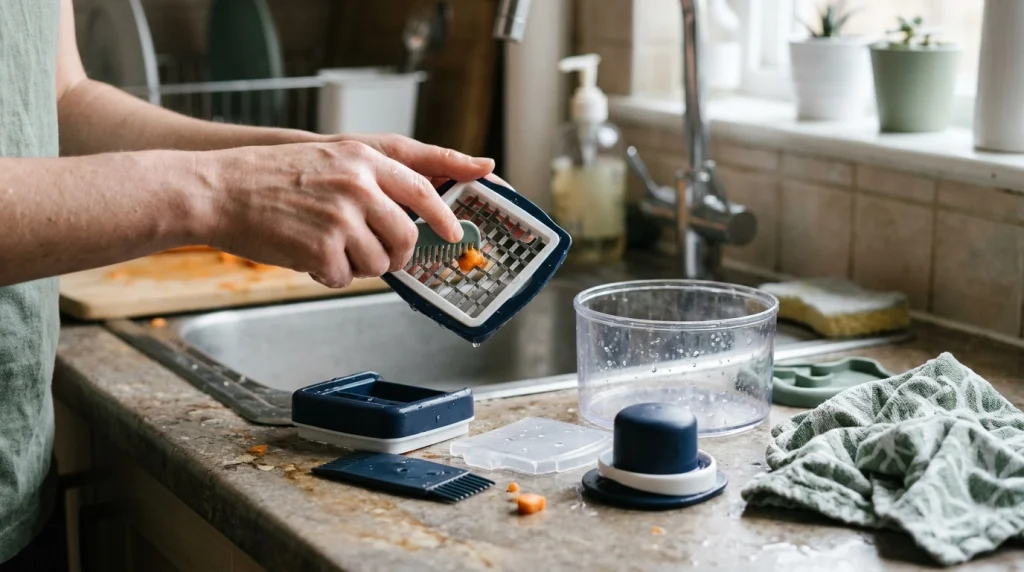
Cleaning the chopper soon after use makes it easier to remove small carrot fragments from the grid and pressing lid. Dried food can be harder to remove from narrow spaces.
- Disassemble the chopper according to its manual.
- Keep your hands away from exposed blade edges while handling the insert.
- Remove trapped carrot pieces with the supplied cleaning comb or another manufacturer-approved tool.
- Wash removable components using the recommended method and suitable dishwashing detergent.
- Rinse away residue and allow the components to dry completely before storage.
- Store blade inserts in their protective covers or designated storage area.
Check whether the parts are dishwasher-safe before placing them in a dishwasher. Some models have removable parts that tolerate dishwasher cleaning, while others require handwashing.
For general food-handling practices, consult FoodSafety.gov and follow the care instructions supplied with your kitchen tool.
What Should You Look for When Buying a Carrot Chopper?
When shopping for a push-down vegetable chopper in 2026, focus on construction, permitted uses, and cleaning convenience rather than the number of accessories alone.
- Sturdy frame: Look for a well-supported lid and a stable base that can handle approved firm vegetables.
- Suitable blade grid: Confirm that the included dicing insert is intended for carrots or other hard vegetables.
- Secure assembly: The blade should lock into place as directed, without unwanted movement.
- Useful container: A collection bin helps catch diced carrots and reduces countertop mess.
- Easy cleaning: Removable inserts and a supplied cleaning tool can simplify maintenance.
- Clear instructions: Choose a model with understandable assembly, usage, and safety guidance.
Before buying, review the current product description and manual. A model suitable for onions and softer vegetables may not be the best choice for frequent carrot preparation.
If you’re comparing options, here are three established kitchen-tool models worth investigating. Their suitability for carrots depends on the exact version, included attachments, and manufacturer guidance.
Vegetable Choppers Worth Comparing
🏆 MULTI-ATTACHMENT OPTION
Fullstar Vegetable Chopper
★★★★☆
Fullstar sells manual choppers in several configurations, with features varying by model. I’d compare the included dicing grid, frame construction, and carrot-specific instructions before choosing one for firm vegetables.
🔎 SIMPLE MANUAL PREP
OXO Good Grips Vegetable Chopper
★★★★☆
OXO offers manual food-preparation tools, but product names and mechanisms matter. I’d verify the exact model and whether it uses a push-down dicing grid before considering it for carrots.
🥕 ALTERNATIVE FOR BATCH PREP
Mueller Pro-Series Vegetable Chopper
★★★★☆
Mueller’s Pro-Series line includes manual vegetable-preparation products with varying attachments. I’d prioritize the exact grid size, approved ingredients, and cleaning accessories over the advertised attachment count.
These are comparison candidates, not hands-on test winners, and the star symbols are illustrative editorial placeholders rather than verified customer ratings. Confirm the exact model, current specifications, and suitability for hard carrots before purchasing.
Frequently Asked Questions
Can you chop raw carrots in a push-down vegetable chopper?
Yes, if the manufacturer approves the chopper and blade insert for firm vegetables. Wash the carrots, trim the ends, and cut thick pieces to fit the grid. If the lid resists normal pressure, stop and use smaller sections or a more suitable tool.
Why won’t my vegetable chopper cut carrots?
The carrot may be too thick, poorly aligned, or unsuitable for the selected grid. A blocked insert, loose assembly, or weak frame can also cause problems. Check the manual, remove blockages safely, and never force the lid or strike it to complete a cut.
Should I boil carrots before using a vegetable chopper?
Usually, no. A suitable manual chopper is intended to process raw vegetables when its instructions permit them. Cooking carrots first softens them and may cause crushing rather than clean dicing. If raw carrots are too difficult for your tool, prepare them with a suitable knife or processor instead.
Which blade size is best for dicing carrots?
The best grid depends on your recipe and the chopper’s design. A medium dicing grid is a sensible starting point when the manufacturer approves it for carrots. Check the stated cube dimensions and avoid fine grids that aren’t designed to handle firm root vegetables.
How do you remove carrots stuck in the blade grid?
Stop pressing and open the chopper according to its instructions. Keep your fingers away from the sharp edges, then use the supplied cleaning comb or an approved cleaning method to remove the fragments. Never push food through the grid with your fingertips.
Final Takeaway: Make Carrot Chopping Easier
A push-down vegetable chopper can make carrot preparation simpler when you choose a suitable grid and prepare the vegetables correctly. The most important steps are to size the carrot pieces appropriately, align them carefully, and stop whenever the mechanism resists.
For everyday diced carrots, start with a sturdy manual chopper whose instructions explicitly support firm vegetables. If you regularly prepare large batches, need shredded carrots, or find that a manual grid struggles, a food processor or another suitable cutting tool may be a better investment.
Above all, let the tool do the cutting without forcing it. Safe preparation and a suitable blade matter more than speed.