Push Down Vegetable Dicer Explained: How It Works

Quick Answer
A push down vegetable dicer is a manual kitchen tool that cuts vegetables by pressing them through a fixed grid of sharp blades. The grid determines the shape and approximate size of the pieces, making the tool useful for preparing evenly diced ingredients for salads, soups, stir-fries, and other dishes.
A push down vegetable dicer explained simply is a cutting tool that uses downward pressure rather than an electric motor or spinning blade to prepare ingredients. You position a suitable piece of vegetable over the cutting grid and press the handle or lid so the food passes through the intersecting blades.
The result is generally more uniform than chopping by hand at different angles, provided the ingredient fits the grid and is suitable for the mechanism. However, the tool does not handle every vegetable equally well, and safe operation depends on keeping your fingers away from the exposed blades.
What Is a Push Down Vegetable Dicer?
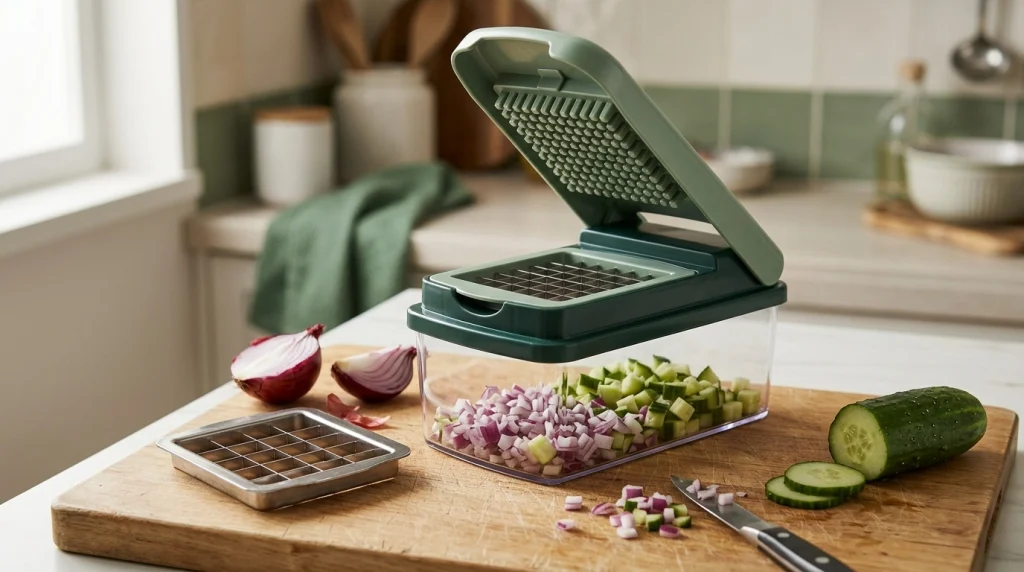
A push down vegetable dicer is a manually operated food preparation tool designed to cut produce into small, similarly shaped pieces. Most household versions have a cutting insert, a pressing lid or pusher, and a container that catches the chopped ingredients.
Some models use a hinged lid, while others have a vertically moving handle or press. Their designs differ, but the basic principle is the same: a pusher forces food through a stationary cutting grid.
The grid contains intersecting sharp blades that divide the vegetable in two directions. The opening size determines the approximate dimensions of the resulting pieces, although the vegetable’s shape, firmness, and preparation can affect the final result.
How Does a Push Down Vegetable Dicer Work?
The mechanism relies on pressure, a fixed blade arrangement, and a pusher that aligns with the grid. Instead of rotating around a bowl, the blades remain in position while the food is forced through their openings.
- The vegetable is positioned. A suitably sized piece sits above the cutting grid, with the collection container beneath it when the design includes one.
- The pusher applies pressure. Pressing the lid or handle drives the vegetable toward the stationary blades.
- The grid divides the food. Intersecting blades cut the ingredient into strips or small pieces as it passes through the openings.
- The cut pieces are collected. The pieces fall into the container or onto the work surface, ready for cooking or further preparation.
The pusher is important because it helps apply force across the cutting area rather than requiring you to push the vegetable through by hand. On suitable models, a matching pusher and blade grid also help the mechanism complete the cut more consistently.
For example, a prepared potato piece may pass through a dicing grid to produce small cubes. If the potato is too large or too firm for the tool, forcing the handle down can strain the mechanism instead of producing a clean cut.
Which Vegetables Can You Cut With One?
Push down dicers generally work best with vegetables that can be cut into manageable pieces and pressed through the selected grid without excessive force. The exact capabilities depend on the blade design and the manufacturer’s instructions.
- Onions: Peeled, suitably sized onion sections can be diced for soups, sauces, salads, and stir-fries.
- Potatoes: Cut large potatoes into manageable sections before dicing; dense pieces may require preparation to fit the grid.
- Cucumbers: Firm cucumber sections can be useful for salads and cold dishes.
- Bell peppers: Remove the stem and seeds, then use sections that sit securely over the cutting area.
- Carrots: Because carrots are firm, check the manufacturer’s guidance and prepare them into suitable pieces rather than forcing whole carrots through a small grid.
- Other suitable produce: Some models can handle zucchini and similar vegetables, provided their firmness, size, and shape suit the insert.
Soft tomatoes and other delicate ingredients can be more difficult to process cleanly because their flesh may compress or release juice. Some dicers include separate slicing inserts for these ingredients, but that capability should not be assumed for every model.
Avoid using the tool for produce that is too large, unusually hard, frozen, or otherwise excluded by its instructions. A blade grid is designed for particular cutting tasks, not as a universal solution for every ingredient.
How to Use a Push Down Vegetable Dicer Correctly
Correct preparation makes the cutting action easier and reduces the temptation to apply excessive force. Before starting, assemble the tool according to its instructions and check that the blade insert is properly seated.
- Set up the dicer. Place it on a stable, level work surface. Position its collection container correctly, if supplied.
- Choose the right grid. Use the cutting insert intended for the size and style of pieces you want.
- Prepare the vegetable. Wash the produce, remove inedible parts, and cut it into sections that fit the opening. Peel ingredients when the recipe or preparation requires it.
- Position the food. Place the prepared piece over the grid without putting your fingers near the blades.
- Press the handle or lid. Use the tool as directed, keeping your hands on its designated gripping surfaces. Apply controlled, firm pressure without striking or forcing the mechanism.
- Check the result. Lift the pusher as instructed and check whether the vegetable has passed through completely. Reposition or prepare another piece if necessary, with the cutting area clear and your hands away from the blades.
- Transfer and clean. Remove the prepared food and clean the tool promptly according to its care instructions.
If the handle stops partway, do not use extra body weight or try to push the ingredient through with your fingers. Stop, follow the manufacturer’s method for releasing or clearing a jam, and inspect the assembly before using it again.
What Are the Main Benefits and Limitations?
The main benefit is consistency: a fixed grid can produce pieces with a more predictable shape than hurried hand chopping. It can also make repeated preparation more straightforward when a recipe calls for a batch of diced onions, potatoes, or other compatible vegetables.
- Consistent cuts: The grid determines the approximate piece size.
- No electricity required: A manual model can operate without a motor or power outlet.
- Simple mechanism: Many designs have fewer operating components than powered food processors.
- Batch preparation: A collection container can keep freshly cut ingredients together.
- Potential time savings: Repeated dicing may take less active effort than cutting each piece individually with a knife.
These advantages come with tradeoffs. A push down dicer usually offers less flexibility in cut size than a knife, and changing the grid may require a compatible insert. Some ingredients need preliminary slicing, trimming, or resizing before they can pass through the cutting area.
The tool can also be bulky to store and inconvenient to clean if food becomes trapped between the blades. It is therefore most useful when you regularly prepare ingredients that match its cutting grid, rather than for every kitchen task.
Push Down Dicer vs. Knife and Other Choppers
These tools produce different results because they use different cutting mechanisms. Choosing between them depends on whether you need uniform cubes, irregular chopped pieces, or more control over the cut.
| Tool | How it cuts | Best suited to |
|---|---|---|
| Push down dicer | Presses food through a fixed grid | Repeated, fairly uniform pieces |
| Kitchen knife | Cuts manually under direct control | Flexible sizes, shapes, and precision |
| Pull-cord chopper | Spins blades inside a container | General chopping and finer mixtures |
| Electric food processor | Uses a powered blade or attachment | Larger batches and multiple tasks, depending on attachments |
A push down dicer is a sensible choice when repeatable piece size matters and the vegetables suit the grid. A knife is more versatile for unusual shapes or delicate cuts, while a pull-cord chopper is often more suitable when uniform cubes are not the priority.
How to Clean and Maintain the Dicer
Clean the dicer soon after use so vegetable residue does not dry between the blades. Follow the instructions for the specific model, particularly when removing blade inserts or determining whether any components are dishwasher-safe.
- Disassemble only the parts the manufacturer identifies as removable.
- Use running water and the recommended cleaning brush or tool to dislodge food trapped in the grid.
- Keep your fingers away from the sharp edges. Do not wipe directly across the blades.
- Wash the container, pusher, lid, and other removable parts using the approved cleaning method.
- Allow the components to dry thoroughly before reassembling or storing them.
- Inspect the grid and pusher for damage, loose fittings, or signs of wear before the next use.
Do not assume every part is dishwasher-safe or dismantle a blade assembly that is not designed for user disassembly. The GARDE vegetable dicer operating and maintenance instructions illustrate why model-specific guidance matters for safe operation, cleaning, and assembly.
Warning
The cutting grid can cause serious cuts even when the dicer is not in use. Never reach through the grid to clear trapped food, carry an exposed blade insert carelessly, or test sharpness with your fingers.
Common Problems and What to Check
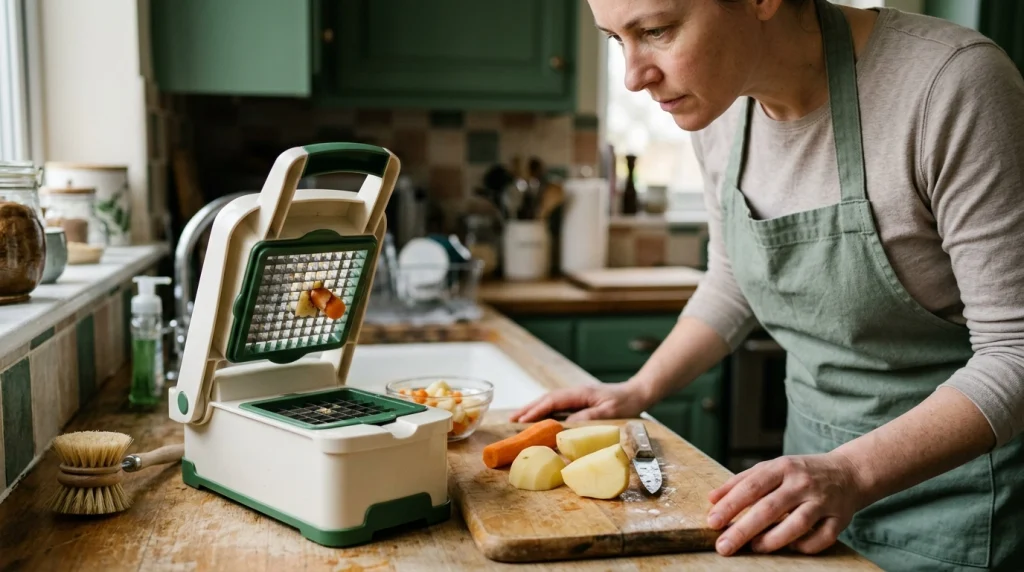
If a push down dicer does not cut cleanly, the problem may involve the ingredient, the blade grid, or the alignment of the pusher. Check the simplest possibilities before assuming the tool is defective.
- The vegetable will not pass through: Check whether it is too large or firm for the selected grid. Prepare a smaller piece if the instructions allow it.
- The pieces look uneven: Check that the ingredient is positioned properly and that the pusher and blade insert are compatible and aligned.
- Food gets stuck: Stop pressing, keep your hands clear, and remove the obstruction using the manufacturer’s recommended cleaning or clearing method.
- The handle feels unusually resistant: Do not force it. Check for a jam, incorrect assembly, or an unsuitable ingredient.
- The blades look bent, damaged, or loose: Stop using the tool until the affected part has been safely replaced or the assembly has been repaired as directed.
A dicer should not require uncontrolled force to perform its intended task. Persistent resistance is a reason to stop and investigate, not a signal to press harder.
Related Product
Manual Push Down Vegetable Dicer
A manual dicer with a suitable cutting grid and collection container can simplify repeated vegetable preparation when consistent pieces are useful.
As an Amazon Associate, we earn from qualifying purchases.
Frequently Asked Questions
1. Does a push down vegetable dicer cut vegetables into equal pieces?
It generally produces similarly sized pieces because the grid determines the cut dimensions. Exact uniformity still depends on the vegetable’s shape, preparation, and how completely it passes through the grid.
2. Can you put raw potatoes in a push down dicer?
Many dicers can handle suitably prepared raw potato, but the potato may need to be cut into smaller sections first. Follow the model’s instructions and never force a hard or oversized piece through the blades.
3. Is a push down vegetable dicer better than a pull-cord chopper?
Neither is universally better. A push down dicer is useful for more uniform pieces, while a pull-cord chopper is often better for general chopping where the exact size and shape matter less.
4. Why does my vegetable dicer get stuck?
Food may be too large or firm for the grid, or pieces may be lodged between the blades. Stop operating the tool, keep your fingers clear, and follow the manufacturer’s procedure for clearing the obstruction.
5. Can a push down vegetable dicer go in the dishwasher?
That depends on the model and its individual components. Check the manufacturer’s cleaning instructions rather than assuming the container, lid, and blade insert all have the same dishwasher compatibility.
6. How do you keep a vegetable dicer sharp and usable?
Clean it promptly, avoid improper force, dry and store the parts correctly, and inspect the grid regularly. Replace damaged or worn cutting components according to the manufacturer’s instructions.
Conclusion
A push down vegetable dicer uses a stationary blade grid and downward pressure to cut suitable vegetables into relatively uniform pieces. It can make repeated preparation easier, especially when recipes call for diced ingredients of a consistent size.
Its effectiveness depends on choosing the correct grid, preparing ingredients to fit, and using the pusher without excessive force. Keep your hands away from the blades, clean the tool promptly, and follow the care instructions for your specific model. For flexible cutting tasks or ingredients that do not suit the grid, a kitchen knife or another type of chopper may be the more practical choice.