
Push Down Vegetable Chopper for Hard Vegetables

Quick Answer
A push down vegetable chopper can cut some firm vegetables, but its ability to handle hard produce depends on the model, blade grid, and manufacturer instructions. Cut permitted vegetables into smaller pieces that fit the grid, position them securely, and press as directed. Do not force the pusher if it stops or meets strong resistance; very hard vegetables, including raw sweet potatoes and some carrots, may be unsuitable for certain models.
Why Do Hard Vegetables Resist a Push-Down Chopper?
Hard vegetables resist a push-down chopper because the food must be forced through a fixed grid of sharp blades. Dense flesh, thick skin, an oversized piece, or an unsuitable cutting grid can make the required pressure greater than the tool is designed to withstand.
Unlike a kitchen knife, which cuts progressively as you move it through food, a push-down dicer applies pressure across several blade edges at once. The food must fit the grid and yield to the blades without making the frame, pusher, or container flex excessively.
The term hard vegetable also covers different situations. A firm carrot, a dense raw sweet potato, and a thick piece of winter squash do not necessarily place the same demands on a chopper. Their suitability depends on the specific tool, not simply on whether the food is classified as a vegetable.
Which Hard Vegetables Can a Push-Down Chopper Handle?
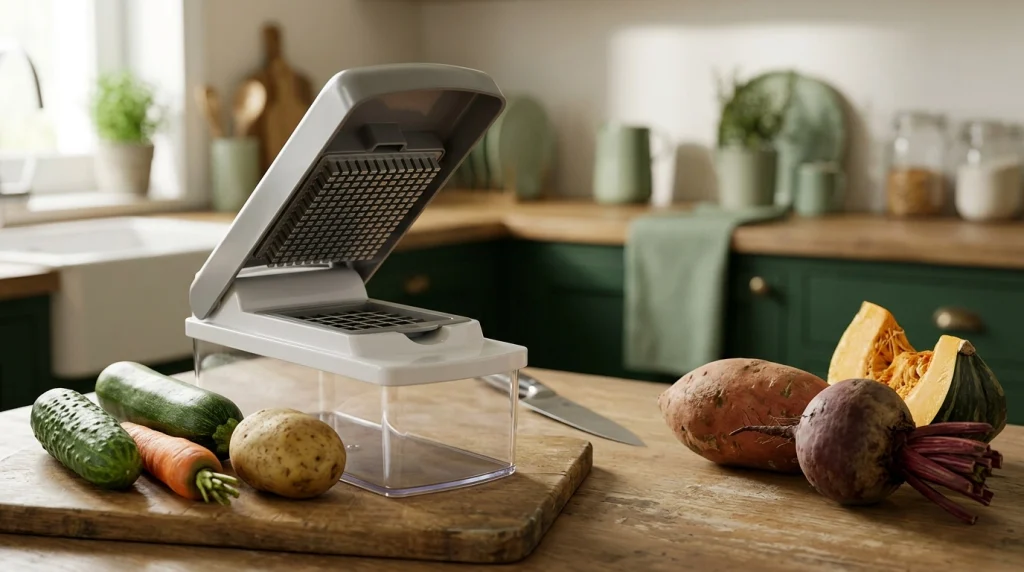
There is no universal list because push-down choppers use different blade sizes, frames, and cutting mechanisms. Always check the instructions for your exact model before processing firm produce.
- Carrots: Some models permit carrots, while others specifically exclude them or restrict their use. Follow the manual rather than assuming every dicer can handle raw carrots.
- Potatoes: Certain choppers can dice ordinary potatoes when they are prepared to the manufacturer’s instructions. Other models restrict hard vegetables, so suitability must be checked first.
- Firm zucchini and cucumbers: These are generally easier to cut than dense root vegetables, although very large pieces and thick ends may still obstruct the grid.
- Raw sweet potatoes: Treat these cautiously. Some manufacturers explicitly advise against using their chopping grids for sweet potatoes because of their density.
- Beetroot and winter squash: Do not assume these are suitable. Their density, tough skin, and size can make them difficult to cut with a small manual grid.
These examples are general guidance, not a substitute for model-specific instructions. If the manual prohibits an ingredient, do not attempt to make it work by applying extra force.
How Should You Prepare Firm Vegetables Before Chopping?
Preparation can make an approved ingredient easier to cut, but it cannot turn an unsuitable vegetable into a suitable one. Once you have confirmed that your model permits the food, prepare it so the blade grid can engage without obstruction.
- Wash and inspect the vegetable. Remove dirt and damaged areas, and check for hard cores, pits, or woody sections that should not enter the grid.
- Peel when appropriate. Thick or tough skins can increase resistance. Follow the recipe and your chopper’s instructions when deciding whether to remove the skin.
- Trim large pieces. Cut the vegetable into manageable sections that fit within the cutting area. Do not place oversized pieces across the frame.
- Make flat, stable pieces when permitted. A flat surface can help a piece sit securely instead of rocking or tipping. For models that allow very firm vegetables, some manufacturer instructions specify thin planks or smaller sections.
- Center the food over the grid. Keep the piece within the cutting area so pressure is distributed as intended rather than concentrated against the frame.
- Confirm the assembly. Check that the blade insert, container, and pusher are properly seated and locked according to the manufacturer’s instructions.
For example, if your model permits carrot dicing but struggles with a thick carrot section, a smaller, properly prepared piece may be easier to process. If the instructions prohibit raw carrots, however, cutting them smaller does not override that restriction.
What Should You Do If the Pusher Will Not Go Down?
Stop pressing when the pusher will not descend normally. Resistance may indicate that the vegetable is too hard, too large, poorly positioned, or lodged in the blade grid. Continuing to force the mechanism can damage the tool or cause it to slip unexpectedly.
- Release the pressure. Do not strike the lid, lean your body weight onto it, or repeatedly slam the pusher.
- Check the vegetable size. Once the tool is safely opened according to its instructions, see whether the piece extends beyond the grid or is positioned at an angle.
- Inspect the blade assembly. Look for trapped food, a misaligned insert, or a frame that has not locked into place. Never press down on an improperly assembled chopper.
- Recheck ingredient restrictions. If the food is excluded by the manual, stop and use a different preparation method.
- Look for damage. Bent blades, cracked plastic, loose locks, or a distorted pusher are reasons to stop using the tool until it can be safely repaired or replaced.
Only reposition or remove the food when the mechanism is released and safe to handle. Keep your fingers away from the cutting edges, and use the supplied cleaning tool or another method specifically approved by the manufacturer to remove lodged pieces.
Warning
Never use a knife, your fingers, or an unapproved utensil to push food through an assembled blade grid. Do not continue using a chopper with a cracked frame, loose blade insert, or damaged locking mechanism.
Can You Soften Hard Vegetables Before Using the Chopper?
Cooking can soften many firm vegetables, but whether cooked vegetables can go into a particular push-down chopper depends on its instructions and the food’s texture. Some tools are designed for raw produce and may not work well with soft, wet, or cooked ingredients.
If the manufacturer permits cooked vegetables, cook them until they reach a suitable texture, allow them to cool as appropriate, and check that they are not so soft that they smear or clog the grid. If the tool is intended only for raw ingredients, use a knife or another suitable preparation method instead.
Do not soak vegetables in water or rely on peeling alone to solve a resistance problem. Neither guarantees that the remaining flesh will be soft enough for the blade grid. For a vegetable that is explicitly excluded from the manual, choose another tool rather than experimenting with preparation tricks.
Which Cutting Method Is Better for Very Hard Vegetables?
When a vegetable is too dense for your push-down chopper, the best alternative is a tool that can handle the food safely without requiring you to force it through a fixed grid.
- A sturdy chef’s knife: Useful for cutting firm vegetables into smaller cubes or slices. Use a stable cutting board, keep the food from rolling, and work with a sharp knife appropriate for the task.
- A suitable food processor: Some models can chop or process firm produce, but their manuals still specify ingredient restrictions and preparation requirements. Confirm that your appliance supports the food in question.
- A dedicated vegetable cutter: A cutter with a suitable mechanism may handle certain firm ingredients better than a small push-down dicer. Check its stated limits rather than relying on appearance or advertised versatility.
- Cooking before cutting: If the recipe allows cooked vegetables and your chosen tool supports them, softening the produce first may make preparation easier.
For example, if you need evenly diced raw sweet potato for a recipe and your chopper excludes it, use a suitable knife or a food processor whose instructions allow the task. Do not try to compensate for an unsuitable chopper by pushing harder.
How Can You Keep the Blade Grid Clear and in Good Condition?
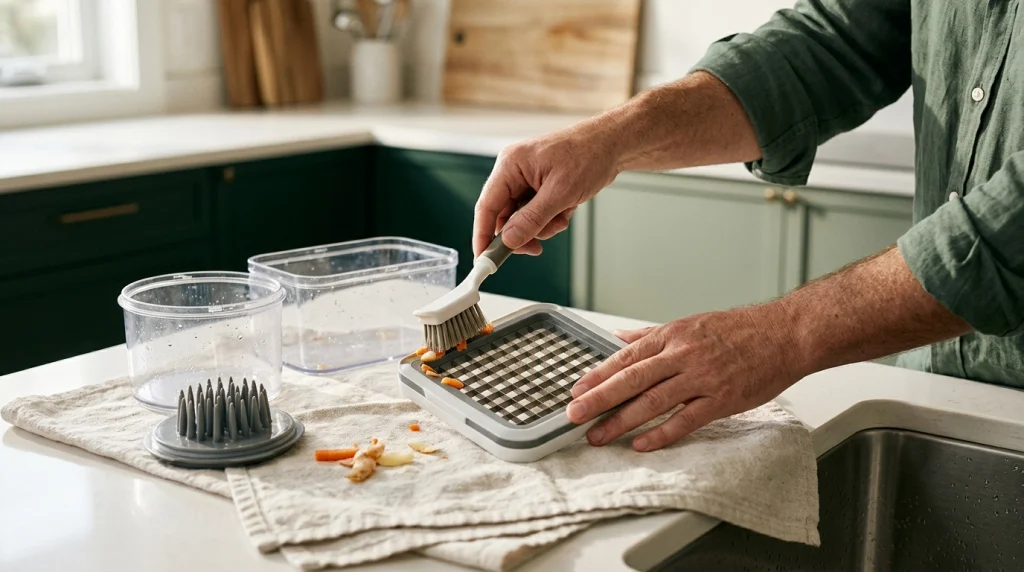
Food trapped between the blades can prevent the pusher from completing its stroke. Starchy vegetables may leave residue, while tough pieces can lodge across individual openings. Keeping the grid clear helps the tool function as intended, but cleaning cannot correct an ingredient that is too hard for the design.
- Remove food residue promptly after use, following the manufacturer’s cleaning instructions.
- Use the supplied brush or cleaning accessory where provided, and keep your hands clear of sharp edges.
- Do not force trapped food through the grid or scrape the blades with an unapproved metal tool.
- Inspect the blade insert and plastic frame for bending, cracks, looseness, or other visible damage before reuse.
- Store detachable blades securely so they cannot injure someone or become damaged in a drawer.
For detailed guidance on removing residue without contacting the cutting edges, follow the tool’s manual and use an appropriate kitchen preparation and cleaning guide when one specifically addresses the relevant task.
How Do You Know When to Stop Trying?
Stop if the pusher remains stuck after you release pressure and check the food placement, if the blade insert shifts, or if the frame bends or makes unusual cracking sounds. These are not signs that you should apply more force; they indicate that the tool may be obstructed, unsuitable for the ingredient, or damaged.
Also stop when the manual excludes the vegetable, even if the chopper appears sturdy. A tool can look robust while still having limits determined by its blade geometry, plastic components, and locking design.
The practical rule is simple: prepare approved vegetables correctly, apply pressure only as instructed, and never force a resistant mechanism. If the food will not pass through safely, switch to a method designed for it.
Frequently Asked Questions
Can a push-down vegetable chopper cut raw carrots?
Some models can, while others specifically warn against cutting very hard foods such as carrots. Check the instructions for your exact model before trying. If carrots are permitted, prepare them as directed and stop if the pusher meets unusual resistance.
Why does my vegetable chopper crush food instead of dicing it?
The food may be too soft, too large, poorly positioned, or unsuitable for the selected grid. Check the ingredient and preparation guidance, and make sure the blade insert is correctly seated. A damaged or dull cutting assembly may also affect results.
Can I use a push-down chopper for raw sweet potatoes?
Only if the manufacturer explicitly permits it. Some popular multi-blade choppers warn against using their dicing grids for raw sweet potatoes because the food is too hard. Choose another suitable cutting method if your model excludes them.
Should I press harder if the chopper gets stuck?
No. Release pressure and check for an oversized piece, misalignment, trapped food, or an ingredient restriction. Do not strike the lid or lean your body weight on it because excessive force can damage the mechanism or make the tool slip.
Will peeling hard vegetables make them easier to chop?
Peeling may reduce resistance when the skin is thick or tough, but it does not remove the density of the vegetable’s flesh. Peel only as appropriate for the ingredient and instructions, and do not use peeling as a workaround for a prohibited food.
What should I use if my chopper cannot cut a hard vegetable?
Use a sturdy kitchen knife, a suitable food processor, or another cutter whose instructions allow that ingredient. Choose a stable work surface and an appropriate cutting method rather than forcing the food through a blade grid that cannot handle it.
Conclusion
A push-down vegetable chopper can save preparation time, but not every model is designed for dense raw vegetables. Carrots, potatoes, sweet potatoes, beetroot, and winter squash require particular care because suitability varies by blade design and manufacturer instructions.
Check the manual, prepare permitted vegetables to fit the grid, and stop whenever the pusher will not descend normally. If an ingredient is too hard for the tool, switch to an appropriate knife or processor instead of applying more force. Correct preparation, careful handling, and respecting the chopper’s limits are the most reliable ways to achieve useful cuts without damaging the tool or risking injury.
