Vegetable Chopper Pros and Cons: Is It Worth It in 2026?

Quick Answer
A vegetable chopper can be worth it if you regularly dice onions, peppers, potatoes, cucumbers, or other vegetables in batches. It speeds up repetitive prep and creates consistent pieces, but the extra parts, sharp blade grids, and cleanup can make a knife more practical for small jobs. If faster preparation is your goal, these practical cooking and meal-prep shortcuts are also worth using.
Main advantages
- Faster batch prep: A push-grid model can dice several vegetables with fewer repeated knife motions.
- Uniform pieces: Fixed blade grids make similarly sized cubes that tend to cook at a similar rate.
- Less counter mess: Models with catch containers hold chopped ingredients instead of scattering them across a board.
- Lower skill requirement: Beginners can produce consistent cuts without advanced knife technique.
Main drawbacks
- More cleanup: Blade grids, lids, containers, and push plates can trap food.
- Limited control: You usually get only the sizes and shapes supplied by the blade inserts.
- Sharp components: Removable blades need careful handling during washing and storage.
- Not ideal for everything: Soft tomatoes, leafy greens, oversized produce, and very hard vegetables can be awkward in some designs.
I understand why vegetable choppers have become such tempting kitchen gadgets. Watching a whole onion turn into tidy cubes with one push makes ordinary knife work look unnecessarily slow.
The real question is whether that convenience survives normal weeknight cooking. Here are the vegetable chopper pros and cons I would consider before giving one permanent space in a kitchen drawer.
What Is a Vegetable Chopper?
A vegetable chopper is a manual or powered kitchen tool that cuts produce using fixed blades rather than a traditional chef’s knife. Common versions use push-down grids, rotating blades, pull cords, or spring-loaded chopping mechanisms.
Simple definition: A vegetable chopper is a food-prep tool designed to reduce repetitive hand chopping while producing relatively consistent pieces.
Push-grid models are especially common for onions, bell peppers, cucumbers, zucchini, potatoes, and similar vegetables. Many drop the finished pieces directly into a removable catch container.
They aren’t replacements for every knife task. Instead, I think of them as specialized prep tools for repetitive cutting.
What Are the Main Pros of a Vegetable Chopper?
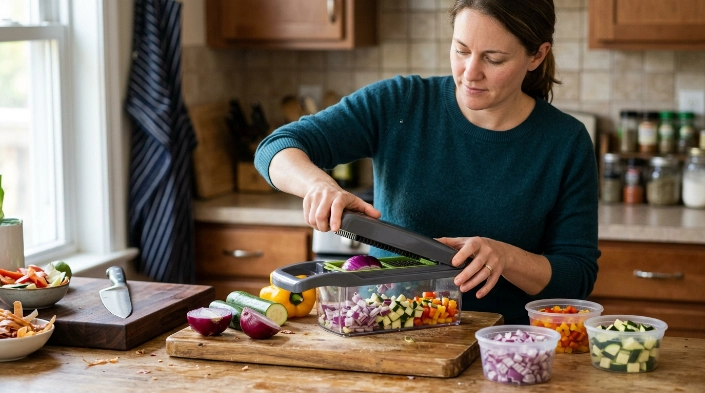
The strongest vegetable chopper advantages are speed, consistency, convenience, and reduced repetitive knife work. Those benefits become more noticeable when preparing several servings rather than one small ingredient.
- Fast repetitive dicing: Once produce fits the cutting grid, repeated batches can move quickly.
- Consistent size: A fixed grid removes much of the variation found in hurried hand chopping.
- Built-in collection: Catch containers keep onions, peppers, and other diced foods together.
- Beginner friendly: You don’t need practiced knife skills to make evenly shaped pieces.
- Useful for meal prep: Preparing several onions, peppers, or salad vegetables is where the format makes the most sense.
- Less direct blade work: Your hands aren’t repeatedly guiding a chef’s knife through every cut.
Uniform pieces can help food cook more evenly
Consistent size isn’t only about appearance. Pieces with similar thickness generally cook more predictably than a mixture of tiny fragments and large chunks.
That is one reason I focus on consistent cutting in my guide to cooking food evenly with simple techniques.
A grid chopper makes that consistency easy for straightforward dice. A knife still gives more control when a recipe calls for a particular thickness or shape.
What Are the Main Cons of a Vegetable Chopper?
The biggest vegetable chopper disadvantages are cleanup, limited cutting flexibility, storage space, and the effort needed for hard produce. Those drawbacks can cancel the time savings when you’re preparing only one small ingredient.
- Several parts need washing: The container, blade insert, lid, pusher, and cleaning tool may all need attention.
- Food can stick in grids: Onion skin, pepper flesh, herbs, and small fragments can become trapped around blades.
- Some produce needs pre-cutting: Large onions or potatoes may need to be halved or quartered before they fit.
- Hard foods need pressure: Dense carrots, potatoes, and similar ingredients may require a firm push.
- Cut sizes are fixed: A chopper cannot match the flexibility of a knife for julienne, mince, rough chop, wedges, or custom dice unless extra inserts are included.
- Blades still require caution: The cutting grid can be extremely sharp even though it looks less intimidating than a chef’s knife.
- It takes storage space: Models with containers and multiple blade inserts occupy more room than one knife.
This is the part that gets overlooked in short product demonstrations. Chopping may take seconds, but the entire workflow includes setup, pre-cutting, emptying, cleaning, drying, and storage.
Does a Vegetable Chopper Really Save Time?
A vegetable chopper can save time when you have multiple vegetables or repeated batches to prepare. For one garlic clove, half an onion, or a few cucumber slices, a knife is often simpler.
I would judge the time savings by the entire task rather than the dramatic chopping moment.
- One small onion: A knife may win because there are fewer parts to clean.
- Several onions and peppers: A grid chopper becomes much more appealing.
- Meal-prep containers: Repeated uniform dicing is an ideal use case.
- Large mixed recipes: A food processor may eventually become faster if precise cubes aren’t important.
There’s also a learning curve with a chef’s knife. Someone with practiced knife skills may gain less from a chopper than a beginner who cuts slowly.
For broader technique, my guide to essential cooking skills every home cook should know explains why basic knife control remains useful even if you own prep gadgets.
Vegetable Chopper vs Knife vs Food Processor: Which Is Better?
No single tool wins every kitchen-prep task. A vegetable chopper is strongest for repeated uniform pieces, while a knife offers maximum control and a food processor handles larger volumes.
| Feature | Push-Grid Chopper | Chef’s Knife | Food Processor |
|---|---|---|---|
| Best use | Uniform dice and repeated prep | Almost any cutting style | Large-volume chopping and processing |
| Cut-size control | Limited to supplied inserts | Excellent | Moderate; easy to over-process |
| Power required | Usually manual | Manual | Usually electric |
| Cleanup | Several small components | Knife and board | Bowl, lid, and blade assembly |
| Storage | Moderate | Minimal | Highest |
| Typical manual capacity | Compact examples commonly use roughly 2–3 cup containers | No fixed capacity | Varies widely by machine |
If I wanted diced vegetables for tacos, salsa, soup, or weekly meal prep, I would consider the chopper. If I wanted several different knife cuts from one carrot, the chef’s knife would stay on the board.
Which Vegetables Work Best in a Chopper?
Vegetable choppers perform best with produce that is firm enough to cut cleanly but not so hard or oversized that excessive force is needed. Produce should also fit the cutting area without being forced sideways.
- Onions: One of the best uses because they dice cleanly and the container helps contain pieces.
- Bell peppers: Good after removing the stem, seeds, and thick inner ribs.
- Cucumbers: Firm cucumbers usually pass through a grid easily.
- Zucchini: Works well for cubes used in sautés, soups, and roasting.
- Potatoes: Useful when pre-cut into pieces that fit the grid.
- Carrots: Possible with sturdy models, although thick carrots may need smaller sections.
Very ripe tomatoes can squash rather than cut cleanly. Leafy greens and delicate herbs are also better suited to a knife, kitchen shears, or rotating-blade chopper.
Start with good produce too. My guide to choosing fresh vegetables at the market explains the firmness and freshness signs I look for before prep begins.
Are Vegetable Choppers Safe to Use?
Vegetable choppers can reduce direct knife handling during repetitive cutting, but their blade grids are still extremely sharp. Cleaning and changing blade inserts deserve the same attention you would give a knife.
The safest habit is to use the supplied pusher or handle rather than pressing food toward exposed blades with your fingers.
- Use a stable surface: Keep the base flat and dry before applying pressure.
- Never touch the cutting grid: Use the supplied brush or cleaning comb for trapped food.
- Store inserts securely: Loose blades shouldn’t float around inside a utensil drawer.
- Keep away from children: Enclosed blades can still cause serious cuts when the unit is open.
- Follow model instructions: Dishwasher-safe parts and cleaning directions differ between products.
Food hygiene matters as much as blade safety. The FDA recommends washing produce under running water before preparation and keeping it away from surfaces contaminated by raw meat.
The USDA also recommends cleaning food-preparation surfaces and preventing cross-contamination. I apply the same principle to chopper containers, lids, blades, and push plates.
For broader kitchen hygiene, the FDA’s safe food-handling guidance organizes the basics around cleaning, separating, cooking, and chilling.
Who Should Buy a Vegetable Chopper?
A vegetable chopper makes the most sense for someone who repeatedly prepares the same kinds of diced produce. The more batch chopping you do, the easier it is to justify another specialized tool.
- Meal preppers: Useful for several containers of onions, peppers, cucumbers, or similar produce.
- Busy home cooks: Handy when repetitive chopping is slowing down weeknight meals.
- Knife-skill beginners: Fixed grids create consistent pieces without mastering precision dice first.
- Salsa and salad fans: Excellent when several ingredients need a similar cube size.
- People who dislike onion prep: The container can make onion chopping feel neater and more contained.
Who may be better off with a knife?
A vegetable chopper is less compelling if you usually cook for one, prepare tiny quantities, or already chop quickly with a chef’s knife.
I would also skip one if storage is tight and every new gadget needs to justify the space it occupies.
The decision is similar to deciding whether a specialized garlic tool deserves drawer space. My guide on whether garlic presses are worth it uses the same practical test: frequency, convenience, cleanup, and control.
What Should You Look for When Buying a Vegetable Chopper?
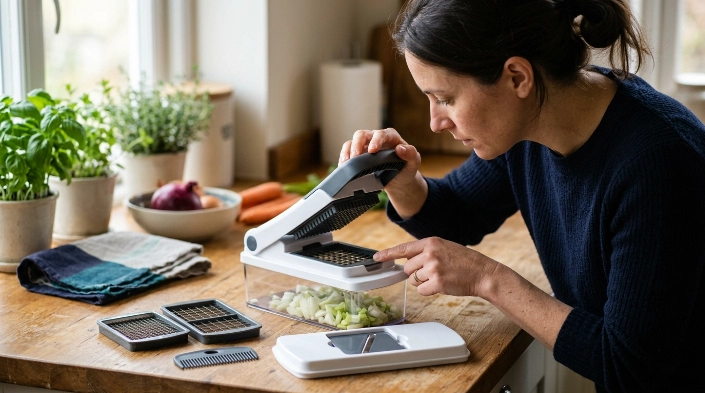
Look beyond the number of accessories printed on the box. A chopper you can press comfortably, clean safely, and store easily is more useful than a huge kit with inserts you never touch.
- Sturdy cutting blades: Stainless steel is common and should feel firmly mounted in its frame.
- Good leverage: A broad lid or comfortable handle makes harder vegetables easier to push through.
- Non-slip base: The tool should stay planted while pressure is applied.
- Useful container size: Larger catch cups reduce how often you need to stop and empty them.
- Simple cleaning: Removable grids and an included cleaning comb or brush are worth having.
- Safe blade storage: Inserts should lock into the unit or have a sensible storage location.
- Replacement parts: Replaceable blade inserts can extend the useful life of a chopper.
I would rather own two genuinely useful blade sizes than twelve accessories that make the box harder to organize.
If you’re ready to choose one, these are three practical designs I would put on the shortlist:
🏆 Best all-around grid chopper
Fullstar Pro Original Vegetable Chopper
★★★★★ 4.6/5 editorial fit
The Pro Original line uses interchangeable stainless-steel blade inserts and a catch container, with several configurations available. I like this format most for cooks who want straightforward dicing plus a few extra prep options without moving to an electric processor.
👌 Best simple design
OXO Good Grips Vegetable Chopper With Easy-Pour Opening
★★★★☆ 4.5/5 editorial fit
OXO uses a stainless-steel cutting grid, recessed cutting area, and an easy-pour opening in a 3.7 × 11.3 × 5.2-inch body. I would choose this when simple operation matters more than collecting a large set of interchangeable accessories.
💰 Best for basic onion prep
PrepSolutions Onion Chopper
★★★★☆ 4.3/5 editorial fit
This straightforward chopper has a 2-cup container with measurement markings, a non-skid base, and a cleaning comb for the grid. I like the concept for someone who mainly wants quick onion, tomato, and pepper prep without paying for a larger multi-blade kit.
Frequently Asked Questions
Are vegetable choppers actually worth it?
Vegetable choppers are worth it for people who frequently dice several vegetables, prepare meals in batches, or want more consistent pieces without advanced knife skills. They offer less value when you prepare tiny amounts because setup and cleaning can take longer than simply using a knife.
Can a vegetable chopper cut potatoes and carrots?
Many sturdy manual choppers can cut potatoes and carrots, but large or thick pieces should usually be reduced first. Dense vegetables require more pressure than onions or cucumbers, so follow the manufacturer’s size guidance and never force food through a blade grid with your fingers.
Do vegetable choppers make perfectly uniform cuts?
A fixed-grid vegetable chopper can make pieces much more consistent in width than hurried hand chopping. Results still depend on how the ingredient is positioned and pre-cut, so the pieces won’t always be identical in every dimension.
Are vegetable choppers hard to clean?
Cleaning depends heavily on the design. Catch containers are usually straightforward, while small blade grids and push plates can trap vegetable fragments. A removable grid and dedicated cleaning comb or brush make the process easier and keep your fingers away from sharp edges.
What should you avoid putting in a vegetable chopper?
Avoid ingredients that exceed the manufacturer’s recommendations, oversized hard produce that needs excessive force, and foods the model isn’t designed to handle. Very soft tomatoes and delicate leafy greens may also give poor results in push-grid designs, even when they aren’t unsafe to use.
Final Takeaway: Should You Buy a Vegetable Chopper?
The vegetable chopper pros and cons come down to how you cook. It offers genuine convenience for repeated dicing, meal prep, salads, salsa, soups, and recipes built around several chopped vegetables.
A chef’s knife remains more versatile, easier to clean, and better for custom cuts. The chopper earns its space when uniform batch prep is a routine job rather than an occasional one.
Before buying, think about what you chopped during the last week. If onions, peppers, cucumbers, potatoes, and similar vegetables kept appearing on your cutting board, a well-designed chopper may be one kitchen shortcut you continue using long after the novelty wears off.
