
Pull Cord Chopper for Onions: How to Get Even Pieces Without the Mess

Quick Answer
A pull cord chopper for onions is a manual kitchen tool that spins internal blades when you pull a handle, chopping onion pieces without electricity. For the best results, peel the onion, cut it into smaller chunks, fill the container only to its recommended level, and pull the cord in short, controlled strokes. This approach gives you better control over texture and helps prevent watery onion paste.
What matters most when chopping onions
- Onion preparation: Cut peeled onions into chunks that fit comfortably around the blades.
- Container capacity: Leave enough room for the onion pieces to move instead of packing them tightly.
- Pull technique: Use several short pulls and check the texture between them.
- Blade condition: Inspect the blade assembly for damage or looseness before use.
- Cleaning: Follow the manufacturer’s instructions for cleaning the bowl, blades, and cord-operated lid.
A simple rule for better texture
- Start with a few pulls, open the chopper only when the blades have stopped, and add more pulls if you need finer pieces.
Chopping onions can take longer than expected, especially when you’re preparing dinner and need several ingredients ready at once. A pull cord chopper can make the job easier, but the way you prepare the onion and operate the tool affects the final result.
In this guide, I’ll explain how to use one for diced onions, how to avoid mushy results, and what to look for when choosing a model. I’ll also compare manual pull choppers with other onion-cutting tools so you can choose one that suits your cooking habits.
What Is a Pull Cord Chopper for Onions?
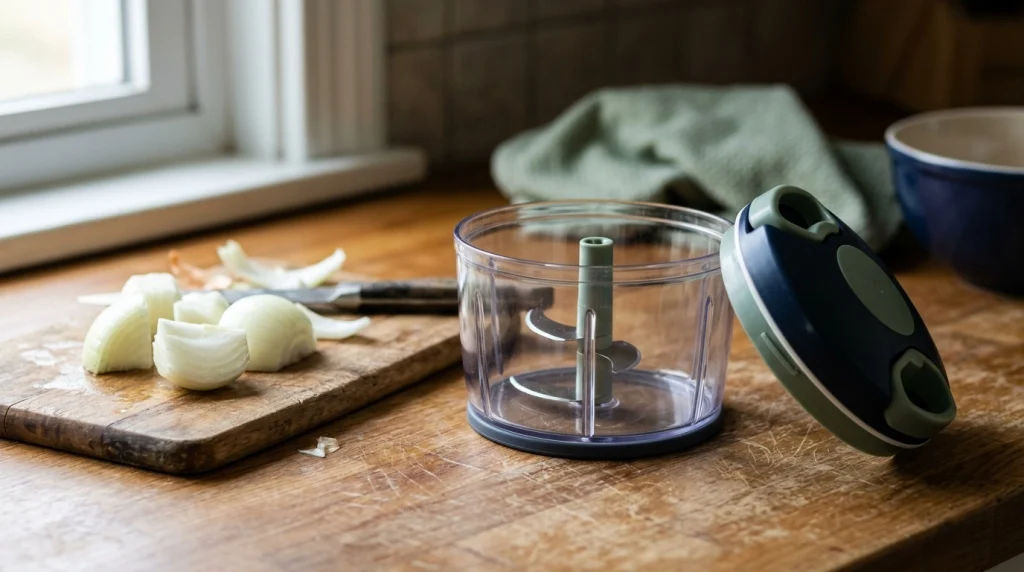
A pull cord chopper is a manual food chopper that uses a retractable cord to rotate blades inside a container. Each pull turns the blade assembly, cutting ingredients into progressively smaller pieces.
Unlike an electric food processor, this tool doesn’t need a power outlet or motor. You control the chopping process through the number and pace of your pulls.
Most models include these components:
- Container: Holds the onion pieces while the blades rotate.
- Blade assembly: Cuts the onion into smaller pieces.
- Lid and pull mechanism: Transfers the cord’s movement to the blades.
- Non-slip base: Helps stabilize the container on a suitable work surface.
Designs differ, so always check the instructions for your particular model. Some containers have a central spindle and stacked blades, while others use a different blade arrangement or lid mechanism.
How Do You Use a Pull Cord Chopper for Onions?
To chop onions with a pull cord chopper, prepare the onion, load the container within its fill limit, secure the lid, and pull the cord several times. Check the pieces frequently because additional pulls can turn diced onion into a much finer mince.
1. Peel and prepare the onion
Remove the papery skin and discard any damaged outer layers. Cut the onion into halves or quarters, then separate the pieces enough to fit comfortably inside the container.
Smaller chunks generally move more easily around the blades than a whole onion. However, follow the manufacturer’s preparation instructions because the ideal piece size varies by design.
2. Load the container without overfilling
Place the onion pieces around the blade assembly without forcing them down. An overcrowded container can restrict movement and produce uneven results.
Use the marked fill line when available. If your model has no marked line, follow its manual rather than assuming every pull chopper can handle the same amount.
3. Secure the lid and stabilize the base
Align the lid with the container and lock it into position as instructed. Place the chopper on a clean, stable surface and hold the container steady while operating the handle.
Never pull the cord with the lid loose or the blade assembly incorrectly installed. The blades are sharp, even when the chopper is not moving.
4. Pull in short strokes
Start with a few controlled pulls rather than immediately making a long series of pulls. This gives you a chance to judge the texture before the onion becomes too fine.
Follow the cord mechanism’s instructions and don’t force the handle or pull beyond its intended travel. Some models specifically recommend short strokes instead of pulling the cord all the way out.
5. Check the onion before continuing
Once the blades stop, open the lid according to the manual and inspect the onion pieces. If the pieces are too large, reassemble the chopper and add a few more pulls.
Keep your fingers away from the blades when checking, emptying, or cleaning the container. Remove the blade assembly only as directed by the manufacturer.
How Many Pulls Do You Need for Diced Onions?
There is no universal number of pulls for diced onions because blade design, onion size, container load, and pulling speed all affect the result. The most reliable method is to begin with a few pulls and inspect the texture before continuing.
Use the following as a practical starting guide, not a guaranteed setting for every chopper.
| Desired texture | Starting approach | Best uses |
|---|---|---|
| Coarse pieces | Use a few short pulls, then inspect. | Sautéed onions, soups, and chunky sauces. |
| Small dice | Add short pulls gradually until the pieces look suitable. | Salsa, omelets, fillings, and everyday cooking. |
| Fine mince | Continue with brief pulls, checking frequently. | Dressings, finely textured sauces, and marinades. |
| Wet paste | Avoid further chopping if the onion is already releasing excess liquid. | Only recipes that specifically call for a paste. |
These texture categories are practical descriptions, not measured particle sizes. If your recipe needs evenly sized onion cubes, a knife or dedicated dicing tool may give you more predictable dimensions.
Why Does a Pull Cord Chopper Turn Onions Into Mush?
Onions become mushy when repeated blade rotations break down their structure and release moisture. Overfilling the bowl or continuing to pull after reaching the desired texture can make the problem worse.
Fortunately, a few simple adjustments can help you keep more definition in the pieces.
- Stop earlier: Inspect the onion after a few pulls instead of following a fixed count.
- Reduce the batch: Chop smaller amounts if pieces seem trapped or uneven.
- Prepare consistent chunks: Similar starting sizes can help the blades process the onion more evenly.
- Check blade placement: Make sure the assembly sits correctly on its spindle or mounting point.
- Use a different tool when necessary: A knife may be better when a recipe requires precise, uniform cubes.
Philips explains that its OnionChef uses a dedicated basket and onion blade assembly to help prevent onions from becoming soggy pulp. That feature illustrates an important point: specialized designs can affect texture, so results from one chopper don’t automatically apply to another.
For a general-purpose pull chopper, careful portioning and frequent texture checks are the simplest habits to adopt.
Is a Pull Cord Chopper Better Than a Knife for Onions?
A pull cord chopper is convenient for quick batches and repetitive chopping, while a sharp knife gives you more direct control over the shape and size of each piece. Neither tool is best for every recipe.
Choose according to the result you need and how much onion you’re preparing.
| Tool | Main advantage | Main limitation | Best fit |
|---|---|---|---|
| Pull cord chopper | Manual operation and quick batch processing. | Texture depends on pull count and blade design. | Small to moderate amounts of chopped onion. |
| Chef’s knife | Direct control over piece size and shape. | Requires knife skills and careful handling. | Uniform dice and precise cuts. |
| Electric food chopper | Motor-driven chopping with convenient pulse controls on some models. | Needs electricity and careful control to avoid overprocessing. | Frequent batches or broader food-preparation tasks. |
| Dedicated dicing tool | A fixed grid can produce more regular cuts. | May require more pressure and careful cleaning. | Recipes where consistent dice matter. |
For broader buying guidance, Consumer Reports’ food processor and chopper guide explains the differences between compact choppers and larger processors.
What Should You Look for When Buying a Pull Cord Onion Chopper?
The best pull cord chopper is one that matches your usual portion size, feels stable during use, and can be cleaned safely. A long list of accessories matters less if the basic mechanism is awkward or difficult to maintain.
Container size and capacity
Choose a bowl that fits your normal cooking routine. A compact model can suit one onion for a quick meal, while a larger container may help with family-sized recipes.
Check the usable capacity rather than judging by the outside dimensions. The maximum fill level and the amount of food that moves freely around the blades aren’t always the same.
Blade arrangement and material
Look for a firmly seated blade assembly and clear instructions for handling and removal. Stainless steel is common in chopper blades, but material claims should come from the specific product’s documentation.
More blades do not automatically guarantee better results. Blade spacing, container shape, and the amount of food can matter just as much.
Pull handle and cord mechanism
The handle should be comfortable to grip, and the cord should retract smoothly without sticking. A mechanism that feels strained with ordinary onion pieces may be unsuitable for your needs.
Don’t force a jammed cord or attempt to dismantle a spring-loaded lid without instructions. Stop using a chopper if the cord, handle, or housing appears damaged.
Cleaning and storage
Onion residue can collect around the blades, central spindle, and lid. Removable parts make cleaning easier, but the lid mechanism may require different care from the bowl.
Check whether the bowl and blade assembly are dishwasher-safe and whether the lid must be wiped clean instead. Store the sharp blade assembly securely, away from children.
How Do You Clean a Pull Cord Chopper After Chopping Onions?
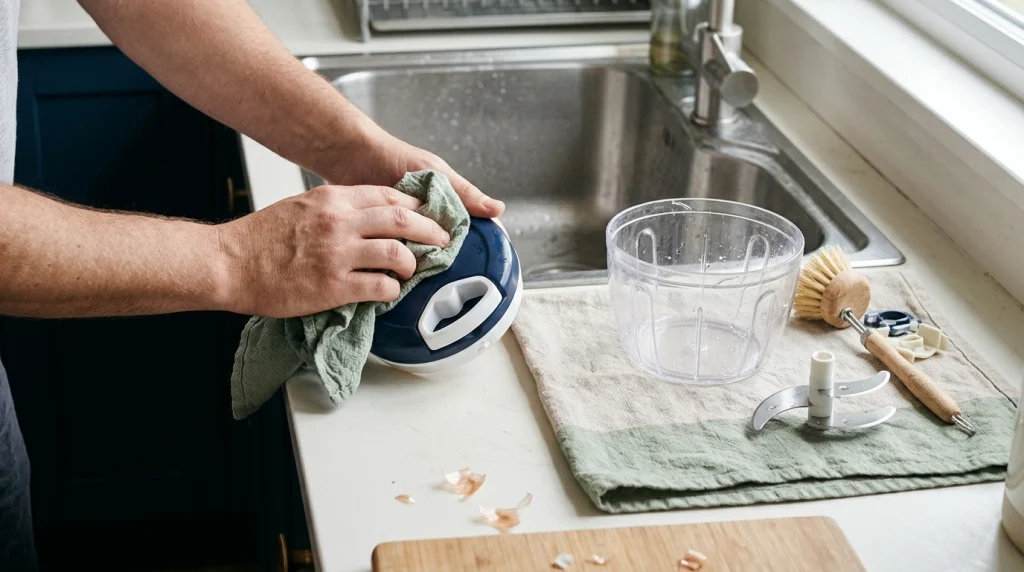
Clean the chopper soon after use so onion fragments don’t dry around the blades or inside the container. Follow the manufacturer’s instructions because some pull-cord lids must never be submerged in water.
- Empty the bowl: Remove the chopped onion without touching the cutting edges.
- Disassemble safely: Remove the lid and blade assembly in the order specified by the manual.
- Wash removable parts: Use the recommended washing method for the container and blades.
- Wipe the lid: Keep water away from enclosed cord mechanisms unless the manufacturer expressly allows immersion.
- Dry thoroughly: Let all washed components dry before reassembly or storage.
For general food-handling guidance, the FoodSafety.gov resource hub provides practical information about keeping food preparation clean and safe.
Common Pull Cord Chopper Problems and How to Fix Them
Most chopping frustrations come from overfilling, poor preparation, incorrect assembly, or expecting the tool to produce a specific texture without checking the results. Start by identifying the symptom before changing your technique.
| Problem | Possible cause | What to do |
|---|---|---|
| Uneven pieces | Large chunks or an overloaded container. | Use smaller, more consistent pieces and reduce the batch. |
| Onion paste | Too many pulls or continued chopping after reaching the target texture. | Check the onion earlier and stop once it reaches the desired size. |
| Cord won’t retract | A jam, damaged cord, or mechanism fault. | Stop using it and consult the manual or manufacturer. |
| Blades don’t rotate properly | Incorrect assembly or food obstructing movement. | Stop, disassemble safely, and check the assembly instructions. |
| Strong onion odor remains | Residue left around the bowl or lid. | Clean all permitted parts thoroughly and dry them before storage. |
If the mechanism repeatedly jams, the blades wobble, or a locking component looks damaged, don’t keep testing it. Safe operation matters more than finishing a batch.
Are Pull Cord Choppers Safe to Use?
A pull cord chopper can be useful for everyday food preparation when you assemble it correctly and keep your hands away from the blades. However, a manual mechanism doesn’t eliminate the risk of cuts or equipment failure.
The U.S. Consumer Product Safety Commission has issued a safety alert concerning certain versions of the Mueller Austria Onion Chopper Pro, model M-700, because a locking tab could detach during use. This is a reminder to check product-specific safety notices rather than assuming every chopper design is equally safe.
Follow these precautions:
- Inspect the lid, locking parts, cord, and blade assembly before use.
- Never operate the chopper with a loose lid or damaged component.
- Keep children away from the device while the blades are exposed.
- Never reach into the container while the blades are moving.
- Use the manufacturer’s cleaning and storage instructions.
You can check official consumer product warnings through the U.S. Consumer Product Safety Commission recalls and safety notices.
Which Pull Cord Chopper Should You Choose?
For most home cooks, a simple manual pull chopper makes sense when convenience, compact storage, and small-batch preparation matter more than exact cube dimensions. Before buying, compare the actual capacity, blade design, lid construction, cleaning instructions, and available safety information.
Here are three product lines worth comparing, depending on how you prepare onions and other ingredients. The links open Amazon search results rather than unverified individual product listings.
🏆 Best for Manual Chopping
Starfrit Pull Chopper
A manual pull-cord design with a bowl and rotating blade assembly. I’d compare its capacity, lid-cleaning requirements, and cord mechanism against your usual onion portions before choosing it.
🥗 Best for Onion-Focused Design
Philips OnionChef
This specialized electric onion chopper uses a dedicated basket and blade unit on applicable models. I’d consider it if onion texture is a priority, while checking model availability and replacement-part support first.
🍲 Best for Versatile Prep
KitchenAid Food Chopper
KitchenAid food choppers offer an electric alternative for preparing onions and other ingredients. I’d look for a model with a suitable bowl size and pulse operation if you want to control the texture without repeatedly pulling a cord.
These are options to compare, not hands-on product test winners. I haven’t verified current prices, customer ratings, or the availability of each model in every market, so check the listing details before ordering.
Frequently Asked Questions
Can you put a whole onion in a pull cord chopper?
It’s generally better to peel the onion and cut it into halves, quarters, or smaller chunks before loading the container. A whole onion may not fit properly or move evenly around the blades. Follow the preparation and fill instructions for your specific model.
How do you chop onions without turning them into mush?
Use a manageable batch, start with a few short pulls, and check the onion texture before continuing. Stop as soon as the pieces reach the size your recipe needs. Excessive blade rotations can break down the onion and release more moisture.
Can a pull cord chopper dice onions evenly?
A pull cord chopper can produce useful chopped onion pieces, but it may not create perfectly uniform cubes. Blade layout, onion chunk size, and pulling technique affect the result. Choose a knife or dedicated dicing tool when consistent dimensions are essential.
Can you use a pull cord chopper for red onions?
Yes, many general-purpose pull choppers can process red onions as well as yellow or white onions. Peel the onion, cut it into manageable chunks, and check the manufacturer’s approved ingredients. Use short pulls to avoid processing the pieces more finely than your recipe requires.
Can you wash a pull cord chopper in the dishwasher?
That depends on the model and its individual components. Some bowls and blade assemblies are dishwasher-safe, while the lid and retractable cord mechanism may require wiping or hand-cleaning. Check the manual before immersing any part in water or putting it in a dishwasher.
Final Takeaway
A pull cord chopper for onions can simplify everyday meal preparation when you want chopped ingredients without setting up an electric appliance. The key is to prepare the onion properly, avoid overfilling the container, and check the texture before adding more pulls.
If you mostly need quick chopped onions for soups, sauces, and weeknight meals, a manual model may be a practical choice. If you need precise cubes or regularly prepare large batches, compare it with a knife, dedicated dicer, or electric food chopper before deciding.
Before buying, verify the model’s capacity, cleaning requirements, blade safety, and cord construction. A well-matched tool and a careful technique will do more for your results than simply pulling faster.
Affiliate disclosure: This article contains affiliate links, which means RecipesPalette may earn a commission if you make a qualifying purchase through them, at no additional cost to you.