
Vegetable Chopper vs Knife for Vegetables: Which Is Better?

Quick Answer
A vegetable chopper is usually better for quickly dicing large amounts of onions, peppers, potatoes, and similar firm produce. A chef’s knife gives you more control, handles more types of cuts, and makes more sense for small everyday jobs. For more ways to speed up prep, see these practical cooking and meal-prep shortcuts.
The key differences
- Best for speed: A chopper handles repetitive dicing quickly once the produce is trimmed to fit.
- Best for control: A knife lets you change thickness, shape, and cut size whenever you want.
- Best for batches: A chopper is useful when several cups of vegetables need the same cut.
- Best for versatility: A chef’s knife can slice, dice, mince, chop, trim, and break down large vegetables.
- Best overall setup: Many home cooks benefit from owning both instead of treating them as replacements.
My simple rule
- Use a chopper for repetitive cubes and a sharp knife whenever precision, flexibility, or unusual shapes matter.
I don’t see a vegetable chopper and a knife as direct enemies. They solve different prep problems, and choosing the right one can noticeably change how much time you spend at the cutting board.
As of 2026, my approach is simple: match the tool to the amount of produce, the cut you need, and how much cleanup you want afterward.
What Is the Difference Between a Vegetable Chopper and a Knife?
A vegetable chopper uses one or more fixed blades to push, dice, slice, or chop produce into predetermined shapes. A chef’s knife relies on your hand movement, blade control, and cutting technique.
Definition: A manual vegetable chopper is a kitchen prep tool that forces vegetables through, against, or across a blade system to reduce them into smaller pieces. Unlike a knife, its blade arrangement usually determines the resulting size or shape.
That fixed design is the chopper’s biggest advantage and its biggest limitation. You gain repeatability, but you give up some flexibility.
- Vegetable chopper: Best for repetitive chopping and dicing.
- Chef’s knife: Best for flexible cuts and varied ingredients.
- Chopper blade insert: Determines much of the final shape.
- Knife technique: Determines thickness, angle, texture, and size.
Is a Vegetable Chopper Faster Than a Knife?
Yes, a vegetable chopper can be faster when you need the same cut repeated many times. The advantage becomes more noticeable as the quantity increases.
Imagine prepping three onions and four bell peppers for tacos. Once everything fits the chopper, repeated presses can create a container of diced vegetables quickly.
- One small onion: A knife may be faster because there is almost no setup.
- Several onions: A chopper starts gaining an advantage.
- Weekly meal prep: A chopper can reduce repetitive cutting.
- Mixed cutting styles: A knife usually stays faster because you do not need to swap inserts.
Pre-cutting still matters. Large potatoes, onions, or peppers often need to be halved or quartered before they fit a manual chopper.
That is why I count total prep time, not just the pressing action. Setup, trimming, blade changes, and cleanup all belong in the comparison.
Which Gives More Even Cuts: A Vegetable Chopper or Knife?
A chopper usually produces more repeatable cubes for beginners because the blade grid controls the shape. A skilled knife user can equal or exceed that consistency while having much more control over size.
Uniform pieces matter because similar-sized vegetables tend to cook at a similar rate. Uneven pieces can leave small cubes soft while larger pieces remain firm.
| Comparison | Vegetable Chopper | Chef’s Knife |
|---|---|---|
| Cut size | Fixed by the installed blade or grid | Freely adjustable with each cut |
| Repeated dicing | Fast and consistent after setup | Depends on knife skill and speed |
| Slicing thickness | Limited to available attachments | Can change from paper-thin to thick chunks |
| Fine mincing | Usually limited | Excellent with good technique |
| Small batch | Extra assembly and washing | Usually faster |
| Large batch | Strong advantage for repeated cuts | More hand work required |
| Cleanup | Blade grid, lid, container, and attachments | Knife plus cutting board |
If uneven cooking is a recurring problem, it is worth looking at other common cooking mistakes and practical fixes too.
Which Tool Works Best for Different Vegetables?
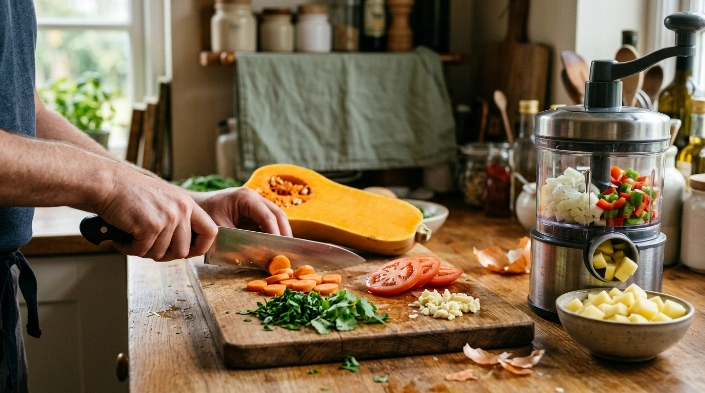
The best tool changes with the vegetable. Shape, firmness, moisture, and the final recipe all matter.
- Onions: Choppers are excellent for repeated dice, while knives give better control for slices, wedges, and fine mince.
- Bell peppers: Either works well, but a knife makes trimming the stem, ribs, and seeds easier first.
- Potatoes: Choppers work well for cubes if the potato is pre-cut small enough to fit.
- Carrots: A knife offers more flexibility for rounds, diagonal slices, batons, and fine dice.
- Tomatoes: A sharp knife usually handles soft ripe tomatoes more gently than forcing them through a grid.
- Leafy herbs: A knife is far better for slicing or mincing without crushing everything into a wet mass.
- Garlic: A chef’s knife is excellent for smashing and mincing small quantities.
- Large squash: A sturdy knife gives the leverage and positioning control that small chopper grids cannot provide.
Small aromatics are another reason I keep a knife close. If garlic is your main problem, these ways to prepare garlic without a press give you several simple options.
Is a Vegetable Chopper Safer Than a Knife?
A chopper can reduce direct knife work during repetitive dicing, but it is not automatically risk-free. Its blades are still sharp, especially when you remove food or clean the grid.
A knife becomes safer and easier to control when you use a stable board, a suitable grip, and deliberate cutting technique.
- Keep the board stable: A slipping cutting board makes controlled cuts harder.
- Create a flat surface: Cut round vegetables so they sit firmly before continuing.
- Protect fingertips: Curl the guiding hand into a claw rather than extending fingertips toward the blade.
- Do not rush: Speed should come after control.
- Clean chopper blades carefully: Use the supplied cleaning tool or a brush rather than pushing fingers into the grid.
NC State Extension demonstrates the chef’s knife as a versatile tool for chopping, slicing, and dicing and emphasizes a stable cutting surface and controlled grip. You can review its chef’s knife technique guidance.
Utah State University Extension also recommends using a sharp knife, choosing the right knife, and keeping the cutting surface stable in its vegetable-cutting safety guidance.
Does Food Safety Change With a Chopper or Knife?
The basic food-safety rules are the same whichever tool you use. Clean produce, clean tools, and separation from raw meat matter more than the cutting method.
The FDA recommends washing whole produce under running water before cutting it. It also advises cleaning utensils and surfaces to reduce cross-contamination.
- Wash first: Rinse produce before peeling or cutting.
- Clean every surface: Wash blades, boards, chopper containers, and counters after use.
- Separate raw meat: Keep produce away from boards or utensils contaminated by raw meat, poultry, or seafood.
- Dry thoroughly: Let chopper components dry before reassembly or storage.
For more detail, see the FDA’s produce handling recommendations.
The USDA also provides practical advice on cleaning and replacing cutting boards in its cutting-board food safety guidance.
Which Is Easier to Clean?
A knife is usually easier to clean. You wash one blade and the cutting board instead of dealing with grids, corners, lids, containers, and interchangeable inserts.
This difference feels small until you chop one onion and then spend several minutes clearing bits from a chopper grid.
- Knife cleanup: Wash, rinse, dry, and store the knife safely.
- Chopper cleanup: Separate the blade, lid, container, and removable parts.
- Grid cleanup: Check small blade openings for trapped onion, carrot, or pepper pieces.
- Dishwasher use: Follow the manufacturer’s instructions because not every component has the same care requirements.
For tiny meals, that extra washing can erase much of the time saved by chopping. For a large batch, the tradeoff often makes more sense.
Do You Still Need a Knife If You Own a Vegetable Chopper?
Yes. A vegetable chopper cannot fully replace a good kitchen knife because vegetables rarely arrive in the exact size and shape required by the chopper.
You may still need a knife to remove stems, halve onions, trim peppers, cut potatoes to fit, or tackle produce that does not suit a fixed grid.
- Trim vegetables before placing them in the chopper.
- Slice tomatoes and other delicate produce.
- Mince herbs and aromatics.
- Cut large or irregular vegetables.
- Adjust the size of a cut while cooking.
Building basic knife confidence also improves many other kitchen tasks. This guide to essential cooking skills for home cooks is a useful next step.
Which Is Better for Meal Prep and Everyday Cooking?
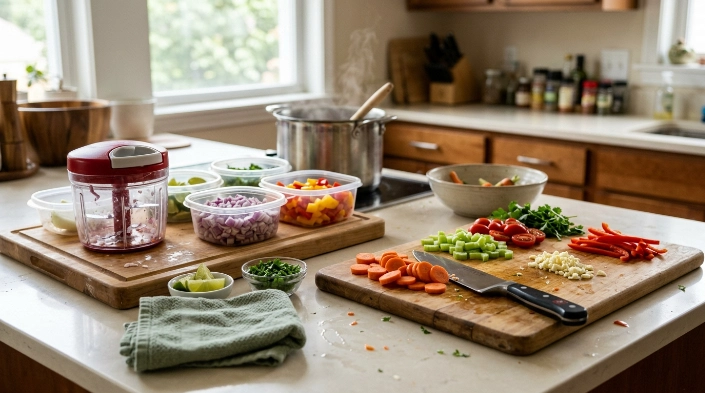
For large meal-prep sessions, I would choose the chopper when most ingredients need a similar dice. For everyday cooking, I reach for the chef’s knife because it handles changing tasks without assembly.
A soup is a good example. If I need an onion, carrots, celery, and garlic, the knife can move from one ingredient to the next without changing tools.
- Weekly taco prep: Chopper for several onions and bell peppers.
- Large salad batch: Chopper for firm diced ingredients, knife for tomatoes and herbs.
- Stir-fry: Knife for strips, diagonal slices, and different vegetable thicknesses.
- Salsa: Either tool works, depending on whether you want neat cubes or a hand-cut texture.
- Soup: Knife for varied vegetables, or a chopper when you want repeated dice.
If soup is part of your batch-cooking routine, the vegetable prep in this easy homemade chicken soup shows where consistent onion, carrot, and celery cuts are useful.
How Do You Choose Between a Vegetable Chopper and a Knife?
Choose according to what you cook most often rather than which tool looks faster in a demonstration. Your typical batch size matters more than a single impressive chop.
- Choose a chopper if: You regularly prepare several cups of firm vegetables with similar cuts.
- Choose a knife if: You make small meals and frequently change cutting styles.
- Choose a chopper if: Consistent cubes are more important than precise custom sizing.
- Choose a knife if: You prepare herbs, soft produce, large vegetables, and detailed cuts.
- Own both if: You batch-prep some days but still cook varied meals throughout the week.
My favorite setup is not complicated. A dependable 8-inch chef’s knife handles normal cooking, while a manual chopper comes out for repetitive prep.
Vegetable Chopper vs Knife: Final Comparison
A vegetable chopper wins when speed and repeated uniform cuts are the priority. A chef’s knife wins when flexibility, precision, easier cleanup, and broad usefulness matter more.
| Priority | Better Fit |
|---|---|
| Large amounts of repeated dice | Vegetable chopper |
| Precise or changing cut sizes | Chef’s knife |
| Minimal cleanup | Chef’s knife |
| Beginner-friendly uniform cubes | Vegetable chopper |
| Herbs and delicate vegetables | Chef’s knife |
| Overall kitchen versatility | Chef’s knife |
If you are ready to pick a tool, these are the three options I would put on a practical shortlist:
🏆 Best for Batch Prep
Fullstar Original Vegetable Chopper
★★★★☆
The Fullstar line uses interchangeable cutting components and a catch container for repetitive vegetable prep. I like this style most for onions, peppers, potatoes, and other batch-cooking ingredients where uniform pieces matter more than custom knife cuts.
🥕 Best Simple Chopper
OXO Good Grips Vegetable Chopper
★★★★☆
OXO lists stainless-steel blades, a recessed cutting area, an easy-pour opening, and dimensions of about 3.7 × 11.3 × 5.2 inches. I prefer this simpler format when the goal is straightforward chopping without keeping a large collection of attachments.
🔪 Best for Versatility
Victorinox Fibrox Chef’s Knife Extra Wide, 8-Inch
★★★★☆
Victorinox lists a 7.9-inch straight-edge blade, extra-wide profile, and non-slip ergonomic handle. This is the type of all-purpose knife I would choose when slicing, chopping, dicing, and mincing flexibility matters more than automatic uniform cubes.
Frequently Asked Questions
Is a vegetable chopper worth buying if I already have knives?
It can be worth buying if you often dice several onions, peppers, potatoes, or similar vegetables at once. If you normally prepare small meals or enjoy knife work, a chopper may spend more time in the cabinet than on your counter.
Can a vegetable chopper replace a chef’s knife completely?
No. Most choppers still require vegetables to be trimmed or cut into smaller sections first. A chef’s knife also handles slicing, mincing, herbs, delicate produce, large vegetables, and custom cut sizes that fixed chopper blades cannot easily reproduce.
Does a vegetable chopper make vegetables cook more evenly?
It can help because a fixed blade grid creates pieces with similar dimensions. Consistent pieces tend to cook more evenly, but the chopper does not guarantee perfect results if vegetables vary greatly in firmness, thickness, moisture, or starting size.
Are manual vegetable choppers difficult to clean?
They usually require more cleaning than a knife because food can collect around blade grids, lids, containers, and attachments. Models with removable, dishwasher-safe components can reduce the work, but sharp blade inserts still need careful handling during cleaning.
What knife is best for cutting most vegetables?
An 8-inch chef’s knife is a versatile starting point for most home cooks. It can handle chopping, slicing, dicing, and mincing while offering enough blade length for larger vegetables without becoming excessively bulky for ordinary cutting-board work.
Final Takeaway
The vegetable chopper vs knife for vegetables decision comes down to repetition versus flexibility. Choose the chopper for fast, uniform batches and the knife for precision, variety, and everyday convenience.
You do not need to force yourself into one camp. Keep a good chef’s knife as your everyday tool, then add a chopper if repeated vegetable prep is one of the jobs you genuinely want to make faster.
