Benefits of Using a Vegetable Chopper: 9 Practical Reasons

Quick Answer
The main benefits of using a vegetable chopper are faster prep, more uniform pieces, less knife work, easier batch cooking, and tidier counters. A good chopper can be especially useful for onions, peppers, carrots, cucumbers, potatoes, and salad vegetables when you need repeatable cuts; these practical meal-prep shortcuts can help you use that saved time well.
Biggest advantages
- Faster prep: Grid and push-style choppers can dice several pieces with one press.
- Even pieces: Fixed blade grids create repeatable sizes that cook more consistently.
- Less knife work: The tool reduces repetitive chopping motions during large prep jobs.
- Contained mess: Catch containers keep many chopped ingredients in one place.
- Batch-friendly: Uniform diced vegetables are easy to portion for soups, salads, stir-fries, and meal prep.
One important limit
- Not a knife replacement: You still need a knife for trimming, very large produce, delicate cuts, and foods that do not fit the blade grid.
A vegetable chopper can turn the most repetitive part of dinner into a short, organized task. I like it most when a recipe calls for several cups of similarly sized vegetables, not when I only need half an onion.
This guide explains where a chopper genuinely helps, where it does not, and how to use one safely in 2026. I’ll also compare common chopper styles so you can decide whether the tool deserves space in your kitchen.
What Is a Vegetable Chopper?
A vegetable chopper is a manual or powered kitchen tool that cuts produce into smaller pieces using fixed or rotating blades. Common designs include hinged grid choppers, pump choppers, pull-cord choppers, and electric food choppers.
Grid models press vegetables through square blades into a container. Pump and pull-cord models use moving blades to create a rougher chop, while electric models handle larger batches with less physical effort.
- Grid chopper: Best for cubes and repeatable dice sizes.
- Pump chopper: Good for onions, herbs, nuts, and quick rough chopping.
- Pull-cord chopper: Compact and useful for small batches without electricity.
- Electric chopper: Better for frequent, high-volume prep and softer mixtures.
What Are the Main Benefits of Using a Vegetable Chopper?
The biggest benefit is simple: a vegetable chopper can reduce active prep work while producing consistent pieces. That combination matters when you cook several meals, prep salads for a family, or repeat the same cuts often.
1. It can save time on repetitive chopping
A grid chopper can cut several pre-trimmed pieces in one press. That is often quicker than making many parallel knife cuts for onions, peppers, potatoes, or cucumbers.
The time saving becomes more noticeable with volume. Chopping one tomato may not justify setup, but dicing six vegetables for soup often does.
- Use the chopper for repeated dice sizes.
- Keep a knife nearby for trimming ends and large pieces.
- Work in batches instead of forcing an overloaded blade grid.
2. It creates more uniform pieces
Fixed blade grids make pieces closer in size than casual hand chopping. Uniform vegetables usually cook at a more similar rate, which helps reduce the mix of soft edges and undercooked centers.
This is especially helpful for sheet-pan vegetables, soups, hash, salsa, and stir-fries. My practical rule is to match the cut size to the cooking method instead of choosing the smallest blade automatically.
If even cooking is your goal, this guide to cooking food more evenly explains why consistent size and spacing matter.
- Fine dice: Useful for salsa, relishes, omelets, and quick sautés.
- Medium dice: Works well for soups, salads, curries, and sheet-pan meals.
- Larger chunks: Better for roasting when you want browned edges without a mushy center.
3. It reduces repeated knife motions
A chopper can reduce how many individual cuts you make during meal prep. That can make a large prep session feel less tedious, especially when several ingredients need the same shape.
It does not make blades harmless. Chopper inserts are sharp, so I treat every blade cartridge like a knife and use the supplied holder or cleaning tool whenever possible.
4. It can keep the counter tidier
Many choppers drop food directly into an attached container. That helps keep onion pieces, carrot cubes, and pepper bits from spreading across the board and counter.
The container also makes transferring ingredients easier. I can chop, remove the lid, and pour the prepared vegetables into a pan or storage container with fewer loose pieces to chase.
- Choose a model with a stable catch bin.
- Stop before the container becomes packed.
- Empty wet ingredients before liquid pools around the blades.
5. It makes batch meal prep easier
Meal prep gets easier when ingredients are consistent and easy to portion. A chopper is useful for preparing several cups of onions, peppers, carrots, cucumbers, celery, or zucchini at once.
That can support soups, grain bowls, wraps, salads, curries, and quick skillet meals. If you want a practical use case, this easy vegetable curry is the kind of recipe where pre-chopped vegetables shorten active prep.
6. It may encourage more home-prepped vegetables
Convenience matters when you are deciding what to cook. If chopping feels like the slowest part, lowering that friction can make fresh vegetables easier to include in everyday meals.
The USDA MyPlate vegetable guidance notes that vegetables can be eaten raw or cooked and count in many forms, including cut-up vegetables. A chopper does not improve nutrition by itself, but it can make vegetable preparation more convenient.
For broader meal planning, see these balanced diet basics for beginners.
- Salads: Prep cucumbers, peppers, onions, and firm tomatoes.
- Soups: Dice carrots, celery, potatoes, and onions consistently.
- Stir-fries: Prepare vegetables in similar sizes for fast cooking.
- Snack boxes: Portion chopped vegetables into ready-to-grab containers.
7. It can simplify portioning and recipe consistency
Repeatable cut sizes make it easier to fill measuring cups and divide vegetables across several meals. That is useful when you are following recipes closely or preparing identical lunch containers.
Consistency also helps with texture. If one batch of salsa uses a fine dice and the next uses large chunks, the eating experience changes even when the ingredients stay the same.
8. Multi-blade models can replace several small prep tools
Some vegetable choppers include dicing, slicing, julienne, grating, or spiralizing attachments. One base can therefore cover several jobs that would otherwise need separate handheld tools.
This advantage only matters when you use those attachments. A ten-piece set that stays in a drawer creates more storage work, so I prefer the smallest kit that covers my normal recipes.
9. A manual chopper works without electricity
Manual grid and pump choppers do not need an outlet. They are easy to move between a kitchen counter, RV, outdoor prep table, or other workspace where power is inconvenient.
They also give you direct control over each batch. You can stop after one press for a clean dice instead of pulsing an electric processor and risking an uneven mince.
Is a Vegetable Chopper Better Than a Knife?
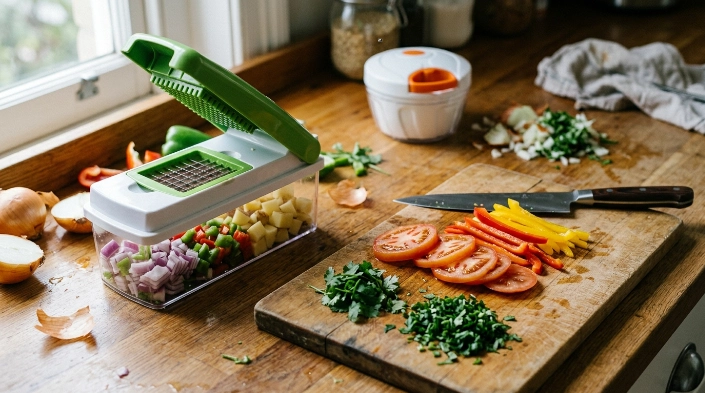
A vegetable chopper is better for repeated, uniform cuts, while a chef’s knife is better for flexibility and precision. Most kitchens benefit from using both rather than treating one as a complete replacement for the other.
| Prep tool | Best for | Cut consistency | Cleanup | Main limitation |
|---|---|---|---|---|
| Grid vegetable chopper | Repeated dice, meal prep, onions, peppers, potatoes | High for the selected grid size | Several parts and blade slots to clean | Food must fit the grid and should not be excessively hard |
| Pump or pull chopper | Rough chopping, herbs, onions, nuts, small batches | Medium; depends on number of pulls or pumps | Usually bowl, lid, and blade assembly | Not ideal for exact cubes |
| Chef’s knife | Trimming, slicing, herbs, delicate cuts, any size | Depends on knife skill | Knife and cutting board | More repetitive cutting for large batches |
I reach for a knife when shape matters, such as thin tomato slices or long pepper strips. I reach for a chopper when speed and repeatable dice sizes matter more than presentation.
Which Vegetables Work Best in a Chopper?
Firm vegetables that can be trimmed to fit the blade area usually work best in a grid chopper. Softer produce can work too, but ripe tomatoes and delicate herbs may crush or release more liquid.
- Usually easy: Onions, bell peppers, cucumbers, zucchini, mushrooms, celery, and peeled potatoes.
- May need pre-cutting: Carrots, sweet potatoes, large potatoes, cabbage, and thick squash.
- Use care: Ripe tomatoes, avocados, soft fruit, and delicate herbs can become crushed.
- Avoid forcing: Frozen foods, bones, pits, and produce harder than the manufacturer recommends.
For dense vegetables, cut the ingredient into manageable sections first. A firm, quick press usually works better than slowly leaning on the lid with excessive force.
Are Vegetable Choppers Safe to Use?
Vegetable choppers are safe when you keep fingers away from exposed blades, use the cleaning accessories, and place the unit on a stable surface. The most common risk comes during blade changes and cleanup, not during the downward chopping motion.
Food safety matters too. The FDA recommends washing fresh produce under running water before cutting it and keeping produce away from surfaces or utensils contaminated by raw meat.
- Wash produce first: Rinse fruits and vegetables before peeling or cutting.
- Use a dry base: Set the chopper on a flat, stable, non-slip surface.
- Never clear blades by hand: Use a brush, scraper, or cleaning fork.
- Separate raw meat tools: Follow safe cross-contamination practices.
- Replace damaged parts: Stop using cracked containers, warped lids, or loose blade frames.
For detailed safety guidance, see the FDA’s fresh produce handling recommendations and USDA guidance on cutting boards and cross-contamination.
The FDA also summarizes the four basic food-handling steps as clean, separate, cook, and chill. You can review that broader safe food handling guidance when setting up a meal-prep routine.
What Should You Look for When Buying a Vegetable Chopper?
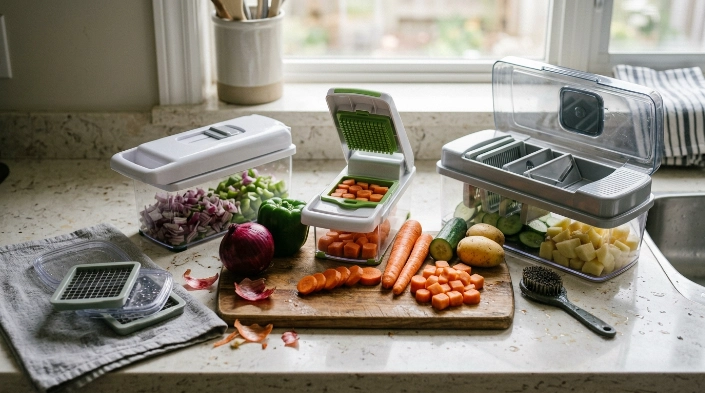
Choose a chopper around the foods you prepare most often, not the number of attachments in the box. Blade quality, stability, easy cleaning, useful cut sizes, and storage matter more than a long accessory list.
- Blade sizes: Make sure the included grids match your normal dice size.
- Stable base: Non-slip feet or a grippy container reduce movement.
- Cleaning tools: A brush or grid cleaner keeps fingers away from sharp edges.
- Catch capacity: Larger bins need fewer emptying breaks during batch prep.
- Storage: Check whether loose blades store safely inside or beside the unit.
- Dishwasher guidance: Follow the manufacturer’s exact care instructions for lids and blades.
As of 2026, three common styles show the trade-offs clearly. Fullstar emphasizes interchangeable grid functions, OXO offers a simpler compact chopper, and Mueller bundles multiple slicing and grating options with its dicing blades.
| Model | Notable setup | Good fit for |
|---|---|---|
| Fullstar Original Pro Chopper 4-in-1 | Stainless-steel blades, catch tray, non-skid base, multiple prep functions | Routine dicing with a compact multi-use kit |
| OXO Good Grips Vegetable Chopper 11122600 | 2.5-cup container, stainless-steel grid, easy-pour opening, non-slip base | Simple chopping without many loose attachments |
| Mueller Pro-Series 10-in-1 MC-780 | 1/4-inch and 1/2-inch dicing blades plus six slicing and grating blades | Cooks who want one prep system for several cut styles |
If your goal is eating more vegetables, the USDA MyPlate vegetable guide is a useful reference for vegetable variety and serving examples.
If you are ready to pick one, here are the three styles I would compare first:
🏆 Best all-around grid chopper
Fullstar Original Pro Chopper 4-in-1
★★★★☆
This model combines stainless-steel chopping blades with a catch tray and non-skid base. I would choose it when repeatable dicing matters more than having the smallest possible tool.
🧼 Best simple cleanup
OXO Good Grips Vegetable Chopper 11122600
★★★★☆
The 2.5-cup container, removable grid, pour opening, and non-slip base keep the design straightforward. I would pick it for smaller kitchens where extra blade cartridges would become clutter.
🥕 Best for multiple cut styles
Mueller Pro-Series 10-in-1 MC-780
★★★★☆
The kit includes 1/4-inch and 1/2-inch dicing blades plus slicing and grating attachments. I would favor it when one prep station needs to cover dice, slices, julienne cuts, and grating.
Frequently Asked Questions
Do vegetable choppers really save time?
Yes, they can save time when you need repeated cuts or several cups of vegetables. The advantage is smaller for one quick ingredient because setup and cleanup can take longer than using a knife.
Can a vegetable chopper cut hard vegetables?
Many manual choppers can handle firm vegetables when pieces are trimmed to fit the grid. Dense foods such as large carrots or sweet potatoes may need smaller starting pieces, and you should never force foods that the manufacturer says are unsuitable.
Does a vegetable chopper replace a food processor?
No. A grid chopper is better for defined cubes, while a food processor is better for fast rough chopping, shredding, puréeing, and larger batches.
The tools overlap, but they produce different textures and require different cleanup.
Are vegetable choppers easy to clean?
Some are easy to clean, but grid blades can trap onion, carrot, and pepper pieces. Models with removable grids, cleaning forks, or dishwasher-safe parts are easier to maintain, though sharp blades still require careful handling.
Is a vegetable chopper worth buying?
A vegetable chopper is worth buying if you regularly dice several vegetables, batch-cook, or want more consistent cuts with fewer knife motions. It is less useful if you cook small portions, prefer custom knife cuts, or dislike storing multiple attachments.
Final Takeaway
The best benefits of using a vegetable chopper are speed, consistency, easier batch prep, and a more contained workspace. It earns its place when you use those advantages often enough to justify washing and storing the extra parts.
Start with a simple model that matches your usual vegetables and cut sizes. Keep your chef’s knife for trimming and precision work, then let the chopper handle the repetitive jobs it does best.