
What Are the Available Sizes for Dish Racks?

Quick Answer
Dish racks come in compact, standard, full-size, two-tier, expandable, in-sink, and over-the-sink sizes. Compact racks may be about 14–17 inches long, while many full-size countertop models reach roughly 19–21 inches; expandable racks can change size when you need extra capacity, as shown by the OXO Good Grips Foldaway Dish Rack.
Common dish rack size categories
- Compact: Often around 14–17 inches long and suited to one or two people.
- Standard: Usually around 17–20 inches long for everyday plates, cups, and bowls.
- Full-size: Commonly about 19–21 inches long with more space for cookware.
- Two-tier: Often 12–16 inches tall, using vertical space to increase capacity.
- Expandable: Changes width or length depending on how many dishes you have.
- Over-sink: Available in adjustable spans designed around different sink widths.
Before buying
- Measure the usable counter or sink space rather than choosing a rack from the words “small” or “large” alone.
Dish rack sizing looks simple until you compare actual products. Two racks described as “large” can have noticeably different footprints.
I focus on the measurements first and the marketing label second. That approach makes it much easier to find a rack that fits beside your sink without crowding the kitchen.
What Does Dish Rack Size Actually Mean?
Dish rack size means the rack’s physical length, width or depth, and height. Those measurements determine both how much counter space it occupies and what dishes it can hold.
Dish rack size: the outside dimensions of the rack when it is ready for use, usually shown as length × width/depth × height.
The order of dimensions isn’t consistent between manufacturers. One brand may list width first, while another starts with length.
Always look at the product diagram when available. It prevents a surprisingly common mistake: assuming the longest number runs parallel to the sink.
What Dish Rack Sizes Are Available?
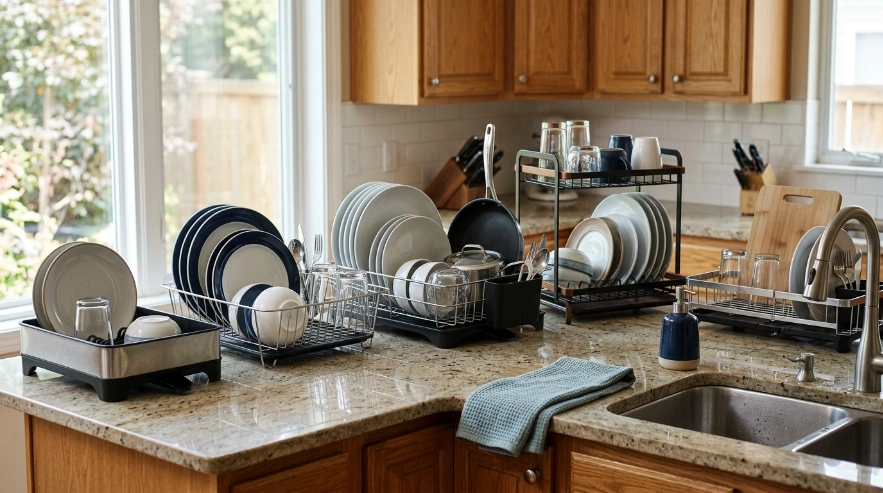
Most household dish racks fall into five practical groups: compact, standard/full-size, expandable, multi-tier, and sink-mounted designs. There is no single industry-standard measurement for each category.
The ranges below are a practical guide based on common products rather than fixed manufacturing standards.
| Dish rack type | Common footprint | Typical height | Best suited to |
|---|---|---|---|
| Compact | About 14–17 × 7–12 in. | About 4–7 in. | Apartments, couples, small counters |
| Standard | About 17–20 × 11–15 in. | About 5–8 in. | Typical daily household washing |
| Full-size / large | About 19–21 × 14–18 in. | About 6–10 in. | Families and larger loads |
| Two-tier | About 16–22 × 9–12 in. | About 12–16 in. | High capacity with limited counter depth |
| Expandable | Varies from roughly 13–15 in. closed to 20–21+ in. extended | Usually 5–8 in. | Changing load sizes |
| Over-sink | Highly model-specific and often adjustable | Often much taller | Keeping the countertop clear |
These dimensions should be treated as shopping ranges, not guarantees. Check the exact listed dimensions before ordering.
How Big Is a Small Dish Rack?
A small dish rack usually measures about 14–17 inches long and roughly 7–12 inches deep. It generally handles one meal’s dishes for one or two people.
A compact model makes sense when every inch beside the sink matters. It can also work well in dorms, RVs, studio apartments, and kitchenettes.
What fits in a compact dish rack?
Capacity varies with tine spacing and layout. A narrow rack can sometimes outperform a wider one if its interior is organized efficiently.
- Dinner plates: Usually several plates arranged vertically.
- Bowls: Small and medium bowls may share the main rack.
- Cups: Side hooks or cup holders preserve interior space.
- Cutlery: A detachable utensil cup is common.
- Cookware: Large pans often need to dry separately.
For a small kitchen, I prefer a rack that leaves a little bare countertop around it. A rack squeezed tightly between the sink and wall becomes awkward to clean.
What Is a Standard or Full-Size Dish Rack?
A standard countertop rack is often around 17–20 inches long, while full-size models frequently approach 19–21 inches. Depth commonly lands somewhere around 12–16 inches.
For example, a current KitchenAid full-size rack is listed at 19.6 × 14.9 × 6.9 inches. That footprint illustrates what many shoppers will recognize as a family-size countertop rack.
Who should choose a full-size rack?
- Families: More room helps when several place settings are washed together.
- Home cooks: Wider open areas can handle mixing bowls and smaller cookware.
- No dishwasher: Extra drying capacity matters when everything is hand washed.
- Frequent cooking: A larger rack reduces the need to unload it between small batches.
Large capacity isn’t automatically better. An oversized rack can permanently consume a valuable prep area.
Some premium racks push usable capacity further through external cup holders and dedicated glassware areas. The simplehuman Steel Frame Dishrack, for example, uses accessories around the main rack to increase drying space.
Are Two-Tier Dish Racks Better for Small Counters?
Two-tier racks can provide more drying capacity without demanding an equally large countertop footprint. Instead of spreading dishes outward, they stack drying areas vertically.
Typical countertop two-tier models can stand around 12–16 inches high. Some are taller, so cabinet clearance becomes important.
Measure overhead space before buying
Check the distance between your countertop and upper cabinet. Then allow extra space to lift plates and bowls onto the upper level comfortably.
- Rack height: Check the assembled height, not the package size.
- Plate clearance: Tall dinner plates may extend above the rack.
- Cabinet clearance: Leave enough room for your hands.
- Stability: A tall rack should have a wide, secure base.
I wouldn’t choose a tall rack purely because it holds more dishes. Easy loading and stability matter just as much as capacity.
How Much Space Does an Expandable Dish Rack Need?
An expandable rack needs enough room for its largest configuration if you plan to use its full capacity. Its closed size alone doesn’t tell the whole story.
The Joseph Joseph Extend Steel Dish Rack shows the difference clearly. It measures about 12.75 × 14.5 × 6.5 inches closed and expands to about 20.75 inches across.
Expandable rack vs fixed-size rack
- Expandable rack: Better when your washing load changes from day to day.
- Fixed rack: Simpler when you have a permanent drying area.
- Expandable rack: Can reclaim some counter space between larger loads.
- Fixed rack: Usually requires no sliding sections or size adjustment.
An expandable rack is one of my favorite approaches for mixed-use counters. You can keep it compact for breakfast and open it after cooking dinner.
What Size Over-the-Sink Dish Rack Should You Buy?
An over-the-sink rack must match your sink width, faucet position, and available vertical clearance. Generic labels such as medium or large aren’t enough.
These racks vary more than conventional countertop designs. Many use an adjustable horizontal frame so one product can fit several sink widths.
Take these measurements first
- Measure the outside sink width. Measure the full area the rack must span.
- Check faucet height. The rack must clear the faucet and handles.
- Check cabinet clearance. Confirm that plates won’t hit upper cabinets.
- Measure counter support areas. The feet need stable surfaces on both sides.
- Check accessory positions. Cup holders and baskets can increase total width.
Also check whether the manufacturer gives an adjustable range. Your sink measurement should sit comfortably inside that range, not right at its limit.
How Do You Measure Your Counter for a Dish Rack?
Measure the usable surface beside your sink, not the total countertop. Faucets, backsplashes, appliances, and cabinet edges can reduce the practical space.
I use a simple three-measurement method before comparing products.
- Measure length: Find the horizontal space available beside the sink.
- Measure depth: Measure from the backsplash toward the counter edge.
- Measure height: Check clearance under cabinets or shelves.
Then compare those measurements with the rack’s assembled dimensions. Include removable cup holders and utensil baskets if they extend beyond the main frame.
Does Dish Rack Capacity Matter More Than Dimensions?
Dimensions and capacity measure different things. Dimensions tell you how much kitchen space the rack uses, while capacity tells you how effectively that space holds dishes.
Look beyond the outside measurements when comparing similar racks.
- Tine spacing: Determines how securely plates and bowls stand.
- Open drying area: Helps with pans and mixing bowls.
- Cup holders: Increase capacity without filling the main basket.
- Utensil caddy: Keeps forks and spoons from occupying plate space.
- Drainboard design: Controls where water goes.
- Adjustability: Lets one rack serve different load sizes.
Air circulation matters too. Packing wet items too closely can slow drying even when the rack technically holds them.
For commercial food-service settings, the FDA Food Code specifically addresses air-drying cleaned and sanitized utensils. At home, giving washed dishes enough open space to drain and dry remains a sensible practice.
Which Dish Rack Size Should You Choose?
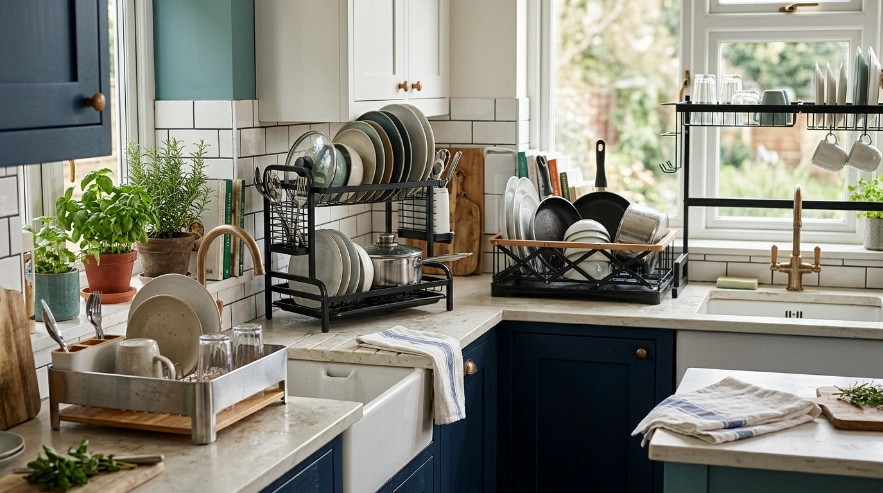
Choose the smallest rack that comfortably handles your normal washing load. Buying for your everyday routine usually works better than buying for the largest meal you might cook once a month.
| Kitchen situation | Good starting point |
|---|---|
| One person or studio kitchen | Compact rack |
| Couple with moderate dishwashing | Compact or standard rack |
| Family household | Standard or full-size rack |
| Small counter but many dishes | Two-tier rack |
| Dish load changes frequently | Expandable rack |
| Counter space is the main problem | Over-the-sink rack |
If you’re ready to choose one, these three designs cover different sizing needs well.
🏆 Best Flexible Countertop Pick
OXO Good Grips Foldaway Dish Rack
★★★★☆ 4.7/5 fit-versatility rating
It measures about 19.4 × 15.5 × 5.125 inches when open and folds into a shallower configuration for storage. I like this format when you want full-size drying space without leaving the same bulky setup on the counter all day.
↔️ Best Expandable Pick
Joseph Joseph Extend Steel Dish Rack
★★★★☆ 4.8/5 sizing-flexibility rating
Its width changes from about 12.75 inches closed to 20.75 inches expanded while depth remains about 14.5 inches. I’d choose this style when weekday loads are small but weekend cooking creates many more dishes.
🍽️ Best Full-Size Pick
KitchenAid Full Size Dish-Drying Rack
★★★★☆ 4.6/5 everyday-capacity rating
At roughly 19.6 × 14.9 × 6.9 inches, this is a useful reference point for a conventional full-size rack. I prefer this footprint when a household regularly dries several plates, bowls, cups, and utensils together.
Frequently Asked Questions
What is the most common dish rack size?
Many everyday countertop dish racks are roughly 17–20 inches long and 11–15 inches deep. There is no universal standard, so always compare the exact product dimensions with your available counter space.
What size dish rack is best for two people?
A compact or medium rack around 15–18 inches long is often enough for two people who wash dishes frequently. Choose a larger rack if you regularly wash pots, pans, meal-prep containers, or several place settings together.
How much space should I leave around a dish rack?
Leave enough room to wipe around the rack and position its drainboard or spout correctly. Even one or two inches of practical working clearance can make daily cleaning and loading easier.
Is a two-tier dish rack larger than a normal rack?
Not necessarily in countertop footprint. A two-tier rack increases capacity mainly by adding height, which can make it useful when horizontal counter space is limited.
Can a dish rack be too large?
Yes. A rack is too large when it blocks prep space, interferes with the faucet, overhangs the counter, or cannot drain toward the sink properly.
Final Takeaway
Dish racks are available in sizes ranging from narrow compact models to large full-size, expandable, two-tier, and over-the-sink systems. The best size depends on your usable counter space and typical dish load, not the product’s “small” or “large” label.
Measure your counter, sink, and overhead clearance before buying. A rack that fits the kitchen comfortably will usually be more useful than the biggest model you can squeeze beside the sink.