Different Types of Vegetable Choppers: 7 Styles Explained

Quick Answer
The main types of vegetable choppers are grid choppers, pull-cord choppers, push choppers, hand-crank choppers, rocking choppers, electric mini processors, and mandoline-chopper hybrids. The right choice depends on whether you want uniform cubes, finer chopping, larger batches, or multiple cut styles for more even cooking.
Quick differences between vegetable choppers
- Grid chopper: Best for fast, uniform cubes of onions, peppers, potatoes, and similar firm vegetables.
- Pull-cord chopper: Best when you want to control how coarse or fine the pieces become.
- Push chopper: Compact and simple for garlic, herbs, nuts, onions, and smaller prep jobs.
- Hand-crank chopper: Useful for repeated chopping without pressing directly on the food.
- Rocking chopper: Ideal for chopped salads, leafy greens, herbs, and softer vegetables.
- Electric chopper: Fastest for larger amounts and very fine chopping.
- Mandoline hybrid: Best when you also want slices, julienne strips, shreds, or several interchangeable cuts.
Vegetable choppers can look similar on a store shelf, but they don’t all produce the same result. Some make neat cubes, while others work more like small food processors.
I find it much easier to choose one once I separate the tools by cutting mechanism. This guide explains the seven main styles, their strengths, their limits, and the vegetables each handles best.
A vegetable chopper is a manual or powered kitchen tool designed to cut vegetables into smaller pieces with less repetitive knife work. Depending on its design, it may dice, mince, slice, shred, julienne, or roughly chop food.
What are the different types of vegetable choppers?

There are seven practical vegetable chopper styles worth knowing in 2026. The biggest differences are how the blade moves, the shape of the finished pieces, and how much control you have over size.
| Type | How It Works | Best For | Cut Result | Main Advantage |
|---|---|---|---|---|
| Grid/box | Food is pressed through a fixed blade grid | Onions, peppers, potatoes, zucchini | Uniform cubes | Fast, consistent dicing |
| Pull-cord | Pulling a cord spins blades inside a bowl | Onions, herbs, salsa ingredients | Coarse to fine | Good texture control |
| Push | Repeated downward presses move or rotate blades | Garlic, herbs, nuts, small onions | Fine or rough chop | Compact and simple |
| Hand-crank | Turning a handle rotates internal blades | Vegetable mixes, nuts, herbs | Variable chop | Low-impact repeated chopping |
| Rocking | Curved blade rolls through food | Salads, herbs, leafy greens | Rustic chop | Handles bulky greens well |
| Electric | A motor spins blades at high speed | Large batches, fine chopping | Fine to minced | Speed and low effort |
| Mandoline hybrid | Interchangeable fixed blades create several cuts | Meal prep, salads, fries, slaws | Dice, slice, julienne, shred | Maximum versatility |
1. How does a grid vegetable chopper work?
A grid chopper forces food through sharp crossing blades into a container below. It is one of the easiest choices when consistent cubes matter.
I like this style most for recipes where several vegetables should cook at roughly the same rate. Consistent size also makes salsa, soups, omelets, and sheet-pan meals look more organized.
- Best foods: onions, bell peppers, potatoes, cucumbers, zucchini, carrots, and firm fruit.
- Best feature: pieces come out in a predictable size.
- Main limitation: very hard or oversized vegetables may need to be pre-cut first.
- Cleanup: blade grids can trap small pieces, so rinsing soon after use helps.
Grid choppers are particularly useful if uneven knife cuts are causing cooking problems. My rule is simple: use the largest pieces the grid can handle comfortably instead of forcing dense vegetables through it.
2. When should you choose a pull-cord vegetable chopper?
A pull-cord chopper is better when you care more about texture than perfect cubes. Each pull spins the blades, so additional pulls make the food progressively finer.
This makes the design useful for onions, herbs, peppers, salsa, dips, and small batches of mixed vegetables. You can stop while the mixture is coarse instead of processing everything into a paste.
- Few pulls: produce a rougher chop for chunky salsa or salads.
- More pulls: create smaller pieces for sauces, fillings, and dressings.
- Covered bowl: helps contain onion pieces, juices, and loose herbs.
- No electricity: makes the tool convenient for compact kitchens or travel.
The trade-off is shape. A pull chopper produces useful small pieces, but you should not expect the clean square dice of a fixed grid.
3. Are push choppers good for onions, garlic, and herbs?
Push choppers are excellent for smaller prep jobs because repeated downward presses move the cutting mechanism. They work especially well when getting out a full food processor would feel excessive.
Cuisinart’s current Push Chopper, for example, uses stainless steel blades and is designed for vegetables, garlic, herbs, nuts, hard cheeses, and similar ingredients. Compact tools like this can also reduce the amount of exposed blade handling during normal chopping.
- Ideal quantity: small to medium prep jobs.
- Useful ingredients: garlic, herbs, nuts, onion pieces, and aromatics.
- Texture: depends on how many times you press.
- Storage: usually easier than storing a large multi-piece chopping system.
For tiny quantities of garlic, you may not need a vegetable chopper at all. My guide on pressing garlic without a garlic press covers simple alternatives using common kitchen tools.
4. What is a hand-crank vegetable chopper best for?
A hand-crank chopper uses a rotating handle to turn blades inside a covered container. It gives you repetitive chopping action without pulling a cord or repeatedly pushing a plunger.
I see this style as a middle ground between a pull chopper and an electric processor. You still control the speed manually, but the circular motion can feel smooth during longer chopping sessions.
- Best for: mixed vegetables, nuts, herbs, onions, and soft ingredients.
- Control: slower cranking usually gives you more time to check texture.
- Advantage: no outlet or battery is required.
- Downside: the handle and internal mechanism create extra parts to clean.
This style makes the most sense when you want adjustable chopping but dislike cord mechanisms. It is less suitable when identical cubes are important.
5. What is a rocking or salad chopper?
A rocking chopper uses one or more curved blades that roll through ingredients. It shines with leafy vegetables because you can move through a wide bowl without squeezing food through a small grid.
The OXO Good Grips Salad Chopper and Bowl is a good example of this category. Its matching bowl has a curved interior, while the chopper uses two stainless steel blades.
- Great for: lettuce, spinach, cabbage, herbs, cooked vegetables, and chopped salads.
- Cut style: rustic rather than perfectly geometric.
- Batch size: larger bowls can handle substantial salad portions.
- Control: you can visually monitor the food while chopping.
I prefer this approach when texture should remain chunky and fresh. It is less useful for tiny onion cubes or julienne strips.
6. Is an electric vegetable chopper worth it?
An electric chopper is the easiest option when speed and low hand effort matter most. A small motor spins the blades, allowing quick chopping with a button or pulse control.
The key is to pulse instead of running the motor continuously. Vegetables can move from chopped to overly fine surprisingly quickly in a powerful machine.
- Best for: larger batches, meal prep, sauces, finely chopped onions, and mixed ingredients.
- Main advantage: minimal repetitive hand effort.
- Main limitation: less control over exact cube shape.
- Extra consideration: motor bases normally require more storage space than simple manual tools.
Electric models are useful when chopping volume matters more than geometric consistency. A grid chopper remains the better match when a recipe specifically needs tidy cubes.
7. Are mandoline and chopper hybrids worth buying?
A mandoline-chopper hybrid combines several prep tools into one system. Depending on the blade set, it may dice, slice, shred, grate, or cut vegetables into julienne strips.
Fullstar and Mueller both sell current multi-blade systems built around this idea. These tools make the most sense for cooks who prepare several vegetables at once and will use multiple blade styles.
- Dicing blade: useful for onions, potatoes, peppers, and cucumbers.
- Slicing blade: useful for potatoes, zucchini, onions, and salad vegetables.
- Julienne blade: produces thin strips for slaws and stir-fries.
- Grating blade: useful for carrots, vegetables, and other shreddable ingredients.
The downside is the number of accessories. If you only dice an onion twice a week, a simpler chopper may be faster to store and clean.
Which vegetable chopper is best for onions?
For uniform diced onions, I would choose a grid-style vegetable chopper. A pull-cord or push model is better when exact shape does not matter.
Onions also show why blade choice matters. A sharp grid cuts cleanly, while repeated spinning creates a more irregular texture suitable for sauces, fillings, and salsa.
| Your Goal | Best Chopper Style |
|---|---|
| Uniform onion cubes | Grid chopper |
| Chunky salsa | Pull-cord chopper |
| Small amount of onion or garlic | Push chopper |
| Large batch, very fine texture | Electric chopper |
How do you choose the right vegetable chopper?
Choose based on the cut you use most often, not the number of accessories advertised on the box. A simpler tool you use every evening is more valuable than twelve blades sitting in a cabinet.
I also consider cleanup before buying. Complicated blade systems save prep time only when washing and storing them still fits your routine.
- For uniform cubes: choose a grid chopper.
- For adjustable texture: choose a pull-cord, crank, or push chopper.
- For chopped salads: choose a rocking chopper and bowl.
- For high-volume prep: consider an electric chopper.
- For several cut styles: choose a mandoline-chopper hybrid.
- For limited storage: favor a compact push or pull model.
Consistent preparation can prevent several common cooking mistakes, especially when mixed-size vegetables finish at different times. Matching the tool to the recipe is more important than choosing the biggest set.
How should you use a vegetable chopper safely?
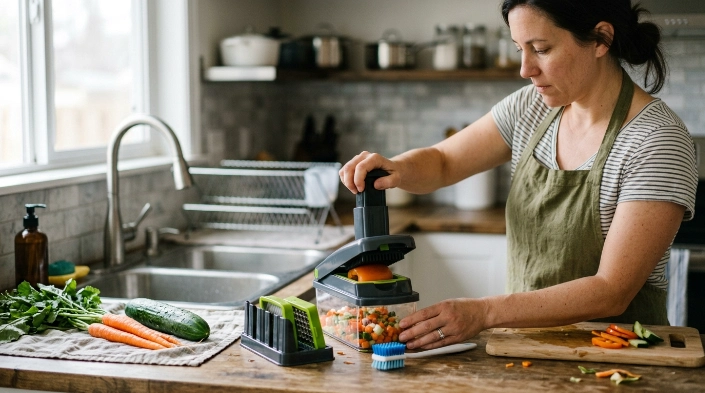
Vegetable chopper blades are sharp, even when much of the edge is hidden inside the tool. Keep fingers away from exposed inserts and use the manufacturer’s food holder or pusher whenever one is supplied.
Food safety matters too. The FDA recommends rinsing fresh produce under running water before preparing or eating it, including produce that will be peeled.
- Wash first: rinse vegetables before chopping rather than washing the cut pieces as a substitute.
- Use clean equipment: wash the container, lid, blades, cutting board, and work surface.
- Avoid cross-contamination: keep produce away from tools or surfaces used for raw meat unless they have been properly cleaned.
- Don’t force food: pre-cut large or dense vegetables when required.
- Store blades carefully: use blade covers or dedicated storage slots when supplied.
The CDC’s food-safety guidance also stresses clean hands, clean surfaces, separation, proper cooking, and prompt chilling. The USDA food-safety basics reinforce the same clean, separate, cook, and chill approach.
What vegetables work best in manual choppers?
Manual vegetable choppers generally perform best with produce that is firm enough to cut cleanly but not so hard that it overloads the mechanism. The ideal choice also depends on the blade style.
- Onions: work with almost every chopper type.
- Bell peppers: work particularly well with grid and slicing systems.
- Zucchini: works for dicing, slicing, julienne cuts, and spiralizing.
- Cucumbers: work well in grid and slicing attachments.
- Potatoes: suit sturdy grid and slicing blades after being cut to a manageable size.
- Carrots: work best with strong grids, graters, or slicing attachments.
- Leafy greens: are better suited to rocking or bowl-style choppers.
Small aromatics sometimes need a different tool. If garlic is your main ingredient, my guide explaining what a garlic press is can help you compare a press with a small chopper.
Vegetable choppers I would consider for everyday prep
If you’re ready to pick one, these three designs cover different priorities rather than repeating the same type of tool.
🏆 Best for versatile meal prep
Fullstar Original Vegetable Chopper 4-in-1
★★★★★ My fit rating: 4.8/5
The current 4-in-1 system uses interchangeable stainless steel blades and a catch container, with slicing and julienne capability alongside chopping functions. I like this format for cooks who want several common prep cuts without moving to an electric processor.
🥗 Best multi-blade option
Mueller Original Vegetable Chopper Pro 8-Blade
★★★★☆ My fit rating: 4.6/5
Mueller’s current system includes eight interchangeable stainless steel blades for chopping, dicing, slicing, julienne cuts, grating, and shredding. I would choose it when blade variety matters more than having the smallest possible gadget.
👌 Best simple design
OXO Good Grips Vegetable Chopper with Easy-Pour Opening
★★★★☆ My fit rating: 4.5/5
OXO uses a stainless steel blade pattern, recessed cutting area, and an easy-pour opening that lets you empty chopped food without removing the lid. I like it for cooks who want straightforward chopping without managing a large collection of inserts.
Frequently Asked Questions
What is the most versatile type of vegetable chopper?
A mandoline-chopper hybrid is usually the most versatile because interchangeable blades can handle dicing, slicing, julienne cuts, grating, and shredding. The trade-off is extra storage and cleaning compared with a simple one-purpose chopper.
Which vegetable chopper gives the most even cubes?
A fixed grid or box-style chopper normally gives the most consistent cubes because every piece passes through the same blade openings. Pull-cord, push, and electric choppers create more irregular shapes because their rotating blades strike food from changing angles.
Are manual vegetable choppers better than electric ones?
Neither type is better for every job. Manual choppers offer more direct control, require no electricity, and often store easily, while electric choppers handle larger amounts with less hand effort and can create a finer texture quickly.
Can a vegetable chopper replace a knife?
A vegetable chopper can reduce routine knife work, but it rarely eliminates a knife completely. Large vegetables often need trimming or pre-cutting before they fit the chopper, and delicate or specialized cuts may still be easier with a sharp kitchen knife.
How do I stop vegetables from getting stuck in the blades?
Cut oversized vegetables into manageable pieces and place flat sides against the cutting grid when possible. Avoid forcing extremely hard food through a lightweight chopper, and clean trapped pieces with the supplied tool or brush rather than pushing fingers into sharp blades.
Which type should you choose?
If you mainly want neat onion and pepper cubes, start with a grid chopper. For salsa and adjustable textures, a pull-cord model gives you more control.
A rocking chopper makes more sense for salads, while an electric model suits frequent large-batch prep. Choose a mandoline hybrid when slicing, shredding, julienne cuts, and dicing all appear regularly in your cooking.
- Best for consistent dice: grid chopper
- Best for texture control: pull-cord chopper
- Best compact choice: push chopper
- Best for leafy salads: rocking chopper
- Best for big batches: electric chopper
- Best all-around versatility: mandoline-chopper hybrid
Think about the vegetables you prepare every week and the cuts your recipes actually require. Pick the simplest chopper that handles those jobs well, keep its blades clean and protected, and you’ll get far more value from it than from a complicated gadget you rarely use.
