
How Does a Pull String Chopper Work? A Simple Guide to Its Mechanism and Use

Quick Answer
A pull string chopper works by converting the pulling motion of a cord into rapid rotation of sharp blades inside a container. When you pull the handle, the cord turns a small internal rotor, which spins the blades to chop vegetables, fruits, herbs, and other suitable ingredients. Repeated pulls create more cuts, giving you greater control over the final texture than a single pull.
How the mechanism works
- Add ingredients: Cut oversized vegetables into manageable pieces and place them inside the container.
- Secure the lid: Lock the lid in place so the blade assembly stays enclosed during chopping.
- Pull the handle: The cord turns the internal rotor and spins the connected blades.
- Repeat as needed: Additional pulls create more cuts and generally produce smaller pieces.
- Check the texture: Stop, open the lid safely, and inspect the pieces before deciding whether to pull again.
What affects the result?
- Ingredient size: Smaller, evenly sized pieces usually chop more consistently.
- Pull count: Fewer pulls leave larger pieces, while more pulls produce a finer chop.
- Blade condition: Clean, undamaged blades help the chopper cut effectively.
A pull string vegetable chopper looks simple, but a small mechanical system does most of the work inside it. Instead of powering a motor, you supply the energy by pulling a cord.
In this guide, I’ll explain how the cord, rotor, and blades work together, what happens during each pull, and how to get more consistent results. I’ll also cover common problems, safe cleaning, and what to look for when choosing a manual chopper.
What Is a Pull String Vegetable Chopper?
A pull string vegetable chopper is a manual kitchen tool that uses a retractable cord to rotate blades inside a covered food container. It chops ingredients without electricity, making it useful for small food-preparation jobs and kitchens where a powered appliance isn’t necessary.
You’ll also see these tools called pull cord choppers, string choppers, manual food choppers, or hand-pull vegetable choppers. Their capacities, blade arrangements, and cord mechanisms vary by model.
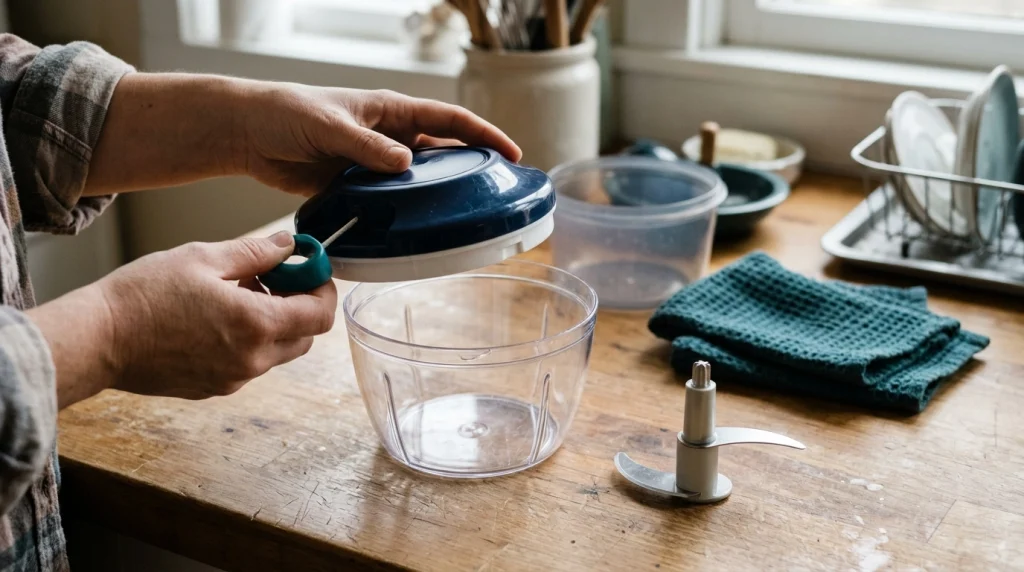
Most standard designs include these main components:
- Container: Holds the food while the blades rotate.
- Lid: Covers the container and houses the pulling mechanism.
- Pull cord and handle: Let you supply the force needed to turn the mechanism.
- Internal rotor or gear assembly: Transfers the cord’s movement into rotation.
- Blade spindle: Connects the rotating mechanism to the cutting blades.
- Blades: Cut the ingredients into smaller pieces.
- Return mechanism: Retracts the cord after a pull, readying the mechanism for another cycle.
Not every model uses the same internal parts. Some rely on a direct cord-and-rotor arrangement, while others use gears or a spring-assisted return system.
How Does a Pull String Chopper Work Step by Step?
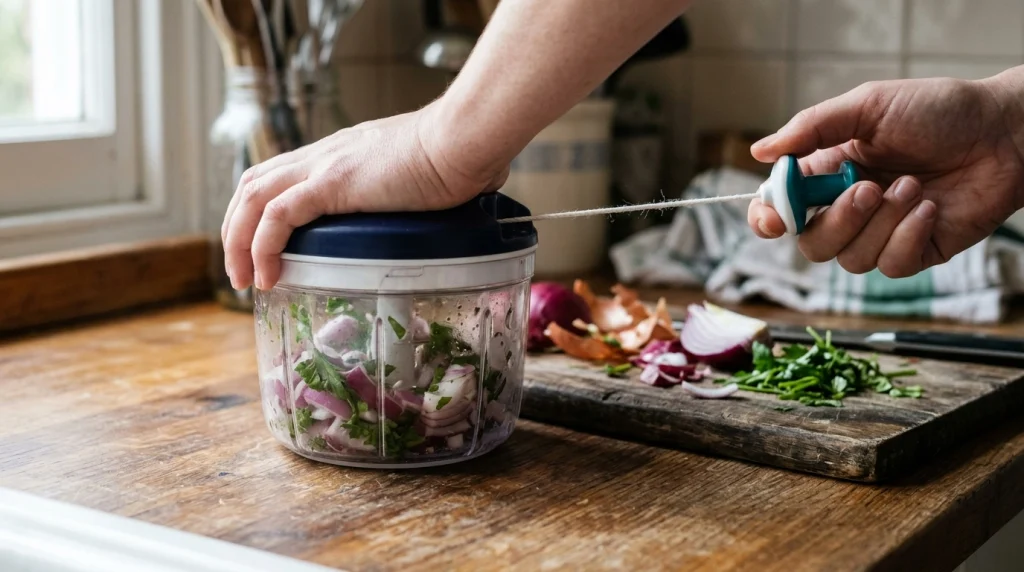
The chopper converts your hand movement into rotational energy, then uses that rotation to move the blades through the food. The basic process is similar across many models, although the internal mechanism can differ.
- Food enters the container. You place suitable, manageable pieces of vegetables or other ingredients around the blade assembly.
- The lid locks into position. The lid keeps the cutting mechanism enclosed and supports the drive assembly.
- You pull the handle outward. The cord unwinds from its internal spool or engages the drive mechanism.
- The rotor begins to spin. The cord’s movement turns a rotor, directly or through gears, depending on the design.
- The blades rotate. The blade spindle carries the blades through the ingredients, cutting them into smaller pieces.
- The cord retracts. A return mechanism draws the cord back into the lid, allowing another pull.
- You check the food. After the blades stop, you open the lid and inspect the texture before continuing.
One important detail: the blades don’t usually cut the food in the same way a stationary knife does. They move rapidly through the container, and repeated rotations expose different parts of the ingredients to the cutting edges.
That’s why a few pulls may leave chunky onion pieces, while additional pulls can create a much finer texture. The exact result depends on the ingredients, blade layout, container loading, and how consistently you pull.
What Happens Inside the Chopper When You Pull the String?
The cord mechanism is the part that makes this tool different from a conventional knife or push-down chopper. It transfers a straight pulling motion into the circular movement required to spin the blades.
1. The cord transfers your pulling force
When you pull the handle, you apply force to a cord connected to an internal spool or drive component. The cord unwinds and causes that component to rotate.
The harder you pull, the more quickly the mechanism may accelerate, but force alone doesn’t guarantee better chopping. A smooth, controlled pull is generally more useful than a sudden jerk that strains the cord or handle.
2. The rotor or gears transmit the motion
The rotor transfers the cord’s rotation to the blade assembly. Some designs use gears to change how the movement reaches the spindle, while simpler designs may use a more direct arrangement.
Gear ratios and internal layouts vary, so you shouldn’t assume every pull produces the same number of blade rotations. Manufacturers don’t always publish those mechanical details.
3. The blades cut the ingredients
As the spindle rotates, the blades sweep through the food. Their sharp edges slice the ingredients whenever they encounter them, gradually reducing larger pieces into smaller ones.
Ingredient placement matters. An overloaded container can restrict movement, while large, hard pieces may prevent the blades from turning freely.
4. The return system resets the cord
After you release the handle, a return mechanism draws the cord back toward the lid. Depending on the model, this may involve a spring or another internal arrangement.
The return action prepares the mechanism for another pull. Never force a cord that doesn’t retract normally, because the problem may involve tangled cord, a damaged return component, or a jammed drive assembly.
How Many Times Should You Pull the String?
The number of pulls depends on the texture you want, the ingredient, and your chopper’s design. There isn’t one universal pull count that works for every recipe.
Use this table as a starting point, then inspect the food and adjust as needed.
| Pulls | Likely result | Possible use |
|---|---|---|
| 1–3 | Lightly chopped, uneven pieces may remain | A coarse starting chop |
| 4–6 | Often a coarse to medium chop | Chunky onion or vegetable mixtures |
| 7–12 | Potentially finer, more uniform pieces | Salsa ingredients or finely chopped aromatics |
| 13 or more | Very fine chopping or a paste-like mixture may develop | Garlic, ginger, or soft ingredients when appropriate |
These ranges are illustrative, not guaranteed performance specifications. Start with a few pulls and check the food before continuing.
For example, when preparing onion for a chunky salsa, I’d stop as soon as the pieces reach the desired size. Continuing to pull can release more juice and turn the mixture mushy.
Which Foods Work Best in a Pull String Chopper?
Pull string choppers work best with ingredients that fit comfortably inside the container and yield to the blades without excessive force. Always check the manufacturer’s instructions because blade strength and container capacity vary.
| Ingredient | Suitability | Preparation tip |
|---|---|---|
| Onion | Generally suitable | Peel and cut into smaller sections. |
| Garlic | Generally suitable | Remove the papery skin first. |
| Fresh herbs | Usually suitable | Use clean, drained leaves and small batches. |
| Tomato | Suitable with care | Use controlled pulls to avoid a watery mixture. |
| Carrot | Model-dependent | Cut into small chunks and avoid forcing the cord. |
| Nuts | Model-dependent | Use only if the instructions permit them. |
| Ice or frozen food | Avoid unless explicitly approved | Hard ingredients can damage the blades or drive mechanism. |
For firm vegetables, preparation makes a difference. Smaller pieces allow the blades to move through the food more easily than oversized chunks.
Soft, juicy ingredients need a lighter touch. Stop frequently to check consistency, especially when preparing salsa, tomato mixtures, or other foods that can quickly become watery.
Pull String Chopper vs. Electric Food Chopper: Which Is Better?
A pull string chopper offers manual control and doesn’t need a power outlet. An electric chopper uses a motor, making it a more convenient option for some larger or more demanding preparation jobs.
| Feature | Pull string | Electric |
|---|---|---|
| Power source | Your hand | Electricity or a rechargeable battery |
| Control | Adjust through individual pulls | Adjust through controls and processing time |
| Effort | Requires repeated hand movement | Requires less manual chopping effort |
| Cleaning | Usually a bowl, blade, and mechanism lid | Usually a bowl, blade, and motor unit |
| Best use | Small, everyday chopping tasks | Tasks suited to the motor’s capacity and attachments |
Neither option wins for every kitchen. A manual model is worth considering when you want a compact tool for small batches, while an electric model may suit frequent, larger-volume preparation.
Whichever you choose, don’t assume that a larger motor or a greater number of pulls automatically produces better results. Ingredient preparation, blade design, and stopping at the right texture matter too.
What Should You Check Before Buying a Pull String Chopper?
A good buying decision starts with the mechanism, not the marketing claims. Look for a model that suits your usual ingredients and feels practical to clean and store.
- Container capacity: Choose enough space for your normal batch without filling the bowl to the brim.
- Blade assembly: Check the blade material, attachment method, and whether the assembly can be removed safely.
- Cord action: Look for a handle and cord that move smoothly without obvious sticking.
- Lid fit: The lid should attach securely to the container during operation.
- Base stability: A stable base helps keep the container in place while you pull.
- Cleaning instructions: Confirm which parts can be washed or placed in a dishwasher.
- Replacement parts: Check whether the manufacturer or seller offers replacement blades, bowls, or lids.
As of 2026, manual pull-cord choppers remain a straightforward alternative to powered food-preparation appliances. Product designs and care instructions differ, so compare the specific model rather than relying on a generic feature list.
Recommended Pull String Choppers and Alternatives
If you’re ready to choose a chopper, I’d start by comparing a dedicated string model with a simple manual alternative and an electric option. The right choice depends on how much you prepare and which ingredients you chop most often.
🏆 BEST FOR MANUAL CHOPPING
Wonderchef Classic String Chopper
A dedicated string-operated design for chopping suitable fruits and vegetables. I’d compare its cord mechanism, container capacity, blade arrangement, and cleaning requirements before choosing it for regular meal preparation.
💰 BEST FOR SIMPLE PREP
Manual Pull-Cord Vegetable Chopper
A basic manual model can suit small batches of onion, garlic, herbs, and other compatible ingredients. I’d prioritize a secure lid, stable bowl, and easily removable blade over extra accessories.
⚡ BEST FOR POWERED PREP
Electric Food Chopper
An electric chopper may be more convenient if you regularly prepare larger batches or prefer not to pull a cord repeatedly. I’d compare capacity, motor instructions, cleaning requirements, and available safety features before buying.
These are options to compare, not hands-on product-test winners. Check the current listing for exact specifications, included parts, compatibility, and seller information before ordering.
Frequently Asked Questions
1. How does a pull string chopper spin its blades?
Pulling the cord turns an internal spool or drive component, which transfers rotation to the blade spindle. The spindle carries the blades through the ingredients, cutting them into smaller pieces. A return mechanism retracts the cord so you can repeat the process.
2. How many pulls does it take to chop an onion?
The number depends on the onion pieces, bowl capacity, blade design, and desired texture. Start with a few controlled pulls, inspect the onion, and continue if needed. More pulls generally create smaller pieces, but they can also make juicy ingredients mushy.
3. Why does my pull string chopper stop working?
A jammed blade, overloaded container, damaged cord, or faulty return mechanism may prevent normal operation. Stop pulling, open the lid only after the blades stop moving, and check for obstructions. Never force a stuck cord or use a chopper with damaged parts.
4. Can I wash the pull string chopper lid?
Cleaning instructions depend on the model. Unless the manufacturer confirms that the mechanism lid is washable or water-safe, wipe it with a damp cloth instead of immersing it. Wash removable food-contact parts separately and dry everything thoroughly before storage.
5. Is a pull string chopper better than an electric chopper?
A pull string model suits small batches and kitchens where manual operation is preferred. An electric chopper may be more convenient for larger workloads or users who want to reduce repetitive hand movement. Compare capacity, cleaning needs, and permitted ingredients before deciding.
Final Takeaway
A pull string chopper works by turning a simple pulling action into blade rotation. Once you understand the cord, rotor, return mechanism, and blade assembly, it’s easier to use the tool effectively and recognize common problems.
For the best results, prepare ingredients in manageable pieces, avoid overfilling the bowl, pull smoothly, and check the texture frequently. Handle the blades carefully and follow the manufacturer’s cleaning instructions to keep your chopper in good condition.
For further guidance on kitchen tools and everyday food preparation, explore the Recipes Palette kitchen guides.
Affiliate disclosure: This article contains affiliate links. If you purchase through them, Recipes Palette may earn a commission at no additional cost to you.