
How Does a Pull Cord Vegetable Chopper Work?

Quick Answer
A pull cord vegetable chopper works by converting a hand-powered pull into rotational movement that spins sharp blades inside a covered bowl. Pulling the handle drives an internal reel and gear mechanism, while a return spring retracts the cord when you release it. Each pull makes the blades cut the ingredients again, so repeated pulls produce progressively finer pieces.
How to use one correctly
- Prepare ingredients: Wash vegetables and cut oversized or hard pieces into smaller chunks.
- Fill the bowl: Add a manageable quantity without exceeding the manufacturer’s fill limit.
- Secure the lid: Check that the blade assembly and lid fit correctly.
- Pull the handle: Use controlled, even strokes to rotate the blades.
- Check the texture: Stop and inspect the food between pulls until it reaches the desired consistency.
- Clean safely: Remove food with a suitable utensil and handle the sharp blades carefully.
One useful tip
- Use fewer pulls for coarse chopping and more for finer results, checking frequently to avoid turning vegetables into a paste.
Chopping onions, garlic, carrots, and herbs doesn’t have to mean standing over a cutting board with a knife. A pull cord vegetable chopper offers a simple, hand-powered way to speed up small kitchen preparation tasks.
In this guide, I’ll explain the mechanism, show how the individual parts work together, and compare pull cord choppers with other manual options. I’ll also cover common problems, safe cleaning, and what to consider before buying one.
What Is a Pull Cord Vegetable Chopper?
A pull cord vegetable chopper is a manual kitchen tool that uses a retractable cord to spin blades inside a container. It needs no electricity or batteries, making it useful for everyday food preparation in kitchens of different sizes.
Unlike a traditional knife, which depends on individual cutting movements, this chopper rotates several blades through the ingredients with each pull. The enclosed bowl keeps most chopped food together while you work.
Most models have a bowl, a lid with a pull handle, a cord-and-reel mechanism, and a removable blade assembly. Designs vary, so the number of blades, bowl capacity, and internal drive components depend on the model.
How Does a Pull Cord Vegetable Chopper Work Mechanically?
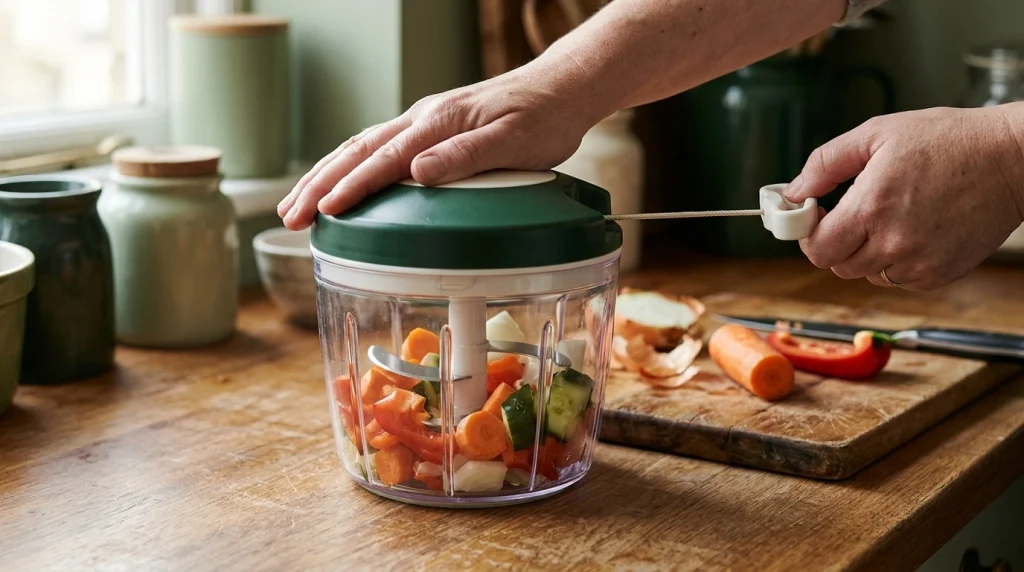
The chopper converts a straight pulling motion into rotational energy. An internal reel and drive mechanism transfer that motion to a central shaft, which turns the blades inside the bowl.
Here’s the basic sequence: pulling the cord rotates the drive components, the blade assembly spins, and the cutting edges pass through the food. A spring-assisted return mechanism then rewinds the cord, preparing it for another pull.
1. The Pull Cord Transfers Your Effort
The handle attaches to a cord wound around an internal reel. When you pull the handle outward, the cord unwinds and turns the reel.
That movement supplies the mechanical input needed to rotate the blades. You provide the power with your hand rather than an electric motor.
2. The Internal Drive Turns the Blade Shaft
Inside the lid, gears, a ratchet-style mechanism, or another drive arrangement transfers reel movement to the blade shaft. The exact design varies between manufacturers.
Some mechanisms also use a one-way drive so the shaft receives useful rotation during the pulling stroke without simply reversing whenever the cord returns. This helps convert repeated pulls into effective chopping action.
3. The Blades Cut the Ingredients
The shaft connects to a central spindle or blade holder. As it rotates, the sharp cutting edges move through the vegetables and divide them into smaller pieces.
Multiple blades can pass through different levels of the bowl, depending on the design. This helps process more of the contents than a single cutting edge might reach in one rotation.
4. The Return Spring Resets the Cord
A spring inside the lid stores energy as the cord extends. When you release the handle, the spring helps rewind the cord around the reel.
The reset prepares the mechanism for the next stroke. On a typical self-retracting model, you don’t need to wind the cord manually.
5. Repeated Pulls Control the Final Texture
Each pull gives the blades another opportunity to cut the ingredients. A few strokes may leave larger chunks, while additional strokes generally create smaller pieces.
There’s no universal pull count for a particular texture. Ingredient hardness, moisture, quantity, blade arrangement, and pulling speed all affect the result.
What Are the Main Parts of a Pull Cord Chopper?
Knowing the parts makes the tool easier to operate and troubleshoot. Most of the mechanism sits inside the lid, while the bowl and blade assembly handle the food.
| Part | What It Does | What to Check |
|---|---|---|
| Pull handle | Provides a grip for pulling the cord. | Cracks, looseness, or an uncomfortable grip. |
| Cord | Transfers your pulling force to the reel. | Fraying, kinks, or failure to retract. |
| Reel and spring | Unwinds during a pull and rewinds the cord. | Unusual resistance or inconsistent return. |
| Drive mechanism | Transfers motion to the blade shaft. | Slipping, grinding, or a lack of blade movement. |
| Blade assembly | Cuts food as it rotates. | Damage, incorrect seating, or food buildup. |
| Bowl and lid | Contain food and keep the mechanism covered. | Cracks, damaged locks, or an insecure fit. |
These parts work as a system, so a problem with one component can affect the entire chopper. For example, a tangled cord can prevent blade rotation even when the blades themselves remain in good condition.
How Do You Use a Pull Cord Vegetable Chopper Step by Step?
The simplest approach is to prepare the ingredients, load the bowl, secure the lid, and pull gradually until the food reaches the desired size. Always follow the instructions supplied with your particular model.
- Wash and prepare the vegetables. Remove dirt, peel ingredients when needed, and cut large or firm vegetables into manageable pieces.
- Position the blade assembly. Place it on its designated central fitting without touching the sharp edges.
- Add the ingredients. Distribute them around the bowl and stay within the stated capacity.
- Secure the lid. Check that the lid sits firmly and that the blade drive engages correctly.
- Stabilize the bowl. Place it on a flat, dry surface and hold it securely if the instructions recommend doing so.
- Pull the handle. Use controlled strokes rather than jerking the cord or forcing it against resistance.
- Inspect the result. Stop, open the unit safely, and check the texture before deciding whether another pull is necessary.
- Empty and clean the chopper. Keep fingers away from the blade edges when removing chopped food.
For example, when preparing onions for salsa, start with a small batch and use a few controlled pulls. Check the texture before continuing, because extra strokes can turn diced onion into a wet, uneven mixture.
Important: Never pull the cord while the lid is loose or the blade assembly is incorrectly positioned. Stop using the tool if the cord jams, the bowl cracks, or the lid no longer locks securely.
Which Vegetables Work Best in a Pull Cord Chopper?
A pull cord chopper works well for many everyday ingredients, especially onions, garlic, bell peppers, fresh herbs, and other vegetables that fit comfortably inside its bowl. Results depend on the model, blade design, and how you prepare the food.
For general produce preparation, the following categories provide a practical guide rather than a guarantee for every chopper.
| Ingredient | Expected Suitability | Preparation Tip |
|---|---|---|
| Onions | Excellent for most suitable models | Peel and cut into smaller sections. |
| Garlic | Well suited to small batches | Remove the papery skin first. |
| Bell peppers | Generally suitable | Remove seeds and cut into chunks. |
| Fresh herbs | Suitable with careful pulsing | Use short batches to avoid overprocessing. |
| Carrots | Depends on blade strength and preparation | Cut into thin slices or small pieces. |
| Sweet potatoes and beets | Potentially difficult for small models | Check the manual and never force the cord. |
| Large or frozen hard pieces | Avoid unless expressly permitted | Follow the manufacturer’s restrictions. |
One useful distinction is that a vegetable’s hardness matters as much as its size. A small carrot piece can still resist the blades more than a similarly sized piece of ripe tomato.
As of 2026, manufacturer instructions remain the best guide to a specific model’s limits. For example, the Starfrit Pull Chopper product information describes a three-blade system, while its user manual provides preparation guidance for denser vegetables.
How Many Times Should You Pull the Cord?
The number of pulls depends on the food and the texture you want. Rather than following a universal count, start with a few strokes and check the results frequently.
Some manufacturers provide model-specific ranges that help users understand how pull count affects texture. Starfrit, for example, gives the following guidance for its 900 mL Pull Chopper.
| Pulls | Manufacturer’s Suggested Result |
|---|---|
| 5–6 | Coarse cut |
| 7–12 | Medium to fine cut |
| 13–20 | Very fine chop or purée |
These figures apply to that particular model’s guidance, not every pull cord chopper or every ingredient. Always check the instructions for your own unit.
My practical recommendation is to check the contents before adding more pulls. That’s especially important with tomatoes, herbs, and other moist ingredients that can quickly become mushy.
Pull Cord vs. Push-Down vs. Electric Vegetable Choppers
All three styles reduce manual knife work, but they use different mechanisms and suit different cooking routines. A pull cord model offers hand-powered blade rotation, while a push-down model uses downward pressure and an electric chopper uses a motor.
| Feature | Pull Cord | Push-Down | Electric |
|---|---|---|---|
| Power source | Hand pull | Hand pressure | Electricity or battery |
| Blade movement | Rotational | Depends on design | Motor-driven rotation |
| Control over texture | Adjust by pull count | Adjust by strokes or pressure | Adjust by operating time or settings |
| Main consideration | Cord and spring maintenance | Repeated downward effort | Power, storage, and motor cleaning restrictions |
| Best fit | Small manual batches | Simple, direct chopping tasks | Frequent or larger preparation tasks, depending on capacity |
Choose a pull cord chopper if you want a compact tool without a power connection. Consider an electric model if your usual cooking involves larger quantities or you prefer not to provide the chopping force yourself.
For general food hygiene, FoodSafety.gov’s food safety guidance also recommends washing utensils and food-contact surfaces after use.
Why Is My Pull Cord Vegetable Chopper Not Working?
When a pull cord chopper stops working properly, the cause may be a jammed blade assembly, a tangled cord, an improperly fitted lid, or a worn internal mechanism. Check the simple possibilities before assuming the chopper needs replacing.
- The cord won’t retract: Stop pulling and inspect the cord for visible damage or tangles; don’t force the handle back into place.
- The blades won’t spin: Check that the blade assembly and lid engage correctly, and remove any food obstruction only after opening the unit safely.
- The cord feels unusually stiff: Reduce the food quantity and check whether oversized or dense pieces are blocking the blades.
- The blades spin but chop poorly: Check for dull or damaged edges, incorrect blade placement, and ingredients that need smaller pieces.
- The lid or bowl moves during use: Stop immediately and inspect the locking features and non-slip base.
Never open the lid mechanism to reach the spring unless the manufacturer explicitly permits user servicing. A spring-loaded assembly can release suddenly, and damaged internal parts may make the tool unsafe.
If the cord is frayed, the lid is cracked, or the drive mechanism repeatedly slips, contact the manufacturer or replace the unit rather than continuing to use it.
How Do You Clean and Maintain a Pull Cord Chopper?
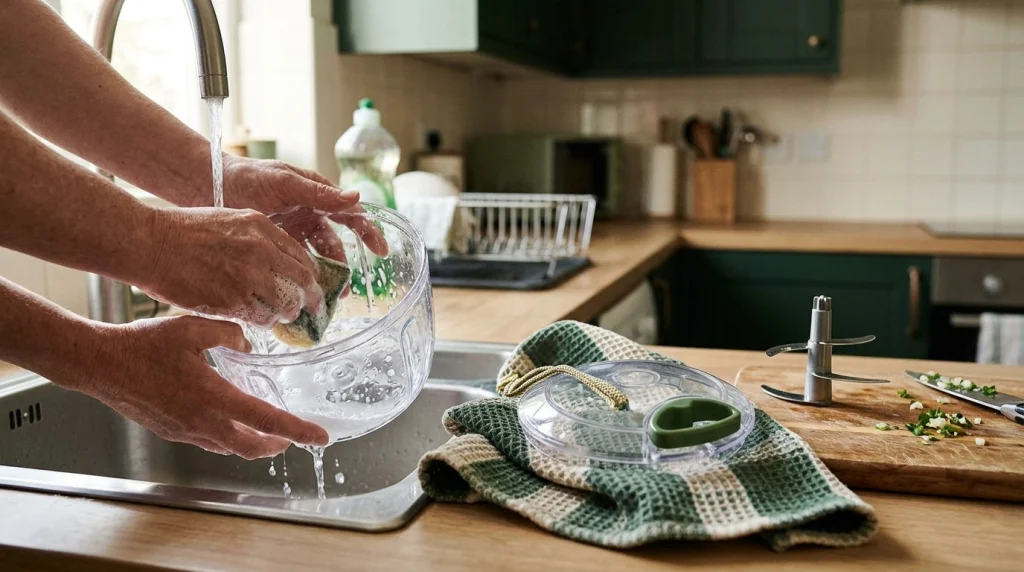
Cleaning promptly prevents food residue from drying around the blades and central shaft. The bowl and blade assembly often detach for washing, but the lid may contain a mechanism that needs different care.
- Separate the food-contact parts: Remove the bowl and blade assembly according to the instructions.
- Wash the bowl and blades: Use the recommended washing method and a suitable brush to clean around cutting edges.
- Clean the lid carefully: Wipe it or wash it only as permitted by the manufacturer.
- Remove trapped residue: Check around the center post and blade holder without placing fingers against the cutting edges.
- Dry every component: Let parts dry thoroughly before reassembly and storage.
- Store safely: Keep blades protected and the cord free from tension or tangles.
Don’t assume the entire lid is dishwasher-safe just because the bowl is. Water can enter some pull mechanisms and affect the spring or internal drive parts.
For instance, Starfrit recommends handwashing the lid of its Pull Chopper while allowing its other components to be washed in the dishwasher. Always follow your own model’s care instructions.
Regular maintenance is simple: clean after use, avoid forcing the cord, and inspect the moving parts for visible damage. Those habits help preserve the mechanism and keep food preparation safer.
Which Pull Cord Vegetable Chopper Should You Choose?
If you’re ready to buy one, compare the blade arrangement, bowl capacity, cord mechanism, and cleaning requirements before focusing on appearance or price. These three options represent different approaches to everyday food preparation.
🏆 Best for Pull-Cord Operation
Starfrit Pull Chopper, 900 mL
★★★★☆
Features a 900 mL bowl, three blades, and a self-retracting cord. Its manufacturer provides model-specific guidance for coarse chopping through puréeing, making it a useful reference when comparing pull-operated designs.
💰 Alternative Manual Design
OXO Good Grips Vegetable Chopper
★★★★☆
This push-operated chopper uses a different mechanism from a pull-cord model. Compare it if you prefer direct downward chopping action for onions and other everyday ingredients.
🔄 Alternative Pull Design
Zyliss Easy Pull Food Processor
★★★★☆
This manual food processor offers a pull-operated approach to food preparation. Check the current model’s capacity, included attachments, and cleaning instructions before deciding whether it fits your kitchen routine.
Selection note: These are editorial comparisons based on product type and stated features, not hands-on test results or verified customer-rating averages. Check current listings for availability, included components, and exact model specifications.
Frequently Asked Questions
Does a pull cord vegetable chopper need electricity?
No. A conventional pull cord vegetable chopper uses your pulling force to rotate the internal blades. Its cord, reel, and drive mechanism convert hand movement into chopping action, so it doesn’t need an electrical outlet or batteries.
Why does pulling the cord make the blades spin?
The cord unwinds from a reel inside the lid, turning the reel as you pull. An internal drive transfers that movement to the blade shaft, while a return spring rewinds the cord after release. Repeated pulls create additional blade rotations.
Can a pull cord chopper cut carrots and other hard vegetables?
Many models can handle carrots when you cut them into small, thin pieces first. Dense vegetables may require more effort and can strain smaller mechanisms. Check your manufacturer’s approved ingredient list, and never force the cord when the blades encounter resistance.
How do I get evenly chopped vegetables?
Cut ingredients into similarly sized pieces before loading the bowl, avoid overfilling, and use controlled pulls. Stop regularly to inspect the texture. Since ingredients move differently inside the bowl, a pull chopper may not produce perfectly uniform cubes like a dedicated dicing tool.
Can I wash the entire pull cord vegetable chopper in the dishwasher?
Not necessarily. Many bowls and removable blade assemblies are dishwasher-safe, but the lid may contain a spring, reel, or other mechanism that needs wiping instead. Follow the specific manufacturer’s cleaning instructions and dry all washed components before reassembly.
Final Takeaway: How Does a Pull Cord Vegetable Chopper Work?
A pull cord vegetable chopper works by turning your hand’s pulling motion into rotation that drives sharp blades through food. The internal reel and drive mechanism power the chopping action, while a spring-assisted system resets the cord for another stroke.
For the best results, prepare ingredients properly, work in manageable batches, and check the texture as you go. A pull chopper can simplify everyday chopping, but its capacity and ingredient limits matter just as much as the mechanism.
If you’re choosing a model, start with the manufacturer’s instructions, compare its blade and bowl design, and confirm that its cleaning requirements suit your routine. A well-matched manual chopper can be a practical addition to an everyday kitchen.
Affiliate disclosure: This article contains Amazon affiliate links. RecipesPalette may earn a commission from qualifying purchases at no additional cost to you.