
What Is the Largest Dish Drying Rack? Size Guide for 2026

Quick Answer
There is no official single largest dish drying rack because racks are sold in several designs. As of 2026, large expandable countertop racks can reach about 26 to 27 inches long, while extra-large over-the-sink racks can expand to about 35.5 inches long.
Typical Extra-Large Sizes
- Countertop rack: Large expandable models may reach roughly 26–27 inches long.
- Two-tier rack: Large models commonly measure around 18–23 inches wide but add vertical drying space.
- Over-sink rack: Expandable versions can reach roughly 35.5 inches across the sink.
- Best for families: Choose capacity and usable compartments instead of dimensions alone.
- Before buying: Measure counter depth, sink width, faucet height, and cabinet clearance.
My Simple Rule
- If maximum capacity matters most, I would compare a 26-inch expandable countertop rack with a 35-inch over-sink system.
If you wash several plates, bowls, pans, cups, and utensils by hand every day, a standard dish rack can feel full almost immediately.
I look at usable drying space rather than trusting words such as “large” or “extra large.” Manufacturers use those labels differently.
- Need maximum horizontal room? Look at expandable racks.
- Need more capacity on a smaller counter? Consider two tiers.
- Want the counter left open? An over-the-sink rack usually gives you the most total storage.
What Is the Largest Dish Drying Rack?
The largest practical home dish racks are usually expandable over-the-sink systems. Some current models adjust from about 24 inches to 35.5 inches long.
That makes them noticeably larger than most traditional countertop racks. However, size alone does not tell you how many dishes they hold.
Definition: An extra-large dish drying rack is a rack designed to hold more dishes than a standard countertop drainer through added length, width, tiers, expandable sections, or over-the-sink storage.
For example, an ADBIU over-the-sink rack currently sold in an adjustable 24–35.5-inch length offers far more horizontal span than a conventional rack.
A large Kitsure countertop model expands from about 19.2 to 26.7 inches long. That is substantial without requiring a structure over the sink.
How Big Is an Extra-Large Dish Drying Rack?
An extra-large rack usually starts becoming meaningfully different once its usable length reaches about 20 inches. Expandable designs can stretch several inches farther when needed.
Two-tier racks may look smaller from above. Their second level increases actual drying capacity without using another 10 inches of counter.
| Current Example | Approximate Size | Design | Best Fit |
|---|---|---|---|
| ADBIU Over-the-Sink Rack | 24–35.5″ L × 12″ W × 19–22″ H | Expandable, 2-tier | Maximum overall capacity |
| Kitsure Large Extendable Rack | 19.2–26.7″ L × 12.9″ W | Expandable countertop | Large counter with flexible capacity |
| SUNLY 2-Tier Rack | 22.48″ W × 12.6″ D × 15.16″ H | Two-tier countertop | Large families needing vertical storage |
| Joseph Joseph Excel | 18.32″ W × 12.4″ D × 12.6″ H | Two-tier countertop | High capacity in a smaller footprint |
These measurements show why I do not judge capacity from width alone. A narrower two-level rack can outperform a wider single-level rack when drying plates, glasses, and bowls together.
Is an Over-the-Sink Rack Larger Than a Countertop Rack?
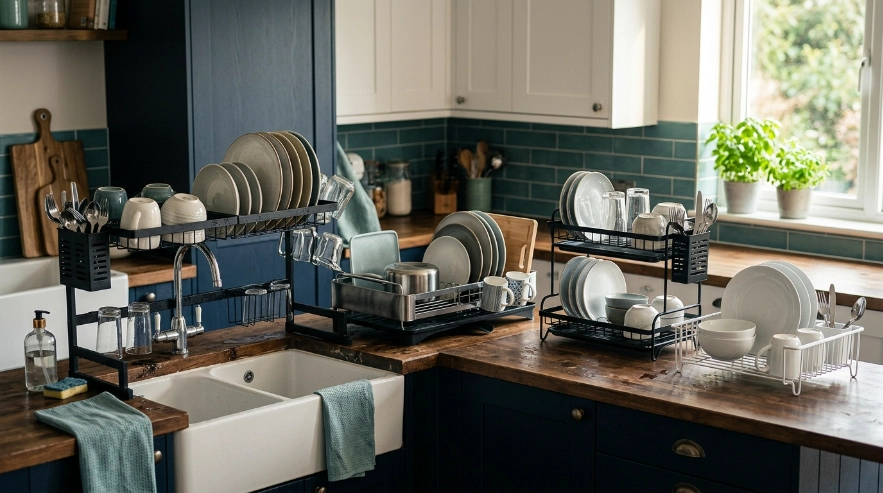
Usually, yes. Over-the-sink racks have more room to expand because they use the space above the sink instead of staying inside a small countertop footprint.
They can also drain directly into the sink. That eliminates the need for a large drainboard underneath.
- More usable space: Full-width frames can cross most of the sink area.
- Less counter loss: Plates and bowls sit above the sink instead of beside it.
- More compartments: Many include separate baskets for plates, bowls, utensils, glasses, and cutting boards.
- Direct drainage: Water falls into the sink rather than collecting on a tray.
The downside is installation space. Faucets, wall cabinets, windows, and low shelves can prevent a large over-sink rack from fitting.
I would never order one from the advertised sink-width range alone. Faucet and cabinet clearance matter just as much.
Are Two-Tier Dish Racks Better for Large Families?
A two-tier rack is often the better choice when you need more capacity without covering the whole counter. It creates a second drying level above the first.
This works well when your normal wash includes plates, bowls, mugs, glasses, and food-storage containers at the same time.
- Upper tier: Plates, saucers, lids, or shallow bowls.
- Lower tier: Larger bowls, cups, pans, or containers.
- Side holders: Utensils, mugs, cutting boards, or glasses.
The Joseph Joseph Excel is a good example. Its footprint is only about 18.3 inches wide, yet its two levels create substantially more organized drying room.
The SUNLY design is wider at roughly 22.5 inches. That can suit a household that regularly washes cookware along with dinnerware.
How Much Dish Capacity Do You Really Need?
The biggest rack is not automatically the best rack. A rack that blocks your prep space or cabinet doors quickly becomes annoying.
I prefer to estimate capacity from one normal washing session. That gives a more useful answer than counting household members alone.
- Light use: A few plates, cups, bowls, and utensils usually fit a standard rack.
- Moderate use: One-tier expandable models provide more room when needed.
- Heavy daily use: A large two-tier design is easier to organize.
- Very heavy use: An over-the-sink system can handle mixed cookware and dinnerware while preserving counter space.
A family of four that uses a dishwasher may need less drying space than two people who hand-wash every pan and cooking tool.
Your washing habits matter more than the household number.
What Should You Measure Before Buying the Largest Rack?
Measure the kitchen before comparing capacities. An extra-large rack only helps when every part of it fits comfortably.
I check six measurements before choosing one.
- Available counter length: Measure from the sink edge to the next appliance, wall, or prep area.
- Counter depth: Make sure the rack does not hang over the front edge.
- Sink width: This is critical for over-the-sink models.
- Faucet height: Tall faucets need enough open space inside the frame.
- Cabinet clearance: Two-tier racks can interfere with low upper cabinets.
- Drain direction: Check whether the spout can actually reach the sink.
Leave a little extra room rather than choosing a rack that technically fits to the nearest fraction of an inch. Dishes often extend beyond the frame itself.
What Features Matter More Than Maximum Size?
Capacity is useful only when the rack remains stable, drains correctly, and separates dishes well. I would choose a slightly smaller well-designed rack over a huge unstable one.
These are the features I prioritize.
- Drainage system: Look for a sloped tray or adjustable spout that sends water toward the sink.
- Rust resistance: Stainless steel or well-coated metal generally makes sense around constant moisture.
- Stable feet: Non-slip feet reduce movement when the rack is heavily loaded.
- Plate spacing: Slots should keep dishes upright without forcing them together.
- Removable holders: Adjustable cup and utensil sections make a large rack easier to customize.
- Easy cleaning: Removable trays and baskets make buildup easier to reach.
A large rack with poor drainage may simply create a larger wet area. That defeats much of the point.
How Do You Keep a Large Dish Drying Rack Sanitary?
Large racks still need regular cleaning because water, food residue, soap film, and mineral deposits can collect around trays and joints.
The CDC recommends thorough air drying for cleaned items rather than rubbing them dry with a used towel.
- Empty it fully: Remove dishes before cleaning the rack.
- Wash removable parts: Use warm water and dish soap where the manufacturer allows it.
- Scrub corners: Pay attention to utensil cups, drain channels, joints, and feet.
- Rinse well: Remove remaining cleaner and loosened debris.
- Let it dry: Reassemble only after the parts are dry.
The FDA advises washing dishes, utensils, and kitchen surfaces with hot, soapy water as part of normal kitchen hygiene.
USDA food-safety guidance also stresses keeping food-contact items and kitchen surfaces clean. I apply the same habit to the rack that holds freshly washed dishes.
Which Large Dish Rack Type Should You Choose?
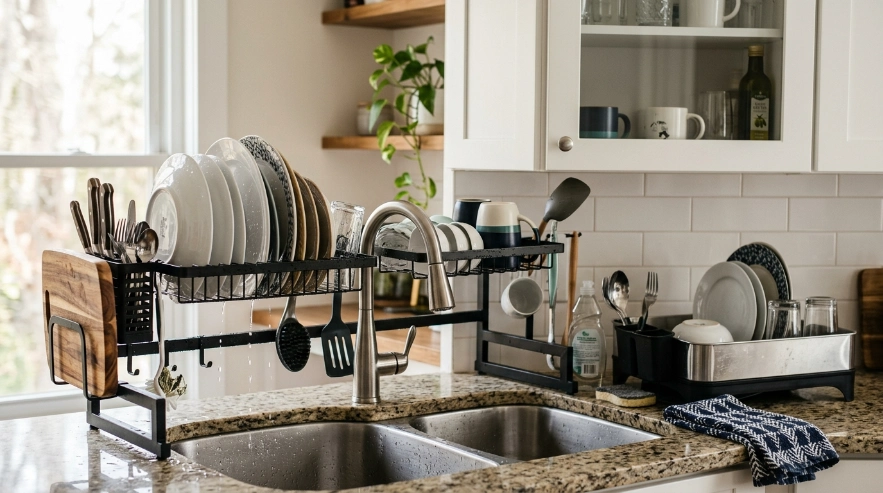
Choose the design that solves your specific space problem. The physical largest option is not always the most useful one.
| Your Priority | Best Rack Type | Why |
|---|---|---|
| Maximum possible capacity | Over-the-sink | Uses horizontal and vertical sink space |
| Expandable capacity | Extendable countertop | Expands only when extra room is needed |
| Small footprint, high capacity | Two-tier | Adds vertical storage |
| Occasional hand washing | Standard single-tier | Simpler and easier to store |
If you are ready to choose one, these are the types I would shortlist first.
🏆 BEST FOR MAXIMUM CAPACITY
ADBIU Over-the-Sink Dish Drying Rack
★★★★½ 4.5/5
The frame expands from roughly 24 to 35.5 inches and adjusts from about 19 to 22 inches high. I like this format when preserving counter space matters as much as raw dish capacity.
📏 BEST EXPANDABLE COUNTERTOP
Kitsure Large Extendable Dish Drying Rack
★★★★½ 4.6/5
This rack expands from roughly 19.2 to 26.7 inches long while staying about 12.9 inches wide. I would choose it when you want occasional extra capacity without installing a large structure over the sink.
🍷 BEST COMPACT TWO-TIER
Joseph Joseph Excel Steel 2-Tier Dish Rack
★★★★☆ 4.1/5
At about 18.3 inches wide, this two-tier rack focuses on vertical capacity and includes dedicated glassware space. I like it for kitchens where a 26-inch rack would consume too much worktop.
Retailer ratings and availability can change, so check the current listing before purchasing.
Frequently Asked Questions
What size is considered a large dish drying rack?
A countertop rack around 20 inches or longer generally falls into the large-capacity range. Expandable versions may extend to roughly 26 or 27 inches, while large over-the-sink racks can exceed 30 inches.
What is the biggest countertop dish drying rack?
There is no official single biggest countertop model. Among current mainstream examples, expandable countertop racks reaching about 26.7 inches long are significantly larger than the common 15-to-20-inch designs.
How large can an over-the-sink dish rack be?
Some adjustable home models expand to approximately 35.5 inches long and around 22 inches high. Always compare that measurement with your sink, faucet, cabinets, and available vertical clearance.
Is a two-tier rack better than an extra-wide rack?
A two-tier rack is usually better when counter space is limited because it adds drying capacity vertically. An extra-wide expandable rack is better when you have plenty of countertop room and frequently dry pans or other bulky items.
Can a dish rack be too large?
Yes. A rack is too large when it blocks food-preparation space, cabinet doors, the faucet, or comfortable access to the sink.
Final Takeaway
If you mean the largest overall home design, an expandable over-the-sink rack that reaches about 35.5 inches is among the biggest practical options available in 2026.
If you want a traditional countertop design, look toward expandable racks around 26 to 27 inches long or a large two-tier model. Measure first, then choose the layout that gives you the most usable drying space without taking over your kitchen.