
Pull Cord Chopper Cutting Consistency: How to Get Evenly Chopped Vegetables

Quick Answer
To improve pull cord chopper cutting consistency, cut vegetables into similarly sized pieces, distribute them around the blades, avoid overfilling the bowl, and pull the cord in controlled strokes. Check the texture after a few pulls and stop before softer ingredients turn mushy. For perfectly uniform cubes, a fixed-grid vegetable dicer is usually a better choice.
Five ways to get more consistent results
- Prepare evenly: Cut large vegetables into similarly sized chunks before loading the bowl.
- Control the quantity: Leave enough room for ingredients to move around the blades.
- Distribute ingredients: Avoid packing everything into one tight cluster.
- Pull steadily: Use smooth strokes instead of forcing the cord.
- Check early: Stop the mechanism and inspect the texture before continuing.
A pull cord vegetable chopper can make everyday food preparation easier, but getting evenly chopped vegetables takes a little technique. If your bowl contains large chunks, tiny fragments, and crushed pieces at the same time, the problem may come from how you prepare and load the ingredients.
In this guide, I’ll explain what affects chopping consistency, how to correct common problems, and when another type of vegetable chopper makes more sense. I’ll also cover practical ways to prepare onions, carrots, tomatoes, and other everyday ingredients.
What Is Pull Cord Chopper Cutting Consistency?
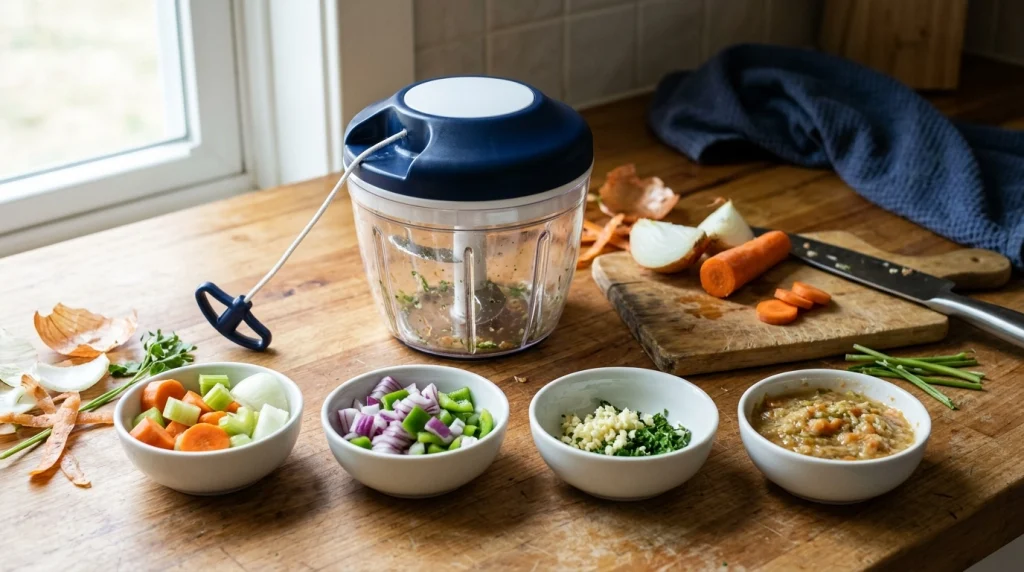
Pull cord chopper cutting consistency describes how evenly a manual, cord-operated chopper reduces food into pieces of a similar size and texture. It depends on ingredient preparation, blade design, bowl capacity, food texture, and the number of cord pulls.
Unlike a fixed-grid dicer, a pull cord chopper uses rotating blades that repeatedly cut and move ingredients around the bowl. The result is generally chopped or minced food rather than perfectly identical cubes.
- Coarse chopping: Larger pieces that retain their shape.
- Medium chopping: Smaller pieces suitable for many everyday cooking tasks.
- Fine chopping: Small pieces useful for garlic, herbs, and finely minced vegetables.
- Overprocessing: Food becomes too fine, wet, or paste-like for the intended recipe.
The ideal result depends on what you’re cooking. Salsa may benefit from a slightly chunky texture, while a finely minced garlic mixture needs much smaller pieces.
Why Does a Pull Cord Chopper Cut Vegetables Unevenly?
Uneven chopping usually happens when ingredients differ in size, the bowl is overloaded, or the blade cannot move them effectively. Food texture also matters because soft vegetables break down differently from firm ones.
1. The vegetables start at different sizes
A large carrot chunk and a small carrot piece won’t necessarily reach the same size after the same number of pulls. Smaller pieces may become tiny while larger pieces remain noticeably chunky.
Cut larger ingredients into manageable, similarly sized chunks before loading them. This gives the rotating blades a more consistent starting point.
2. The bowl contains too much food
Overfilling restricts ingredient movement and can make the cord harder to pull. Some pieces may repeatedly encounter the blades while others remain relatively untouched.
Try a smaller batch. Follow the fill guidance supplied with your model rather than relying on a universal fill percentage.
3. Ingredients are packed unevenly
When vegetables sit in one dense cluster, the blades may process some pieces more thoroughly than others. Spreading the ingredients around the blade assembly can help them move more freely.
Don’t push food down around the blades with your fingers. Arrange ingredients before closing the lid, then operate the chopper as directed.
4. You pull the cord too many times
Every additional pull gives the rotating blades another opportunity to cut the ingredients. Soft pieces may become very fine before firmer pieces reach the same texture.
Start with a few pulls, inspect the result, and continue only if necessary. There is no universal pull count because different choppers and ingredients behave differently.
5. The ingredients have different textures
Carrots, onions, tomatoes, and herbs don’t respond identically to a rotating blade. Firm vegetables can retain larger pieces while juicy or delicate ingredients become crushed or wet.
For a mixed batch, consider whether the recipe needs every ingredient at exactly the same size. If it does, processing similar ingredients separately may give you better control.
How Can You Get More Even Chopping From a Pull Cord Chopper?
The most reliable method is to prepare the food first, process a manageable batch, and check the texture between short rounds of chopping. This approach helps prevent large chunks and overprocessed pieces from appearing together.
- Wash and prepare the vegetables. Rinse fresh produce under running water and remove unwanted skins, stems, or damaged areas.
- Cut large vegetables into similar chunks. Quarter a large onion or divide a large carrot into manageable pieces, following your chopper’s instructions.
- Load a moderate quantity. Leave room for the ingredients to move around the blades.
- Position the ingredients evenly. Avoid creating one tightly packed mound on one side of the bowl.
- Secure the lid. Confirm that the lid and blade assembly are correctly fitted before pulling the cord.
- Pull smoothly. Use controlled strokes and allow the cord to retract as instructed by the manufacturer.
- Stop and inspect the result. Wait until the blades have stopped completely, then open the lid safely and check the texture.
- Repeat only if needed. Refit the lid correctly before continuing, and stop once the food reaches the desired size.
One useful habit is to judge the food rather than counting pulls alone. The same number of pulls can produce different results when you switch from carrots to tomatoes or change the batch size.
Practical tip
If your chopper has a transparent bowl, use it to monitor progress without opening the lid. When you need to inspect the food directly, stop the blades completely and follow the manufacturer’s safe-opening instructions.
How Many Pulls Give You a Consistent Chop?
There is no single correct number of pulls for every vegetable chopper. Blade configuration, bowl size, ingredient firmness, and the desired texture all affect the result.
Use the following table as a practical starting framework, not a guaranteed pull-count specification.
| Stage | What to do | What to check |
|---|---|---|
| Initial round | Make a few controlled pulls. | Are the large pieces breaking down? |
| Texture check | Stop and inspect the ingredients. | Are some pieces much larger than others? |
| Fine adjustment | Continue with a small number of pulls if needed. | Is the texture approaching the target? |
| Final check | Stop when the food reaches the desired texture. | Has the food become too fine or watery? |
As a practical example, imagine chopping onion for a curry. You want small, recognizable pieces rather than a wet onion paste, so inspect the first batch before making more pulls.
For a smooth dip, a finer result may be acceptable. The right stopping point depends on the recipe rather than a fixed number.
How Do Different Vegetables Affect Cutting Consistency?
Vegetable type plays a major role in the final texture. Firm, juicy, and leafy ingredients behave differently inside a rotating-blade chopper, so adjust your preparation and expectations accordingly.
| Ingredient | Common challenge | Helpful adjustment |
|---|---|---|
| Onion | Large chunks alongside finely minced pieces. | Quarter it and begin with a small batch. |
| Carrot | Firm chunks take more processing. | Cut into manageable pieces and check the texture between rounds. |
| Tomato | Juice and soft flesh can become mushy. | Use short rounds and stop early. |
| Bell pepper | Large curved sections may remain uneven. | Remove seeds and cut into manageable pieces. |
| Garlic | Small quantities may become overly fine quickly. | Use a suitable small batch and inspect early. |
| Fresh herbs | Delicate leaves can bruise or clump. | Drain excess water and use brief processing rounds. |
These adjustments help with common ingredients, but they don’t guarantee identical pieces. Always check the manufacturer’s guidance before chopping particularly hard foods or ingredients the product may not support.
Pull Cord Chopper vs. Push-Down Vegetable Dicer
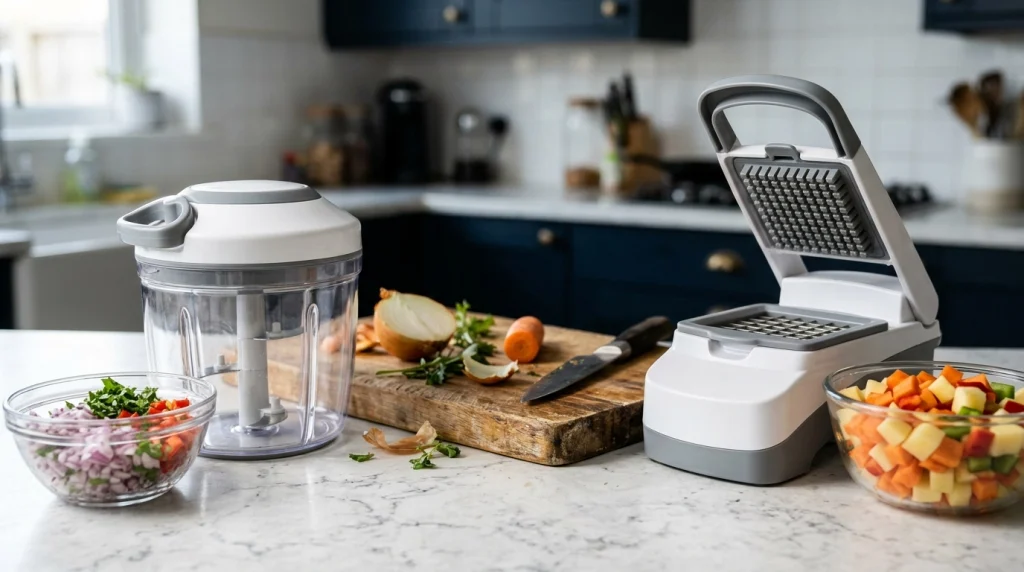
A pull cord chopper is generally better for adjustable chopping and mincing, while a push-down grid dicer is better suited to producing similarly shaped cubes. Choose according to the texture your recipes require.
| Feature | Pull cord chopper | Push-down dicer |
|---|---|---|
| Cutting action | Rotating blades | Fixed cutting grid |
| Texture control | Adjustable through processing | Determined largely by the grid |
| Piece shape | Often varied | More consistent when food fits the grid |
| Best use | Mincing onions, garlic, and herbs | Preparing evenly diced vegetables |
| Main limitation | Can overprocess softer ingredients | Ingredients must fit the cutting grid |
For curry bases, sauces, and minced aromatics, a pull cord chopper can be convenient. For potato cubes, evenly diced vegetables, or recipes where appearance matters, a suitable grid dicer or a sharp knife may give you more predictable shapes.
How Can You Fix Common Chopping Problems?
Before replacing your chopper, check whether the problem comes from the ingredients, loading method, or cutting technique. Small adjustments may improve the result without requiring a different appliance.
- Large pieces remain: Prepare smaller, more uniform chunks and process a manageable batch.
- Some pieces become mushy: Reduce the number of pulls and inspect the food sooner.
- The cord feels difficult to pull: Stop and check for overfilling, incorrect assembly, or an obstruction; never force the mechanism.
- Ingredients cling to the bowl: Stop the blades and follow the manual’s instructions for safely redistributing food.
- The results vary between batches: Keep the starting piece size and batch quantity similar.
- The blades appear damaged: Stop using the chopper and follow the manufacturer’s repair or replacement guidance.
Don’t attempt to redistribute ingredients while the blades are moving. Remove the lid only after the mechanism has stopped, and handle the sharp blade assembly carefully.
What Should You Look for in a Chopper That Cuts Consistently?
If you’re choosing a new vegetable chopper, focus on the design features that help you control texture and prepare food safely. A higher price alone doesn’t guarantee more consistent results.
- Blade arrangement: Look for a clearly described blade configuration suited to your intended ingredients.
- Useful bowl capacity: Choose a size that fits your typical batch without encouraging overfilling.
- Stable base: A secure, non-slip base can help keep the bowl steady during operation.
- Visible bowl: A transparent container makes it easier to monitor chopping progress.
- Clear instructions: Check the manual for recommended ingredients, operating limits, and cleaning methods.
- Easy maintenance: Confirm which parts can be washed and whether replacement parts are available.
As of 2026, the most useful buying decision remains matching the mechanism to your cooking needs rather than assuming every chopper can produce the same cut. Pull cord models prioritize convenience and adjustable texture, while grid-based models prioritize defined shapes.
How Should You Clean a Pull Cord Chopper?
Clean blades and food-contact surfaces help keep your chopper ready for the next batch. Follow the instructions for your exact model because the bowl, blades, and pull-cord lid may have different cleaning requirements.
- Remove the lid only after the blades have stopped completely.
- Lift out the blade assembly by its designated handle or stem, keeping fingers away from the cutting edges.
- Wash the bowl and removable food-contact parts according to the manual.
- Use a suitable brush rather than rubbing sharp blade edges with your fingers.
- Clean the pull-cord lid as directed; don’t submerge its mechanism unless the manufacturer explicitly permits it.
- Dry the parts thoroughly before reassembly or storage.
For broader food-preparation hygiene guidance, the FDA’s produce safety guidance explains how to wash fresh produce and handle food safely. The USDA’s cutting board guidance also covers cleaning preparation surfaces and preventing cross-contamination.
Product Recommendations: Which Chopper Should You Consider?
If you want better control over chopping consistency, start by deciding whether you need flexible mincing or more uniform diced pieces. The following established product lines offer different approaches, but check the current model details and instructions before buying.
BEST FOR ADJUSTABLE CHOPPING
Kuhn Rikon Pull Chop
This manual pull-cord design is intended for chopping vegetables, herbs, and other suitable ingredients. Consider it when you want to adjust texture by processing in short rounds rather than relying on a fixed cutting grid.
BEST FOR MANUAL FOOD PREP
Zyliss Easy Pull Food Chopper
This pull-operated chopper is another option for preparing ingredients without electricity. Check the available model’s capacity, blade configuration, and care instructions to determine whether it suits your usual batch sizes.
BEST FOR DEFINED CUBES
Fullstar Vegetable Chopper
Fullstar sells push-down vegetable choppers designed around cutting inserts. Consider a suitable model when uniform diced pieces matter more than adjustable mincing, and verify its included grid sizes before purchase.
These are options to investigate, not products I’ve personally tested for this article. I haven’t assigned star ratings because a reliable, comparable test of their cutting consistency isn’t available here.
Frequently Asked Questions
Why does my pull cord chopper leave some vegetables in large pieces?
Large pieces can remain when the starting chunks vary in size, the bowl is overloaded, or ingredients don’t circulate effectively around the blades. Cut the vegetables into similarly sized pieces, reduce the batch if needed, and check the texture after a few controlled pulls.
Does pulling the cord faster make chopping more consistent?
Not necessarily. Consistency depends more on preparation, ingredient movement, blade design, and how closely you monitor the texture. Use smooth, controlled strokes according to the manufacturer’s instructions rather than yanking the cord or trying to maximize speed.
How do I stop vegetables from becoming mushy?
Begin with fewer pulls and inspect the texture before continuing. Tomatoes, onions, and other moisture-rich ingredients can become very fine when processed repeatedly. If the food is already mushy, additional chopping won’t restore the original pieces.
Can a pull cord chopper produce perfectly uniform vegetable cubes?
Usually, a rotating-blade pull-cord chopper cannot guarantee perfectly identical cubes because it chops food from multiple directions. For consistent cube shapes, choose a suitable push-down dicer with a fixed cutting grid or use a knife and cutting board.
What should I do if the pull cord becomes difficult to operate?
Stop pulling and check for overfilling, incorrect assembly, or a visible obstruction after the blades have stopped. Never force the mechanism or dismantle a spring-loaded lid unless the manufacturer’s instructions permit it. Stop using the chopper if its cord, gears, or other parts appear damaged.
Final Takeaway
Better pull cord chopper cutting consistency starts before you pull the cord. Prepare similar-sized pieces, avoid overloading the bowl, distribute the ingredients, and inspect the texture before processing further.
For everyday onion, garlic, and herb preparation, a pull-cord model offers useful flexibility. If your priority is consistently shaped vegetable cubes, a grid-based dicer is often the more suitable tool.
Choose the method that fits your recipe, and let the food’s texture guide when you stop. A few careful checks can help you avoid both oversized chunks and an unwanted paste.
Affiliate disclosure: This article contains affiliate links. RecipesPalette may earn a commission from qualifying purchases made through these links, at no additional cost to you.