
Pull Cord Chopper Cutting Mechanism: How It Works

Quick Answer
A pull cord chopper uses a cord-driven mechanism inside its lid to rotate sharp blades in a bowl. Pulling the handle turns an internal reel and drive assembly, transferring motion to the blade holder. A return spring typically rewinds the cord when released, allowing repeated pulls to chop vegetables into smaller pieces without electricity.
Main parts of the cutting mechanism
- Pull cord: Transfers the force from your hand into the lid mechanism.
- Cord reel: Rotates as the cord unwinds from its internal winding area.
- Drive assembly: Transfers rotation to the blade shaft, often through a one-way coupling.
- Return spring: Rewinds the cord after you release the handle in spring-return designs.
- Blade assembly: Spins inside the bowl to cut ingredients into smaller pieces.
- Chopping bowl: Holds the ingredients around the rotating blades.
What determines the cutting result?
- The number of pulls, ingredient size, moisture, bowl load, blade arrangement, and pulling technique all affect the result.
- For general food-preparation guidance, consult the FDA’s safe food handling guidance.
When I look at a manual vegetable chopper, the pull handle is the easiest part to understand, but the real work happens inside the lid. A small mechanical assembly turns a straight pulling motion into repeated blade rotation.
Understanding this mechanism helps you use the chopper correctly, recognize common faults, and choose a model that suits your everyday food preparation. Here’s how the cutting system works, from the first pull to the final chopped ingredient.
What Is a Pull Cord Chopper Cutting Mechanism?
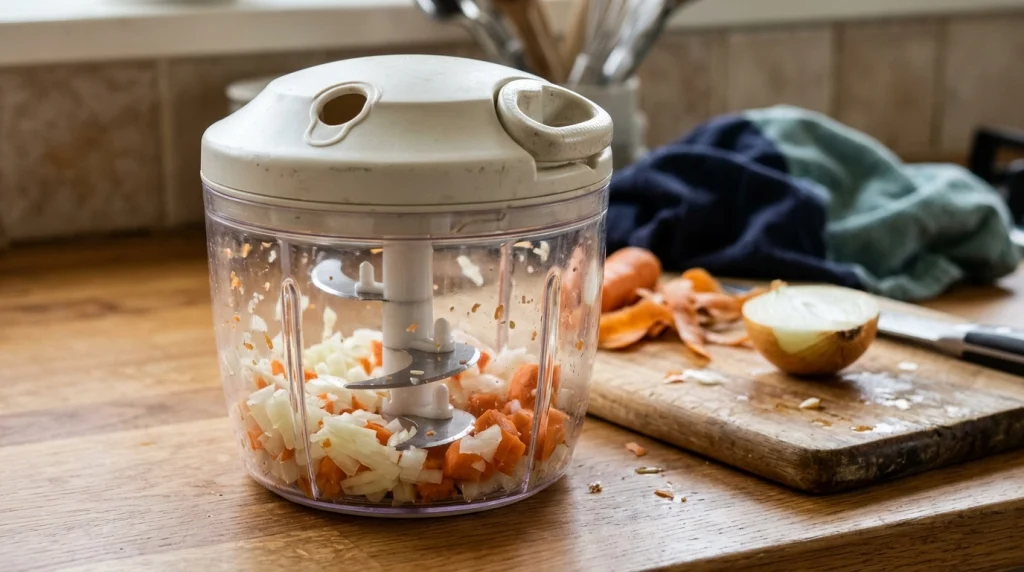
A pull cord chopper cutting mechanism is a manual drive system that uses a retractable cord to rotate blades inside a food container. The mechanism transfers energy from your hand to a rotating blade assembly, reducing the need for repeated knife cuts.
Most designs combine a pull handle, cord, internal reel, drive components, and a blade holder. Spring-return models also include a spring that winds the cord back after each pull.
Not every model uses identical internal parts. Some use a ratchet-style coupling, while others use a different arrangement to transmit rotation and retract the cord.
Why Does the Mechanism Use a Pulling Motion?
The cord provides a simple way to generate rotation without a motor, battery, or electrical connection. Each pull supplies mechanical energy that the internal drive system transfers to the blades.
This design keeps the operating action outside the food bowl. Your hands can remain on the lid and handle while the blades work inside the closed container.
How Does a Pull Cord Chopper Turn a Pull Into Cutting Motion?
When you pull the handle, the cord unwinds and turns an internal reel. The drive assembly then transfers that rotational movement to the blade holder, causing the blades to sweep through the ingredients.
In a spring-return model, releasing the handle allows the spring to rewind the cord. A one-way coupling can prevent the returning reel from driving the blades backward, so repeated pulls produce successive cutting rotations.
- Pull the handle: Your hand draws the cord out of the lid.
- Rotate the reel: The unwinding cord turns the internal reel.
- Transfer the motion: The drive coupling engages the blade shaft or connecting column.
- Rotate the blades: The blades pass through the ingredients inside the bowl.
- Release the handle: The return spring rewinds the cord when the design includes this feature.
- Pull again: Another stroke rotates the blades, further reducing the ingredient size.
The cycle repeats as needed. You control the result by stopping to inspect the food rather than relying on a fixed cutting time.
Which Parts Make Up the Pull Cord Cutting System?
The mechanism works because several components perform different jobs. A problem with any one of them can affect cord movement, blade rotation, or the ability to reset the handle.
| Part | Main function | Possible problem |
|---|---|---|
| Pull cord and handle | Carry pulling force into the lid | Fraying, breakage, or a stuck handle |
| Cord reel | Unwind and wind the cord | Jamming or uneven winding |
| Return spring | Retract the cord after release | Weak or absent retraction |
| Ratchet or drive coupling | Transfer rotation in the intended direction | Slipping or inconsistent engagement |
| Blade shaft and holder | Carry rotation to the blades | Misalignment or poor engagement |
| Blades | Cut food into smaller pieces | Dullness, damage, or residue buildup |
This table describes common components and possible symptoms, not a diagnosis for every chopper. Some models combine several functions in one assembly or use different drive parts.
How Does the Cord Reel Work?
The cord reel is the rotating component around which the pull cord winds. Pulling the handle turns the reel as the cord unwinds from its groove or winding area.
When the cord returns, the reel turns in the opposite direction to collect it. In spring-return designs, the spring provides the force needed for this reset.
What Do the Ratchet and Return Spring Do?
A ratchet-style drive can transmit rotation during the pulling stroke while allowing the reel to return without reversing the blade assembly. This helps the blades rotate in the intended direction over repeated pulls.
The return spring performs a separate job. It stores energy during the pull and releases that energy to rewind the cord when you let go.
Some pull choppers use different internal arrangements, so these parts may not appear in every model. Never assume that a mechanism is broken simply because its internal design differs from a diagram of another chopper.
Why Do Repeated Pulls Make Vegetables Finer?
Each pull moves the blades through the food again, creating additional cuts. As the pieces become smaller, repeated blade passes can produce a finer texture.
The number of pulls alone doesn’t determine the result. A firm carrot, a juicy tomato, and a handful of herbs respond differently to the same blade movement.
- Coarse chopping: Use a few pulls, then inspect the size of the pieces.
- Fine chopping: Add short sets of pulls, checking the texture between sets.
- Very fine processing: Continue cautiously, since moist ingredients can become a wet mixture rather than evenly sized pieces.
For example, if you’re preparing onion for a curry, start with a small batch of roughly even chunks. Pull a few times, inspect the pieces, and continue only if they’re still larger than you want.
This is a practical adjustment method, not a guaranteed pull count. Blade geometry, bowl size, and ingredient condition differ between models.
How Does a Pull Cord Chopper Compare With Other Choppers?
Pull cord, push-down, and electric choppers all reduce food into smaller pieces, but they use different ways to drive their blades. The right choice depends on how much food you prepare and the type of cutting you need.
| Feature | Pull cord | Push-down | Electric |
|---|---|---|---|
| Operating action | Pull a cord | Press a plunger | Activate a motor |
| Power source | Hand force | Hand force | Electricity or battery |
| Cutting control | Adjust through pull cycles | Depends on the pressing mechanism | Depends on motor speed and duration |
| Typical advantage | Compact, motor-free operation | Direct pressing action | Powered processing |
| Main consideration | Cord and drive maintenance | Required pressing force | Power, size, and cleaning |
These are general design differences rather than measured performance rankings. Individual models vary in capacity, blade layout, durability, and ease of cleaning.
How Can You Use the Cutting Mechanism Correctly?
Correct loading and controlled pulling help the mechanism operate as intended. Follow the manufacturer’s instructions first, especially for bowl capacity, locking features, and permitted ingredients.
- Prepare the ingredients: Wash produce and cut large items into smaller chunks that fit comfortably in the bowl.
- Position the blades: Place the blade assembly in its designated position without touching the cutting edges.
- Load the bowl: Add a suitable quantity of food without exceeding the model’s capacity.
- Secure the lid: Align and lock it according to the product instructions.
- Stabilize the chopper: Place it on a flat, stable surface and hold the lid as directed.
- Pull smoothly: Use controlled strokes instead of jerking the cord or forcing it beyond its normal travel.
- Check the texture: Stop pulling and open the container safely when you need to inspect the result.
Don’t force hard, frozen, or unsuitable ingredients into the mechanism. If the cord suddenly resists, stop and check the load rather than pulling harder.
What Causes a Pull Cord Chopper to Stop Cutting?
A chopper may stop cutting because the blades are obstructed, the drive coupling no longer engages, or the cord mechanism cannot move freely. The symptom can help narrow down the likely cause, but it doesn’t confirm which part has failed.
| Symptom | Possible cause | Safe first step |
|---|---|---|
| Cord won’t pull | Overloaded bowl, jam, or internal fault | Stop and check for an obstruction |
| Cord won’t retract | Cord jam or return-spring problem | Don’t force the handle back |
| Cord pulls but blades don’t turn | Slipping drive or disconnected blade holder | Check assembly alignment |
| Blades turn poorly | Food jam, overloading, or damaged parts | Remove the load and inspect safely |
| Cord feels rough or catches | Uneven winding or cord damage | Stop using the chopper and inspect the cord |
Can You Repair the Pull Cord Mechanism at Home?
You can often address basic setup issues without opening the lid. Remove the food, check that the blade assembly sits correctly, and confirm that the lid and bowl fit together as intended.
However, a broken cord, failed return spring, or damaged internal drive may require a manufacturer-approved replacement or professional repair. Don’t open a sealed spring-loaded lid unless the manufacturer explicitly provides a safe service procedure.
Never use a chopper with a frayed cord, cracked housing, loose blade assembly, or a lid that won’t secure properly.
How Should You Clean and Maintain the Mechanism?
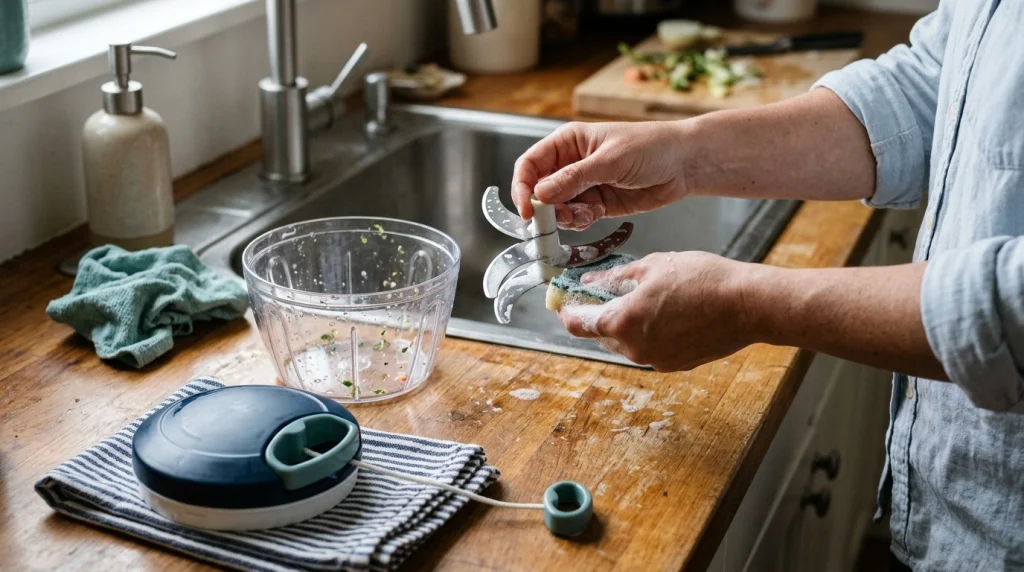
Food residue can interfere with the blades and make the chopper harder to operate. Regular cleaning also helps keep the bowl and removable food-contact parts in good condition.
- Clean after use: Remove leftover food from the bowl and blade assembly.
- Handle blades carefully: Hold the designated plastic stem or grip rather than the cutting edges.
- Protect the lid: Don’t immerse the pull-cord lid unless its instructions explicitly permit immersion.
- Keep the cord dry: Avoid allowing water or cleaning liquid to enter the cord opening.
- Dry removable parts: Let washable parts dry fully before storing them.
- Inspect before use: Check the cord, handle, lid, and blade holder for visible damage.
Cleaning instructions differ by product. For broader guidance on washing produce and preventing food contamination, consult the USDA’s food-handling resources and the FDA’s food safety guidance.
What Should You Check Before Buying a Pull Cord Chopper?
The best design is one that fits your food-preparation routine and has a mechanism you can operate, clean, and maintain safely. Look beyond the exterior appearance when comparing models.
- Drive construction: Check whether the manufacturer explains the cord mechanism and provides clear operating instructions.
- Blade assembly: Review the blade material, arrangement, and whether the assembly can be removed safely for cleaning.
- Bowl capacity: Choose a size that suits your usual ingredient quantities.
- Lid security: Look for a stable fit between the bowl and lid.
- Cleaning requirements: Confirm which components are washable and whether the lid must stay dry.
- Replacement support: Check whether the manufacturer offers replacement parts or repair guidance.
As of 2026, pull-cord choppers remain a practical option for small batches of everyday ingredients. Still, advertised blade counts and capacity alone don’t establish how durable or easy to use a particular model will be.
For a useful technical reference, the description of a hand-pulled vegetable cutter mechanism illustrates how a cord reel, spring, ratchet components, and blade assembly can work together in one design. It is an example of a mechanism, not a specification for every product.
Pull Cord Chopper Product Recommendations
If you’re ready to choose a chopper, compare the actual mechanism, bowl size, cleaning requirements, and support available for each model. The following options illustrate different ways to approach manual food preparation; verify current specifications and availability before buying.
🏆 Established brand option
Borosil EazyPull Manual Chopper
★★★★☆
A pull-operated manual chopper to consider for everyday ingredient preparation. I’d check the current model’s bowl capacity, blade assembly, and cleaning instructions before choosing it; the stars represent an editorial fit assessment, not a verified customer rating.
🔧 Mechanism-focused option
Manual Pull-Cord Vegetable Chopper with Metal Blades
★★★★☆
Look for a transparent bowl, a removable blade assembly, and a clearly described pull mechanism. I’d prioritize secure lid fitting and easy inspection of the ingredients over decorative features; verify the actual materials and parts in the listing.
🥕 Alternative for simple prep
Manual Push-Down Vegetable Chopper
★★★☆☆
A push-down model is worth comparing if you’d rather press a plunger than pull a cord. I’d compare its cutting chamber, blade protection, and cleaning process with a pull-cord model; this is a category-level recommendation, not a review of one verified product.
Recommendation note: The star symbols above are provisional editorial assessments of how each option fits the stated use case. They are not verified customer scores or results from hands-on testing.
Frequently Asked Questions
Does a pull cord chopper use gears?
Some pull-cord choppers use a ratchet, pawls, or other drive components to transfer rotation to the blades. Others use a different internal arrangement. Check the manufacturer’s diagram or product documentation to identify the exact mechanism in your model.
Why does the cord return but the blades don’t spin?
The return spring may still rewind the cord even when the drive coupling fails to engage the blade shaft. A misaligned blade assembly or damaged internal component can also cause this symptom. Stop using the chopper and inspect the removable parts according to its instructions.
Do more pulls always produce better chopping?
No. More pulls generally create more cutting opportunities, but the result depends on the food, blade layout, and quantity loaded. Too many pulls can turn juicy vegetables into a wet mixture. Inspect the ingredients between short sets of pulls to control their texture.
Can I wash the pull-cord lid under running water?
Only if the manufacturer explicitly allows it. Water entering the lid can affect the cord mechanism or its internal spring. Unless the instructions confirm that the lid is washable, clean its exterior with a suitable damp cloth and wash the removable food-contact parts separately.
Can I replace a broken pull cord myself?
That depends on the model and whether replacement parts or a service procedure are available. The lid may contain a spring-loaded assembly that can release unexpectedly when opened. Avoid dismantling it without manufacturer-approved instructions, and replace a damaged unit if safe repair isn’t supported.
Final Takeaway
The pull-cord chopper cutting mechanism turns a simple hand movement into rotating blade action through a cord reel and drive assembly. In spring-return designs, the spring resets the cord so you can repeat the cutting cycle without electricity.
For better results, load the bowl correctly, pull with controlled strokes, and inspect the food between cycles. If the cord jams, fails to retract, or turns without driving the blades, stop and investigate the cause instead of forcing the mechanism.
Choose a model with a secure lid, suitable blade assembly, clear cleaning instructions, and dependable parts support. Those details matter more than appearance when you want a manual chopper that fits your kitchen routine.
Affiliate disclosure: This article contains affiliate links. If you purchase through these links, RecipesPalette may earn a commission at no additional cost to you. Product availability, specifications, and prices can change, so confirm the current listing before buying.