
Push Down Chopper Safety: How to Use a Vegetable Chopper Without Injuries

Quick Answer
To use a push down vegetable chopper safely, place it on a stable, flat surface, secure the blade assembly, position the food correctly, and press the lid or handle with your hands away from the cutting grid. Never reach into exposed blades, force oversized or unsuitable ingredients through the chopper, or remove stuck food while the blade assembly remains accessible. Follow the manufacturer’s instructions for assembly, cleaning, and storage.
Essential safety precautions
- Check the blades: Look for damage, loose parts, or incorrect alignment before each use.
- Stabilize the base: Keep the container or chopper firmly positioned on a clean, level countertop.
- Keep fingers clear: Use the intended lid, pusher, or food holder instead of your hands to press ingredients.
- Press correctly: Apply controlled, even pressure without striking, twisting, or forcing the handle.
- Clear jams safely: Stop pressing, open the unit as instructed, and use the supplied cleaning tool only when safe to do so.
- Store securely: Keep detached blades covered or locked away from children and other household members.
Before preparing food
- Read the model-specific instructions, especially its restrictions on hard, frozen, or oversized ingredients.
- Wash hands, rinse produce under running water, and clean food-contact surfaces according to FoodSafety.gov’s food safety guidance.
A push down vegetable chopper can make everyday meal preparation quicker, but its convenience depends on using it correctly. The cutting grid can be sharp enough to cause a serious injury when you assemble, operate, or clean the device carelessly.
In this guide, I’ll explain the precautions that matter most, how to press ingredients without forcing the mechanism, what to do when food gets stuck, and which safety features deserve attention when choosing a chopper.
What Is Push Down Chopper Safety?
Push down chopper safety means using a manual vegetable chopper in a way that reduces the risk of cuts, pinched fingers, unstable equipment, and damage caused by incorrect operation. It covers the entire process, from fitting the blade to cleaning and storing the device.
Unlike a knife, a push down chopper often hides its cutting grid beneath a lid or pusher during operation. However, the blades remain hazardous whenever you expose or handle the cutting assembly.
- Blade safety: Keep hands away from the cutting edges during loading, unloading, and cleaning.
- Pressure safety: Press only as the manufacturer directs, without excessive force.
- Stability: Prevent the container or frame from slipping during chopping.
- Maintenance: Inspect moving parts, locks, and blade alignment regularly.
- Storage: Protect exposed blades and restrict access to children.
These precautions apply to common countertop choppers with hinged lids, interchangeable dicing grids, push blocks, and collection containers. Some commercial lever-operated models have different designs, so always follow the instructions supplied with your particular model.
How Do You Use a Push Down Vegetable Chopper Safely?
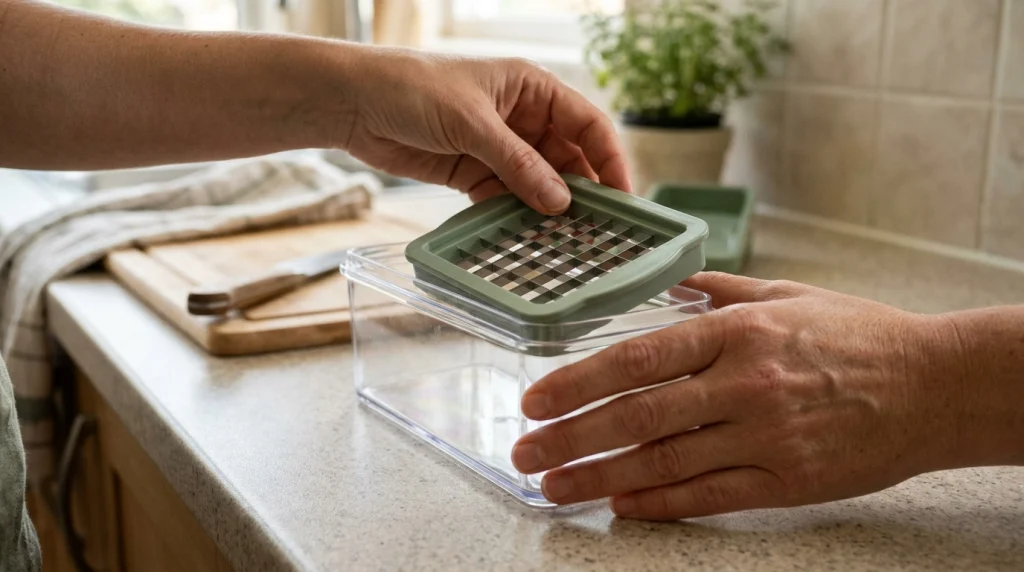
The safest method is to assemble the chopper correctly, prepare ingredients to fit the cutting grid, and press the handle with your fingers clear of the cutting area. Never improvise a workaround when the lid or pusher does not close properly.
- Inspect the equipment. Check the blade grid, lid, hinges, locks, container, and any supplied pusher for damage or missing parts.
- Secure the base. Place the chopper on a clean, dry, flat countertop where it cannot rock or slide easily.
- Fit the blade correctly. Install the appropriate cutting grid according to the manufacturer’s instructions and confirm that it locks into position.
- Prepare the ingredient. Remove unsuitable stems, stones, and other hard objects, then cut oversized vegetables into manageable pieces.
- Position the food. Center the ingredient over the cutting grid and keep your fingertips away from its edges.
- Close the lid or pusher. Make sure the parts align properly before applying pressure.
- Press in a controlled motion. Use the intended handle or lid and apply steady pressure without sudden impacts.
- Check the result. If the food does not pass through, stop and investigate rather than pushing harder.
One important distinction is that not every push down chopper uses the same pressing motion. A hinged household lid may require a different technique from a commercial lever-operated unit, so the model’s manual takes priority over general advice.
Why Should You Keep Your Fingers Away From the Blade Grid?
The cutting grid contains closely spaced edges that can catch a fingertip even when the blades appear small. A brief slip while positioning food or removing scraps can cause a cut.
Keep your hands on the designated handle or safe gripping surfaces. Never use your fingers to press food into the grid, push food through an opening, or retrieve pieces trapped beneath the cutting assembly.
For additional guidance on safe kitchen habits, consult the U.S. Consumer Product Safety Commission’s childproofing guidance, which discusses restricting children’s access to sharp household items.
What Should You Check Before Pressing the Handle?
A quick inspection can reveal problems before you apply pressure. A loose blade, cracked lid, or unstable base can make an otherwise straightforward chopping task unsafe.
| Part or area | What to check | Safe response |
|---|---|---|
| Blade grid | Bent, chipped, loose, or misaligned blades | Do not use a damaged or incorrectly fitted grid. |
| Lid and hinge | Cracks, loose joints, or faulty closure | Replace or repair the affected part as directed. |
| Locking mechanism | A blade or lid that will not lock securely | Stop until the assembly fits correctly. |
| Base and feet | Rocking, sliding, or damaged grip surfaces | Clean and dry the surface; stop if the unit remains unstable. |
| Handle or pusher | Cracks, sticking, or unusual resistance | Check assembly and instructions before using again. |
Do not test a blade’s sharpness by running a finger along its edge. Inspect it visually, handle it only as instructed, and replace damaged components with compatible parts approved for that model.
How Hard Should You Press a Push Down Chopper?
Use firm, controlled pressure that matches the design and the ingredient being chopped. The handle should move as intended without excessive force, impact, or twisting.
If the lid stops partway through a cut, the ingredient may be too large, too hard, or incorrectly positioned. A blade grid may also be misaligned, or food may have become trapped between the pusher and cutting surface.
- For soft vegetables: Position the pieces properly and use the normal pressing motion.
- For firm vegetables: Follow the manufacturer’s guidance and cut the ingredient into smaller pieces when needed.
- For oversized pieces: Stop and prepare them to fit the opening rather than forcing the lid closed.
- For repeated resistance: Stop, inspect the assembly, and check whether the ingredient is suitable for that chopper.
Never strike the lid with your palm or a kitchen utensil to force a stubborn vegetable through the grid. Excessive pressure can damage components or cause the unit to shift unexpectedly.
Which Foods Can Make a Push Down Chopper Unsafe?
Ingredients that exceed the grid’s opening or are too hard for the mechanism can increase the force needed to chop. The safe range varies by model, so do not assume that every vegetable is suitable for every chopper.
| Ingredient situation | Potential issue | Safer approach |
|---|---|---|
| Large onion or potato pieces | The lid may not close or the food may jam. | Cut into pieces that fit the grid. |
| Very hard carrots or similar produce | The mechanism may resist or require excessive pressure. | Check the manual and prepare smaller pieces if permitted. |
| Frozen vegetables | Hardness may exceed the tool’s intended capacity. | Use only if the manufacturer explicitly permits it. |
| Fruit pits, bones, or other hard objects | They can damage blades or cause sudden resistance. | Remove them and follow the product’s permitted-use list. |
| Overripe or very soft produce | Food may crush or smear instead of cutting cleanly. | Use a suitable cutting method if the chopper gives poor results. |
Do not treat these examples as universal permissions or restrictions. Your chopper’s instructions determine which foods it can handle safely.
What Should You Do If Food Gets Stuck in the Chopper?
Stop pressing immediately when food jams. Never put your fingers into the cutting grid or force the handle through the obstruction.
- Release the pressure. Let the handle or lid return to its safe resting position without placing your fingers near the blades.
- Open the unit carefully. Follow the manufacturer’s procedure for releasing the lid or pusher.
- Check the obstruction. Look for oversized pieces, incorrectly positioned ingredients, or debris blocking the grid.
- Use the supplied tool. If the instructions permit it, use the designated cleaning tool while keeping your hands away from the cutting edges.
- Reassemble correctly. Make sure the blade and lid lock securely before trying again.
If the obstruction will not come free using the approved method, stop and consult the manufacturer’s instructions or customer support. Do not use a knife, screwdriver, or other improvised object to pry food out of the blade assembly.
A jam that happens repeatedly may indicate an unsuitable ingredient, incorrect assembly, worn parts, or a damaged grid. Continuing to press harder will not solve the underlying problem safely.
How Do You Clean a Push Down Chopper Without Cutting Yourself?
Cleaning is one of the riskiest parts of using a manual vegetable chopper because food debris can hide the cutting edges. Remove the blade assembly only as directed, and never assume that a dishwasher-safe component is safe to handle without care.
- Disassemble carefully. Follow the model’s instructions and hold components only by their designated safe areas.
- Remove loose food. Use the supplied cleaning comb or brush where appropriate, directing your hands away from the blades.
- Wash the components. Use the cleaning method recommended by the manufacturer, including any dishwasher restrictions.
- Rinse and inspect. Check for remaining food around hinges, grids, and narrow slots without running your fingers over the cutting edges.
- Dry and store. Let parts dry as directed, then cover or secure the blades before putting the chopper away.
Do not grab a blade grid while scrubbing it, and never push a fingertip through a blocked opening. A soft brush or purpose-designed cleaning tool is safer than direct finger contact.
For general food hygiene, the FoodSafety.gov cleaning recommendations explain why hands, utensils, and food-contact surfaces need regular cleaning during preparation.
Should You Wear Cut-Resistant Gloves?
Cut-resistant gloves may offer additional protection during certain blade-handling tasks, but they do not make it safe to touch cutting edges carelessly. Use them only if appropriate for the task and compatible with the manufacturer’s instructions.
For most household users, the primary safeguards are correct disassembly, safe gripping points, suitable cleaning tools, and careful storage. Gloves should never replace these precautions.
How Can You Keep Children Safe Around a Vegetable Chopper?
Keep children away from the chopper while it is in use, especially when the lid is open or detached blades are exposed. A compact kitchen tool can look harmless even when its cutting grid is sharp.
- Store blade inserts in a secure, covered location that children cannot access.
- Keep the chopper away from countertop edges where it could be pulled down.
- Never leave a loaded chopper unattended.
- Clean up detached blades and accessories immediately after use.
- Do not let a child operate the chopper unless the product’s age guidance, ability requirements, and appropriate adult supervision support that activity.
Do not rely on a closed lid as a childproof lock unless the manufacturer specifically designed it for that purpose. The U.S. Consumer Product Safety Commission recommends using suitable safety latches to restrict children’s access to dangerous household items.
What Safety Features Should You Look for When Buying a Push Down Chopper?
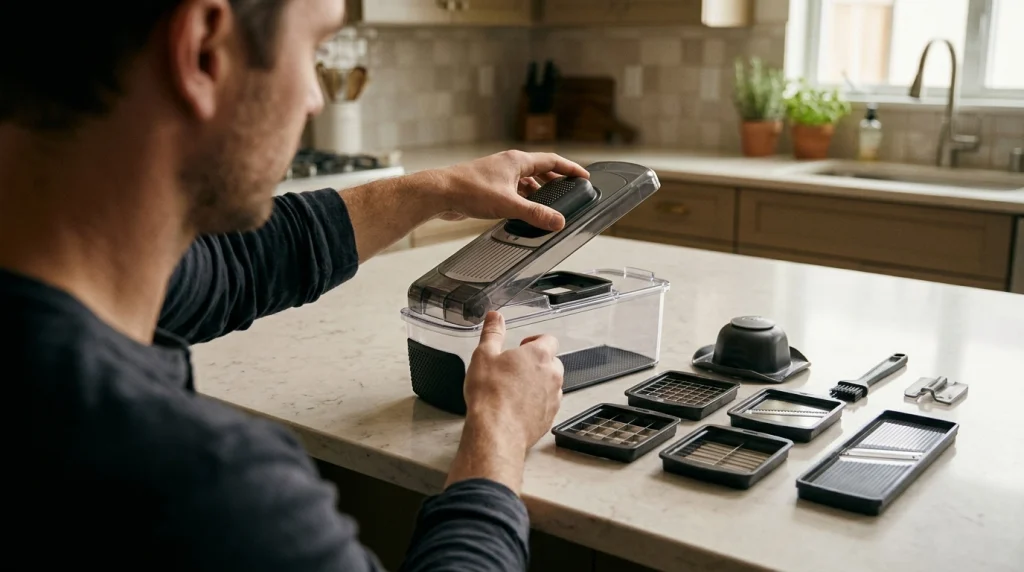
A safer design makes correct use easier and reduces the need to touch exposed blades. Look for features that support stability, secure assembly, controlled pressing, and safer cleaning.
| Feature | Why it matters | What to verify |
|---|---|---|
| Non-slip base | Helps keep the unit steady during pressing. | Check grip surfaces and countertop compatibility. |
| Secure blade lock | Helps prevent the cutting insert from shifting. | Confirm that the insert locks as instructed. |
| Enclosed pusher | Keeps hands away from the cutting area during normal operation. | Look for a well-fitting lid or designated pusher. |
| Cleaning accessory | Helps remove debris without direct finger contact. | Check whether the tool fits the grid and cleaning instructions. |
| Replaceable parts | Makes it easier to replace damaged components properly. | Check manufacturer support and compatible replacements. |
For household use, I would prioritize stable construction, a secure blade assembly, and easy access to replacement parts over a large collection of cutting attachments. More accessories can be useful, but each extra blade also needs safe handling and storage.
What Should You Do if a Push Down Chopper Breaks or Causes an Injury?
Stop using a chopper immediately if the handle cracks, the lid separates unexpectedly, a blade bends, or the assembly becomes unstable. Do not attempt a repair that could weaken the blade holder or compromise the locking mechanism.
If a cut occurs, put the chopper aside and focus on the injury. For a minor cut, apply firm, continuous pressure with clean gauze or cloth, then rinse the wound when bleeding is controlled and cover it with a clean dressing.
Seek urgent medical care for heavy or persistent bleeding, a deep or gaping wound, numbness, loss of movement, or a suspected tendon injury. If the bleeding is severe, apply firm pressure and contact local emergency services.
Before using the device again, identify what went wrong and replace any damaged components with approved parts. If you cannot establish that the chopper is safe, retire it rather than risking another injury.
Recommended Vegetable Choppers to Consider
If you’re choosing a chopper, prioritize the way it contains its blades, the stability of its base, and how easily you can clean it without touching sharp edges. The following established product lines are worth comparing, but check the current model’s manual and included accessories before buying.
BEST FOR MULTIPLE CUTTING TASKS
Fullstar Vegetable Chopper
Fullstar offers multipurpose vegetable choppers in several configurations. Compare the included blade inserts, locking design, and cleaning accessories; I would choose a version whose parts are straightforward to secure and remove.
BEST FOR SIMPLE PREP
OXO Good Grips Vegetable Chopper
OXO’s manual chopper line is worth comparing if you prefer a dedicated chopping tool rather than a large accessory set. Confirm the exact model, operating mechanism, blade enclosure, and cleaning procedure before deciding whether it suits your needs.
BEST FOR COMPACT STORAGE
Brieftons Manual Food Chopper
Brieftons offers manual food-preparation tools with different mechanisms and attachments. Check the specific product’s operation method, enclosed blade design, and cleaning instructions rather than assuming every Brieftons model is a push down chopper.
These are comparison candidates, not laboratory-tested safety rankings. I have not independently verified current prices, included accessories, or the safety performance of individual listings, so review the exact product documentation before purchasing.
Push Down Chopper Safety: Frequently Asked Questions
Can you use both hands to press a vegetable chopper?
Only if the manufacturer’s instructions permit two-handed pressing and provide a safe way to position both hands. Keep your hands on the intended handle or designated pressing surfaces, never on the blade grid, hinge gap, or other moving parts.
Is it safe to press down hard when a vegetable gets stuck?
No. Excessive pressure can damage the mechanism or cause the chopper to shift unexpectedly. Stop pressing, release the handle safely, and check the ingredient size, blade alignment, and assembly before trying again according to the manufacturer’s instructions.
Can I remove food stuck between the blades with a knife?
A knife is not a safe improvised tool for clearing a jammed chopper. Follow the manufacturer’s disassembly procedure and use the supplied cleaning accessory if permitted. Keep your fingers away from the cutting edges and seek manufacturer guidance if the obstruction remains trapped.
How often should I inspect a push down vegetable chopper?
Inspect the blades, lid, locking mechanism, handle, and base before each use. Also check for damage during cleaning and storage. Stop using the chopper if a component cracks, loosens, bends, or no longer fits securely.
Are push down vegetable choppers safe for children to use?
Do not assume a push down chopper is suitable for children simply because the blades sit beneath a lid. Follow the manufacturer’s age guidance, keep children away from exposed cutting parts, and store detachable blades securely. Adult supervision does not replace proper safety precautions.
Final Takeaway: Make Safe Chopping a Habit
Push down chopper safety comes down to a few consistent habits: inspect the device, stabilize the base, fit the blade correctly, keep your fingers away from the cutting area, and use controlled pressure. Stop whenever food jams or the mechanism behaves unexpectedly.
Cleaning and storage deserve the same attention as chopping itself. Choose a design with secure assembly and practical cleaning accessories, follow its instructions, and replace damaged parts before using the chopper again.
Remember: A vegetable chopper should make food preparation easier, not encourage you to force a stubborn cut. When the tool resists, stop and solve the problem safely.
Affiliate disclosure: This article contains Amazon affiliate links. As an Amazon Associate, the publisher may earn from qualifying purchases, at no additional cost to the buyer.