Vegetable Chopper Disadvantages: 10 Drawbacks to Know Before Buying

Quick Answer
The main vegetable chopper disadvantages are extra cleanup, sharp exposed blades, uneven results with soft produce, limited control over cut size, bulky storage, and more parts that can wear out. A chopper can still save time for repetitive meal prep, but safe technique matters, so I recommend reviewing these kitchen safety tips for home cooks before using one regularly.
Biggest drawbacks at a glance
- More cleanup: Food can become trapped inside blade grids, lids, corners, and containers.
- Sharp blades: Removing, washing, and storing blade inserts requires careful handling.
- Uneven texture: Tomatoes and other soft foods may crush or mash instead of forming clean cubes.
- Less control: Fixed grids limit your choice of thickness, shape, and final texture.
- Storage clutter: Multi-blade models can occupy more cabinet space than expected.
- Not always faster: For one onion or pepper, a knife may be quicker once washing is included.
My rule of thumb
- Use a chopper for repetitive meal prep. Reach for a knife when you need precise cuts or only have one small ingredient.
Vegetable choppers look like an easy answer to slow meal prep. Push an onion through a grid, empty the container, and dinner suddenly feels simpler.
The trade-offs become more obvious after cleanup, storage, and different vegetables enter the picture. Here are the disadvantages I think are worth understanding before you give one permanent counter or cabinet space.
What Is a Vegetable Chopper?
A vegetable chopper is a manual or powered kitchen tool designed to cut produce faster than repeated knife chopping. Manual grid-style models usually press vegetables through fixed stainless-steel blades into a catch container.
Simple definition: A vegetable chopper trades some cutting control for speed and repeatability. That trade is useful for batch preparation, but it creates most of the disadvantages discussed below.
Some models include dicing grids, slicers, graters, julienne blades, or spiralizers. Others keep things simple with one chopping blade.
- Grid choppers: Push food through square blades into a container.
- Pull-cord choppers: Spin an internal blade when you pull a cord.
- Electric choppers: Use a small motor and rotating blade.
- Multi-function choppers: Combine dicing, slicing, grating, and spiralizing attachments.
What Are the Main Disadvantages of a Vegetable Chopper?
The biggest problems are cleaning effort, blade safety, inconsistent performance, limited cutting control, storage, and durability. Whether these drawbacks matter depends on what you cook and how often you prep vegetables.
1. Vegetable choppers can be annoying to clean
Cleanup is the disadvantage I notice first with grid-style designs. Small onion, carrot, pepper, and potato pieces can lodge between narrow blades or inside the lid.
A chopper that saves three minutes during cutting can give part of that time back during washing. Independent testing by Consumer Reports also treated cleanup as an important part of judging whether these tools truly save effort.
- Blade grids may need brushing from both sides.
- Wet food can stick underneath removable inserts.
- Small lid channels can trap scraps.
- More attachments mean more individual pieces to dry and store.
2. The blades can be dangerously sharp
Sharp blades are necessary for pushing vegetables through a grid. Unfortunately, those same edges can be hazardous while changing inserts or washing them.
The risky moment often isn’t chopping. It’s when you reach toward a blade to remove a stuck piece of carrot or onion.
- Never clear a blade grid with your fingers.
- Use the supplied cleaning tool when available.
- Store loose blade inserts where hands cannot contact the edges.
- Keep the chopper out of children’s reach.
The FDA’s safe food handling guidance also recommends washing utensils and food-contact surfaces thoroughly after preparing food.
3. Soft vegetables may become crushed or mushy
A vegetable chopper works best when a firm ingredient passes cleanly through its blade grid. Soft tomatoes, ripe fruit, delicate mushrooms, and similar foods don’t always cooperate.
Pressure from the lid can compress the food before the blade finishes cutting it. You may get juice and broken pieces instead of neat cubes.
Consumer Reports found similar limitations during veggie-dicer testing, particularly with softer foods and round vegetables. That matters if presentation or texture is important to your recipe.
4. Hard vegetables can require surprising force
Carrots, sweet potatoes, potatoes, beets, and other dense vegetables aren’t always effortless to chop. Large pieces may need to be cut smaller before they fit the grid.
That creates an awkward question: if you’re already using a knife to pre-cut everything, how much work is the chopper saving?
- Cut large vegetables into manageable sections first.
- Place the flat side against the blade when possible.
- Don’t force oversized pieces through the grid.
- Use a stable, dry counter surface.
5. You have less control over cut size
A chef’s knife lets you decide whether an onion needs a rough chop, fine dice, thin slice, or irregular rustic cut. A grid chopper gives you the dimensions of the installed blade.
That’s convenient when consistency is the goal. It becomes a disadvantage when your recipe needs a different shape.
This is one reason I still consider basic knife skills useful even with a chopper in the cupboard. Our guide to common cooking mistakes also covers why using the right tool and technique matters.
6. A chopper is not ideal for every vegetable
Marketing photos can make a vegetable chopper look universal. In practice, produce varies too much in firmness, shape, water content, and fiber.
- Onions: Usually work well after peeling and halving.
- Bell peppers: Work well once stems and seeds are removed.
- Carrots: Often need shortening or pre-cutting.
- Potatoes: Can require considerable downward pressure.
- Tomatoes: Soft varieties may crush.
- Leafy greens: Usually work better with a knife.
- Fresh herbs: Fine knife chopping generally gives better control.
Starting with firm, good-quality produce also helps. Here’s how I choose fresh vegetables at the market before meal prep.
7. Multi-function models create storage clutter
A basic chopper may have only a lid, blade, and container. An all-in-one model can arrive with several cutting grids, graters, slicers, spiralizing attachments, holders, and cleaning tools.
That versatility sounds great until every attachment needs a home. Small kitchens feel this disadvantage quickly.
8. Plastic components can wear, stain, or hold odors
Many affordable choppers combine stainless-steel blades with plastic lids and containers. Plastic keeps weight and cost down, but it isn’t indestructible.
Repeated pressure, drops, staining ingredients, and improper dishwasher use can shorten the useful life of some components. Onion odors or strongly colored foods may also linger in certain plastics.
- Follow the manufacturer’s dishwasher instructions.
- Don’t slam the lid harder than necessary.
- Inspect locking points and hinges for damage.
- Stop using cracked food-contact parts.
9. Food can become trapped in the cutting grid
Not every piece passes cleanly into the container. Vegetable fibers and thin scraps can remain caught across the grid after each press.
That can slow down a large batch because you have to clear the surface periodically. It can also increase food waste if you discard everything left behind.
10. It may be slower than a knife for small jobs
This is the disadvantage that changes my buying advice most. A chopper makes sense when you’re processing several ingredients, but the math changes for one small onion.
My practical rule is simple: if setup and washing take longer than the chopping itself, I use a knife. For larger meal-prep sessions, the chopper becomes much easier to justify.
If saving prep time is your main goal, these broader time-saving cooking strategies can also help without adding another gadget.
Are Vegetable Choppers Safe to Use?
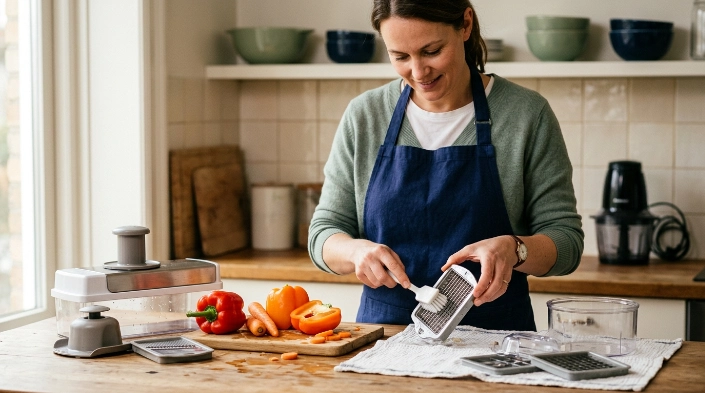
Vegetable choppers can be used safely, but the cutting inserts deserve the same respect as sharp knives. Blade handling and cleaning are the moments when I would be most careful.
Food hygiene also matters because raw vegetables contact the container, lid, and blade surfaces. The USDA’s cutting-board guidance recommends cleaning food-preparation surfaces after use and avoiding cross-contamination.
- Wash produce first: Remove visible dirt before chopping.
- Use a stable surface: Don’t press down on a chopper that slides.
- Use the food holder: Keep fingers away from slicer-style attachments.
- Disconnect electric units: Unplug before touching internal blades.
- Clean promptly: Dried vegetable fibers are harder to remove safely.
- Dry before storage: Reassemble only after parts are fully dry.
The FDA also advises washing fresh produce under running water before cutting and keeping produce away from utensils contaminated by raw meat. You can review its produce safety recommendations for the full guidance.
Vegetable Chopper vs Knife vs Food Processor: Which Has Fewer Drawbacks?
No single tool wins every kitchen task. A manual chopper favors repetitive dicing, a knife favors control, and a food processor favors larger volumes.
| Feature | Vegetable Chopper | Chef’s Knife | Food Processor |
|---|---|---|---|
| Best use | Repeated dicing | Precise everyday cutting | Large batches |
| Cut control | Limited by blade insert | High | Moderate to low |
| Small-job setup | Moderate | Minimal | Highest |
| Cleanup | Grid, lid, container | Knife and board | Bowl, lid, blade, accessories |
| Storage | Moderate, more with attachments | Low | High |
| Main drawback | Cleaning and fixed cuts | Requires knife skill | Bulk and cleanup |
A knife is still my first choice when texture and shape matter. The chopper becomes more attractive when I want several cups of similarly sized onions, peppers, or firm vegetables.
Do More Attachments Mean a Better Vegetable Chopper?
Not necessarily. More attachments increase versatility, but they also increase washing, organizing, and storage.
Current 2026 models show how wide the difference can be. A simple OXO unit focuses mainly on chopping, while Mueller and Fullstar sell systems with multiple interchangeable cutting options.
| Model | Key specification | Practical trade-off |
|---|---|---|
| OXO Good Grips Vegetable Chopper | Approx. 3.7 × 11.3 × 5.2 inches | Simpler setup, fewer cutting styles |
| Fullstar Compact Chopper & Slicer | Approx. 1.2-liter container; multi-blade configurations | More versatility, more pieces to organize |
| Mueller 12-Blade Ultimate Chopper | 12-in-1 system; 7-cup container | Large tool set and greater storage needs |
The important question isn’t how many attachments come in the box. It’s how many you will use often enough to justify cleaning and storing them.
Who Should Avoid Buying a Vegetable Chopper?
A vegetable chopper is less appealing if you cook small portions, enjoy precise knife work, have limited storage, or dislike washing multi-part tools. Those users may be happier with a good knife and stable cutting board.
- Solo cooks: Small meals may not create enough chopping to justify setup.
- Small-kitchen owners: Attachment-heavy sets can consume valuable storage space.
- Precision cooks: Fixed grids won’t replace controlled knife cuts.
- People with limited hand strength: Dense vegetables may require uncomfortable downward pressure.
- Anyone who hates gadget cleanup: Blade grids can feel tedious after every meal.
On the other hand, a family that meal-preps several vegetables at once may accept these drawbacks easily. The tool has to match the kitchen, not the trend.
How Can You Reduce Vegetable Chopper Disadvantages?

You can’t remove every drawback, but good habits make a chopper easier and safer to live with. I focus on reducing force, trapped food, cleanup time, and unnecessary attachments.
- Choose the simplest model that meets your needs. Don’t buy twelve functions if you only want diced onions and peppers.
- Pre-cut oversized vegetables. Smaller sections pass through grids with less pressure.
- Use firm produce. Overripe tomatoes and very soft fruit are more likely to crush.
- Rinse soon after use. Fresh vegetable residue is easier to remove than dried residue.
- Use a brush or cleaning pick. Keep your fingers away from sharp blade openings.
- Store blades together safely. Loose inserts should never float uncovered in a drawer.
- Keep your knife available. A chopper should complement basic prep tools, not replace every one of them.
Despite the disadvantages, faster vegetable prep can make it easier to build produce into everyday meals. If that’s your goal, our guide to the benefits of vegetables in a daily diet offers more practical ideas.
Vegetable Choppers I’d Consider Despite the Drawbacks
If the disadvantages still feel manageable, I’d focus on models that solve a specific need rather than simply offering the longest attachment list.
🏆 Best Everyday Pick
OXO Good Grips Vegetable Chopper with Easy-Pour Opening
My rating: ★★★★½
This relatively simple stainless-steel-and-plastic design focuses on quick chopping instead of a huge accessory collection. I like this approach for cooks who want a chopper without turning one kitchen task into an attachment-management project.
🥗 Best Compact Multi-Use Pick
Fullstar Compact Chopper & Slicer
My rating: ★★★★☆
Fullstar offers interchangeable dicing, slicing, grating, and julienne options in compact configurations. I’d consider it when those extra cuts will be used regularly, because unused attachments quickly become the biggest disadvantage of this style.
🍽️ Best for Meal Prep
Mueller 12-Blade Ultimate Vegetable Chopper & Spiralizer
My rating: ★★★★½
The 12-in-1 system includes multiple dicing, slicing, grating, and spiralizing options with a 7-cup container. I’d reserve a setup this extensive for serious batch prep, where its versatility can outweigh the extra washing and storage.
Frequently Asked Questions
Are vegetable choppers worth buying?
Vegetable choppers can be worth buying if you regularly dice several onions, peppers, potatoes, or other firm vegetables. They make less sense for occasional small jobs because setup, cleaning, and storage can outweigh the few minutes saved during cutting.
What is the biggest disadvantage of a vegetable chopper?
For many home cooks, cleanup is the biggest disadvantage. Food often becomes trapped around blade grids and lid mechanisms, so a chopper isn’t automatically faster once washing and drying time are included.
Can a vegetable chopper replace a knife?
No. A vegetable chopper handles repetitive cuts well, but a knife offers greater control over shape, thickness, and texture. You will also need a knife for trimming, peeling, halving oversized vegetables, chopping herbs, and preparing foods that don’t fit the chopper.
Why does my vegetable chopper mash tomatoes?
Tomatoes can mash when they’re too soft for the blade grid or when the chopper requires substantial pressure. Firmer tomatoes usually perform better, but a sharp knife is often the better choice when you need clean tomato slices or carefully shaped pieces.
Are vegetable choppers difficult to clean?
Some are. Simple models with removable dishwasher-safe parts can be convenient, while complex choppers with narrow grids and many inserts take longer. Rinsing the tool immediately after use and using a cleaning brush helps prevent food from drying inside the blades.
Final Takeaway
Vegetable choppers aren’t bad kitchen tools, but they’re not effortless shortcuts either. Their main disadvantages are cleaning, sharp blade handling, limited cutting control, storage needs, and inconsistent results with certain foods.
I think they make the most sense for cooks who prepare firm vegetables in batches. If you’re chopping one or two ingredients and care about precise texture, a sharp chef’s knife is often simpler.
Choose the tool based on how you actually cook. A useful chopper should remove work from your routine, not move that work from the cutting board to the sink and storage cabinet.
