
How to Use a Push Down Vegetable Chopper for Onion: Easy Steps for Even Dicing

Quick Answer
To chop an onion with a push-down vegetable chopper, peel the onion, cut it into halves or smaller sections, and place a flat cut surface over the cutting grid. Close the lid and press down firmly with both hands, following the manufacturer’s instructions. For reliable results, keep each onion piece within the grid, empty the container when needed, and clean the blade assembly promptly; see these practical cooking tips for home cooks for more preparation advice.
What makes onion dicing easier?
- Choose the grid: Use a fine grid for smaller pieces or a larger grid for a coarser dice.
- Prepare the onion: Halve or quarter large onions so they fit inside the cutting area.
- Position it correctly: Place the flat side against the grid to help the onion sit securely.
- Press evenly: Keep the lid aligned and use firm, controlled pressure rather than rocking it.
- Protect your hands: Keep fingers away from exposed blades and use the supplied cleaning tool.
- Wash it promptly: Rinse away onion residue before it dries between the grid blades.
One important tip
- Never force a jam: Stop, open the chopper safely, and remove the obstruction with the designated tool before trying again.
Chopping onions can take longer than expected when you need small, consistent pieces for a recipe. A push-down vegetable chopper offers a practical shortcut, especially when you’re preparing onions for salsa, soups, sauces, and weeknight meals.
In this guide, I’ll explain how to prepare the onion, choose the right cutting grid, get a more even dice, and avoid common problems. I’ll also compare manual choppers with other options so you can decide which tool makes sense for your kitchen.
What Is a Push-Down Vegetable Chopper?
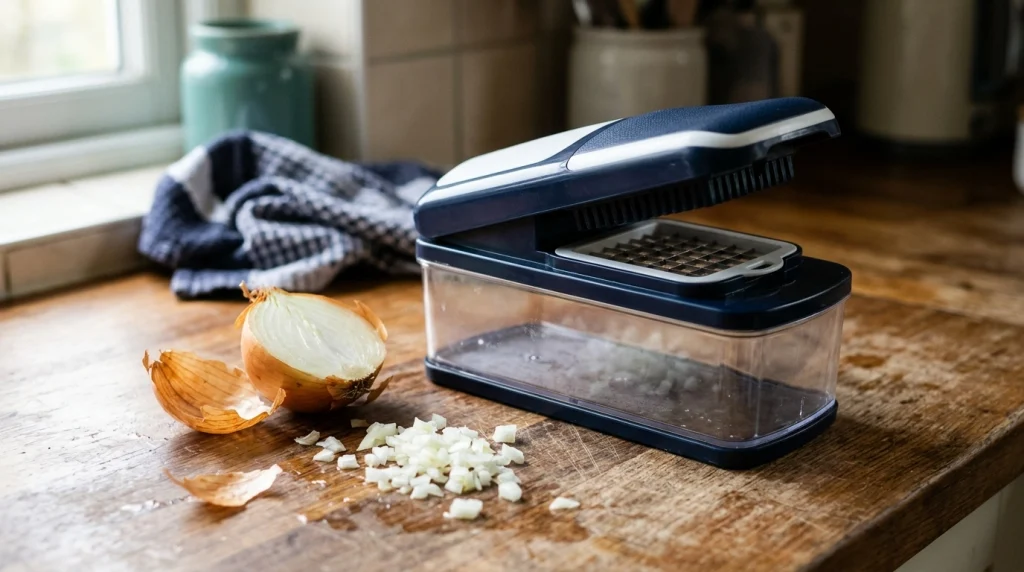
A push-down vegetable chopper is a manual kitchen tool that uses a sharp cutting grid and a hinged or pressing lid to cut vegetables into smaller pieces. The chopped food usually falls into a container underneath, keeping the preparation area more organized.
Unlike an electric food chopper, which spins a blade to mince ingredients, a push-down model uses fixed blades to create a more regular, grid-shaped cut. The exact result depends on the blade spacing, onion size, and design of the chopper.
Which parts matter when chopping onions?
- Cutting grid: The sharp metal insert determines the approximate size and shape of the pieces.
- Pressing lid: This pushes the onion through the grid when you close it.
- Collection container: This catches the diced onion and helps limit scattered pieces.
- Locking or support base: Depending on the model, this keeps the assembly in position during use.
- Cleaning accessory: Some models include a comb or scraper for removing food trapped between the blades.
Before using a new chopper, check its manual for assembly, blade installation, food-size limits, and cleaning instructions. Designs vary, so a technique that suits one model may not suit another.
How Do You Use a Push-Down Vegetable Chopper for Onion?
The easiest method is to prepare the onion into manageable pieces, position each piece correctly, and apply even pressure through the cutting grid. You don’t need complicated knife cuts, but preparation makes a noticeable difference to the result.
Step 1: Choose and assemble the cutting grid
Start by placing the collection container on a stable, dry countertop. Install the cutting grid according to the manufacturer’s instructions, checking that it sits securely before you begin.
Choose the grid based on the recipe rather than automatically selecting the smallest one. A fine grid works well for smaller dice, while a larger grid can suit onions for stews, sautés, and other dishes where a coarser texture is welcome.
Step 2: Wash, peel, and trim the onion
Rinse the uncut onion under running water and dry it with a clean towel before peeling. Remove the papery skin and trim the ends as needed, keeping your fingers away from the knife blade.
Cut the onion in half through its stem and root ends, then inspect the size of each half against the chopper opening. If a half is too large, divide it into quarters or smaller sections rather than forcing it through the grid.
Step 3: Position the onion over the grid
Place one onion section with its flat cut surface facing the cutting grid, provided this matches your chopper’s instructions. Center the piece so the onion stays within the blade area instead of hanging over the edges.
Good positioning helps the lid press the onion evenly through the blades. A piece that sits crookedly or extends beyond the grid can resist the press and produce an uneven cut.
Step 4: Press the lid down firmly
Close the lid and press down with both hands if your model calls for two-handed operation. Keep the lid aligned and follow the pressure and movement recommended in the manual.
Don’t strike the lid, twist it sideways, or lean on an assembly that feels unstable. If the onion resists, stop and check its size, alignment, and the blade installation instead of applying more force.
Step 5: Collect the diced onion and repeat
Open the lid carefully, keeping your fingers clear of the grid. Transfer the diced onion from the container when needed, then position the next section and repeat the process.
For a large onion, work in several manageable sections rather than overloading the chopper. This makes it easier to monitor the cut and prevents chopped onion from accumulating beneath the grid.
Step 6: Check the final texture
Inspect the diced onion before adding it to your recipe. If a few larger pieces remain, cut them separately with a knife rather than trying to push loose scraps through an exposed grid.
Remember that a grid chopper produces pieces based on its blade spacing, not laboratory-level uniformity. Onion layers, firmness, and the fit of each section can all affect the final result.
Which Onion Size Should You Choose?
The right dice depends on how you plan to use the onion. Smaller pieces spread more evenly through sauces and dips, while larger pieces retain more texture in cooked dishes.
| Desired result | Grid choice | Suitable uses | Practical note |
|---|---|---|---|
| Fine dice | Small-grid insert | Dips, dressings, finely chopped salsa | Large onion sections may need quartering. |
| Medium dice | Medium-grid insert | Soups, sauces, everyday cooking | A useful starting point for general meal prep. |
| Coarse dice | Large-grid insert, if available | Stews, roasts, chunky vegetable dishes | Check that the model supports a larger cut. |
| Rough mince | Electric bowl chopper | Sauces, fillings, cooked mixtures | Results depend on pulse duration and blade design. |
The table is a practical guide, not a promise of exact dimensions. Check the manufacturer’s stated cutting sizes when a recipe calls for a specific dice.
Why Does a Push-Down Onion Chopper Leave Uneven Pieces?
Uneven pieces usually come from oversized onion sections, poor alignment, a crowded container, or a grid that doesn’t match the desired cut. The good news is that most of these problems are easy to correct.
Common problems and their fixes
- Some onion remains uncut: Check whether the section extends beyond the grid or sits at an angle.
- The lid won’t close: Open the unit safely and inspect for an oversized piece, trapped onion layers, or incorrect assembly.
- Onion gets crushed: Check that the blades are clean and intact, and use firm, fresh onion rather than a soft or damaged one.
- The container fills too quickly: Empty it before the chopped onion obstructs the cutting area.
- Pieces stick between blades: Stop using the chopper and clear the grid with the supplied cleaning accessory.
- The chopper slides across the counter: Check the base and countertop for moisture, and use the tool only on a stable surface.
Never use your fingers to force onion through the grid or remove trapped pieces while the blade assembly is exposed. If the cutting insert is bent, cracked, loose, or damaged, stop using it and replace the affected part if the manufacturer offers one.
Can a Push-Down Chopper Help You Chop Onions Without Crying?
A push-down chopper may reduce the time you spend handling a cut onion, but it cannot guarantee tear-free chopping. Onions release irritating compounds when their cells are damaged, and enclosed preparation doesn’t eliminate those compounds.
If onions make your eyes water, try these practical adjustments:
- Chill the onion: Refrigerating it before preparation may help reduce the release of irritating vapors.
- Work with a sharp, clean grid: Damaged or clogged blades can make cutting less consistent.
- Keep the preparation brief: Prepare the onion shortly before adding it to the dish.
- Improve ventilation: Use a kitchen extractor or a well-ventilated work area.
- Open the container carefully: Avoid placing your face directly over freshly chopped onion.
Don’t treat a chopper as a substitute for ventilation or proper blade handling. If you still experience irritation, use another cutting method that feels comfortable and safe.
Push-Down Vegetable Chopper vs. Knife vs. Electric Chopper
A manual push-down chopper is most useful when you want diced onion without spending time making repeated knife cuts. A chef’s knife offers more control over shape, while an electric chopper suits cooks who prefer a rough mince or need to process ingredients in a bowl.
| Feature | Push-down chopper | Chef’s knife | Electric chopper |
|---|---|---|---|
| Typical result | Grid-shaped dice | Dice, slices, or mince | Mince or coarse chopped pieces |
| Power | Manual pressure | Manual cutting | Electric motor |
| Cutting control | Limited by the grid | Highest flexibility | Depends on pulsing and design |
| Cleaning focus | Grid and pusher | Knife and board | Bowl, blade, lid, and drive area |
| Best fit | Repeated, fairly regular dice | Flexible cuts and precise control | Mincing and batch preparation |
For general kitchen use, I would choose based on the cut you make most often rather than the number of accessories included. A simple grid chopper can be useful for regular onion dicing, but a knife remains the more flexible tool for thin slices and custom-sized pieces.
For additional kitchen preparation guidance, see this guide to kitchen safety for home cooks.
How Do You Clean a Push-Down Onion Chopper Safely?
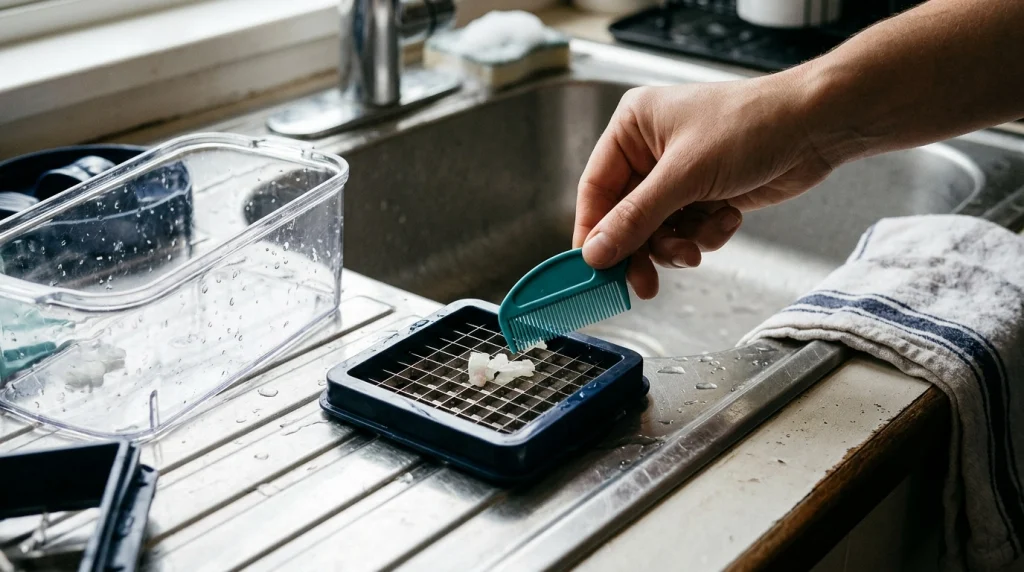
Clean the chopper as soon as practical after use, before onion residue dries between the blades. Always disassemble it according to the manual and keep your fingers away from sharp cutting edges.
- Remove the remaining onion: Empty the container and discard any scraps.
- Disassemble carefully: Remove the grid and other detachable parts as directed by the manufacturer.
- Rinse the grid: Use running water to loosen onion pieces trapped between the blades.
- Use the cleaning tool: Move the supplied comb or scraper in the intended direction, away from your fingers.
- Wash removable parts: Use dish soap and water unless the manual specifies another method.
- Dry and store: Allow the parts to dry thoroughly before reassembly or storage.
Some choppers have dishwasher-safe parts, while others require handwashing. Never assume the whole assembly is dishwasher-safe, and don’t immerse any component that the manufacturer identifies as unsuitable for water.
For general produce-handling advice, FoodSafety.gov recommends rinsing fresh produce under running water and cleaning food-contact surfaces and utensils appropriately.
What Should You Look for When Buying an Onion Chopper?
The most useful onion chopper is one that fits your cooking habits and is easy to clean. I would prioritize safe construction and practical cutting performance over a long list of accessories.
- Blade quality: Look for securely fitted, corrosion-resistant blades with clear care instructions.
- Useful grid sizes: Choose a model with the cut sizes you actually need.
- Stable construction: A secure base and properly aligned lid help make pressing more controlled.
- Practical capacity: Consider how many onions you prepare at once and whether the container needs frequent emptying.
- Easy cleaning: A removable grid and dedicated cleaning tool can simplify maintenance.
- Replacement parts: Check whether the manufacturer offers replacement blades or other serviceable components.
- Clear instructions: Make sure the manual explains assembly, safe pressing, and cleaning.
Before buying, verify the current product listing for the exact model, included inserts, dimensions, cleaning requirements, and warranty. Product descriptions can change, so don’t rely on a generic photograph to confirm what comes in the box.
Recommended Vegetable Choppers for Onion Preparation
If you’re ready to choose a chopper, these three options represent different preparation styles. The ratings below are provisional editorial fit scores, not results from hands-on testing or verified customer-review averages; check the current listing to confirm the model and accessories.
🏆 BEST FOR MANUAL DICING
Fullstar Vegetable Chopper
★★★★☆ 4/5 editorial fit
A manual push-down design is worth considering if you mainly want diced onion and other firm vegetables. I’d prioritize a secure grid, a stable container, and a cleaning accessory when checking the exact model.
💡 BEST FOR ACCESSORIES
Mueller Pro-Series Vegetable Chopper
★★★★☆ 4/5 editorial fit
This is another manual chopper line to compare if you want different cutting inserts for everyday preparation. I’d check the exact package contents and make sure the onion grid suits your preferred dice.
🥣 BEST FOR MINCING
OXO Good Grips Vegetable Chopper
★★★☆☆ 3.5/5 editorial fit
Consider this style if you prefer a bowl-based manual chopping action over pressing onion through a fixed grid. Check the current listing carefully, since the cutting mechanism and final texture differ from a push-down dicer.
My practical recommendation is to start with a manual grid chopper if uniform onion dice is your main goal. If you prefer finely minced onion for sauces or fillings, compare bowl-based choppers instead and choose one whose mechanism matches the texture you want.
Frequently Asked Questions
Can you put a whole onion in a push-down vegetable chopper?
Usually, you should cut the onion into halves or smaller sections first. The correct size depends on the cutting grid and the manufacturer’s instructions. An oversized onion can sit unevenly, obstruct the blades, or prevent the lid from closing properly.
Why won’t my vegetable chopper cut through an onion?
The onion may be too large, poorly positioned, or caught against a clogged or incorrectly installed grid. Stop pressing, open the chopper safely, and check the assembly. Never force the lid or use your fingers to push food through exposed blades.
Which blade size is best for dicing onions?
A fine grid is suitable for smaller onion pieces, while a medium or larger grid works better for coarser dice. The best choice depends on your recipe and the available inserts. Check the manufacturer’s stated cutting dimensions if your dish requires a specific size.
Does a push-down vegetable chopper stop onions from making you cry?
No. A chopper may shorten preparation time, but it cannot eliminate the irritating compounds released when onion cells are damaged. Chilling the onion, maintaining good ventilation, and avoiding prolonged exposure may help reduce discomfort, though results vary.
How do you remove onion stuck in the cutting grid?
Stop using the chopper and open it according to the manual. Use the supplied cleaning comb or another manufacturer-approved tool to clear the grid while keeping your hands away from the sharp edges. Rinse removable parts promptly so onion residue doesn’t dry in the openings.
Final Takeaway
A push-down vegetable chopper can make onion preparation easier when you want reasonably consistent dice for everyday cooking. The most important habits are to size the onion correctly, position it securely, press with controlled force, and clean the cutting grid carefully.
Choose a fine or medium grid according to your recipe, and don’t force an onion section that doesn’t fit. With the right technique and a suitable chopper, you can simplify meal preparation without giving up control over the final texture.
Affiliate disclosure: This article contains affiliate links. If you purchase through these links, RecipesPalette may earn a commission at no additional cost to you.