How to Use a Push Down Vegetable Chopper for Tomatoes Without Crushing Them

Quick Answer
A push down vegetable chopper can dice tomatoes quickly when you choose firm, ripe tomatoes and a compatible blade designed for soft produce. Wash and dry the tomatoes, remove the stem, cut them into manageable pieces if necessary, and press the chopper lid down steadily without forcing it. For more control over soft tomatoes, use a dedicated tomato blade or a sharp knife if your chopper crushes the flesh.
What matters most when chopping tomatoes
- Tomato firmness: Choose ripe tomatoes that still hold their shape instead of overripe, mushy ones.
- Blade design: Check whether your model supports tomatoes and soft produce before pressing.
- Piece size: Cut large tomatoes into halves or smaller sections when the manufacturer’s instructions recommend it.
- Steady pressure: Apply controlled downward pressure rather than repeatedly slamming the lid.
- Moisture control: Drain excess tomato juice when you need drier pieces for salsa, salads, or sandwiches.
Before you start
- Read the chopper’s instructions and confirm that its blade is suitable for tomatoes.
- Keep your hands away from the cutting grid and never force a jammed lid.
If you’ve ever tried to push a juicy tomato through a vegetable chopper, you know the problem: the tomato can flatten before the blades cut cleanly through it.
In this guide, I’ll explain how push-down choppers handle tomatoes, how to prepare the fruit for cleaner cuts, and what to look for when choosing a chopper for everyday cooking.
What Is a Push Down Vegetable Chopper?
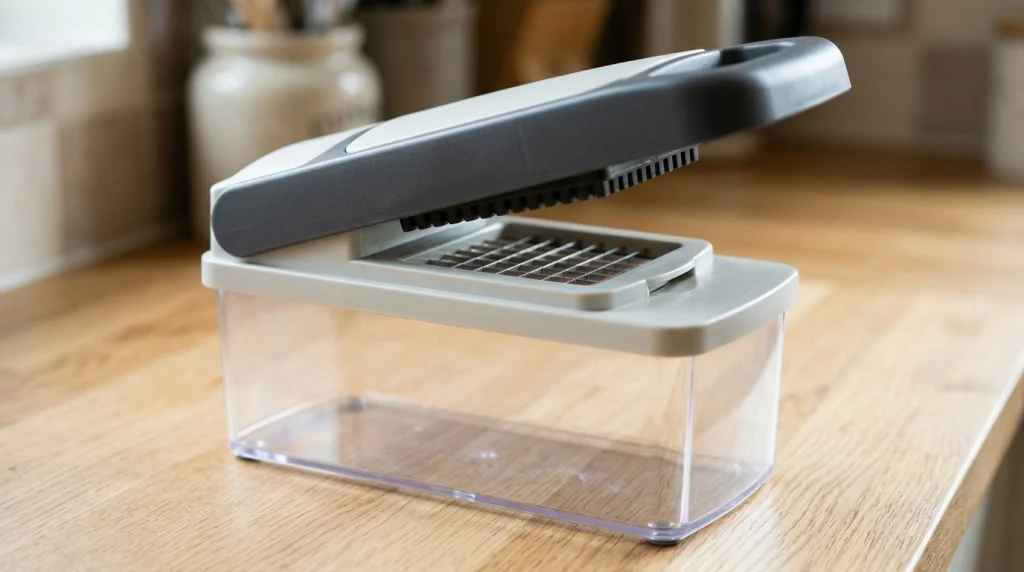
A push-down vegetable chopper is a manual kitchen tool that uses a cutting grid and a hinged or pressing lid to cut food into smaller pieces. When you press the lid, the food moves through the grid and falls into a collection container underneath.
Unlike a pull-cord chopper, which spins blades inside a bowl, a push-down model typically creates more uniform cuts because its blade grid has a fixed shape and spacing.
However, the design matters. A grid made for firm vegetables may not slice soft tomatoes as neatly as a blade specifically designed for delicate produce.
How does the cutting mechanism work?
The lid or pusher applies downward force, pressing the tomato against sharp intersecting blades. The grid determines the approximate shape and size of the resulting pieces.
- Blade grid: Cuts the tomato into strips or small sections as it passes through.
- Pressing lid: Transfers your hand pressure to the food.
- Collection container: Catches the chopped pieces and much of their released juice.
- Frame and base: Keep the cutting assembly stable during use.
Some models include interchangeable grids, a soft-food blade, or a dedicated tomato attachment. Others are designed mainly for onions, potatoes, peppers, and similar vegetables, so check the manufacturer’s guidance before using one on tomatoes.
Can You Use a Push Down Vegetable Chopper for Tomatoes?
Yes, provided the manufacturer approves tomato use and the blade can cut soft produce. A suitable chopper can make tomato preparation quicker, especially when you need several cups for salsa, salads, or cooked dishes.
The main challenge is texture. Tomatoes have delicate flesh, slippery skins, and juicy interiors, so pressure alone cannot guarantee neat cubes.
Which tomatoes work best?
Choose tomatoes that feel firm but yield slightly when gently pressed. They should be ripe enough to taste good without being so soft that the flesh collapses under pressure.
- Roma tomatoes: Often a practical choice because their elongated shape and relatively firm flesh make them easier to handle.
- Firm slicing tomatoes: Suitable for many compatible choppers after you cut them to fit the blade area.
- Beefsteak tomatoes: Can work when divided into smaller sections, although their size and juicy centers require extra preparation.
- Overripe tomatoes: Better suited to sauces or other preparations where soft texture is acceptable.
Tomato variety alone doesn’t determine success. Ripeness, blade sharpness, grid size, and the chopper’s design all influence the result.
How Do You Chop Tomatoes With a Push Down Chopper?
The most reliable approach is to prepare the tomatoes first, position them correctly, and apply controlled pressure. Follow these steps, adjusting them to your specific chopper’s instructions.
Step 1: Wash and dry the tomatoes
Rinse the tomatoes under clean running water and gently dry them with a clean towel. Removing excess surface moisture helps you handle them without adding unnecessary water to the collection container.
Wash your hands and make sure the chopper, lid, container, and cutting surface are clean before preparing food.
Step 2: Remove the stem
Cut away the stem scar and any tough surrounding tissue with a small knife. Remove damaged or bruised areas as needed.
Keeping the tough stem portion out of the blade grid helps prevent uneven cuts and unnecessary resistance.
Step 3: Cut the tomato to fit the grid
Don’t assume every whole tomato belongs directly on the cutting surface. Some choppers require a tomato to be halved, quartered, or otherwise reduced before pressing.
Check the manufacturer’s instructions for the maximum food size and recommended orientation. Never wedge an oversized tomato into a grid that cannot accommodate it safely.
Step 4: Position the tomato correctly
Place the prepared tomato on the blade grid according to your model’s instructions. If the design allows it, a stable cut surface can help prevent the piece from rolling or shifting.
Keep your fingers clear of the blades while positioning food. Use the designated pusher or lid rather than your hands to press the tomato.
Step 5: Press down steadily
Close the lid and apply firm, controlled pressure using the handle or designated pressing surface. Avoid bouncing on the lid or adding excessive force when the tomato resists.
If the lid will not close normally, stop and inspect the setup. The tomato may be too large, the blade may be incorrectly installed, or the chopper may not be suitable for that ingredient.
Step 6: Check the chopped pieces
Open the chopper only as instructed and inspect the results. If the pieces are too large, don’t push your fingers through the grid to clear or reposition them.
Use the manufacturer’s cleaning tool or another recommended method after making the chopper safe to handle. For finer cuts, a knife may give you better control than repeated pressing.
Why Does a Vegetable Chopper Crush Tomatoes Instead of Dicing Them?
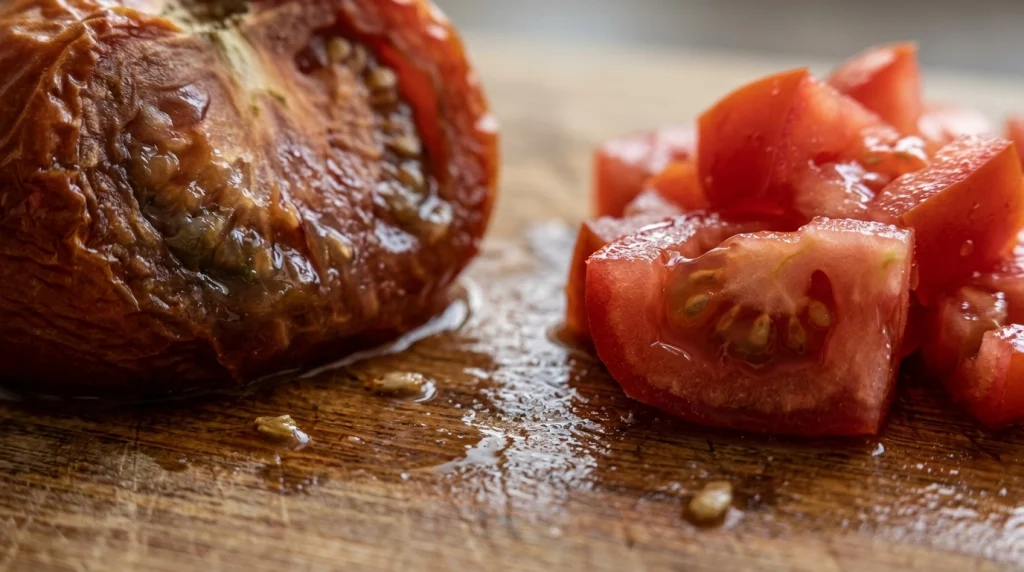
A push-down chopper usually crushes tomatoes when the flesh cannot pass cleanly through its blades. Softness, a blunt or unsuitable cutting grid, oversized pieces, and excessive pressure can all contribute.
Before replacing your chopper, identify which part of the process is causing the problem.
| Problem | Likely reason | What to do |
|---|---|---|
| Tomato turns mushy | Fruit is too soft or pressure is excessive | Choose firmer tomatoes and use a compatible blade. |
| Skin stays attached | The skin resists the cutting grid | Try a suitable sharp tomato blade or use a knife. |
| Lid won’t close | Food is oversized or the blade assembly is misaligned | Stop, check the assembly, and reduce the piece size if instructed. |
| Pieces are uneven | Tomato shifts or the grid doesn’t suit the desired cut | Stabilize the piece and choose an appropriate grid. |
| Too much juice collects | Tomato is juicy or heavily compressed | Use firmer tomatoes and drain excess liquid when needed. |
Here’s a useful distinction: a chopper can produce uneven pieces without being defective. A fixed grid creates a particular cut, but it cannot control the natural softness and internal structure of every tomato.
Should you remove the seeds first?
Removing seeds and some of the surrounding gel can reduce excess liquid in recipes where you want a drier dice. It isn’t necessary for every dish, and it won’t automatically prevent crushing.
For salsa, soup, or pasta sauce, retaining the tomato juice may be perfectly desirable. For a sandwich or a finely diced salad topping, draining the chopped pieces can help prevent sogginess.
Push Down Chopper vs. Knife vs. Pull-Cord Chopper
Each tool handles tomatoes differently. The best choice depends on whether you value uniform pieces, adjustable texture, convenience, or control over juice.
| Tool | Best use | Main limitation |
|---|---|---|
| Push-down grid chopper | Consistent cuts in batches | Some grids crush soft tomatoes or resist their skins. |
| Sharp chef’s or serrated knife | Precise cuts and control over texture | Requires manual cutting skill and more attention. |
| Pull-cord chopper | Rough chopping and adjustable texture | Can produce irregular pieces and become mushy with excessive pulls. |
| Electric food processor | Processing larger batches quickly | Overprocessing can turn tomatoes into a coarse puree. |
For a few tomatoes, I would prioritize control over speed. A sharp knife with a serrated edge or a sharp chef’s knife can slice delicate skin before the flesh collapses.
For larger batches, a push-down chopper with a suitable tomato attachment may be more convenient. A pull-cord model is another option when a rough chop is acceptable rather than perfectly uniform cubes.
For additional knife-preparation guidance, see Food Network’s guide to dicing tomatoes.
What Should You Look for in a Push Down Tomato Chopper?
If you plan to chop tomatoes regularly, look beyond the number of attachments in the box. Blade suitability, stability, cleaning, and the size of the collection container have a greater impact on daily use.
- Tomato-compatible blades: Look for explicit manufacturer guidance or an attachment designed for soft produce.
- Secure blade locking: The grid should fit and lock into place as instructed.
- Stable base: A non-slip base or secure container helps prevent movement during pressing.
- Useful container capacity: Choose a bowl large enough for the quantity you normally prepare.
- Easy cleaning: Removable components and an included cleaning tool can simplify maintenance.
- Clear instructions: The manual should explain food-size limits, blade compatibility, and safe cleaning.
Stainless steel cutting grids can be useful, but the material alone doesn’t prove that a chopper will cut tomatoes well. Blade geometry, sharpness, and the design of the pressing mechanism matter too.
Is a multi-blade chopper always better?
Not necessarily. Multiple grids can give you more options for onions, cucumbers, peppers, and other vegetables, but they don’t guarantee good results with tomatoes.
For a tomato-focused kitchen, I would rather choose a sturdy, easy-to-clean model with a clearly supported soft-food attachment than pay extra for several grids that don’t suit my recipes.
How Do You Keep a Push Down Chopper Clean After Tomatoes?
Tomato pulp and seeds can collect around the blade intersections, the underside of the pusher, and the container corners. Cleaning these areas promptly helps prevent dried residue from becoming difficult to remove.
- Follow the manufacturer’s instructions for disassembling the chopper.
- Remove loose tomato pieces using the supplied cleaning tool, if provided.
- Rinse removable parts and wash them according to the care instructions.
- Use a suitable brush for accessible spaces, keeping your fingers away from sharp edges.
- Dry the components thoroughly before reassembling or storing them.
Never push a sponge or cloth directly through a sharp cutting grid with your bare fingers. Don’t assume a component is dishwasher-safe unless the manufacturer confirms it.
For general produce-handling and kitchen-cleaning guidance, consult FoodSafety.gov and the Mississippi State University Extension Service.
Common Mistakes to Avoid When Chopping Tomatoes
Most tomato-chopping problems become easier to prevent once you understand how the fruit responds to pressure.
- Using very soft tomatoes: Overripe flesh often collapses instead of holding its shape.
- Forcing the lid: Excessive pressure can damage the chopper or cause an unsafe slip.
- Ignoring food-size limits: Oversized pieces can block the cutting grid.
- Using an unsuitable blade: A grid designed for firm vegetables may not handle tomato skin well.
- Overloading the container: Excessive quantities can make chopped pieces difficult to collect and handle.
- Leaving pulp to dry: Dried tomato residue can be harder to remove from small blade openings.
One practical rule is worth remembering: if the chopper needs unusual force, stop rather than press harder. Check the tomato size, blade installation, and the instructions before trying again.
Recommended Vegetable Choppers to Consider
If you’re shopping for a chopper in 2026, compare the actual attachments and operating instructions before deciding. The following models offer different approaches to manual chopping, but their suitability for tomatoes depends on the specific task and configuration.
🏆 BEST FOR VERSATILITY
Mueller Pro-Series 10-in-1 Vegetable Chopper
★★★★☆
A manual multi-attachment chopper designed for a range of food-preparation tasks. I’d consider it for a kitchen that needs several cutting styles, but I’d verify the included blades and tomato instructions before buying.
💰 BEST FOR SIMPLE PREP
OXO Good Grips Vegetable Chopper
★★★★☆
A manual chopper worth considering for straightforward chopping tasks and a compact kitchen setup. Its chopping mechanism differs from a grid-style push-down model, so check whether its resulting texture suits your tomato recipes.
🥗 BEST FOR MULTI-PURPOSE PREP
Fullstar Vegetable Chopper
★★★★☆
A manual chopper family with cutting attachments for everyday vegetables. I’d compare the exact model’s grid, container, and cleaning features, then confirm that the manufacturer supports tomato use before choosing it for soft produce.
Selection note: These are product candidates, not the results of hands-on tomato-chopping tests. The star symbols are editorial shortlist indicators, not verified customer ratings or measured performance scores. Check the current listing for the exact model, included accessories, care instructions, and tomato compatibility.
Frequently Asked Questions
Can a push down vegetable chopper dice tomatoes evenly?
Yes, a compatible push-down chopper can dice firm, ripe tomatoes into relatively uniform pieces. The result depends on the grid spacing, blade sharpness, tomato size, and firmness. For very soft tomatoes or especially precise cuts, a sharp knife may provide better control.
Should tomatoes be cut in half before using a vegetable chopper?
It depends on the chopper’s design and the size of the tomato. Some models specifically recommend halving tomatoes before pressing, while others require smaller sections or a dedicated attachment. Always follow the manufacturer’s instructions rather than forcing a whole tomato into the blade area.
Why does my vegetable chopper squeeze juice out of tomatoes?
Tomatoes release juice when their delicate flesh gets compressed. Overripe fruit, an unsuitable blade, or excessive downward pressure can make the problem worse. Try firmer tomatoes and a compatible cutting grid, and drain excess liquid if your recipe requires drier chopped pieces.
Can I use a push-down chopper for cherry tomatoes?
Only if the manufacturer explicitly supports that use and the cutting assembly can accommodate them safely. Small round tomatoes may roll or sit unevenly on a grid, so cutting them individually with a knife can offer more control. Never put your fingers near the blade to stabilize them.
How do I stop tomato pieces from sticking to the chopper blades?
Use tomatoes with suitable firmness, avoid overloading the cutting grid, and remove residue promptly after each batch. Follow the manual’s cleaning instructions and use the supplied cleaning tool where available. Never clear stuck pieces with your fingers while the blade assembly remains exposed or unsafe.
Final Takeaway: Choose the Right Chopper for Tomatoes
A push down vegetable chopper can simplify tomato preparation, but the right technique matters as much as the tool itself. Start with firm, ripe tomatoes, prepare pieces that fit the grid, and use a blade designed for the ingredient.
If the tomato keeps collapsing, don’t solve the problem by pressing harder. Switch to a suitable soft-food attachment or use a sharp knife for cleaner cuts and better control over texture.
Before purchasing a new chopper, check the exact model’s tomato compatibility, blade configuration, stability, and cleaning instructions. A tool that handles your usual recipes safely and consistently is a better choice than one that simply comes with more attachments.
Affiliate disclosure: This article contains affiliate links. RecipesPalette may earn a commission from qualifying purchases made through these links, at no additional cost to you.